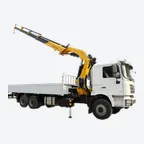
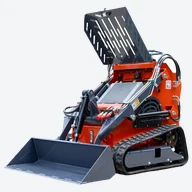

A fly jib is a lattice or box-section extension pinned to the tip of a crane’s main boom. It lets the crane reach higher and further than the main boom alone, at the cost of a much lower lifting capacity on the jib’s own hook line. The same words are also used for a different machine: a forklift fly jib crane, which is a complete hydraulic crane that hangs on a forklift’s fork carriage.
BOB-LIFT has built cranes in Xuzhou, China, since 2003, and we make the second kind. This guide explains both. It covers what a fly jib on a mobile crane does, the fixed and luffing types, how a jib changes the load chart, and how a forklift fly jib crane differs. Every BOB-LIFT figure below comes from our technical-department drawings.
Key takeaways
- On a mobile or crawler crane, a fly jib is an extension fitted to the boom tip to gain height and reach. It has its own hoist line and its own, much lower, load chart.
- Fixed (offset) jibs are set at one angle before the lift. Luffing jibs can change angle under load and are mostly found on larger cranes.
- A forklift fly jib crane is not an extension. It is a separate hydraulic crane that turns a forklift into a small mobile crane, and the forklift acts as its counterweight.
- BOB-LIFT makes five forklift fly jib cranes rated from 2.3 t to 7 t close to the mast, with maximum reach from 5.4 m to 11 m.
- In the United States, a forklift that hoists and moves a suspended load on a hook falls under the OSHA crane rules, not only the forklift rules.
What is a fly jib on a crane?
A fly jib is a shorter structure attached to the head of the main boom. On a hydraulic truck crane or all-terrain crane it is usually carried folded along the side of the boom and swung out and pinned when the job needs it. On a lattice crawler crane it is assembled section by section on the ground.
Once fitted, the jib carries its own sheave at the tip, and the load hangs from an auxiliary hoist line, often called the whip line. The main boom keeps its main hook block for heavy lifts close in. The jib is used for lighter loads that must go higher or further out, such as roof units, glass panels, steel members on an upper level or loads placed over a building edge.
The trade names vary. You will see fly jib, flyjib, flying jib, jib extension and boom extension, and some buyers simply call it a fly. In Spanish it is the plumín, and Russian crews call it the гусёк. They all describe the same idea: a lighter arm on the end of the boom.

Fixed (offset) vs luffing fly jibs
Crane jibs fall into two broad groups. US federal crane rules name both, for example when they require a jib stop for “a fixed or luffing jib” [1].
- A fixed (offset) jib is set by the crew at one offset angle to the boom, typically straight in line or angled down by a few set steps, before the lift starts. The angle does not change during the lift. Most hydraulic truck and all-terrain cranes use this type because it is simple and quick to rig.
- A luffing jib is a jib with its own luffing system, so the operator can raise and lower it while the load is on the hook. That gives fine control of radius close to tall structures. Luffing jibs are mostly found on large crawler cranes and on cranes rigged for tower-style work.
Some hydraulic jibs can also telescope. Whatever the type, the crane manufacturer’s documents state which jib lengths and offsets are allowed for each boom length.
How a fly jib changes the load chart
A crane is limited by its load moment: load multiplied by the horizontal distance from the slewing centre. A jib moves the hook further out and adds its own weight at the boom tip, so the load it may carry is a small fraction of the crane’s headline rating. US rules define rated capacity as the maximum working load the manufacturer permits “under specified working conditions”, including configuration, radius and boom length [1]. A jib is a different configuration, so it has its own chart.
In practice that means four things for the lift plan:
- Read the jib chart for the boom length, jib length and offset you will rig, not the main boom chart.
- The single-part whip line is often the limiting factor at short radius, so check the line pull as well as the chart.
- Deduct the main hook block and rigging if the chart says so, because they hang below the boom head even when unused.
- Wind matters more with a long jib and a light, large load such as a panel. Follow the manufacturer’s wind limits.
Our guide on how to read a crane load chart walks through radius, boom angle and deductions with real chart examples.
What is a forklift fly jib crane?
A forklift fly jib crane is a complete hydraulic crane, not an extension of anything. Its frame hangs on the forklift’s fork carriage where the forks normally sit, and it runs from the forklift’s auxiliary hydraulic circuit. The boom luffs, telescopes and folds back in front of the mast for travel, so a forklift you already own becomes a small mobile crane for factories, yards, building sites and pits.
It has no outriggers. The forklift is its counterweight, which is why each model is matched to a forklift capacity class. The forklift mast lifts the whole crane, so mast height adds to hook height before the boom moves. The CC85 lifts 2,300 kg at 1.7 m and 400 kg at its full 5.4 m reach, and with a 4.5 m mast its hook reaches 9.9 m.

The video below, recorded at our factory, shows a CC85 on a counterbalance forklift as it unfolds, extends and carries the hook.
Our five models cover forklifts from 3 t to 10 t:
| Model | Rated load near the mast | Load at full reach | Hook height (4.5 m mast) | Crane weight | Forklift class |
|---|---|---|---|---|---|
| CC85 | 2,300 kg at 1.7 m | 400 kg at 5.4 m | 9,900 mm | 560 kg | 3–3.5 t |
| CC105 | 2,500 kg at 1.7 m | 300 kg at 6.6 m | 11,000 mm | 650 kg | 3.5–4 t |
| CC125 | 3,500 kg at 2.1 m | 350 kg at 8 m | 12,500 mm | 850 kg | 4–6 t |
| CC145 | 4,900 kg at 2.2 m | 500 kg at 9.4 m | 13,900 mm | 1,200 kg | 5–7 t |
| CC165 | 7,000 kg at 2.8 m | 750 kg at 11 m | ≈ 14,000 mm (carriage lowered) | 2,000 kg | 10 t |
Crane fly jib vs forklift fly jib crane
| Fly jib on a mobile crane | Forklift fly jib crane | |
|---|---|---|
| What it is | An extension pinned to the main boom tip | A complete hydraulic crane |
| Where it mounts | Head of a truck, all-terrain or crawler crane boom | Fork carriage of a counterbalance forklift |
| What keeps it stable | The crane’s outriggers or tracks and counterweight | The forklift itself, matched by capacity class |
| Why you use it | Extra height and reach for lighter loads | Hook lifting where a forklift already works |
| Who buys it | Crane owners, from their crane manufacturer | Factories, yards, contractors and rental fleets |
So if you are searching for a jib for your mobile crane, contact that crane’s manufacturer, because the jib must match the boom head and be covered by the crane’s load charts. If you want hook lifting without hiring a mobile crane and you already run a forklift, a forklift fly jib crane is the machine to look at.
How to choose a forklift fly jib crane
Start with the forklift you own, because it is the counterweight. Then size the crane by the load you must place at your working radius, not by the headline rating: the CC145 lifts 1,300 kg at 6.6 m where the CC125 lifts 800 kg. Finally, check your mast height for hook height and confirm the carriage and auxiliary hydraulics with us. The forklift fly jib cranes page has a step-by-step buying guide, and our forklift boom crane guide compares the load charts in detail.
For the full checklist on matching a jib crane attachment to your forklift, and what the safety rules require, see our forklift jib crane guide.
Rules apply as well. In the United States, the construction crane standard excludes forklifts “except when configured to hoist and lower (by means of a winch or hook) and horizontally move a suspended load” [2]. The general industry forklift rule also says that modifications affecting capacity need the forklift manufacturer’s prior written approval, and that a truck with non-factory front-end attachments should be marked with the combined weight [3]. Check the local rules where the forklift works before the first lift.
Frequently asked questions
What does a fly jib do on a crane?
It extends the main boom so the hook can reach higher and further out. It is used for lighter loads, such as roof units or panels, that the main boom cannot reach, and it lifts from its own auxiliary hoist line.
Does a fly jib reduce lifting capacity?
Yes. The hook is further from the crane’s slewing centre and the jib adds weight at the boom tip, so the crane works to a separate jib load chart with much lower figures than the main boom chart.
Is a fly jib the same as a jib extension?
In most markets, yes. Fly jib, flyjib, flying jib, jib extension and boom extension all describe an arm fitted to the main boom tip. Check the crane manufacturer’s terms, because some use “extension” for an insert section and “jib” for the tip attachment.
Does BOB-LIFT sell fly jibs for mobile cranes?
No. We build forklift fly jib cranes from 2.3 t to 7 t, plus knuckle boom and telescopic truck mounted cranes. A jib for a mobile crane must come from that crane’s manufacturer. Send us your inquiry if you want a forklift fly jib crane for your forklift.
How we compiled this guide
We compiled the BOB-LIFT ratings, radii, hook heights and crane weights from our technical-department drawings and product pages in November 2026. The cover photo and the video were taken at our Xuzhou factory, and the diagram was drawn by our team. The rules are quoted from the official texts linked above as they stood in November 2026. The guide was reviewed by Achord Chan, Product Operations Director. Specifications can change without notice, so ask for the current drawing before you order.