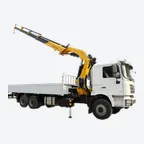

The cranes used at docks depend on the size of the port. Large container terminals use ship-to-shore gantry cranes on the quay and rubber-tyred or rail-mounted gantry cranes in the yard. General cargo and bulk berths use rail-mounted portal cranes, mobile harbour cranes and floating cranes. Small docks, jetties, piers and marinas operate considerably smaller equipment: a fixed hydraulic crane on a pedestal at the quay edge, a truck-mounted crane that is driven onto the dock when required, or a boat hoist that lifts complete vessels out of the water.
This guide explains each type of dock crane, compares them in one table, and then shows how to choose a crane for a small dock or jetty. We build hydraulic knuckle boom and telescopic marine cranes from 0.8 t to 25 t rated capacity, plus truck mounted cranes. We do not build ship-to-shore cranes, gantry cranes or mobile harbour cranes. Achord Chan, Product Operations Director at BOB-LIFT, compiled this guide from US and UK port safety rules, government port equipment guides and the technical drawings of our marine cranes.
Key takeaways
- Container ports use ship-to-shore gantry cranes on the quay and RTG or RMG gantry cranes in the yard.
- General cargo and bulk berths use portal cranes on rails, mobile harbour cranes and, for very heavy or remote lifts, floating cranes.
- A small dock crane is usually a hydraulic crane bolted to a pedestal at the quay edge, or a truck mounted crane that comes and goes.
- Size a small dock crane by the load at the reach to the boat, at both high and low water, then design the foundation from the base drawing.
- In the US, cranes at marine terminals fall under OSHA 29 CFR 1917; in the UK, LOLER and the Safety in Docks code apply.
What is a dock crane?
A dock crane is any crane that stands on a dock, quay, wharf, jetty or pier and lifts cargo, stores or equipment between the shore and a vessel. People also call it a quay crane, wharf crane, dockside crane or, on a pier, a jetty crane. The essential distinction from a ship crane is ownership and location, because a dock crane belongs to the shore installation rather than to the vessel. A crane permanently fixed on the vessel itself is a ship crane, and our guide to ship crane types covers those.
The US Environmental Protection Agency gives a short list for container ports. It says port cranes include rubber tire gantry (RTG) cranes, rail-mounted gantry (RMG) cranes and wharf (ship-to-shore) cranes, along with aerial lifts and cable cranes [1]. Ports that handle bulk commodities, timber, project cargo or small boats operate additional categories of equipment, which the table below summarises.
Types of dock cranes at a glance
The table compares the main dock crane types by what they move and where you find them. Large port cranes are custom designs, so we give no capacity for them; check the rating plate of the actual crane. The capacity for our own cranes comes from our drawings.
| Dock crane type | What it moves | Typical setting | Built by BOB-LIFT? |
|---|---|---|---|
| Ship-to-shore (STS) container crane | Containers between ship and quay | Container terminal berths | No |
| Rubber-tyred gantry (RTG) crane | Containers in the stacking yard | Container yards | No |
| Rail-mounted gantry (RMG) crane | Containers in the yard or at a rail siding | Larger container terminals | No |
| Portal or level-luffing crane | General cargo, steel, bulk with a grab | General cargo and bulk quays, on rails | No |
| Mobile harbour crane | Containers, bulk, project cargo | Multipurpose ports without fixed cranes | No |
| Floating crane | Very heavy or awkward lifts | Shipyards, salvage, ports without quay cranes | No |
| Boat hoist or travel lift | Whole boats in and out of the water | Marinas and boatyards | No |
| Fixed hydraulic pedestal crane (jetty crane) | Pallets, bags, nets, engines, small boats | Small docks, jetties, fishing and island harbours | Yes, 0.8 t to 25 t |
| Truck mounted crane | Materials and equipment, dock to vehicle | Docks served now and then, several sites | Yes, crane only |
Container terminal cranes: STS, RTG and RMG
The giant cranes you see along a container quay are ship-to-shore cranes. Argonne National Laboratory describes them as large dockside gantry cranes used to load and unload intermodal containers from container ships, also called STS gantry cranes, harbor cranes or container-handling gantry cranes [2]. They travel on rails along the berth and their booms extend across the entire width of the vessel. This is the “quay crane” most people have in mind, and it is the largest category of dock crane.
Behind the quay, yard cranes stack the boxes. The same Argonne fact sheet says an RTG crane uses a cross-beam on vertical legs that move on rubber tyres, and that an RMG crane is similar but typically used in larger operations [2]. EPA adds that RTG cranes are typically diesel-powered, while RMG and wharf cranes are often electric [1]. These are individually engineered terminal systems, and we do not manufacture them.
Portal cranes and mobile harbour cranes
At general cargo and bulk quays, the classic dock crane is the portal crane. A portal crane is a slewing crane on a tall frame that straddles the quay tracks, so trucks and rail wagons can pass underneath it. Many portal cranes are level-luffing, which means the load stays at about the same height as the jib moves in and out. US marine terminal rules treat portal cranes as rail-mounted cranes, together with bridge cranes [3].
A mobile harbour crane is a large slewing crane that does a similar job without rails. It drives on wheels or tracks to the berth, sets down on outriggers and handles containers, bulk or project cargo. Argonne’s general definition fits: mobile cranes run on wheels or tracks and use hoist ropes and a hook to lift and lower heavy objects [2]. Ports choose them when traffic is too mixed or too light for fixed cranes.
Floating cranes
A floating crane is a crane mounted on a pontoon or a purpose-built hull. It is positioned alongside the load instead of requiring the load to be delivered to a quay. Shipyards use floating cranes for heavy sections, salvage teams use them to raise wrecks, and some ports use them to work ships at anchor. At the small end, a crane on a work barge does the same job for jetty building and island supply; our barge crane guide covers that case.
For the main types of floating crane, the largest crane vessels and why a crane on water has to be derated, see our floating crane guide.
Cranes for small docks, jetties and marinas
Most docks are not container terminals. Fishing harbours, island jetties, private piers, ferry landings and marinas typically require a crane that lifts a pallet, a net, an outboard engine or a tender, and operators generally prefer equipment that is simple to install and maintain. Three types cover almost every small dock:
- Fixed hydraulic pedestal crane. A knuckle boom or telescopic boom crane bolted to a pedestal or concrete plinth at the quay edge. It remains permanently available, requires no vehicle and operates from an electric hydraulic power pack.
- Truck mounted crane. A crane on a truck that drives onto the dock, sets its outriggers and lifts. It suits docks used now and then, or one operator serving several landings.
- Boat hoist or travel lift. A mobile straddle frame with lifting slings that removes complete vessels from the water for storage or repair. Strictly speaking it is not a crane in the conventional sense, and we do not manufacture it.

This category is where our cranes operate. The cover photograph comes from a customer in the Maldives, and it shows one of our SQ5S-series telescopic cranes installed on a raised concrete plinth at a harbour quay, with small boats moored alongside. Our Maldives harbour case study documents that crane together with two deck cranes on cargo vessels. The photograph above illustrates the same principle in Ecuador, with the boom extending over a moored boat.
How to choose a small dock crane
A small dock crane is selected in the same sequence as any fixed crane, but the water introduces two additional considerations that a workshop installation never encounters: the vessel lies some distance from the quay wall, and the tide raises and lowers it continuously. Work through the points below before you ask for a quotation.
1. Outreach to the berth
Measure the distance from the planned slewing centre to the middle of the vessel’s deck or hatch, rather than to the quay edge, and include the fender gap and the beam of the widest vessel expected to use the berth. Then read the load chart at that radius. Our 5 t telescopic marine crane, the SQ5SA4T, illustrates how rapidly the permissible load decreases: with the boom horizontal, it lifts 1,650 kg at 6.6 m, 900 kg at 9.2 m and only 600 kg at its maximum 11.8 m. The 5 t rating applies exclusively close to the column, so the operating radius to the vessel determines the realistic crane size.
2. Tidal range and hook height
Tidal variation affects the lift in both directions. At high water the load must clear the quay edge, the fenders and the bollards, while at low water the vessel’s deck may lie considerably below the quay and the hook must descend to reach it. Tidal ranges differ enormously between locations: NOAA notes that the highest tides in the United States, near Anchorage, Alaska, average around 30 feet [4]. Use the official local tide tables for your own dock.
Lowering a load below the level of the crane base requires sufficient rope length, so request the available rope drop for any model you are offered, because our drawings do not include winch specifications. Our knuckle boom models identified with J in the designation, such as the SQ10ZA6TJ, are illustrated with a winch drum. Alternatively, a telescopic crane can elevate its boom to gain height: according to the SQ5SA4T table, the boom at 50° still lifts 1,160 kg at a 7.3 m radius.
3. Foundation and pile cap
A dock crane is only as safe as the supporting structure beneath it. Our base drawings give the flange size, the bolt pattern, the crane weight and the rated lifting moment. They do not give foundation design loads, which a structural engineer works out by adding the boom weight and dynamic effects. Three examples from our drawings:
| Model (rated) | Base on drawing | Bolt holes | Crane weight | Max lifting moment | Load at full reach |
|---|---|---|---|---|---|
| SQ5SA4T (5 t, telescopic) | Plate 680 × 680 mm | 24 × Ø22 mm | 2,100 kg | 12.5 t·m | 600 kg at 11.8 m |
| SQ10ZA6TJ (10 t, knuckle) | Flange Ø1,000 mm, bolt circle Ø930 mm | 28 × Ø26 mm | 2,920 kg | 21 t·m | 1,150 kg at 14.68 m |
| SQZ500T (25 t, knuckle) | Flange Ø1,400 mm, bolt circle Ø1,290 mm | 30 × Ø33 mm | 6,474 kg | 53.9 t·m | 2,000 kg at 18.0 m |
On a solid concrete quay, the crane usually sits on a reinforced plinth with cast-in anchor bolts, as in the Maldives photo. On an open pier on piles, the pile cap and deck must carry the overturning moment, and an older timber pier may need new piles first. Our pedestal crane guide lists the bases of 18 models and explains foundation loads in detail.
4. Power supply
A fixed dock crane has no engine of its own, so it requires an electric hydraulic power pack beside the pedestal and an adequate electrical supply from the shore. Hydraulic demand increases considerably with crane capacity. Our 0.8 t SQ08ZA3TJ+1 requires 8 L/min at 18 MPa from 3.5 kW of recommended power, the SQ5SA4T requires 32 L/min at 21 MPa from 18 kW, and the 25 t SQZ500T requires 80 L/min at 35 MPa from 55 kW. Confirm the available shore supply before finalising the crane specification.
5. Corrosion
A crane installed on a quay is exposed to salt spray continuously, including the periods when it is not operating. In the cover photo, the owner has tied a blue protective cover around part of the column. Rinse the crane with fresh water, keep the slewing ring greased, and repair coating damage around the base bolts at every inspection. Water that pools on the plinth around the base plate speeds up corrosion, so give the plinth a slight fall.
6. Fixed crane or truck mounted crane?
A fixed crane is appropriate for a berth with regular traffic, whereas a truck crane is more economical for a dock used a few times a month, or for a contractor who serves several separate jetties. A truck crane needs a dock deck that can carry its outriggers: US marine terminal rules require outriggers to be used to the manufacturer’s specifications, with supports large enough to stop the crane shifting or toppling [3]. Our article on outriggers and ground bearing pressure shows how to check the deck. We export the crane only and can mount it on your truck before shipping.
Example scenario (an illustration, not a customer record): an island harbour requires a jetty crane to unload 800 kg pallets from supply vessels. The furthest pick-up position, on the opposite side of the widest vessel, is approximately 9 m from the planned crane centre. The SQ5SA4T lifts 900 kg at 9.2 m with the boom horizontal, which leaves almost no safety margin. The SQ10ZA6TJ lifts 1,800 kg at 10.56 m, so the harbour would select it and then commission a plinth designed for its Ø1,000 mm flange and 2,920 kg operating weight.
Rules that apply to dock cranes
Dock cranes are regulated under shore-based occupational safety legislation rather than maritime vessel regulations. Requirements differ by country, so confirm the applicable rules at your location; the following three examples illustrate typical obligations.
- US marine terminals. OSHA 29 CFR 1917 covers cargo handling within a marine terminal, and states that all cargo transfer done with shore-based material handling devices is regulated by that part [5]. Section 1917.45 requires a durable rating chart visible to the operator, a boom angle or radius indicator when the load varies with radius, and no use of a crane with a known defect [3]. Section 1917.46 requires a load indicating device or an alternative on cranes, with some exceptions [6].
- UK lifting equipment. Under LOLER, the HSE says equipment assembled on site must be examined by a competent person before first use. After that, it needs a thorough examination every 12 months, or every 6 months if it lifts people, unless an examination scheme sets other intervals [7].
- UK docks. The HSE’s Safety in Docks code of practice, L148, is written for larger ports and for those doing dock work in small harbours [8].
We supply the load chart, base drawing and crane weight so your engineer and examiner can do their part. We do not claim classification society approval for our marine cranes. If your project needs it, raise it before you order.
Frequently asked questions
What are cranes at docks called?
The general designations are dock crane, quay crane, wharf crane and dockside crane. At container ports the principal crane is the ship-to-shore (STS) gantry crane, supported by RTG and RMG cranes in the stacking yard. On a small pier or jetty, the equipment is usually described as a jetty crane or simply a dock crane.
What is the biggest crane at a dock?
At most ports it is the ship-to-shore container crane, which travels on rails along the quay and extends across the complete width of a container vessel. Large floating cranes can handle heavier individual loads, but they are comparatively rare. We do not manufacture either category.
Can I install a crane on a small private dock?
Yes, provided the dock structure can safely support it. A compact pedestal crane such as our 0.8 t SQ08ZA3TJ+1 weighs 220 kg and has a rated lifting moment of 1.3 t·m, which makes it suitable for light recreational and maintenance work. A qualified engineer should nevertheless verify the pier, its piles and the anchor bolts before installation.
What is the difference between a dock crane and a boat hoist?
A boat hoist or travel lift is a wheeled straddle frame with lifting slings that raises an entire vessel out of the water for storage or maintenance. A dock crane, by contrast, handles individual loads on a hook, such as pallets, nets, outboard engines or a small tender. For cranes installed on small vessels, consult our boat crane guide.
Which is better at a dock, a knuckle boom or a telescopic crane?
A telescopic crane provides considerable reach with a relatively simple boom, which is advantageous on an open quay. A knuckle boom folds compactly and can reach down into a hold or onto a vessel at low water. Our deck crane guide compares the two configurations, and our marine crane range lists every available model.
How we compiled this guide
We compiled the port crane types from the EPA’s cargo handling equipment page and Argonne National Laboratory’s fact sheet. The rules come from OSHA 29 CFR 1917, the HSE’s LOLER guidance and the L148 code, and the tide figure from NOAA. Every BOB-LIFT figure comes from the drawings and load charts of the SQ08ZA3TJ+1, SQ5SA4T, SQ10ZA6TJ and SQZ500T. The photos come from our customers in the Maldives and Ecuador. This page replaces our earlier article on the types of cranes used at docks.
Get a dock crane matched to your berth
Send us a plan or photo of the dock, the heaviest load, the distance from the crane position to the boat, your tidal range and the power on site. We will propose a fixed or truck mounted crane with its load chart, base drawing and weight, so your engineer can design the foundation. Contact us for a quotation.