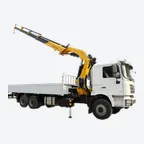

Truck mounted crane installation starts long before the first bolt goes in. The truck has to carry the crane’s own weight, keep its axle loads legal, give the crane a strong frame with enough length behind the cab, and drive its hydraulics through a power take-off (PTO). Only after those checks is the crane fitted on a subframe, connected and tested, because no amount of careful fitting will fix a chassis that is wrong for the crane.
This truck crane installation guide first sets out the chassis requirements, using the real figures from the technical drawings of ten current BOB-LIFT cranes from 3.2 t to 12 t, and then covers each installation step. Every crane figure was read from the original drawings by Achord Chan, Product Operations Director at BOB-LIFT, and the worked examples use stated assumptions.
Key takeaways
- Match the crane to the truck before you buy either, because our 3.2 t to 12 t cranes weigh 1,350 kg to 4,600 kg before oil, subframe and body are added.
- A crane mounted behind the cab puts most of its weight on the front axle, so check the front axle rating as well as the gross vehicle weight.
- Each crane needs a set length of chassis behind the cab, which runs from 750 mm to 1,400 mm on the drawings below.
- The PTO and pump must deliver the crane’s rated oil flow at its working pressure: 25 to 75 L/min at 20 to 30 MPa across these models.
- Finish with function, stability and load tests, and keep the records with the crane.
Can a truck mounted crane be installed on any truck?
No, a truck mounted crane, also called a loader crane or boom truck crane, can be fitted to many makes of truck, but only to a chassis that meets five conditions. The truck needs spare payload for the crane, axle ratings that can take its weight where it sits, and a frame strong enough for the lifting forces. It also needs free frame length behind the cab and a PTO that can drive the crane’s pump. A truck that fails any one of these conditions is the wrong truck for that crane, even if the crane physically fits.
The table shows what each crane asks of the truck, with every figure taken from our technical department’s dimension drawings; a dash means the drawing does not give that value.
| Model | Boom | Max. capacity | Self weight | Installation space | Oil flow | Pressure | Recommended power | Oil tank | Outrigger span |
|---|---|---|---|---|---|---|---|---|---|
| SQ3.2ZA4 | Knuckle | 3,200 kg | 1,450 kg | 850 mm | 25 L/min | 25 MPa | 14 kW | 60 L | 2,250–3,513 mm |
| SQ3.2SA4 | Telescopic | 3,200 kg | 1,350 kg | 750 mm | 25 L/min | 20 MPa | 14 kW | 60 L | 1,720–3,120 mm |
| SQ5ZA4 | Knuckle | 5,000 kg | 2,386 kg | 1,050 mm | 35 L/min | 28 MPa | 22 kW | 100 L | 2,272–5,122 mm |
| SQ5SA4 | Telescopic | 5,000 kg | 2,400 kg | 800 mm | 32 L/min | 21 MPa | 18 kW | 100 L | 2,293–5,593 mm |
| SQ8ZA4 | Knuckle | 8,000 kg | 3,050 kg | – | 40 L/min | 28 MPa | 25 kW | 160 L | 2,310–5,610 mm |
| SQ8SA4 | Telescopic | 8,000 kg | 3,600 kg | 1,100 mm | 55 L/min | 26 MPa | 30 kW | 160 L | 2,290–5,990 mm |
| SQ10ZA6 | Knuckle | 10,000 kg | 3,700 kg | – | 40 L/min | 30 MPa | 30 kW | 160 L | 2,310–5,610 mm |
| SQ10SA4 | Telescopic | 10,000 kg | 3,800 kg | 1,100 mm | 63 L/min | 26 MPa | 37 kW | 200 L | 2,290–5,990 mm |
| SQ12ZA4 | Knuckle | 12,000 kg | 4,480 kg | 1,400 mm | 55 L/min | 28 MPa | 30 kW | 160 L | 2,316–5,706 mm |
| SQ12SA4 | Telescopic | 12,000 kg | 4,600 kg | 1,100 mm | 75 L/min | 26 MPa | 45 kW | 200 L | 2,300–7,500 mm |

Truck chassis requirements for a crane
Check these five requirements in order: the first two are about weight, the third is about strength, and the last two are about the space and power the crane needs.
1. Payload: the crane comes out of the truck’s carrying capacity
Everything you add to the chassis reduces what the truck can carry. Start with the truck’s gross vehicle weight rating (GVWR), subtract the chassis-cab weight, and then subtract the crane, its hydraulic oil, the subframe and the body; what is left is your real payload.
The crane itself is the biggest item, and the SQ10SA4 10-ton telescopic crane weighs 3,800 kg on its drawing. Its 200 L oil tank adds roughly 175 kg more when full, since typical mineral hydraulic oil weighs about 0.87 kg per litre. The subframe and body depend on the build, so weigh them or take them from the body builder’s drawing rather than guessing.
2. Axle loads: check the front axle, not just the total
Most truck mounted cranes sit directly behind the cab, close to the front axle, which puts most of the crane’s weight on the steering axle. The front axle rating is therefore often the first limit a build hits, even when the total weight is well inside the GVWR.
The split follows simple leverage. With a wheelbase L and the crane’s centre of gravity a distance a behind the front axle, the front axle carries the crane weight × (L − a) ÷ L, and the rear axle carries the rest.
Worked example with assumed truck dimensions: take the SQ10SA4 at 3,800 kg on a two-axle truck with a 4,700 mm wheelbase, and assume the crane’s centre of gravity sits 1,700 mm behind the front axle. The front axle takes 3,800 × 3,000 ÷ 4,700 ≈ 2,430 kg and the rear axle about 1,370 kg, so almost two thirds of the crane’s weight lands on the steering axle. Add that to the chassis-cab’s own front axle weight and compare the total with the front axle rating on the truck’s plate. Use your truck’s real dimensions when you do this for your build, and ask us for the crane’s centre of gravity.

Mounting the crane at the rear of the body moves its weight onto the rear axle instead, but it can leave the steering axle too light when the truck is empty. Truck makers set a minimum front axle load for safe steering and braking, so check both the loaded and the empty case.
This calculation is a first estimate to see whether a crane and a truck can work together, not a replacement for the body builder’s full weight calculation. That full calculation includes the crane, oil, subframe, body, outriggers, fuel and crew, and is checked against the truck maker’s body builder guidelines and the vehicle approval required where the truck is registered.
3. Frame strength and the subframe
When the crane lifts, the slewing torque and the lifting moment go into the truck frame through the crane base and outriggers. On their drawings, the ten cranes above are rated from 6.8 t·m (SQ3.2ZA4) to 33 t·m (SQ12SA4), and the chassis frame rails on their own are not designed to take that twist.
A subframe is a steel frame between the crane and the chassis rails that spreads the crane’s loads along the frame and stiffens it against twisting. Whether you need one, and how long and how strong it must be, depends on the crane’s moment and the truck’s frame section. Two documents decide it: the crane maker’s mounting drawing and the truck maker’s body builder guidelines, which also say where you may drill the frame and which fasteners to use. As a rule, never weld to or drill the chassis frame flanges unless the truck maker allows it.
4. Installation space behind the cab
Installation space is the clear length of frame that each crane needs behind the cab for its base and outrigger box. On our drawings it is 750 mm for the SQ3.2SA4, 800 mm for the SQ5SA4 and 1,100 mm for the 8 to 12 t telescopic models, while the knuckle boom models that list it need 850 mm to 1,400 mm. Measure the free frame length behind the cab, allowing for the cab’s tilt clearance, the exhaust, the fuel and air tanks, and the battery box, which often have to move.
Everything behind the crane is your body length, so subtract the installation space and any gap you need from the frame length behind the cab to see how long a deck you can still fit.

5. PTO and hydraulics: flow, pressure and power
A power take-off (PTO) is an output on the truck’s gearbox or engine that drives the crane’s hydraulic pump, and the crane runs on the oil that this pump delivers. The pump must deliver the crane’s rated flow at its working pressure, and the PTO must handle the torque. Our drawings give three figures for this: oil flow, system pressure and a recommended power.
The recommended power includes a margin for losses. Hydraulic power in kilowatts is pressure in MPa × flow in L/min ÷ 60, so for the SQ10SA4 that is 26 × 63 ÷ 60 ≈ 27 kW of oil power against a recommended 37 kW. For the SQ10ZA6 10-ton knuckle boom crane it is 30 × 40 ÷ 60 = 20 kW against a recommended 30 kW. The gap covers pump and PTO losses, so size the PTO to the recommended figure.
Flow sets the pump size, because flow equals pump displacement × pump speed. If the PTO turns the pump at 1,000 rpm, the SQ10SA4’s 63 L/min needs a pump of about 63 cm³ per revolution, plus a little for the pump’s own losses. A different PTO ratio or engine speed changes that number, which is why we ask for the PTO data before we confirm a match.
Outriggers and ground space
The crane’s load chart assumes fully extended outriggers on firm, level ground, and the span on our drawings goes from about 1.7 m retracted on the SQ3.2SA4 to 7.5 m fully extended on the SQ12SA4. Check that your usual job sites have that width and that the body and fuel tanks do not block the outrigger legs. Our guide on how to read a crane load chart explains why the chart only applies in the set-up it was drawn for.
Crane installation on a truck, step by step
Once the chassis matches, a qualified body builder or crane installer should carry out six steps, working from the crane maker’s mounting drawing and the truck maker’s body builder guidelines.

Step 1: Confirm the crane and truck match
Collect the truck’s data: make and model, wheelbase, GVWR, front and rear axle ratings, chassis-cab weight on each axle and frame rail section. Add the free frame length behind the cab and the PTO options with their output ratio and torque rating. Run the payload and axle load checks above with the crane’s figures, and if the numbers do not work, change the crane or the truck now, not after the crane arrives.
Step 2: Prepare the chassis
Clear the mounting area by moving the fuel tank, air tanks, battery box or exhaust where they are in the way of the crane base or outriggers, following the truck maker’s rules for relocating them. Check the frame for damage or old repairs at the same time.
Step 3: Fit the subframe and the crane
Fit the subframe to the chassis rails with the clamps, brackets or shear plates the mounting drawing specifies. Lift the crane onto the subframe with a lifting device rated for its weight, line it up with the truck’s centre line, and fasten it with the specified bolts tightened to the specified torque. Keep a written torque record, because the crane manual sets when these bolts must be re-checked after the first period of use.
Step 4: Connect the PTO, pump and hydraulics
Install the PTO and pump, then run the suction, pressure and return lines to the crane and the oil tank. Keep hoses away from the exhaust and sharp edges and clamp them so they cannot rub, then fill the tank with the hydraulic oil grade the crane manual specifies and bleed the air from the system.
Step 5: Wire the controls and safety devices
Connect the PTO switch in the cab, the crane’s control circuits, the overload protection and any indicators, such as a warning that the outriggers or boom are not stowed. Fit an interlock that stops the truck being driven, or at least a cab warning, when the outriggers or boom are out of their stowed position, and follow the truck maker’s rules on driving with the PTO engaged.
Step 6: Test, inspect and record
Run every crane function without load, including slewing, boom up and down, extension and outriggers, then check for leaks and confirm that the safety devices work. After that, carry out the stability and load tests required by the standard you build to and by the crane manual; in Europe, loader cranes are built and tested to EN 12999. In Great Britain, LOLER 1998 regulation 9 requires lifting equipment whose safety depends on its installation to be thoroughly examined after installation and before it is first put into service. In the United States, articulating boom cranes follow ASME B30.22 and telescopic boom cranes on trucks fall under ASME B30.5. Where OSHA’s construction crane rules apply, 29 CFR 1926.1412(c) requires a qualified person to inspect the equipment after assembly. Re-weigh the finished truck on each axle and keep the weight, torque and test records with the crane.
Do not apply a fixed rule to the crane’s working area. Some guides say, for example, that a crane can lift only about half its rated capacity over the cab, or that the full load chart always applies behind the truck. There is no general percentage: what a crane may lift in each slewing sector depends on that crane, its outrigger setup and the truck it is mounted on. Use the crane’s own load chart and the working-area limits in its manual, and confirm them in the stability test after installation.
A truck mounted crane is built for vertical lifting, although some sources present side loading as a strength of knuckle boom cranes and give dragging a load as an example. Dragging a load or pulling sideways puts forces on the boom, the slewing gear and the truck frame that the load chart does not cover, so do not do it unless the crane manual specifically allows it.
What BOB-LIFT checks before a crane ships
We test our cranes at the Xuzhou factory before delivery, and our product pages show a video of how we test them. When you send an enquiry, our form asks whether you already have a truck and for the truck model and chassis specifications. We use those to check payload, installation space and the PTO’s flow and pressure against the crane’s drawing and confirm the match when we quote, and if the numbers do not work, we tell you before you order.
What decides the cost of truck mounted crane installation?
Truck mounted crane installation cost is what you pay to have the crane fitted, connected and tested on your truck, on top of the crane itself. There is no single figure for it, because the work changes from one truck to the next and depends mainly on where the crane is fitted and how much the chassis has to be prepared. With BOB-LIFT, installation follows one of two routes.
- Your truck is bought in China: the truck supplier can deliver the chassis to our factory in Xuzhou, where we fit the crane and test it on the truck before it ships.
- Your truck is bought in your own country: we ship the crane only, and a local body builder fits it to your truck. Our engineers support the installation remotely, including by video, from the mounting drawing to the first tests, and if you want an engineer on site, we can send one at extra cost.
On either route, five things move the installation cost:
- Crane size: a bigger crane is heavier, needs more installation space, a longer and stronger subframe and a larger pump, and takes longer to lift into place and set up. On the drawings above, self weight runs from 1,350 kg to 4,600 kg.
- Mounting position: a crane behind the cab often means moving the fuel tank, air tanks, battery box or exhaust. A crane at the rear of the body can mean shortening or rebuilding the body and checking the front axle load when the truck is empty.
- Chassis reinforcement: the subframe, and any extra frame reinforcement the truck maker’s body builder guidelines call for, grow with the crane’s lifting moment, which runs from 6.8 t·m to 33 t·m on the drawings above.
- PTO: a truck that already has a PTO matching the crane’s oil flow and recommended power needs less work than one where the PTO, pump, oil tank, hoses and cab switch all have to be added.
- Local labour: the body builder’s labour rate, plus any inspection, axle re-weighing and registration that the law requires where the truck is used.
To get a clear picture for your own truck, tell us whether you are buying the truck in China or locally, and send its make and model, wheelbase, PTO details and where you want the crane mounted. We will check the crane and truck match and set out what the installation involves before you order, so contact us to start.
Frequently asked questions
How much payload does a truck mounted crane take?
Its self weight plus its oil, the subframe and any changes to the body. On our drawings, self weight runs from 1,350 kg for the 3.2 t SQ3.2SA4 to 4,600 kg for the 12 t SQ12SA4, and a full 200 L oil tank adds roughly 175 kg on top.
Does every truck crane need a subframe?
Almost every crane of this size needs one, because the chassis rails alone are not built to resist the crane’s lifting moment and slewing torque. The crane maker’s mounting drawing and the truck maker’s body builder guidelines set its size, so do not leave it out to save weight.
Where should the crane be mounted on the truck?
Behind the cab is the most common position, because it keeps the deck free and lets the crane reach over the whole body, but it loads the front axle. A rear mount loads the rear axle and suits jobs where the crane works off the back of the truck, so choose the position from the axle load calculation and the way you unload.
What PTO does a truck crane need?
One that can drive a pump giving the crane’s rated flow at its working pressure, with power to spare. On our drawings that runs from 25 L/min at 20 MPa with 14 kW recommended for the SQ3.2SA4, up to 75 L/min at 26 MPa with 45 kW recommended for the SQ12SA4.
Can I do the crane truck installation myself?
Only if you are a qualified installer with the right lifting equipment and the mounting documents, because mistakes in fastening, hydraulics or stability show up under load, when they are most dangerous. Many buyers have the crane fitted by a local body builder, who also handles registration or inspection where the law requires it.
Crane installation checklist
- Payload left after crane, oil, subframe and body is enough for your loads.
- Front and rear axle loads stay within their ratings, loaded and empty.
- Subframe designed to the crane’s mounting drawing and the truck’s body builder guidelines.
- Free frame length behind the cab covers the crane’s installation space.
- PTO and pump give the rated flow and pressure, with the recommended power.
- Outriggers can deploy fully on your usual sites.
- Function, stability and load tests done and recorded, axles re-weighed.
The main drawing figures for each model are listed on its product page in our truck mounted crane range, and our guide to knuckle boom vs telescopic boom truck cranes compares the two boom types for your truck. Send us your truck’s data and we will check the match with you.