Customer Feedback · 16 Ton Knuckle Boom Marine Crane
SQ16ZA4T Marine Crane on a Work Pontoon in Russia
- Model
- SQ16ZA4T
- Country
 Russia
- Media
- 7 photos

01 / 07
An orange knuckle boom crane on a rust-red steel work pontoon with rubber fenders, moored at a granite city embankment with its hook lowered into the water: photos from our customer in Russia show a BOB-LIFT SQ16ZA4T marine crane at work.
At a glance: SQ16ZA4T 16 t knuckle boom marine crane · Russia · steel work pontoon · 7 customer photos.
What the photos show
- The crane. The orange crane stands on a pedestal at one end of the pontoon, next to a glass control cabin. Its boom with black extensions reaches out over the side.
- The deck. A diesel engine, pumps, hose reels and winches fill the deck, inside steel railings.
- In the canal. Two photos show the pontoon at a granite embankment along a city canal with autumn trees, with the crane hook lowered into the water.
- In the port. Other photos show the pontoon moored in a port next to tall blue frames on another vessel, with a worker in a hard hat walking on the deck.
- On land. One photo shows the pontoon out of the water on a concrete yard, with the crane folded on top and rubber fenders hung along its side.
These are the customer's own photos. No load weights or comments came with them.
About the SQ16ZA4T
The SQ16ZA4T is an earlier 16 t knuckle boom marine crane. It is no longer in the current range, and the technical department has no current drawing for it, so this record does not quote load figures for it. For a new crane of this size, see the 16 t knuckle boom marine crane page, where each current model has its own dimension and load chart drawings.
Lifting moment is the load times its distance from the slewing centre. That is why the rated load drops as the boom reaches out. For example, a load the crane lifts easily close to the column can be too heavy once the extension is pushed out. Working radius is the level distance from the slewing centre to the hook. On a vessel or a quay, the pedestal takes the place of outriggers. It must be strong enough for the crane's weight and its full lifting moment. For general crane safety rules, see the OSHA cranes and derricks standard.
On a pontoon, the crane does the lifting work for the whole job, from setting down equipment to recovering it from the water. A 6.3 t marine crane works on a vessel in our delivery record from Russia, and a 5 t telescopic marine crane works in our record from the Maldives.
A crane on a work pontoon
A pontoon has little freeboard, and a heavy lift over the side makes it list. Four points to plan for:
- Check the list. Work out how far the pontoon heels with the heaviest load at full radius, and keep it within the crane's limits.
- Brace the pedestal. Tie the pedestal into the pontoon frames, sized for the crane's full lifting moment.
- Keep the deck in order. Route hoses and cables away from the crane's swing path and the landing areas.
- Lift from the water slowly. A load coming out of the water gets heavier as it clears the surface, so lift slowly and watch the load.
Sea water is hard on steel, so the marine cranes get an epoxy zinc primer with a polyurethane acrylic top coat. Other sizes are in the knuckle boom marine crane range, and the marine crane buying guide covers vessel mounting in more detail.
What to send us for a marine crane
To match a current crane to your vessel, we need a few details. Short answers are fine.
- The site. The vessel type and length, or the quay, and where the crane will stand.
- The lifts. The heaviest load, and how far from the crane it is picked up and set down.
- The power. The hydraulic power pack you have now, or whether you need a new one.
If you run an SQ16ZA4T today, a photo of its nameplate helps too. Send these through the contact page, and our team will check reach and load against the current load charts.
Record compiled by Achord Chan, Product Operations Director at BOB-LIFT, from the customer's photos.
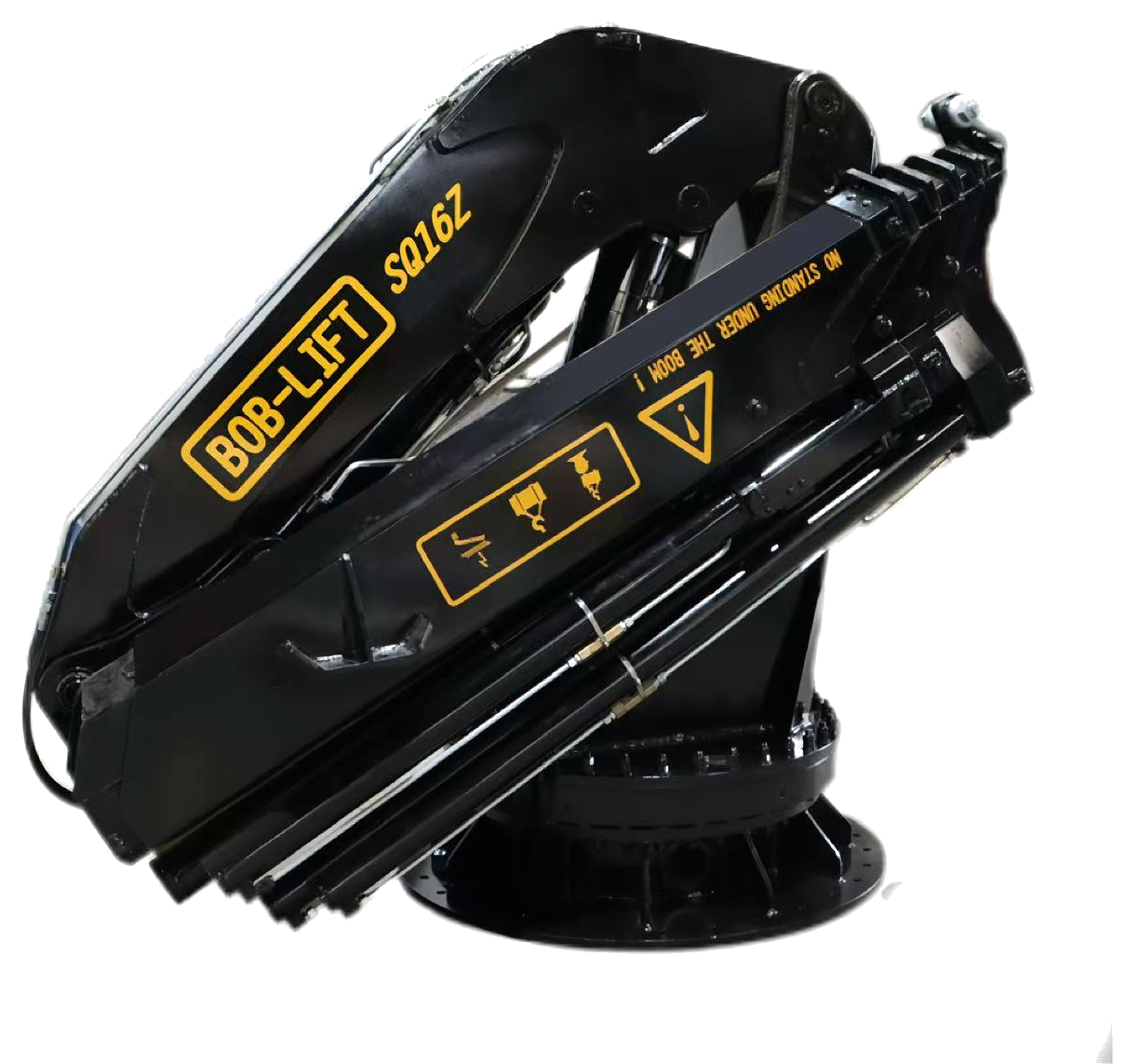
The crane in these photos
Interested in the 16 Ton Knuckle Boom Marine Crane?