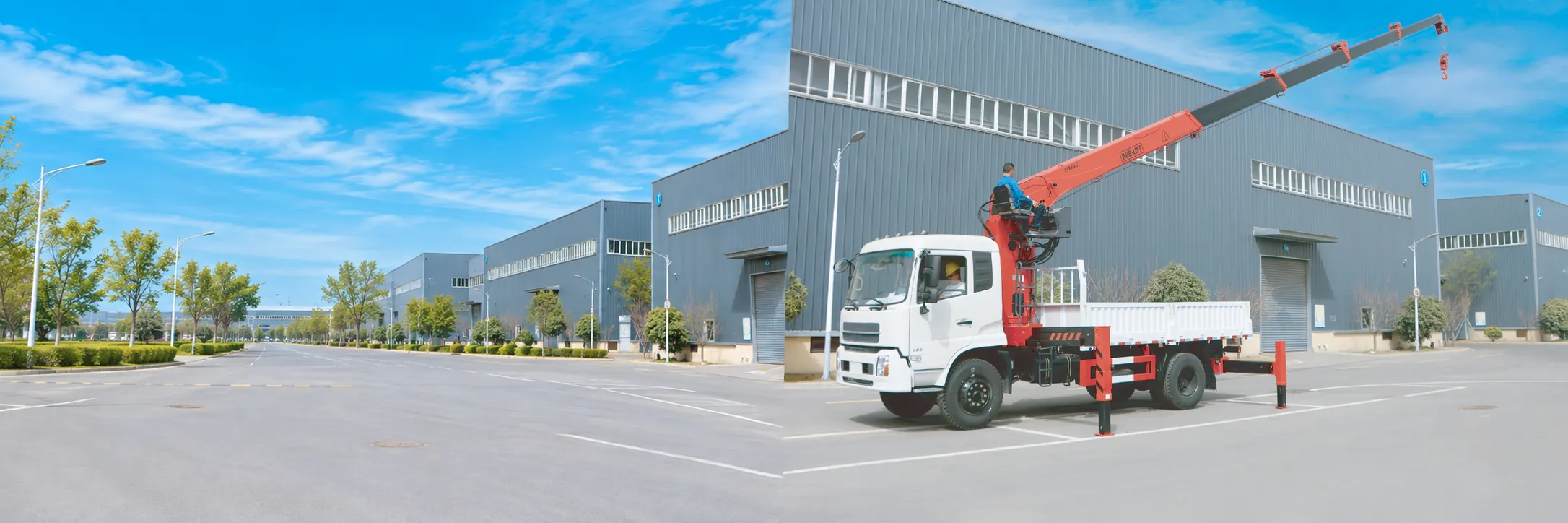

A timber crane is a hydraulic knuckle boom crane with a grapple and a rotator at the boom tip, built to pick up logs, pulpwood and firewood and load them onto a truck, a trailer or a stack. It is also called a log crane, a log loader crane or a forestry crane. BOB-LIFT’s timber cranes lift 600 kg to 1,800 kg, have a lifting moment of 6.5 t·m to 16 t·m and reach 6.5 m to 8.2 m. The crane itself weighs 1,280 kg to 2,700 kg.
We have manufactured cranes in Xuzhou since 2003 and export them to 124 countries and regions. This guide uses the technical drawings and load charts of our six timber cranes to explain how to size a log crane correctly: how heavy your logs actually are, how far the grapple must reach, and what hydraulic supply, mounting space and payload allowance the vehicle needs before you request a quotation.
Key takeaways
- Size a timber crane by the weight of your heaviest grapple load at the reach you need, not by the headline capacity.
- Fresh pine can weigh close to 1,000 kg per cubic metre, so a 0.5 m log 6 m long can weigh over a tonne.
- Our range runs from the 600 kg SL70 to the 1,800 kg ZT160Z-2A. Four of the six models keep their full capacity out to maximum reach.
- A boom that goes 23° to 30° below horizontal lets the grapple pick logs from a ditch or a low pile.
- The vehicle must supply 45 to 80 L/min of oil and carry 1.3 t to 2.7 t of crane on top of its load.
What is a timber crane?
A timber crane is a loader crane designed specifically for round wood. Instead of a hook, it carries a hydraulic grapple that closes around a single log or a bundle of logs, and a rotator between the boom tip and the grapple turns the load so that it lines up with the load bed. Because the grapple grips the load directly, the operator can work alone, without anyone on the ground attaching slings, which is safer and considerably faster in the forest or at a sawmill yard.
Three features distinguish a timber crane from a general cargo crane. First, the boom can operate below horizontal: five of our six models reach 23° to 30° below the crane base, so the grapple can collect logs from a ditch or from the bottom of a pile. Second, all our timber cranes slew 380°, slightly more than a full circle, which allows the operator to reach both sides of the vehicle in one continuous movement. Third, the operator usually sits on the crane itself; on the ZT120Z-2A and ZT160Z-2A, for example, the seat is mounted on top of the column, with an unobstructed view of the grapple.
Like any knuckle boom crane, a timber crane is rated by its lifting moment, which is the load multiplied by its distance from the column. Our guide to what the lifting moment of a crane means explains the idea in detail.

Our six timber cranes at a glance
The following table compares our current timber cranes, and every figure comes from the corresponding model’s technical drawing and load chart.
| Model | Max capacity | Lifting moment | Reach | Load at max reach | Boom angle | Crane weight |
|---|---|---|---|---|---|---|
| SL70 | 600 kg | 7 t·m | 4.7–7.0 m | 600 kg | −30° to 73° | 1,450 kg |
| ZM65 | 700 kg | 6.5 t·m | 5.35–6.5 m | 600 kg | −23° to 66° | 1,280 kg |
| ZM75 | 700 kg | 6.5 t·m | 5.35–7.67 m | 500 kg | −23° to 66° | 1,400 kg |
| SL150-2A | 1,000 kg | 15 t·m | 5.7–8.0 m | 1,000 kg | 0° to 78° | 2,650 kg |
| ZT120Z-2A | 1,300 kg | 12 t·m | 7.3 m | 1,300 kg | −30° to 70° | 2,300 kg |
| ZT160Z-2A | 1,800 kg | 16 t·m | 8.2 m | 1,800 kg | −30° to 70° | 2,700 kg |
Notice how differently the cranes perform at full reach. The SL70, SL150-2A, ZT120Z-2A and ZT160Z-2A maintain their full capacity out to maximum reach, whereas the ZM75 drops from 700 kg to 500 kg at its full 7.67 m, so two cranes with a similar headline capacity can behave very differently at the far edge of a trailer. Our article on how to read a crane load chart shows how to check this for any model.
How heavy is a log?
A log’s weight equals its volume multiplied by the density of the wood, and freshly cut wood is surprisingly heavy because its cells are still full of water. The US Forest Service Wood Handbook gives the average moisture content of green loblolly pine as 110 percent in the sapwood and 33 percent in the heartwood, measured against the weight of dry wood, together with a basic specific gravity of 0.47. Applying the handbook’s density table, that corresponds to approximately 990 kg per cubic metre for fresh sapwood and approximately 625 kg per cubic metre for heartwood, which gives the following estimates.
| Log size (diameter × length) | Volume | Weight at 625 kg/m³ | Weight at 990 kg/m³ |
|---|---|---|---|
| 0.30 m × 4 m | 0.28 m³ | about 180 kg | about 280 kg |
| 0.40 m × 5 m | 0.63 m³ | about 390 kg | about 620 kg |
| 0.50 m × 6 m | 1.18 m³ | about 740 kg | about 1,170 kg |
The conclusion is straightforward. A small crane handles individual pulpwood or firewood logs comfortably, but a single fresh saw log 0.5 m in diameter can exceed the SL70’s 600 kg, and a bundle of several smaller logs accumulates weight just as quickly. Because the grapple and rotator also hang from the boom tip, always leave a reasonable margin. The most reliable figure is your own measurement, for instance by weighing a typical grapple load once or by using the weights printed on your sawmill’s delivery tickets.
Reach, boom angle and lifting height
Reach is the horizontal distance between the crane column and the grapple. To determine the reach you need, measure from the position where the column will stand to the far side of the load bed, and then to the furthest log you expect to pick from the ground. On many vehicles the far side of the bed is already 2 m to 3 m from the column, and logs lying beside a forest road are frequently further away than operators expect.
Most of our timber cranes have hydraulically extending booms: the SL70 extends from 4.7 m to 7.0 m, the ZM75 from 5.35 m to 7.67 m, and the ZT160Z-2A uses two extensions to achieve a reach of 8.2 m. Raised to its maximum angle, the grapple sits approximately 8.5 m to 10 m above the crane base (ZM65 8.5 m, ZT120Z-2A 9 m, SL70 9.1 m, ZM75 9.5 m, SL150-2A and ZT160Z-2A 10 m), which is useful when stacking logs high or reaching over the stakes of a trailer, while lowering the boom below horizontal allows the grapple to collect logs lying beneath the base.
Reach and capacity must always be considered together. If you operate within 6.5 m, the lighter ZM65 is usually sufficient; if you need a full 1,000 kg at 8 m, the SL150-2A is the appropriate choice; and if you handle the heaviest logs, the ZT160Z-2A maintains 1,800 kg out to 8.2 m. The complete model list is available on our timber crane page.
Hydraulic supply, mounting space and weight on the vehicle
A timber crane operates on hydraulic oil supplied by a pump driven by the vehicle’s engine, usually through a power take-off. The pump must deliver the flow and pressure specified on the drawing; otherwise the crane will move slowly or fail to reach its rated performance. The crane also requires adequate space behind the cab and a sufficiently strong frame or subframe underneath it.
| Model | Oil flow and pressure | Power | Oil tank | Mounting space | Outrigger span |
|---|---|---|---|---|---|
| SL70 | 45 L/min at 22 MPa | about 18 kW | 60 L | 750 mm | 2,224–3,514 mm |
| ZM65 / ZM75 | 45 L/min at 19 MPa | about 18 kW | on request | on request | on request |
| SL150-2A | 60 L/min at 25 MPa | about 32 kW | 250 L | 1,000 mm | on request |
| ZT120Z-2A | 60 L/min at 27 MPa | about 25 kW | 150 L | 900 mm | 2,220–5,500 mm |
| ZT160Z-2A | 80 L/min at 28 MPa | about 32 kW | 180 L | 1,000 mm | 2,220–5,500 mm |
Weight is equally important. The crane itself weighs between 1,280 kg and 2,700 kg, and every kilogram of crane reduces the quantity of logs the vehicle can legally carry, so verify the vehicle’s permitted axle loads and remaining payload with the crane fitted before you decide. Wide outriggers, such as the 5.5 m span of the ZT120Z-2A and ZT160Z-2A, also need room at the loading site. Stowed, the compact SL70 measures only 2,393 mm long, 680 mm wide and 2,345 mm high and needs only 750 mm of mounting space behind the cab, against 1,000 mm for the SL150-2A and ZT160Z-2A.
We export the crane, not the vehicle. If you buy a Chinese truck, the supplier can deliver it to our factory and we mount the crane before shipping. If you buy the truck locally, we ship the crane, a local body builder installs it, and our engineers support the work remotely. The mounting and shipping page explains both routes.

Working safely when loading logs
Log loading has its own safety rules. In the United States, the OSHA logging standard, 29 CFR 1910.266, applies to log loaders. It says that “the rated capacity of any machine shall not be exceeded” and that the machine must be operated “within the limitations imposed by the manufacturer”. For loading, it requires that only the operator and essential workers stay in the loading area, and that “each log shall be placed on a transport vehicle in an orderly manner and tightly secured”.
In practice, this translates into four essential habits: position the outriggers on firm ground before every lift, keep other people outside the slewing area, never swing logs over an occupied cab unless the cab is specifically protected, and secure the entire load before driving away. Regulations in your own country may impose additional requirements, so consult them as well.
How to choose a timber crane in five steps
- Weigh or estimate your heaviest grapple load, using fresh wood, not dry.
- Measure the reach you need, from the column to the far side of the bed and to the furthest log.
- Check the load chart: the crane must lift that load at that reach, with a margin.
- Check the vehicle: oil flow and pressure, space behind the cab, axle loads with the crane fitted.
- Send us the vehicle make and model and your loads, and our engineers will confirm the fit before quotation.
Frequently asked questions
What is the difference between a timber crane and a log loader?
In everyday use, the two names mean the same machine: a knuckle boom crane with a grapple and rotator that loads logs. Some people use log loader for larger self-propelled machines, but a timber crane is mounted on a truck, trailer or other vehicle.
How much can a timber crane lift?
BOB-LIFT timber cranes lift from 600 kg with the SL70 up to 1,800 kg with the ZT160Z-2A, and the ZT160Z-2A keeps that 1,800 kg out to its full 8.2 m reach.
How heavy is a fresh log?
Fresh pine sapwood weighs about 990 kg per cubic metre by our calculation from the US Forest Service Wood Handbook, so a fresh log 0.4 m thick and 5 m long can weigh about 620 kg.
What hydraulic supply does a timber crane need?
Our timber cranes need 45 L/min at 19 to 22 MPa for the small models and up to 80 L/min at 28 MPa for the ZT160Z-2A, usually from a pump on the vehicle’s power take-off.
Do you supply the truck with the crane?
No. We export the crane only. A Chinese truck can be delivered to our factory for mounting, or a local body builder can install the crane on your own truck with our remote support.
How we compiled this guide
All crane figures come from the BOB-LIFT technical drawings and load charts of the SL70, ZM65, ZM75, SL150-2A, ZT120Z-2A and ZT160Z-2A, as published on our product pages in November 2026. The log weights are our own calculation from the Wood Handbook (FPL-GTR-282) tables named above. The safety rules are quoted from the official eCFR text. The photos show a real SL70 in our Xuzhou workshop. The guide was reviewed by Achord Chan, Product Operations Director, in November 2026. It does not replace the crane’s manual, the vehicle maker’s rules or the law where you work.
Get the right timber crane for your vehicle
Tell us the vehicle you will use, your heaviest grapple load and the reach you need, and we will recommend a model and send its full drawing and load chart. Every crane carries a 12-month warranty on the whole machine, common spare parts leave the factory within 48 hours, and our service team answers within 12 hours. Contact us for a quotation.