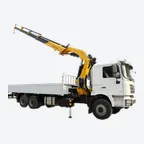

A crane counterweight is a heavy mass placed behind a crane’s slewing centre to balance the tipping moment created by the load on the hook. Mobile, crawler and tower cranes depend on it. A truck mounted crane, also called a knuckle boom or loader crane, normally carries no counterweight at all: it stays upright because its outriggers widen the support base and the weight of the truck holds it down. BOB-LIFT’s truck cranes, from the 2 t SQ2ZA4 to the 50 t SQZ1000, are all built this way.
We have manufactured truck mounted cranes in Xuzhou since 2003. This guide explains how a counterweight works, why loader cranes are designed without one, what replaces it, and why adding improvised weight to a crane or truck is never a safe solution.
Key takeaways
- A counterweight balances the load’s tipping moment by placing mass on the opposite side of the slewing centre.
- Mobile cranes, crawler cranes and tower cranes use counterweights; truck mounted loader cranes normally do not.
- On a truck crane, the outrigger spread and the vehicle’s own weight provide the stability that a counterweight would otherwise supply.
- Our outrigger spans grow from 3.5 m on the 2 t SQ2ZA4 to 8.6 m on the 50 t SQZ1000, according to the technical drawings.
- US rules forbid exceeding the counterweight or ballast specified by the manufacturer, so never add improvised weight.
What is a crane counterweight?
Every crane is a lever. The load hanging from the hook, multiplied by its horizontal distance from the point about which the crane would tip, produces a tipping moment. On the other side of that point, the crane’s own weight produces a stabilising moment. As long as the stabilising moment is clearly larger, the crane stays on the ground; when the load moment approaches it, the crane begins to tip.
A counterweight increases the stabilising side of that balance. It is usually a set of cast iron or steel blocks fixed to the rear of the rotating superstructure, so it slews with the boom and always stays opposite the load. By placing a large mass at a large distance behind the slewing centre, the designer can allow much heavier loads at longer radius than the crane’s basic structure alone could support. Our article on the lifting moment of a crane explains the load-times-radius calculation in more detail.
Which cranes use a counterweight?
Counterweights belong to cranes whose boom sits on a revolving superstructure with a long tail behind it. All-terrain and rough-terrain mobile cranes carry removable counterweight plates, and the configuration is chosen for each job from the load chart. Crawler cranes carry substantial rear counterweights, sometimes supplemented by extra ballast, and tower cranes carry a counter-jib loaded with concrete or steel blocks.
The US construction crane standard treats this mass as a strict operating condition. Under 29 CFR 1926.1417(aa), equipment other than tower cranes “must not be operated without the counterweight or ballast in place as specified by the manufacturer”, and “the maximum counterweight or ballast specified by the manufacturer for the equipment must not be exceeded”. Too little counterweight lets the crane tip forward under load; too much can tip it backwards when the hook is empty.
A rotating counterweight also creates its own hazard, because the tail can strike or crush a worker as the crane slews. That is one reason why 29 CFR 1926.1424 requires the swing radius hazard area to be marked with barriers or warning lines.
Why a truck mounted crane has no counterweight
A truck mounted crane is a loading tool for a working truck, not a dedicated lifting machine. It is mounted behind the cab or at the rear of the chassis, and the truck still has to carry its own payload on the bed. A heavy counterweight would consume that payload, overload the axles and make the vehicle harder to drive legally on public roads, so loader cranes are designed around a different principle.
Instead of a rotating counterweight, the crane uses three sources of stability. First, hydraulic outriggers extend sideways and move the tipping line far away from the slewing centre. Second, the mass of the truck chassis, the crane itself and the base frame acts as a fixed counterweight that does not rotate. Third, the rated lifting moment limits how much load can be handled at each radius, so the crane never asks the vehicle for more stability than it can provide.

How outriggers replace a counterweight
When a loader crane lifts over the side, the vehicle would tip about the line through the outrigger feet on that side. The further that line is from the slewing centre, the shorter the load’s effective lever arm and the longer the lever arm of the truck’s weight. Doubling the outrigger span therefore does far more for stability than adding a small amount of weight would. The following table compares the outrigger spans our drawings specify with each crane’s lifting moment and self-weight.
| Model | Boom type | Max capacity | Lifting moment | Crane weight | Outrigger span, retracted–extended |
|---|---|---|---|---|---|
| SQ2ZA4 | Knuckle | 2,000 kg | 4.2 t·m | 750 kg | 1,842–3,500 mm |
| SQ5ZA3 | Knuckle | 5,000 kg | 10.5 t·m | 2,286 kg | 2,272–5,122 mm |
| SQ10ZA6 | Knuckle | 10,000 kg | 21 t·m | 3,700 kg | 2,310–5,610 mm |
| SQ12ZA6 | Knuckle | 12,000 kg | 27 t·m | 4,800 kg | 2,316–5,706 mm |
| SQZ430 | Knuckle | 20,000 kg | 42.3 t·m | 5,500 kg | 2,300–6,600 mm |
| SQZ500 | Knuckle | 25,000 kg | 53.9 t·m | 6,300 kg | 2,300–7,400 mm |
| SQZ1000 | Knuckle | 50,000 kg | 90 t·m | 10,000 kg | 2,250–8,600 mm |
| SQ20SA5 | Telescopic | 20,000 kg | 50 t·m | 7,300 kg | 2,450–8,050 mm |
The pattern is instructive. As the lifting moment rises from 4.2 t·m to 90 t·m, the outrigger span rises from 3.5 m to 8.6 m, while the crane’s own weight grows far more slowly. The larger cranes gain their stability mainly through a wider footprint and a heavier truck, not through extra mass on the crane. Our guide to crane outriggers and ground bearing pressure explains how to set them up and how to size the pads.
Outriggers only work on ground that can carry them. The US standard, 29 CFR 1926.1402, says equipment must not be used unless ground conditions are “firm, drained, and graded” sufficiently to meet the manufacturer’s requirements for support and level, if necessary with mats or cribbing. A fully extended outrigger standing on soft fill provides far less stability than the drawing assumes.
The truck acts as the counterweight
On a loader crane, the vehicle itself does the job of a counterweight. This has two practical consequences that buyers often overlook. First, the same crane can be more stable on a heavy chassis than on a light one, which is why the vehicle has to be checked for each crane model. Second, stability can change with the position of the cargo on the bed and with the direction of the lift, because the vehicle’s mass is not evenly distributed around the crane.
That is why we always ask for the truck’s make, model, wheelbase and axle ratings before recommending a crane, and why the stability instructions in the crane manual take priority over any rule of thumb. Our truck mounted crane installation guide explains the chassis requirements, and the comparison of a truck mounted crane vs a mobile crane shows how the two machines achieve stability differently.
Can you add a counterweight to a truck crane?
No, not on your own initiative. A truck crane’s load chart is calculated for a defined combination of crane, vehicle and outrigger positions. Bolting steel plates to the base or loading ballast onto the bed to “gain capacity” changes the structural loads on the column, the slewing system and the chassis, which the chart never considered. It can also overload the axles on the road and tip the vehicle backwards when the hook is unloaded.
European machinery law places the stability calculation firmly with the manufacturer. Annex I of the Machinery Directive 2006/42/EC, section 4.1.2.1, requires lifting machinery to remain stable “both in service and out of service”, including during foreseeable component failures, and requires the manufacturer to use appropriate verification methods. If you need more stability, the correct answers are a crane with a wider outrigger span, a heavier vehicle, or a crane with a larger lifting moment, which we can propose from your figures.
Example scenario (an illustration, not a customer record): a contractor wants to place 2,000 kg roof trusses at 9 m radius from a light truck, which is a load moment of 18 t·m. Rather than adding ballast to an 8 t·m crane, the correct choice is a crane rated above that moment, such as the 21 t·m SQ10ZA6, mounted on a chassis that has been checked for it.
Stability hazards that a counterweight cannot solve
Because outriggers carry so much responsibility, their own hazards deserve attention. The UK Health and Safety Executive issued safety notice EPD04-2023 after three fatal incidents in Great Britain since 2019, in which operators were crushed against the bodywork by a powered tilting stabiliser leg as it retracted. HSE asks owners to seek improvements such as interlocks from manufacturers and to include the hazard in risk assessments and lift plans.
The other common causes of loader crane overturning are equally unrelated to counterweight: lifting with the outriggers only partly extended, setting a foot on a cellar cover or soft verge, and lifting beyond the load chart at long radius. A load moment limiter, which our lifting moment guide also describes, helps prevent the last of these, but it cannot compensate for poor ground.
What about marine cranes?
Knuckle and telescopic marine cranes such as ours work on a similar principle without outriggers: they are bolted to a pedestal on the deck, and the vessel’s structure provides the reaction. On a small vessel the relevant limit becomes heel rather than tipping, which we explain in our barge crane guide.
Frequently asked questions
Do truck mounted cranes have a counterweight?
Normally they do not. Truck mounted loader cranes rely on hydraulic outriggers and the weight of the truck for stability, and BOB-LIFT’s truck cranes from 2 t to 50 t are built without one.
What is the purpose of a counterweight on a crane?
It balances the tipping moment of the load by placing a heavy mass behind the slewing centre, which allows heavier loads at longer radius without the crane tipping forward.
How heavy is a crane counterweight?
It depends entirely on the crane model and the configuration chosen from its load chart. Always use the exact counterweight the manufacturer specifies, because US rules forbid both too little and too much.
Can I add weight to my truck to lift more?
No. The load chart covers a defined crane, vehicle and outrigger set-up, and extra ballast can overload the structure and the axles. Choose a crane with a larger lifting moment instead.
Why do outriggers matter more than weight?
Outriggers move the tipping line away from the slewing centre, which shortens the load’s lever arm and lengthens the truck’s lever arm at the same time. Our spans grow from 3.5 m to 8.6 m across the range.
How we compiled this guide
We compiled the lifting moments, self-weights and outrigger spans from the BOB-LIFT technical drawings of the eight models in the table, as published in November 2026. The photos show an SQZ430 on our test stand and an SQ8ZA6 lifting a test weight at our Xuzhou factory. The regulatory quotations come from the official eCFR text, the HSE website and legislation.gov.uk. Achord Chan, Product Operations Director, reviewed the guide in November 2026. It does not replace the crane’s manual, the vehicle manufacturer’s limits or the law where you work.
Get a crane matched to your truck
Send us your truck’s make, model and axle ratings together with your heaviest load and the radius you need, and we will recommend a crane with the right lifting moment and outrigger span, with its drawing and load chart. Every crane carries a 12-month warranty on the whole machine, common spare parts leave the factory within 48 hours, and our service team answers within 12 hours. Contact us for a quotation.