
Crane outriggers are the extendable legs that lift a truck crane’s weight off the tyres and spread it across a wider footprint, so the crane can lift its rated loads without tipping. Outriggers only work if two things are right: they are extended to the span the load chart assumes, and the ground under each foot can carry the force that foot puts into it. Most outrigger problems on site come from the second point, not the first.
BOB-LIFT has built truck mounted cranes since 2003. This guide uses the outrigger spans printed on the technical drawings of twelve of our knuckle boom and telescopic cranes, from 2 t to 50 t. It shows how much room the outriggers need, why the extended span matters, and how to size outrigger pads so the ground does not give way. The pad sizing method is the standard one used across the lifting industry; the example force in it is for illustration only, and for a real lift you need the outrigger force for your exact crane and configuration.
Key takeaways
- Retracted, almost every crane in our range is about 2.3 m across its outriggers, roughly the width of the truck. Fully extended, the span grows to 3.1 m on a 2 t crane and 8.6 m on our 50 t knuckle boom.
- The extended span is what makes the load chart valid. Extending to only part of it reduces how much the crane can safely lift over the side.
- Ground pressure under a foot is the outrigger force divided by the contact area. A small steel foot on its own can press harder into the ground than most soils can take, which is why outrigger pads are used.
- Pad area needed = outrigger force ÷ allowable ground bearing pressure. Soft clay may need a pad several times larger than firm gravel for the same force.
- Before the lift: check the ground, look for hidden voids and services, set the pads, extend fully, and level the crane.
What do crane outriggers do?
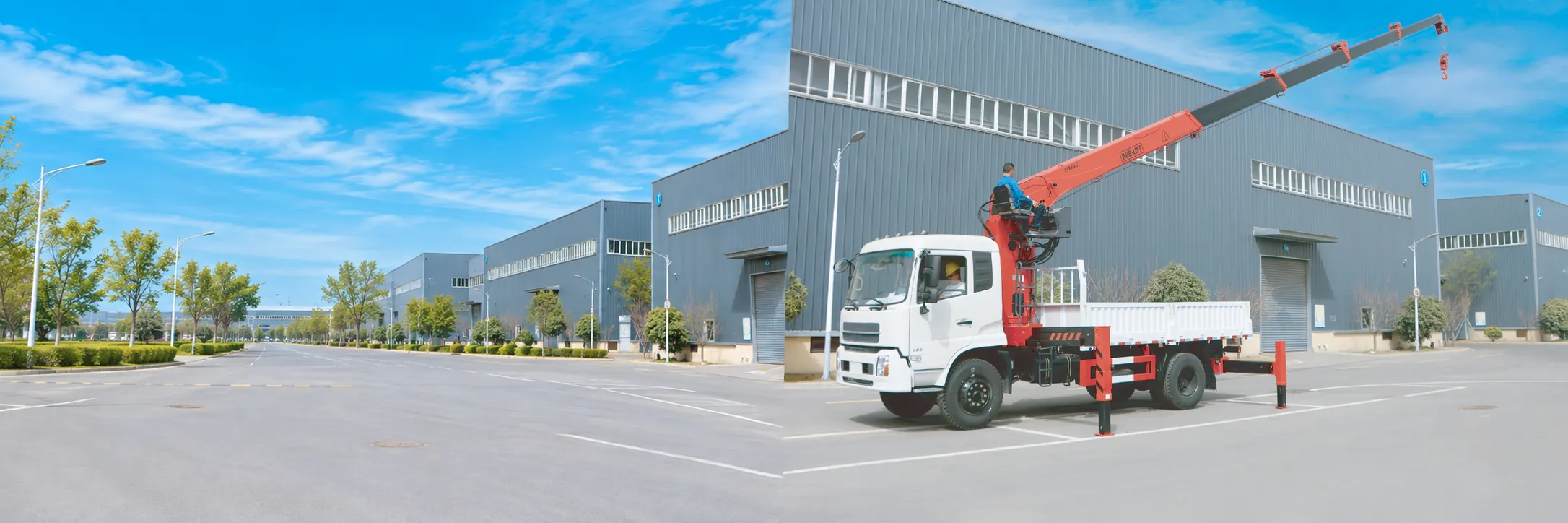
A crane outrigger is a beam that slides out sideways from the crane base or the truck subframe, with a vertical hydraulic leg and a foot at its end. When the legs are lowered, they take the weight of the crane, the truck and the load, and the tyres and suspension stop carrying the lift. This matters for two reasons.
First, stability. A loaded crane tips about a line between the outrigger feet on the side where the load is. The further that line is from the slewing centre, the larger the moment the crane can resist before it tips. Extending the outriggers moves the tipping line outward. Second, a rigid base. Tyres and leaf springs compress unevenly as the load swings, which lets the crane lean and the load radius grow. Outriggers set on firm ground hold the crane level and still through the lift.
That is why the rated loads on a truck crane load chart are given for a defined outrigger set-up: extended as the chart states, on firm ground, with the crane level. If you have not read a load chart before, our guide on how to read a crane load chart explains radius, boom configuration and the chart notes.

Outrigger span by crane size: figures from our drawings
Every BOB-LIFT dimension drawing gives the outrigger span as two numbers: the centre-to-centre distance between the feet when the beams are retracted, and when they are fully extended. The table lists twelve current models. The retracted figure is what the truck carries on the road; the extended figure is the width of ground you must have free and firm on site.
| Model | Boom type | Rated capacity | Crane weight | Outrigger span, retracted–extended | Extended ÷ retracted |
|---|---|---|---|---|---|
| SQ2ZA4 | Knuckle | 2,000 kg | 750 kg | 1,842–3,500 mm | 1.9× |
| SQ5ZA3 | Knuckle | 5,000 kg | 2,286 kg | 2,272–5,122 mm | 2.3× |
| SQ10ZA6 | Knuckle | 10,000 kg | 3,700 kg | 2,310–5,610 mm | 2.4× |
| SQ12ZA6 | Knuckle | 12,000 kg | 4,800 kg | 2,316–5,706 mm | 2.5× |
| SQZ430 | Knuckle | 20,000 kg | 5,500 kg | 2,300–6,600 mm | 2.9× |
| SQZ500 | Knuckle | 25,000 kg | 6,300 kg | 2,300–7,400 mm | 3.2× |
| SQZ1000 | Knuckle | 50,000 kg | 10,000 kg | 2,250–8,600 mm | 3.8× |
| SQ2SA3 | Telescopic | 2,000 kg | 950 kg | 1,720–3,120 mm | 1.8× |
| SQ5SA3 | Telescopic | 5,000 kg | 2,100 kg | 2,260–5,100 mm | 2.3× |
| SQ10SA4 | Telescopic | 10,000 kg | 3,800 kg | 2,290–5,990 mm | 2.6× |
| SQ12SA4 | Telescopic | 12,000 kg | 4,600 kg | 2,300–7,500 mm | 3.3× |
| SQ20SA5 | Telescopic | 20,000 kg | 7,300 kg | 2,450–8,050 mm | 3.3× |

Three things stand out in these figures:
- Retracted spans are almost the same. From 5 t to 50 t, every model retracts to between 2,250 and 2,450 mm, because the outriggers have to stow within the width of the truck. Only the 2 t cranes, built for light trucks, are narrower.
- The extended span is what grows with size. Our 50 t SQZ1000 spreads its feet 8.6 m apart, 3.8 times its retracted span. The 2 t SQ2ZA4 spreads 3.5 m.
- Span does not follow tonnage exactly. The 12 t SQ12ZA6 knuckle boom extends to 5.7 m, while the 12 t SQ12SA4 telescopic extends to 7.5 m, because the telescopic crane’s longer boom puts the load further out. Compare the drawing, not the class.
For a site survey, add the width of the outrigger pads to the extended span, plus clearance to walk around them. A 25 t crane such as our SQZ500 needs a strip of firm ground roughly 8 m wide across the truck. Our boom truck sizes guide lists the span of every current telescopic model alongside its reach and weight.
Why the full outrigger span matters for stability
The distance from the slewing centre to the tipping line is roughly half the outrigger span when the crane lifts over the side. On the SQZ1000, extending the outriggers from 2,250 mm to 8,600 mm moves that line from about 1.1 m to about 4.3 m out, nearly four times the lever arm. The weight of the truck and crane acts at that lever arm to hold the crane down. Cut the span and the crane’s resistance to tipping falls with it.
On a tight street it is tempting to extend the outriggers only partway. Treat the standard load chart as valid only for the outrigger set-up it states. If your site cannot take the full span, ask for the crane’s reduced-span rating, if it has one, before the lift; never estimate it. Lifting over the front or the rear of the truck is also different from lifting over the side, because the tipping line and the support from the chassis change. The operator’s manual and load chart for your crane say which areas are rated.
Ground bearing pressure: will the ground hold the outrigger?
Ground bearing pressure is the force an outrigger foot or pad applies to the ground divided by the area it rests on, usually quoted in kilopascals (kPa) or tonnes per square metre. The ground can carry only so much pressure before it sinks or shears. If the pressure under a foot exceeds what the ground can take, the foot punches in, the crane leans, the radius grows and the crane can overturn.
The force on one outrigger is not fixed. It changes as the boom slews: the outrigger nearest the load can carry far more than its share of the total weight, and the one opposite can go light. The figure you need is the maximum force on a single outrigger for your crane, truck and heaviest lift. Ask your crane supplier or a lifting engineer for it; for a mobile crane it is often provided as an outrigger load figure or calculated by the lift planner.
What the ground can carry depends on what it is. The values below are the presumed allowable bearing values from the British foundation code BS 8004 (1986), widely used for preliminary checks [1]. They assume undisturbed natural ground and are for screening only. Made ground, fill, backfilled trenches and ground softened by rain can be much weaker.
| Ground type | Presumed allowable bearing value |
|---|---|
| Dense gravel, or dense sand and gravel | more than 600 kPa |
| Medium dense gravel, or medium dense sand and gravel | 200–600 kPa |
| Loose gravel, or loose sand and gravel | less than 200 kPa |
| Compact sand | more than 300 kPa |
| Medium dense sand | 100–300 kPa |
| Very stiff boulder clays and hard clays | 300–600 kPa |
| Stiff clays | 150–300 kPa |
| Firm clays | 75–150 kPa |
| Soft clays and silts | less than 75 kPa |
Paved surfaces need the same caution. A concrete slab can spread load well, but only if it is thick enough and not sitting over a void, a drain or a culvert. Kerbs, manhole covers and the edges of trenches are weak points; keep the feet and pads clear of them.
How to size outrigger pads: a worked example
The method is one line of arithmetic. Pad area needed = maximum outrigger force ÷ allowable bearing pressure of the ground. Then choose a pad at least that large, and stiff enough to spread the force over its whole area.
Take an example outrigger force of 12 t, about 118 kN. This is an illustrative figure, not the rating of any particular crane.
- Foot alone. A round foot 300 mm across has an area of 0.07 m². Pressure = 118 ÷ 0.07 ≈ 1,670 kPa. That is more than even dense gravel is presumed to carry.
- On a 1.0 × 1.0 m pad. Area 1.0 m², pressure ≈ 118 kPa. Acceptable on stiff clay (150–300 kPa) or medium dense gravel. On firm clay (75–150 kPa) it is acceptable only where the clay is at the firm end, with little margin.
- On soft clay, taken at 75 kPa. Area needed = 118 ÷ 75 ≈ 1.6 m², so a pad of at least 1.3 × 1.3 m (1.69 m², about 70 kPa). Softer clay needs more. On ground this weak, get a competent person to assess it, or bring in crane mats or a prepared platform.
A pad only spreads the force if it is stiff enough. A thin plastic pad on soft ground bends, and most of the force stays under the foot. Use pads rated by their maker for the force involved, centre the foot on the pad, and lay the pad flat on levelled ground rather than on a mound or loose packing. Timber cribbing, steel plates or crane mats can build a larger bearing area when one pad is not enough.
For many sites this simple check is enough to show whether the ground is clearly fine or clearly not. When the answer is close, or the ground is unknown, involve a geotechnical or temporary-works engineer. The UK Construction Plant-hire Association published its free guide Ground Conditions for Construction Plant with a simplified outrigger-mat calculator for exactly this purpose. Its stated aim is to help site staff decide when they need to consult an expert [2].
Outrigger set-up checklist before every lift
- Plan the position. Park so the heaviest lift is at the shortest radius and inside the rated area of the load chart. Check overhead power lines before the boom moves.
- Check the ground. Look for soft or wet ground, fill, slopes, recent excavations, basements, drains, culverts and buried services. Ask whoever controls the site what is under the surface.
- Set the pads. Place pads of the size you calculated, flat and centred under each foot, clear of trench edges and covers.
- Extend fully. Extend the outrigger beams to the span the load chart requires. Lock them if your crane has beam locks.
- Lower and level. Lower the legs until the feet bear on the pads and the crane is level within the tolerance in its manual. Do not lift the truck so high that the tyres lose all contact unless the manual says to.
- Re-check during the job. After rain or a long lift, look for pads sinking or tilting and for the crane going off level. Stop and re-set if they do.
Rules in many countries make this a duty, not a choice. The US construction-crane rule, 29 CFR 1926.1402, requires the ground to be firm, drained and graded enough that, with supporting materials if needed, the crane maker’s specifications for support and level are met. It also requires the controlling entity to tell the crane operator about known hazards beneath the set-up area, such as voids, tanks and utilities [3]. In Great Britain, lifting operations under the LOLER regulations must be properly planned by a competent person, and that plan covers where the crane stands [4]. Outriggers themselves are part of the regular crane inspection; our truck mounted crane inspection checklist covers the beams, legs, check valves and feet.
Common outrigger mistakes
- Short-jacking: extending one side only, or partway, to fit a narrow street, then lifting as if fully extended.
- Foot on the bare ground: no pad, or a pad too small for the ground, so the foot sinks slowly during the lift.
- Pads on packing: a stack of loose blocks or a mound of soil under the pad, which can shift or collapse.
- Ignoring what is underneath: a pad over a drain, cellar, septic tank or freshly backfilled trench.
- Not watching for creep: a leg that slowly retracts because of a leaking check valve or cylinder seal. A leg that will not hold is a reason to stop and repair before lifting.
Frequently asked questions
Do truck cranes need outriggers?
Yes, for rated lifting. Tyres and suspension cannot hold a crane level and stable under a swinging load. Even the 2 t cranes in our range have outriggers that extend to 3.1–3.5 m.
How wide do truck crane outriggers spread?
On our drawings, from about 3.1 m on a 2 t telescopic crane to 8.6 m on our 50 t knuckle boom. Retracted, most models measure about 2.3 m, close to the truck’s width.
What size outrigger pads do I need?
Divide the maximum outrigger force by the allowable bearing pressure of the ground. For example, a 118 kN force on soft clay taken at 75 kPa needs at least 1.6 m² of stiff pad, about 1.3 × 1.3 m.
Can I lift with the outriggers partly extended?
Only if the crane has a load chart for that reduced span. The standard chart assumes the stated outrigger set-up; partial extension reduces stability, especially over the side.
Should the truck wheels leave the ground?
Follow the crane’s operating manual. Some set-ups call for the tyres to stay lightly in contact, others for the axle to be raised. What always matters is that the outriggers, not the tyres, carry the lift and the crane is level.
How we compiled this guide
The outrigger spans, rated capacities and crane weights come from the BOB-LIFT technical-department dimension drawings of the twelve models listed, compiled in October 2026. The bearing values are from BS 8004:1986 as cited, and the pad calculation uses an illustrative force rather than a rated figure. The photo shows a real crane base at our factory in Xuzhou. Reviewed by Achord Chan, Product Operations Director, in October 2026. Specifications can change without notice, so ask for the current drawing before you plan a lift or an order.
Plan the right crane for your site
If your sites are narrow, the outrigger span can decide the crane as much as the tonnage does. Tell us your truck, your heaviest loads, the reach you need and the space you have to set up. We will suggest models from our knuckle boom truck cranes and telescopic boom truck cranes, with the dimension drawing and load chart for each. Contact us to start.