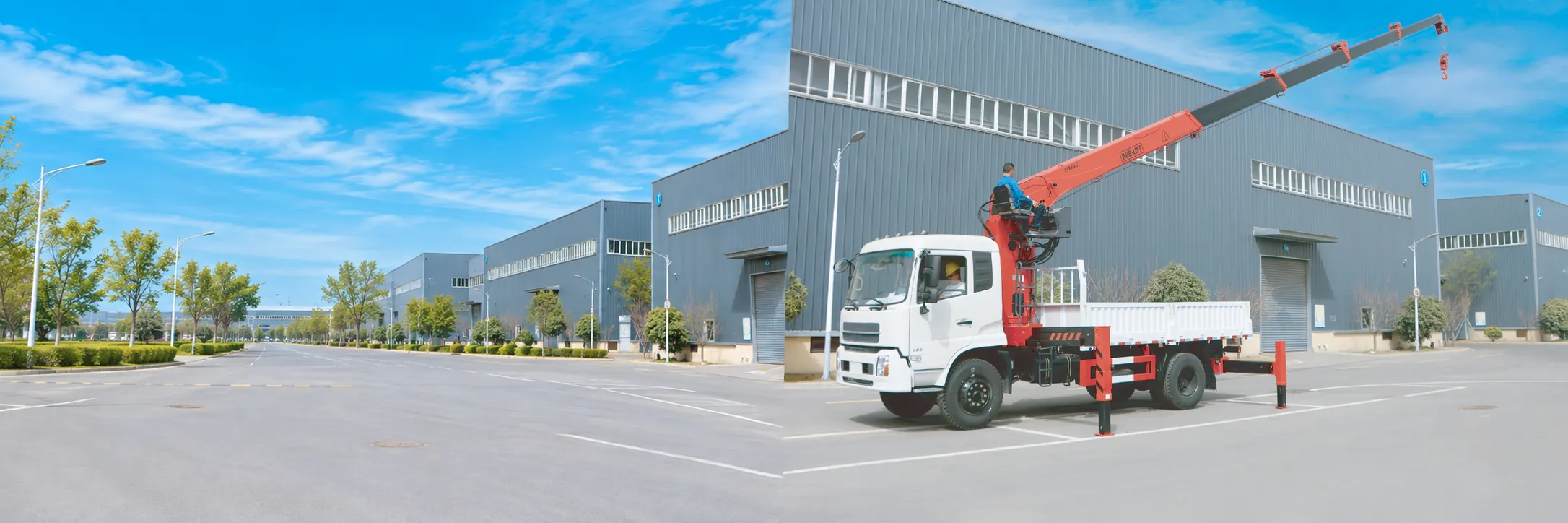

A truss crane is a truck mounted crane, usually a knuckle boom, that lifts roof trusses off the delivery truck or the ground and sets them on the wall plates of a building. To choose one, you need three figures: the radius from the crane’s slewing centre to the furthest truss, the hook height that clears the walls with the rigging attached, and the weight of the heaviest lift. Then check all three against the crane’s load chart and range diagram.
BOB-LIFT has built truck mounted cranes in Xuzhou since 2003, and we supply the crane only: the truck, spreader bars, slings and taglines come separately. This guide explains how trusses are rigged under the truss industry’s own handling guidance, and how to calculate the reach and hook height a particular roof requires. It then compares three of our 8 to 12 tonne knuckle boom cranes at typical house radii and summarises the US regulations that apply once a crane starts setting trusses.
Key takeaways
- Size a crane for trusses at the longest radius on the job, which is usually the gable-end truss, not the truss straight in front of the truck.
- Hook height is the wall plate height plus clearance, the height of the pick points on the truss and the drop of the spreader bar and slings below the hook.
- The truss industry’s BCSI guide says not to lift a single truss by the peak or the webs, to use a spreader bar for trusses over 30 ft, and never to lift a bundle by its banding.
- At their first chart points beyond 10 m radius, our SQ8ZA6, SQ10ZA6 and SQ12ZA6 knuckle boom cranes are rated 1,420 kg, 1,800 kg and 1,850 kg, and their boom tips reach about 16.5 to 17 m above the crane base.
- Setting roof trusses is not a “material delivery” under US rules, so the full crane standard applies, including the fall zone rules.
What is a truss crane?
It is any crane used to lift and place trusses, and on house and light commercial roofs it is most often a knuckle boom crane mounted on the truss delivery truck or on a separate crane truck. A timber roof truss is a framework that bridges the space above a room and supports the roof. Its top members are the top chords, the bottom member is the bottom chord, and the members in between are the webs, as Wikipedia’s article on the timber roof truss describes. Factory-manufactured trusses usually arrive in banded bundles, so the crane has two separate jobs: unloading the bundles, and lifting each truss, or a braced group of trusses, onto the walls.
A knuckle boom suits this work because its jointed boom reaches over a wall, down to the wall plate, and folds behind the cab for travel, as our guide on what a knuckle boom crane is explains. A telescopic truck mounted crane with a winch can also set trusses, and we compare the two later in this guide.
What does the crane actually lift?
The crane lifts the trusses plus everything between them and the boom tip, including the spreader bar, slings, shackles and hook. Truss weight depends on span, pitch, timber dimensions and web configuration, so take it from the truss supplier rather than from a rule of thumb. The load weight must come “from a source recognized by the industry (such as the load’s manufacturer)” or from a recognised calculation method, as 29 CFR 1926.1417(o)(3)(i) requires. When the operator requests it, that information must be provided before the lift.
Three lifts are common on a roof job, and each has a different weight.
- A single truss on a spreader bar or two slings, the lightest lift but often the longest radius.
- A braced truss section assembled on the ground and lifted as one unit, heavier, and it also needs the bracing and any sheathing counted.
- A banded bundle lifted off the truck, the heaviest lift, usually landed close to the truck or on the ground.
A spreader bar is a rigid beam hung below the hook that holds the lifting lines apart, so a long truss can be picked up at several points along its top chord. Every item below the hook counts against the rated load, which our article on safe working load explains. Spreader bars and lifting beams are below-the-hook devices, and our guide to below-the-hook lifting devices covers their types and markings.
How do you rig a roof truss for a crane lift?
Follow the truss designer’s handling instructions first, and the truss industry’s general guidance wherever specific instructions are unavailable. That guide is BCSI (Building Component Safety Information), published by the Structural Building Components Association (SBCA). SBCA’s technical column on pick points for hoisting trusses sums up its rules: “Installers should not lift single trusses by the peak,” and lifting by the webs can cause lateral bending of the truss [1]. It adds that “lifting devices should be attached to the truss top chord using only closed-loop attachments”.
| Truss or bundle | What BCSI guidance says |
|---|---|
| Single truss up to 30 ft | “two pick-points near top chord joints”; “The line angle should be 60° or less.” [1] |
| Single truss over 30 ft and under 60 ft | Use a spreader bar “1/2 to 2/3 of the Truss Span” [2], with lines that slope inward (“toe-in”) to the truss [1] |
| Single truss 60 ft and over | Spreader bar “2/3 to 3/4 of the Truss Span” [2]; “Consult a Registered Design Professional for trusses longer than 60′ (18.3 m).” [2] |
| Bundles | One lift point is allowed for top chord pitch truss bundles up to 45 ft, at least two up to 60 ft and at least three over 60 ft; “NEVER use banding to lift a bundle.” [2] |
| Any lift | “Only one bundle should be lifted at a time.” [1] “DON’T overload the crane.” [2] |
The spreader bar is there because a long, slender truss bends sideways easily before any bracing is installed. SBCA’s column notes that “spreader bars can help add rigidity to a truss while it’s being hoisted, lessening the likelihood of lateral bending” [1]. Slings, hitches and sling angles are covered in our crane rigging and slings guide.
One US detail matters to truss crews, because hooks with self-closing latches or their equivalent must be used when workers hook, unhook or guide a load inside the fall zone, under 29 CFR 1926.1425(c)(2). The rule then makes one exception: “‘J’ hooks are permitted to be used for setting wooden trusses.” The same paragraph still requires the materials to be rigged by a qualified rigger and “to prevent unintentional displacement”.
How far does a truss crane need to reach?
The working radius is the horizontal distance from the slewing centre of the crane to the centre of the load. For a truss at its final position, it equals the setback from the slewing centre to the near wall plus half the truss span, which gives the radius for the truss directly opposite the truck. Trusses towards each gable end sit further along the building, so their radius is the hypotenuse of that straight-ahead radius and the distance along the wall, which normally makes the gable-end truss the longest lift on the job.

Park as close to the building as the ground and the outriggers allow, because every metre of setback is added to the radius of every truss. A position halfway along the long wall usually gives the shortest gable radius, while a corner position may suit a site with only one access point. Read the rated load at the actual radius using our guide on how to read a crane load chart, and if the radius falls between two chart points, use the point further out.
How high does the hook need to go?
Required hook height is the sum of five measurements, the first three being the wall plate above the ground, a clearance so the bottom chord passes over the plate, and the height of the pick points above the bottom chord. The other two are the drop from the hook to the pick points through the spreader bar and slings, and the hook block below the boom tip. Then subtract the height of the crane’s mounting base above the ground, because a knuckle boom range diagram measures height from that base, which sits on the truck frame.
The rigging drop is the measurement most often forgotten. For example, a spreader bar with vertical drops to the truss and two slings up to the hook can add several metres, so measure your own rigging rather than estimating it. If the boom tip cannot rise high enough at the gable radius, the solution is shorter rigging, a closer truck position or a crane with more reach, not a heavier crane.
Which BOB-LIFT knuckle boom cranes suit truss work?
For two-storey houses, our six-section 8 to 12 tonne knuckle boom cranes reach past 14 m and keep a useful rated load beyond 10 m. The SQ8ZA6 and SQ10ZA6 share the same reach, from 4,509 mm to 14,680 mm, although the SQ10ZA6 carries more at every radius. The table below lists the figures from each crane’s dimension drawing and load chart that matter most for truss work.
| Figure from the drawing | SQ8ZA6 | SQ10ZA6 | SQ12ZA6 |
|---|---|---|---|
| Maximum lifting capacity / moment | 8,000 kg / 16 t·m | 10,000 kg / 21 t·m | 12,000 kg / 27 t·m |
| Rated load, radius near 8,500 mm | 1,820 kg at 8,510 mm | 2,280 kg at 8,510 mm | 2,500 kg at 8,190 mm |
| Rated load, radius near 10,500 mm | 1,420 kg at 10,560 mm | 1,800 kg at 10,560 mm | 1,850 kg at 10,100 mm |
| Rated load, radius near 12,500 mm | 1,160 kg at 12,630 mm | 1,480 kg at 12,630 mm | 1,400 kg at 12,200 mm |
| Maximum radius, rated load | 14,680 mm, 850 kg | 14,680 mm, 1,150 kg | 14,500 mm, 1,000 kg |
| Boom tip at its steepest, above crane base (read from range diagram) | about 17 m | about 17 m | about 16.5 m |
| Outrigger span | 2,310–5,610 mm | 2,310–5,610 mm | 2,316–5,706 mm |
| Self weight | 3,450 kg | 3,700 kg | 4,800 kg |

Chart spacing has one important effect: the SQ12ZA6 has more capacity close to the crane, but its chart points sit at 10,100 and 12,200 mm. At a radius of 10,400 mm you must therefore read 1,400 kg from the 12,200 mm point. At the same radius the SQ10ZA6 reads 1,800 kg from its next point, so always compare cranes at your own working radius rather than at their headline tonnage.

You can see each crane’s full drawing and load chart on its product page: the SQ8ZA6, the SQ10ZA6 and the SQ12ZA6. Every BOB-LIFT crane is listed with a load moment limiter, as our article on the lifting moment of a crane explains, but the limiter is a backstop, not a way to find out what a truss bundle weighs.
Example: sizing a crane for a two-storey roof
Example scenario (an illustration, not a customer record): a framer sets trusses on a house 12 m long and 10 m deep, with the wall plates 5,600 mm above the ground. The truss span of 10 m is about 33 ft, which is over 30 ft, so BCSI calls for a spreader bar of 1/2 to 2/3 of the span and the crew uses a 6 m bar. All weights and site dimensions below are ASSUMED for the example, not data for any real truss, spreader bar or building site.
- Radius: the truck parks halfway along the long wall, with its slewing centre an assumed 3,500 mm from the wall. The middle truss is then at 3,500 + 5,000 = 8,500 mm, and the gable-end truss, 6,000 mm along the wall, is at √(8,500² + 6,000²) ≈ 10,400 mm.
- Single truss: an assumed 140 kg truss, plus an assumed 180 kg spreader bar and 20 kg of slings and shackles, makes 340 kg.
- Braced section: four trusses assembled on the ground with an assumed 250 kg of bracing and sheathing, plus the bar and slings, make 1,010 kg.
- Bundle: ten trusses at the assumed 140 kg each, plus 20 kg of slings, make 1,420 kg.
- Hook height: 5,600 mm wall plate + 500 mm clearance + 1,000 mm to the pick points + 2,500 mm rigging drop + 600 mm hook block = 10,200 mm above the ground. With the crane base an assumed 1,300 mm above the ground, the boom tip must be about 8,900 mm above the crane base at the gable radius.
The single truss is comfortably within the capacity of all three cranes, since even the SQ8ZA6 is rated 850 kg at its full reach of 14,680 mm. The braced section at the gable radius also passes on all three, because the SQ8ZA6 reads 1,420 kg, the SQ10ZA6 1,800 kg and the SQ12ZA6 1,400 kg at their next chart points beyond that radius. The height check passes as well, since on the range diagrams all three boom tips can still rise more than 11 m above the crane base at radii just beyond 10 m, roughly 2 m more than the example needs.
The bundle determines the choice, because at the middle position all three cranes pass, with 400 kg to spare even on the SQ8ZA6. At the gable position, however, the SQ8ZA6’s 1,420 kg leaves no margin at all and the SQ12ZA6’s 1,400 kg is 20 kg short, while the SQ10ZA6 still has 380 kg spare. A crew that lands bundles near the middle can therefore use the SQ8ZA6, whereas one that wants to land bundles anywhere on the roof requires the SQ10ZA6. Whether the walls can carry a bundle at all is a question for the building designer, because BCSI warns: “Do not over load supporting structure with truss bundle.”
Need more height? Manual extensions and fly jibs
A manual extension adds one more boom section, which the operator pins out by hand for long or high lifts. On the SQ8ZA6+1, the load chart adds a point of 650 kg at 16,800 mm. Its range diagram shows the boom tip about 19 m above the crane base at its steepest, compared with about 17 m for the SQ8ZA6. All other chart points are identical to the SQ8ZA6, so the extension suits single trusses on taller buildings rather than heavy sections at long reach.
The SQ8ZA6+1 product page carries the full chart, whereas a fly jib is a separate jib fitted to the boom tip, with its own load chart, as our article on what a fly jib is explains.
Knuckle boom or telescopic crane for setting trusses?
A knuckle boom places the load with the boom tip close above the wall, which gives fine control and folds into a short package behind the cab. A telescopic truck mounted crane lifts on its winch rope, which can give more hook height for tall buildings but lets the load swing more on a long line. Our knuckle boom vs telescopic boom comparison looks at five real pairs side by side.
How do you set trusses safely with a crane?
Treat truss setting as a full crane operation, because the US crane standard does. It lists “roof trusses (wooden, cold-formed metal, steel, or other material)” as prefabricated components, so the knuckle boom delivery exclusion, which our drywall delivery crane guide explains, does not apply to them under paragraph (c)(17)(iii)(B) of 29 CFR 1926.1400.
- Plan the lift: agree the truck position, the lift order from the first braced truss outwards, the radius and weight of the heaviest lift, and who signals, using the template in our crane lift plan guide.
- Ground and outriggers: new building sites often have backfilled trenches near the walls, so check the ground under each outrigger with our guide to outriggers and ground bearing pressure, and use pads or crane mats where needed.
- Fall zone: nobody may be in the fall zone except workers “engaged in hooking, unhooking or guiding a load” or in its initial attachment to a component or structure, under 29 CFR 1926.1425(b). Paragraph (d) then allows only the workers “needed to receive a load” there while the load is landed.
- Taglines: control a truss from the ground with a tagline instead of with hands on the load, keeping clear of the swing path of the truck mounted crane.
- Hold until restrained: BCSI says to “hold each truss in position with the erection equipment until top chord temporary lateral restraint is installed” and to “brace first truss securely before erection of additional trusses” [2].
- Wind: a truss or a sheathed section catches wind like a sail, and BCSI warns to “use special care in windy weather or near power lines and airports”. The competent person must also adjust operations for “the effect of wind” under 29 CFR 1926.1417(n). Our page on crane wind speed limits shows how to set a stop limit before the job.
- Power lines: house sites often have a service drop or street line next to the roof, so follow our crane power line safety guide for clearances.
Bracing the trusses and protecting the crew on the walls is the framer’s responsibility, not the crane’s. OSHA’s fact sheet on reducing falls while installing roof trusses notes that “trusses are not stable until they are properly restrained and braced”. It also states that “OSHA requires fall protection measures for residential construction activities 6 feet or more above lower levels” [3]. In addition, it points out that “many builders find it efficient to pre-assemble truss sections on the ground and then lift them with a crane”, which reduces work at height but makes each lift heavier.
For lifting braced assemblies, SBCA’s column on lifting truss assemblies says the top chord, bottom chord and webs “should be braced prior to lifting the trusses”, and to “always consult a Professional Engineer when setting an assembly with long-span trusses”. A radio remote control helps here, because the operator can position themselves where the wall plate, the truss and the crew are all visible; our guide to truck crane remote control compares the options. Nobody rides on a truss or on the load.
How is the crane fitted to your truck?
We supply the crane and the truck comes separately, so if you buy the truck in China, we can fit the crane at our factory. If you buy the truck locally, we ship the crane only, a local body builder fits it, and we support the fitting remotely. Because a truss delivery truck also has to carry the bundles, the crane’s self weight, from 3,450 kg for the SQ8ZA6 to 4,800 kg for the SQ12ZA6, comes directly out of the truck’s payload. Our truck mounted crane installation guide covers the subframe and mounting work.
Frequently asked questions
What size crane do I need to set roof trusses?
Size it for the heaviest lift at the longest working radius, usually a bundle or braced section at the gable end. In our two-storey example, a 1,420 kg bundle landed at the gable end needed the SQ10ZA6, which is rated 1,800 kg at its next chart point, while single trusses were well within the chart of an 8 tonne crane.
Can a knuckle boom crane set trusses?
Yes. A knuckle boom reaches up and over the wall and places the truss with the boom tip close above the wall plate. Check that the boom tip can rise high enough at the gable radius with the spreader bar and slings hanging below the hook.
Do you need a spreader bar to lift trusses?
For single trusses over 30 ft, BCSI guidance calls for a spreader bar of 1/2 to 2/3 of the span, and 2/3 to 3/4 of the span at 60 ft and over. Trusses up to 30 ft can be lifted from two pick points near top chord joints, although the truss designer’s instructions always come first.
Can you use a J hook to set trusses?
Under US rules, yes for wooden trusses: the fall zone rule requires self-closing latch hooks when workers are in the fall zone, but it states that “J” hooks are permitted for setting wooden trusses. The load must still be rigged by a qualified rigger.
Can the truss delivery truck set the trusses too?
It can if its crane has the reach, hook height and rated load for the job. Under US rules, setting trusses falls under the full crane standard, so the operator, rigging and fall zone rules apply, even when the same truck delivered the load.
How we compiled this guide
The rigging guidance comes from SBCA’s BCSI booklet (2018 edition, updated May 2019) and two SBCA technical columns, read in November 2026. We took the rules from the official eCFR text of the crane standard in 29 CFR part 1926, subpart CC, and from OSHA fact sheet FS-3477 on installing roof trusses, while the truss terms come from Wikipedia. The crane figures come from the current BOB-LIFT dimension drawings and load charts, and the boom tip heights for the SQ8ZA6, SQ8ZA6+1, SQ10ZA6 and SQ12ZA6 are read from the grids of their range diagrams and rounded down. The example uses clearly marked assumed weights and dimensions, and Achord Chan, Product Operations Director, reviewed the guide before publication. It does not replace the truss designer’s instructions, the crane’s operator’s manual or the rules where you work.
Need a crane for setting roof trusses?
Tell us your typical building width and wall height, how far from the wall the truck can park, your heaviest bundle or braced section, and the truck you will mount the crane on. We will recommend a knuckle boom truck mounted crane and send its dimension drawing and load chart, so you can check the gable-end radius yourself. Contact us for a quotation and a load chart check; every crane carries a 12-month warranty on the whole machine.