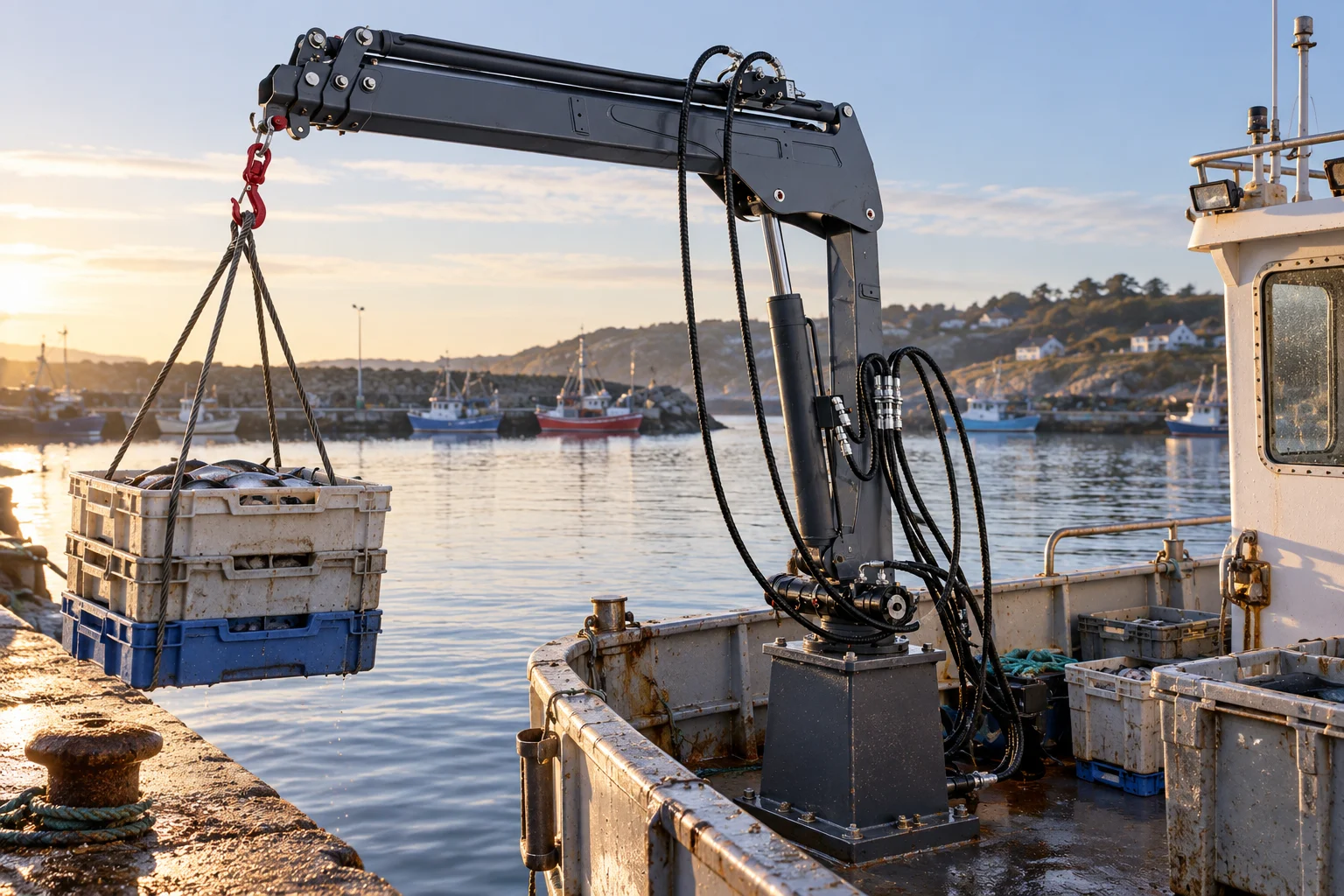
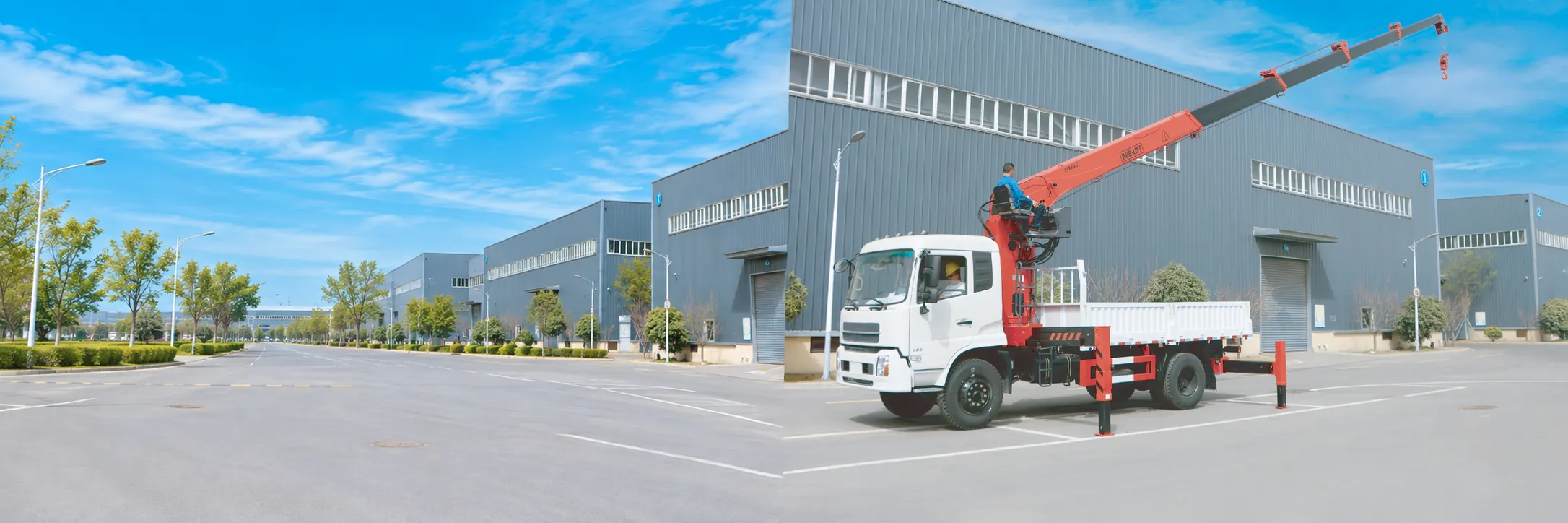
A knuckle boom crane is a hydraulic crane whose boom is made of two or more sections joined by a hinge, the “knuckle”, so it can fold and unfold like a finger. Most are mounted on a truck just behind the cab, where they fold into a compact package for driving and unfold to load and unload the truck and deliver goods over walls, fences and onto roofs.
This guide explains what a knuckle boom crane is, the parts it is made of, how its hydraulics work, what it is used for, and its advantages and disadvantages. The figures come from the technical drawings of our own knuckle boom truck mounted cranes, seven models from 2 t to 50 t, compiled in October 2026.
Key takeaways
- A knuckle boom crane is also called an articulating crane, a loader crane or a folding boom crane. On a truck it is often called a knuckle boom truck.
- It has a column that slews on a base, an inner boom, an outer boom joined to it by the knuckle, telescopic extensions, and outriggers, all moved by hydraulic cylinders.
- The truck’s engine drives the crane’s hydraulic pump. On the seven cranes in this guide the system works at 20 to 35 MPa, with 20 to 100 L/min of oil flow depending on size.
- Its main advantage is size when folded: our 10 t crane folds to a block 2,460 mm wide across the chassis, 2,340 mm high and only 1,199 mm deep, yet reaches 14.68 m.
- Its main trade-off is that capacity falls with reach, so size it by the load chart, not the rating.
What is a knuckle boom crane?
A knuckle boom crane is a crane with a jointed, folding boom driven by hydraulic cylinders. The boom does not just extend in a straight line: the outer section pivots on the inner one at the knuckle joint, so the operator can bend the boom to reach over an obstacle and down on the other side, or fold it tight against the column for transport. The knuckle boom itself is the jointed arm: an inner boom pinned to the column and an outer boom hinged to it at the knuckle, usually with telescopic extensions inside.
The same machine goes by several names. “Articulating crane” and “folding boom crane” describe the jointed boom. “Loader crane” describes its usual job, loading and unloading the truck it is mounted on. A truck fitted with one is often called a knuckle boom truck. In each case it is the same type of crane. In Europe, loader cranes are covered by the standard EN 12999; in the US, ASME B30.22 covers articulating boom cranes.
Most knuckle boom cranes are mounted on trucks, between the cab and the load bed. They are also fitted on ships, workboats and docks, and as fixed cranes in yards. This guide focuses on the truck mounted type.

What are the parts of a knuckle boom crane?
The drawing below is the side view of our 10 t SQ10ZA6 from its technical drawing, with the boom unfolded and the main parts numbered.

- Outrigger legs. Hydraulic legs that lower to the ground to carry the lifting load and keep the truck stable.
- Base and outrigger beams. The base bolts to the truck chassis. The outrigger beams slide out sideways to widen the support; on the SQ10ZA6 the overall width across the outriggers goes from 2,499 mm to 5,799 mm.
- Control levers. The valve levers that the operator uses to move each function. Many cranes have levers on both sides, and many can also be fitted with radio remote control.
- Slewing unit. The gear drive that turns the column, and with it the whole boom, around the base.
- Column. The upright member that carries the boom and slews on the base.
- Inner boom cylinder. The hydraulic cylinder that raises and lowers the inner boom.
- Inner boom. The first boom section, pinned to the top of the column.
- Outer boom cylinder. The cylinder that folds and unfolds the outer boom at the knuckle.
- Knuckle joint. The hinge and linkage between the inner and outer booms that gives the crane its name.
- Outer boom. The second boom section, which houses the telescopic extensions.
- Extension sections. Telescopic sections driven by cylinders inside the outer boom to add reach. The SQ10ZA6 reaches from 4,509 mm with the extensions in to 14,680 mm with them all out.
- Hook. Where the load is attached. Many cranes can also take a winch, grab, fork or basket.
How does a knuckle boom crane work?
A knuckle boom crane works by hydraulics. The truck’s engine drives a hydraulic pump, usually through a power take-off (PTO) on the gearbox. The pump draws oil from the crane’s tank and sends it to the control valve. When the operator moves a lever, the valve sends oil to the matching cylinder or motor: one for each boom, one for the extensions, one for slewing and one for each outrigger.
A cylinder pushes with the oil pressure acting on its piston, so the system pressure sets how much force the crane can produce, and the oil flow sets how fast it moves. That is why every crane drawing lists the hydraulic flow, pressure and the power it needs from the truck. These are the figures for seven of our cranes:
| Model | Rated capacity | Hydraulic flow | Hydraulic pressure | Recommended power | Slewing |
|---|---|---|---|---|---|
| SQ2ZA4 | 2,000 kg | 20 L/min | 20 MPa | 9 kW | 370° |
| SQ5ZA3 | 5,000 kg | 35 L/min | 28 MPa | 22 kW | 400° |
| SQ10ZA6 | 10,000 kg | 40 L/min | 30 MPa | 30 kW | 360° |
| SQ12ZA6 | 12,000 kg | 55 L/min | 28 MPa | 30 kW | 360° |
| SQZ430 | 20,000 kg | 63 L/min | 33 MPa | 45 kW | 360° |
| SQZ560 | 28,000 kg | 80 L/min | 35 MPa | 65 kW | 360° |
| SQZ1000 | 50,000 kg | 100 L/min | 35 MPa | 75 kW | 360° |
The truck must be able to supply that power through its PTO, which is one reason a crane is matched to a chassis before it is fitted. Our truck mounted crane installation guide covers the PTO, the subframe and the space the crane needs behind the cab.
Before lifting, the operator extends and lowers the outriggers so they, not the truck’s tyres and springs, carry the load. The crane then lifts within its load chart, which sets the safe load at each reach. Read our guide on how to read a crane load chart for a worked example.
Knuckle boom cranes typically use two hydraulic safeguards. A main relief valve caps the system pressure, which limits the force the cylinders can produce. Load-holding valves on the boom cylinders stop the boom from dropping if a hose fails or the engine stops. Neither replaces working within the load chart. In Great Britain, lifting operations and thorough examination of cranes also fall under the LOLER regulations.
What is a knuckle boom crane used for?
A knuckle boom crane is used wherever a truck has to load or deliver its own cargo without a separate crane or forklift on site. Typical jobs include:
- Building materials delivery: bricks, blocks, roof tiles, cement and timber on pallets, set down over a fence or onto a scaffold.
- Steel and precast concrete: rebar bundles, beams, pipes, kerbs and small precast units.
- Equipment and containers: generators, compressors, small machines, tanks and site cabins.
- Stone and landscaping: stone slabs, blocks and bulk bags.
- Utilities and municipal work: poles, cable drums, manhole parts and road furniture.
- Marine work: on ships, workboats and docks, where the folded crane takes little deck space.
What are the advantages and disadvantages of a knuckle boom crane?
The jointed boom brings clear benefits and a few trade-offs.
Advantages
- Compact when folded. Our 10 t SQ10ZA6 folds to 2,460 mm wide across the chassis, 2,340 mm high and only 1,199 mm deep, yet reaches 14.68 m. Even our 50 t SQZ1000 folds to 2,550 mm wide, 2,450 mm high and 1,650 mm deep.
- Clear deck. The folded boom stands behind the cab instead of lying over the load bed, so the deck stays free for loading from above. The base still takes frame length behind the cab: the drawings list 680 mm for our 2 t, 1,050 mm for our 5 t, 1,400 mm for our 12 t and 1,900 mm for our 50 t, so check it against your body length.
- Reach over obstacles. The knuckle lets the boom go up and over a wall or fence and down on the other side, and place loads precisely.
- Flexible working range. The boom can work close to the truck, at height or below ground level, and many cranes slew past a full turn: 370° on our 2 t and 400° on our 5 t.
- Attachments. Grabs, forks, winches and baskets let one crane do several jobs.
Disadvantages
- Capacity falls with reach. The rating applies only close to the column. Our 10 t crane lifts 10,000 kg at 2.0 m but 1,150 kg at its full 14.68 m. See how much a knuckle boom crane can lift for every size.
- More parts to maintain. More joints, pins, cylinders and hoses than a straight boom means more points to grease and inspect.
- Weight on the truck. The crane uses payload: from 750 kg for our 2 t to 10,000 kg for our 50 t, plus the subframe.
- Operator skill. Moving several boom functions together smoothly takes training and practice.
Knuckle boom crane vs telescopic boom crane
A telescopic boom crane, or stiff boom crane, has a straight boom that extends in sections and is usually stowed lying along the truck body. A knuckle boom crane folds upright behind the cab and bends at the knuckle. Neither is better for every job: the knuckle boom suits deliveries over obstacles and keeps the deck clear when stowed, while the telescopic boom gives a simple, straight reach. We compared five pairs of our own cranes at the same tonnage in knuckle boom vs telescopic boom truck crane.
What sizes do knuckle boom cranes come in?
Our knuckle boom truck cranes are rated from 1.6 t to 50 t; the seven in this guide run from 2 t to 50 t. Small models such as our 2 t SQ2ZA4, which weighs 750 kg, suit light trucks. The largest, the SQZ1000, weighs 10,000 kg, is rated at 50,000 kg and 90 t·m, and reaches 20.3 m, so it needs a heavy multi-axle truck. For the full range, see our knuckle boom truck mounted cranes, and for capacity, reach and weight by tonnage, our guide to boom truck sizes.
Frequently asked questions
What is a knuckle boom truck?
A knuckle boom truck is a flatbed or dropside truck with a knuckle boom crane mounted between the cab and the load bed. It loads and unloads its own cargo, so no forklift or separate crane is needed on site. The crane is powered by the truck’s engine through a power take-off.
What is a knuckle boom?
A knuckle boom is a crane boom made of two main sections joined by a hinge, the knuckle. The inner boom is pinned to the column; the outer boom folds at the knuckle and usually carries telescopic extensions, so the arm can bend over obstacles and fold compactly for transport.
Why is it called a knuckle boom crane?
Because its boom bends at a hinge between the inner and outer sections, like the knuckle of a finger. The joint lets the boom fold compactly and reach over obstacles.
Is a knuckle boom crane the same as a loader crane?
Yes. Loader crane, articulating crane, folding boom crane and knuckle boom crane are names for the same type of hydraulic crane with a jointed boom.
Does a knuckle boom crane need its own engine?
On a truck, usually not. The truck’s engine drives the crane’s hydraulic pump through a power take-off. The seven cranes in the table above need from 9 kW for the 2 t SQ2ZA4 to 75 kW for the 50 t SQZ1000.
Can a knuckle boom crane rotate 360 degrees?
All seven of our models in this guide slew at least 360°. On the drawings the slewing angle is 370° for the 2 t SQ2ZA4, 400° for the 5 t SQ5ZA3 and 360° for our 10 t to 50 t models.
How far can a knuckle boom crane reach?
It depends on size and the number of extensions. On our drawings the horizontal reach is 8.05 m for the 5 t SQ5ZA3, 14.68 m for the 10 t SQ10ZA6, 16.6 m for the 20 t SQZ430 and 20.3 m for the 50 t SQZ1000. The load at full reach is far below the rating, so check the load chart.
Can a knuckle boom crane be fitted to any truck?
Not to any truck. The chassis must carry the crane’s weight and its lifting moment, have room behind the cab and a PTO that can drive the pump. Check these against the crane’s drawing before ordering.
How we compiled this guide. Every figure comes from the BOB-LIFT technical-department dimension drawings and load charts for the SQ2ZA4, SQ5ZA3, SQ10ZA6, SQ12ZA6, SQZ430, SQZ560 and SQZ1000, compiled in October 2026. Specifications can change without notice, so ask us for the current drawing of any model before you order.
Find the right knuckle boom crane
Tell us your heaviest load, the reach you need and your truck, and we will suggest models from our range with the technical drawing and load chart for each. Contact us to start.