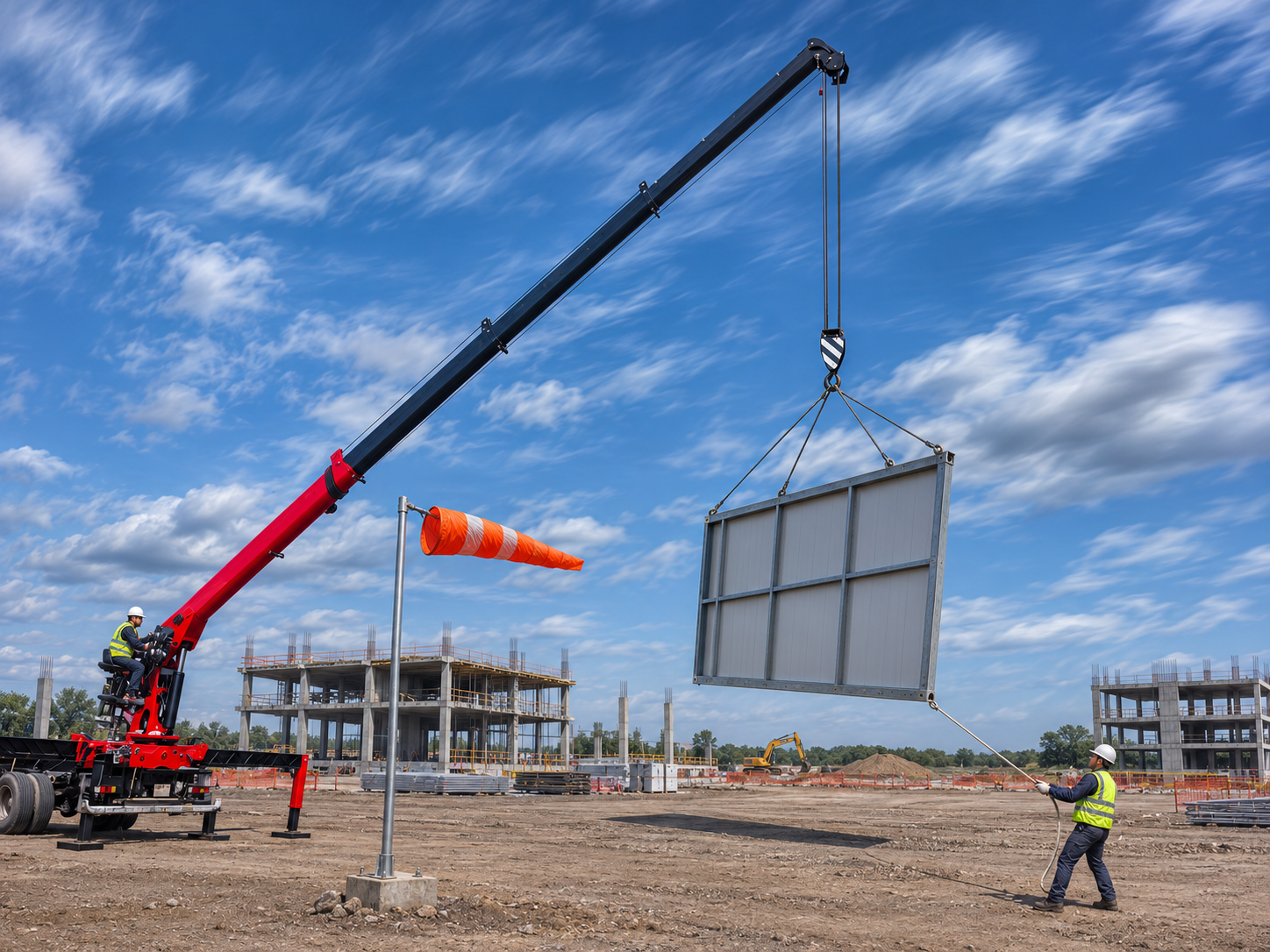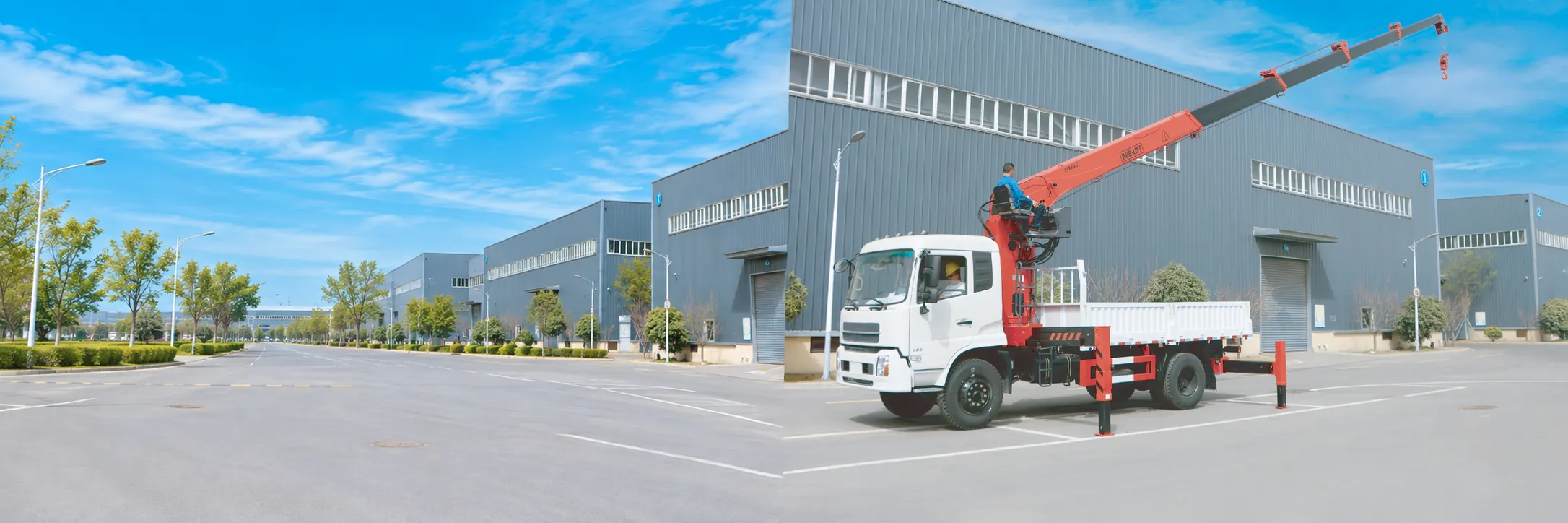

To lift a boat with a crane, first calculate its real weight with engines, fuel, water and equipment on board. Then position two wide, soft slings under the hull at the manufacturer’s sling marks and hang them from a spreader bar, so they press on neither the gunwales nor the propeller, shaft or transducer. Confirm that the boat plus all the rigging fits the crane’s load chart at the radius where the boat meets the water, and make a short trial lift before the real one. Lifting a boat with a crane means hoisting a complete hull on the crane hook, for example from a trailer into the water or from a quay onto a truck deck.
We have manufactured truck mounted cranes in Xuzhou since 2003, and operators who launch and recover workboats, inflatable boats and small cruisers regularly ask us which crane they require. This guide explains the weight calculation, sling positions, the spreader bar, the centre of gravity, the radius to the water and a step-by-step sequence, and it compares knuckle boom and telescopic cranes for marina work.
Key takeaways
- A published boat weight is often a dry weight without engines, fuel, water, equipment or bilge water, so add each of these and the rigging before you select the crane.
- Position the slings at the manufacturer’s sling marks and keep them away from propellers, shafts, rudders, drive legs and transducers, which are invisible from above.
- Hang the slings from a spreader bar so they do not compress the hull, connect them together so they cannot slide, and protect the topsides with padding.
- The radius from the crane to the water usually decides the crane: a 1,700 kg load fails on a 6.3-tonne knuckle boom at 8.3 m but passes on our 12-tonne SQ12ZA5 at 8.2 m.
- Nobody remains on board, everyone stays out of the fall zone, and a trial lift of a few centimetres shows whether the boat hangs level.
Can a truck mounted crane lift a boat?
Yes, if the boat with everything on board and all the rigging fits inside the crane’s load chart at the radius to the water. That covers the typical jobs our customers describe, such as launching a workboat from a quay, recovering an inflatable boat onto a truck deck or moving a small cruiser between a boatyard and a slipway. A larger yacht is a different operation, because its weight and its distance from the quay edge both increase quickly.
Marinas and boatyards that lift boats every day usually operate dedicated equipment, such as travel lifts, boat hoists and fixed quayside cranes. A truck mounted crane suits owners and contractors who need to lift boats at different locations with one machine. BOB-LIFT manufactures and supplies the crane only, so the truck, the boat, the trailer, the slings and the spreader bar are all supplied separately.
How much does the boat really weigh?
Start from the weight that the boat manufacturer publishes, then add everything that it does not include. Many brochures and owner’s manuals quote a dry weight, and Wikipedia’s article on curb weight defines dry weight as the weight “without any consumables, passengers, or cargo”. The same article warns that “There is no standard for dry weight”, so ask the manufacturer or dealer exactly what the published figure includes.
Ships follow the same principle, and Wikipedia’s article on ship displacement defines light displacement as the weight “excluding cargo, fuel, water, ballast, stores, passengers, crew”. Loaded displacement includes all of them, and for a crane lift the loaded figure is the one that matters.
| What to add to the published weight | How to calculate it |
|---|---|
| Engines, if not included | The engine manufacturer’s published weight for each outboard or inboard engine |
| Petrol in the tanks | Litres × 0.720 to 0.775 kg per litre (EN 228 petrol) |
| Diesel in the tanks | Litres × 0.820 to 0.845 kg per litre (EN 590 diesel) |
| Fresh water and water in the bilge | Approximately 1 kg per litre (fresh water 1,000 kg/m³, seawater 1,025 kg/m³) |
| Batteries, anchor, chain and equipment | Weigh them individually or remove them before the lift |
| Rigging | Spreader bar, slings, shackles and any lifting frame, all carried by the crane |
Water in the bilge is the easiest item to overlook. A hull that has been afloat for a season can contain water in the bilge, in a saturated core or in a flooded compartment, and every litre adds approximately one kilogram. Pump the bilge before the lift, drain the water tanks where possible, and run the fuel tanks low if the boat is being recovered for storage.
Under 29 CFR 1926.1417(o), the US crane rule, the operator must verify the load weight from “a source recognized by the industry (such as the load’s manufacturer)” or a reliable calculation. The table above is exactly that calculation for a boat.
Where do the slings go under a hull?
The slings go at the manufacturer’s sling marks, which are the designated lifting points of most small boats. Many manufacturers apply stickers or symbols on the hull or the gunwales and illustrate the positions in the owner’s manual. If your boat has no marks, ask the manufacturer, and once the positions are confirmed, mark them yourself. A boating magazine, Practical Sailor, recommends that owners “mark where the slings go on the side of the gunwales, where they will be easily seen when standing on the deck”.
The marks matter because the components that a sling can damage are located under the waterline. The same article explains that “where is the prop shaft located as well as any other items such as speed wheels, depth sounder, etc. cannot be seen from above”. Cruising World adds that “Strap locations are critical”, and that lift operators often use a boat hook as a probe “to make sure there’s plenty of prop-to-sling separation”. It also advises owners to ensure that the knotmeter transducer is retracted before a haul-out. As general practice, keep both slings away from the following components.
- Propellers, shafts and shaft brackets, where a sling can bend a propeller blade or a shaft.
- Rudders, outboard legs, sterndrives and saildrives, which protrude below the hull at the stern.
- Transducers, speed wheels and keel coolers, which are small and easily damaged or torn off.
- Spray rails, rubbing strakes and foot rails, where a short or tight sling can cut into the hull.

Sailboats require additional care, because a fin keel or a full keel changes where the slings can sit and how the boat balances. Practical Sailor notes that “Full keel boats require special attention and caution”, and that connecting the slings together prevents the forward sling “from sliding off the bow”. Photograph the slings every time the boat hangs correctly, so the next lift starts from identical positions.
Why use a spreader bar, and which slings?
Use a spreader bar because two slings taken directly up to one hook compress the hull inward at the top. A spreader bar is a rigid steel beam suspended below the crane hook, approximately as wide as the boat, with a lifting point at each end so that the slings hang vertically. Cruising World says that with a crane the cable should be “attached to a steel framework or spreader bars to keep the slings from overcompressing the sheer”. A yacht insurer’s guide to correct cranage is more direct: “always ensure that a crossbeam is used with a crane hook, otherwise the yacht may slip out of the sling”.
The same guide recommends long slings “to decrease the likelihood of it cutting into the boat”, and says that even with a crossbeam “the slings should be connected to one another for added security”. Cruising World describes the identical practice at boatyards, where the two slings “are connected with a line to prevent slippage, and are padded or sleeved where the webbing touches the topsides”.
For the slings themselves, wide synthetic webbing slings or round slings are the usual choice on a hull, because they distribute the load and do not scratch the gelcoat or paint as wire rope or chain would. A round sling is an endless loop of load-bearing synthetic fibres inside a protective woven cover. US regulations under 29 CFR 1926.251 require each synthetic web sling to be marked with its “Rated capacities for the type of hitch”. A web sling must be removed from service with “Snags, punctures, tears or cuts” or “Broken or worn stitches”, and shackles must carry legible working load limit markings.
For sling types, hitches and leg tension, see our guide to crane rigging and slings. For the hook latch and the weight of the hook block, which the crane also carries, see our crane hook guide.
Where is the centre of gravity on a boat?
On most small powerboats the centre of gravity is located aft of the middle, because the engines, fuel tanks and batteries are positioned near the stern. Outboard engines hang on the transom, and inboard engines usually sit in the aft half of the hull, so the stern sling carries more of the weight than the bow sling. If the hook is not directly above the centre of gravity, the boat tilts as it leaves the ground or the water, and the heavier end swings downward.
Keep the slings at the marks and adjust the hook position instead, by selecting the lifting point on the spreader bar or by adjusting the upper legs so that the hook sits above the centre of gravity. Then raise the boat a few centimetres and stop. If the boat hangs bow down or stern down, or one sling creeps toward the running gear, lower it again and correct the rigging before lifting any higher.
Why does the radius to the water decide the crane size?
You need a crane whose load chart covers the boat and all the rigging at the largest radius of the lift, and with boats that radius is usually the point where the hull meets the water. The working radius is the horizontal distance from the crane’s slewing centre to the hook. On a quay or a slipway the truck cannot park at the edge, so the radius to the water is frequently 7 to 10 m, even when the boat on its trailer is positioned close to the truck.
Height is equally important, because the water is usually below the quay and the hook must travel down past the quay edge to set the boat afloat and release the slings. A winch allows the hook to descend below the level of the truck on its rope. On our telescopic truck mounted cranes the winch is standard equipment, and on our knuckle boom cranes it is an option indicated by a J in the model code, as our crane winch guide explains.
The table shows how the rated load decreases with radius on four of our truck mounted cranes, using figures from each crane’s technical drawing and load chart.
| Crane and boom | Working radius | Rated load |
|---|---|---|
| SQ3.2ZA3 knuckle boom (3 sections) | 4.35 m / 5.9 m / 7.7 m | 1,350 kg / 910 kg / 680 kg |
| SQ6.3ZA4 knuckle boom (4 sections) | 6.3 m / 8.3 m / 10.2 m | 2,020 kg / 1,500 kg / 1,190 kg |
| SQ12ZA5 knuckle boom (5 sections) | 6.45 m / 8.2 m / 10.15 m / 12.2 m | 3,500 kg / 2,500 kg / 1,850 kg / 1,500 kg |
| SQ10SA5 telescopic, 9.58 m boom at 30° | 8.0 m | 2,600 kg |
| SQ10SA5 telescopic, 12.95 m boom at 40° / 30° | 9.7 m / 11 m | 1,900 kg / 1,700 kg |
The SQ6.3ZA4 is a 6,300 kg, 13.2 t·m crane with a self weight of 2,180 kg. The SQ12ZA5 is a 12,000 kg, 27 t·m crane weighing 4,600 kg, and the SQ10SA5 is a 10,000 kg, 25 t·m telescopic crane weighing 3,950 kg. The heavier cranes therefore require a heavier truck, because the crane’s own weight reduces the truck’s payload.

Example scenario (an illustration, not a customer record): a contractor needs to launch a 6 m aluminium workboat from its trailer into a harbour. For this illustration we assume a published dry weight of 1,100 kg, an outboard engine of 200 kg that is not included, 150 litres of petrol and 80 kg of batteries and equipment. We also assume 40 litres of water in the bilge and 150 kg for the spreader bar, slings and shackles, and these are assumed figures, not the weight of any real boat or rigging set.
At the upper fuel density of 0.775 kg per litre, the petrol weighs approximately 116 kg, so the total is 1,686 kg, which we round up to 1,700 kg. The boat sits on its trailer 4.5 m from the slewing centre, but the water at the foot of the slipway is 8 m away. Because 8 m falls between chart points, we read the next larger radius on each chart, with the following results.
- SQ6.3ZA4: 1,500 kg at 8.3 m, so the lift fails by 200 kg, even though the same crane is rated for 3,010 kg at 4.4 m.
- SQ12ZA5: 2,500 kg at 8.2 m, so the lift passes with 800 kg in reserve.
- SQ10SA5: 2,600 kg at 8.0 m with the 9.58 m boom at 30°, so the lift passes with 900 kg in reserve.
If the slipway were shallower and the boat only floated 10 m from the crane, the result would change considerably. The SQ12ZA5 would be rated for 1,850 kg at 10.15 m, a margin of only 150 kg, and the SQ10SA5 reading at 11 m is exactly 1,700 kg, which leaves nothing for an error in the weight. In both situations the better decision is to reposition the truck closer to the water or to wait for a higher tide, not to accept a minimal margin.
Every BOB-LIFT crane is listed with a load moment limiter, as our article on the lifting moment of a crane explains, but a limiter is a backstop and not a substitute for knowing the weight. Read the chart for the boom and outrigger configuration you will actually use, as demonstrated in our guide on how to read a crane load chart.
Quay edges, slipway tops and reclaimed ground can be considerably weaker than they appear, so keep every outrigger pad well back from the edge, on firm ground or mats. Our guide to crane outriggers and ground bearing pressure explains the calculation. Our drawings specify an outrigger span of 2,290 to 5,606 mm for the SQ6.3ZA4 and 2,316 to 5,706 mm for the SQ12ZA5, so plan where each pad will land before the truck arrives.
Knuckle boom or telescopic crane for marina work?
Both types can lift boats, and the better choice depends on how far the water is from the position where the truck can stand. A knuckle boom folds compactly behind the cab or at the rear and lifts on a hook at the boom tip. It can reach up and over a quay wall, a railing or a parked vehicle and then down to the boat, but it requires the J winch option to lower the hook far below the quay.
A telescopic crane lifts on its winch rope, which is standard on ours, and it reaches further for its capacity class: our SQ10SA5 reaches 19.4 m with 400 kg, while our SQ12ZA5 knuckle boom reaches 12.2 m with 1,500 kg. For most boat operations the deciding numbers are the load at the radius to the water and the hook drop below the quay, not the maximum capacity.
A radio remote control is also valuable, because the operator can stand where both the hull and the water are visible, and our guide to truck crane remote control describes the options. For a model-by-model comparison of the two designs, read our knuckle boom vs telescopic boom truck crane guide.
Can a crane on the vessel lift its own tender or RIB?
Yes, and the same principles of weight, sling positions and radius apply, but the crane, its mounting and the deck all move with the vessel. Our davit crane guide explains when a davit is sufficient and when a small marine crane performs the job better. The boat crane guide covers selecting a crane for a fishing boat, workboat or barge, and the complete range is on our marine crane page.
How do you lift a boat with a crane, from trailer to water?
The sequence below is a general outline, and the crane’s operator’s manual and the boat manufacturer’s instructions take priority. The US crane rule, 29 CFR 1926.1417(a), requires users to “comply with all manufacturer procedures applicable to the operational functions of equipment”.
- Plan the lift: under regulation 8 of the Lifting Operations and Lifting Equipment Regulations 1998 (LOLER), every lifting operation must be “properly planned by a competent person”. The HSE planning guidance lists factors such as “overturning”, “environment” and “location”, and our crane lift plan guide provides a template.
- Confirm the weight from the manufacturer’s figure plus engines, fuel, water, equipment and bilge water, and add every piece of rigging.
- Prepare the boat: pump the bilge, retract or protect the transducer, remove loose equipment, secure covers and hatches, and lower or remove anything that catches the wind.
- Position the crane on fully extended outriggers on firm ground, back from the quay edge and as close to the water as the ground allows. Look up for power lines and lighting masts, and see our crane power line safety guide for clearances.
- Rig the boat at the sling marks with the spreader bar, with padding on the topsides, the slings connected together and the hook latch closed.
- Clear the area: under 29 CFR 1926.1425, only the employees needed to receive a load may be in the fall zone while it lands, and nobody remains on board.
- Make a trial lift: raise the boat a few centimetres, stop, and verify that it hangs level, the slings have not moved and the outriggers are stable.
- Lift, slew and lower slowly with a tag line at the bow and the stern and one signal person visible to the operator, using the signals in our crane hand signals guide.
- Set the boat afloat until it floats free of the slings, confirm that it is not taking on water, and only then slacken and remove the rigging.
A hull with a cabin, a canopy or a mast catches the wind, and the yacht insurer’s guide notes that a rig “adds a wind-exposed area”. Under 29 CFR 1926.1417(n), the competent person must adjust operations for “the effect of wind” on stability and rated capacity, and our guide to crane wind speed limits explains how to set a stop limit. Never use the crane to drag a boat off a trailer or along a slipway, because 29 CFR 1926.1417(q) states that equipment “must not be used to drag or pull loads sideways”. BOB-LIFT cranes never lift people, so the crew boards only after the boat is afloat and unhooked.
The method follows the same weight, rigging and radius checks as our guides on how to lift a forklift with a crane and how to lift a shipping container with a crane. The difference with a boat is the soft, curved hull and the delicate components underneath it. In every case the operator needs appropriate training, which our crane operator licence guide explains.
Which mistakes damage boats and cranes?
Most boat lifting damage results from one of these shortcuts, and every one of them is avoidable.
- Using the brochure dry weight and forgetting the engines, fuel, batteries, equipment and water in the bilge.
- Forgetting the weight of the spreader bar, slings and shackles.
- Guessing the sling positions, so that a sling lands on a propeller, shaft, rudder or transducer.
- Taking two slings directly to the hook without a spreader bar, which compresses the gunwales and allows the hull to slip.
- Using wire rope or chain against the hull instead of soft slings with padding.
- Reading the load chart at the trailer radius when the water is further away.
- Positioning outriggers close to a quay edge or on an unknown slipway surface.
- Allowing anyone to remain on board, or to stand under the boat, while it is suspended.
Frequently asked questions
What slings do you use to lift a boat with a crane?
Use two wide synthetic webbing slings or round slings, rated for the load and marked with their capacity, suspended from a spreader bar. Pad them where they touch the topsides and connect them together with a line so they cannot slide along the hull.
Where are the lifting points on a boat?
On most small boats the lifting points are the sling marks that the manufacturer applies to the hull or the gunwales and illustrates in the owner’s manual, and some boats also have dedicated lifting eyes. If there are no marks, ask the manufacturer before the first lift and mark the positions yourself afterwards.
How do I know how much my boat weighs for a crane lift?
Start from the manufacturer’s published weight, find out whether it is a dry weight, and add the engines, fuel, water, batteries, equipment, water in the bilge and the rigging. Petrol weighs approximately 0.72 to 0.78 kg per litre, diesel approximately 0.82 to 0.85 kg per litre and water approximately 1 kg per litre.
What size crane do I need to lift a boat?
You need a crane whose load chart covers the boat plus the rigging at the radius where the boat meets the water. In our example, a 1,700 kg load at 8 m requires a 10 to 12-tonne class truck mounted crane such as the SQ10SA5 or SQ12ZA5, while a 6.3-tonne knuckle boom is too small at that radius.
Can someone stay on the boat while it is lifted?
No, everyone leaves the boat before it is rigged and boards again only after it is afloat and unhooked, and nobody stands under it while it is suspended, because BOB-LIFT cranes never lift people.
How we compiled this guide
We compiled the regulations from the official eCFR text of 29 CFR 1926.251, 1926.1417 and 1926.1425, and from LOLER regulation 8 on legislation.gov.uk, as they stood in November 2026. The planning factors come from HSE’s page on planning and organising lifting operations. The sling, spreader and hull recommendations come from Practical Sailor’s haul-out tips, Cruising World’s haul-out guide and a yacht insurer’s guide to correct cranage, while the fuel and water densities and the dry weight definition come from Wikipedia. The crane figures come from the current BOB-LIFT technical drawings and load charts of the SQ3.2ZA3, SQ6.3ZA4, SQ12ZA5 and SQ10SA5, and the example uses clearly marked assumed weights. The diagrams are our own work, and Achord Chan, Product Operations Director, reviewed the guide before publication. It does not replace the boat manufacturer’s instructions, the crane’s operator’s manual or the regulations where you work.
Need a crane that can launch your boats?
Tell us the boat’s weight with everything on board, the radius from where the truck can stand to the water, the drop from the quay to the water and the truck you plan to use. We will recommend a knuckle boom or telescopic boom truck mounted crane and send its dimension drawing and load chart. Every crane carries a 12-month warranty on the whole machine, common spare parts leave the factory within 48 hours, and our service team answers within 12 hours. Contact us for a quotation and a load chart check.