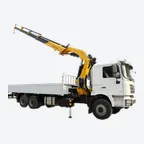

A davit crane is a small crane consisting of a single upright post and a fixed or swinging arm that carries a hoist. Its purpose is to lift a load up and over an edge, such as the side of a boat, a dock, a truck bed, a loading bay or the rim of a manhole. Most davit cranes stand in a socket or on a base plate, rotate by hand, and use a manual or electric winch to raise the hook. Because they are simple, light and economical to operate, they appear on docks, in workshops, on utility vehicles and on yachts.
We have manufactured cranes in Xuzhou since 2003. We do not produce davits. However, we do manufacture the next category up: compact hydraulic marine cranes and 12 V electric mini cranes. Buyers frequently compare these machines with a davit once the load becomes heavier or the required reach increases. This guide explains the principal types of davit crane and how to size one. It also identifies which davits are an entirely different product, and when a compact slewing crane performs the job more effectively.
Key takeaways
- A davit crane is a post-and-arm crane with a hoist that lifts a load over an edge. Portable davits fit into sockets, so one davit can serve several locations.
- The main types are portable socket davits, fixed or pedestal davits, boat and tender davits, ship lifeboat davits and confined-space rescue davits.
- Lifeboat and rescue-boat davits are life-saving appliances under SOLAS and the IMO LSA Code. Rescue davits for confined spaces are personnel equipment. BOB-LIFT makes neither, and our cranes never lift people.
- Size a davit from the total load including rigging, the outreach beyond the edge, the required hook travel, and the structure supporting the socket or base.
- For several hundred kilograms at 3 to 8 m, or for frequent daily lifting, a compact hydraulic marine crane or a 12 V electric mini crane with powered slewing is often the better tool.
What is a davit crane?
The terminology originates in maritime practice. Wikipedia defines a davit as any of various crane-like devices used on a ship for supporting, raising and lowering equipment such as boats and anchors [1]. Davits were first devised for whaling ships in the 17th century, and navies introduced them in the late 18th century, initially as timber beams and subsequently as curved iron arms [1]. Modern davits are manufactured from steel or aluminium, and recent designs also use carbon fibre composites. A lightweight davit can be removed and relocated between several permanently installed deck sockets, so one arm serves the entire vessel [1].
On land, the term “davit crane” now describes the same principle in industrial form. A vertical mast sits in a socket or on a base, a boom projects from the top of the mast, and a hoist or winch raises the load. The operator rotates the mast manually to swing the load over the edge and back again. Because a davit has no slewing motor, no hydraulic power unit and usually no outriggers, it is the simplest available method of lifting something over a side. That simplicity is also its principal limitation: the reach is short, the arm is rotated by hand, and the load must remain small enough for one person to control safely.
Types of davit crane
Search results for “davit crane” combine several quite different machines. The table classifies them by mounting position and typical load, and it indicates clearly where we manufacture an alternative.
| Type | Typical mounting | What it lifts | BOB-LIFT alternative? |
|---|---|---|---|
| Portable davit crane | Drop-in socket on a truck bed, dock, floor, wall or deck; moved between sockets | Pumps, motors, tools and parts over a side or into a pit | Yes, for heavier or longer lifts: 12 V electric mini cranes and small marine cranes |
| Fixed or pedestal davit | Bolted base or pedestal on a quay, deck or loading bay | Goods over a quay edge or through a hatch | Yes: pedestal-mounted marine cranes |
| Boat, tender and dinghy davit | Transom, deck socket, dock or boathouse | A small boat, tender or outboard motor | Yes, for workboats and docks that lift often; not for yacht transoms |
| Ship lifeboat and rescue-boat davit | Ship’s side, as part of the life-saving system | Lifeboats, liferafts and rescue boats with people aboard | No. These are SOLAS life-saving appliances |
| Confined-space and fall-arrest davit | Portable base over a manhole, tank or shaft | A worker, on a retrieval line | No. This is personnel equipment |
Summary compiled by BOB-LIFT, November 2026, from the Wikipedia article “Davit”, the US and IMO rules cited below and our own product range.
Portable davit crane
A portable davit crane separates into a mast, a boom and a hoist, and each component is light enough to carry. Sockets are installed at every location where lifting is required, for example on a service vehicle, at a dock edge, beside a machine in a workshop or above a wet well. The davit is then transferred from socket to socket. Many models have a hand winch on the mast, while others carry an electric winch or a separate chain hoist. This is the most common meaning of the term, and it is the appropriate tool for occasional lifts of light loads close to the post.
Fixed and pedestal davits
A fixed davit is bolted to a base or pedestal and remains permanently in position. It suits a single lifting point that is used every day, for example above a hatch or at one location on a quay. Once a fixed davit receives a powered hoist and a rotation drive, it becomes very similar to a compact pedestal crane. Our pedestal crane guide covers how a crane column is mounted on a deck, a pontoon or a steel platform.

Davit cranes for boats, tenders and dinghies
A davit crane for a boat lifts a tender, a dinghy or an outboard motor. On a yacht it is usually installed on the transom or the deck. On land it is mounted on a dock or in a boathouse, so the owner can lift a small boat out of the water. Dinghy cranes typically consist of a pair of arms, or a single arm, with a manual or electric winch. These davits are dimensioned for one particular boat and are used occasionally during the season. A workboat operator or marina that handles boats, engines and pallets every day requires a different machine, which our boat crane guide covers in detail.

Lifeboat and rescue davits are a different product
Two categories of davit share the name but not the purpose, because their function is to lower or recover people. They are designed, approved and inspected under separate regulations, and they should never be purchased as general lifting equipment.
- Ship lifeboat and rescue-boat davits. Wikipedia notes that davit systems are most often used to lower a lifeboat to the embarkation level so it can be boarded [1]. The IMO adopted the International Life-Saving Appliance (LSA) Code in June 1996. It sets the international requirements for the life-saving appliances required by chapter III of SOLAS, and its chapter VI covers launching and embarkation appliances [2]. In the United States, 46 CFR subpart 160.132 sets the standards and tests for Coast Guard approval of davits used for lifeboats, liferafts and rescue boats [3].
- Confined-space and fall-arrest davits. A rescue davit over a manhole or tank holds a retrieval line attached to a worker’s harness. Under 29 CFR 1910.146, a mechanical device must be available to retrieve personnel from vertical permit spaces more than 5 feet (1.52 m) deep [4]. That device is personal protective and rescue equipment, not a materials crane.
A precise statement about our own products is necessary here: BOB-LIFT manufactures neither type. Our marine cranes are cargo cranes intended for harbours, rivers and sheltered water. They have no class-society certification, they are not life-saving appliances, and they are not offshore cranes. No BOB-LIFT crane may be used to lift, lower or rescue people. Our article on the differences between marine cranes and offshore cranes explains where that line falls.
How to size a davit crane
A davit is selected in the same way as any crane: by the load at the distance where the lift actually happens, not by the headline rating. Consider the following points before comparing individual products.
- Total load. Add the hook, slings, shackles and any lifting frame to the heaviest item. For a boat, use the operating weight including engine, fuel and any accumulated water, not the dry weight from the brochure.
- Outreach past the edge. Measure from the centre of the mast or column to the position where the hook must hang, whether above the water, beyond the vehicle side or over the centre of the pit. A railing, fender or coping usually adds further distance.
- Hook height and drop. Check the clearance under the arm when lifting over a railing or tailgate. Then check the distance below the mounting level when lowering into the water, a hold or a well. Only a winch with sufficient rope allows the hook to descend below deck level.
- The socket or base and its supporting structure. The mounting carries the load and the bending moment of the arm. In the UK, regulation 4 of LOLER 1998 requires lifting equipment to have adequate strength and stability for each load. It specifically mentions the stress induced at the mounting or fixing point [5]. A strong davit installed in a weak truck bed or a thin dock deck remains a weak installation.
- Manual, electric or hydraulic hoist. A hand winch suits occasional light lifts. An electric davit crane with a 12 V or mains-powered winch reduces effort when lifting is frequent. A hydraulic system adds powered luffing and slewing, and at that point a davit effectively becomes a crane.
- Rotation. Most davits are rotated manually. On a sloping deck, a moving vessel or in wind, manual slewing becomes increasingly difficult to control as the load increases.
- Salt water. For marine locations, specify a coating suitable for marine exposure, inspect the winch rope and fixings regularly for corrosion, and rinse the equipment with fresh water after use.
If you are unfamiliar with load charts, our guide on how to read a crane load chart demonstrates how the rated load decreases as the radius increases. The same principle applies to a davit, even when the manufacturer publishes only a single rating.
When a small crane does the job better than a davit
A davit is the appropriate choice for light, occasional lifts close to the post. It becomes less suitable as the load increases, the reach extends or the lifting becomes frequent. At that stage buyers usually begin evaluating a compact powered crane. The chart shows how far our smallest cranes reach beyond the edge, together with the load each one can still lift at maximum radius.

Three categories of machine sit immediately above a davit, and each one addresses a different requirement.
- 12 V electric mini crane. Our SQ1Z-E and SQ2Z-E operate from a 12 V battery, slew through 360° on a toothed slewing ring and luff hydraulically. According to its product page, the SQ2Z-E lifts 2,000 kg at 1.2 m and 500 kg at 3.1 m. They can be mounted on a vehicle or fixed in place, and an optional base cart with side outriggers is available. With its own battery and charger, the power unit can work where there is no vehicle power, such as on a workshop floor or a dock. Our guide to 12 V electric cranes for pickups and light trucks explains battery capacity, wiring and duty cycle.
- Small knuckle boom marine crane. Our smallest marine cranes, the SQ08ZA3T+1 and SQ1ZA3T+1, weigh 200 kg and 350 kg respectively, slew through 330° and reach slightly more than 4 m. The SQ2ZA2TJ adds a winch and continuous 360° slewing, and it lifts 750 kg at 5.1 m. When not in use, the boom folds compactly beside the column. See our small knuckle boom crane overview.
- Small telescopic marine crane. The SQ2SA3T reaches 8.2 m with 250 kg at full reach, and the SQ3.2SA3T reaches 8.3 m with 550 kg. A telescopic boom provides the longest reach for its size, and our comparison of knuckle boom vs telescopic marine cranes goes into the choice.
Every marine crane figure comes from the current technical drawing of each model. The complete specification table for small marine cranes, including hydraulic flow, operating pressure and self-weight, appears in our boat crane guide, so we do not repeat it here. Every model is listed in our marine crane range.
A powered crane is usually the better choice in the following situations.
- You need to place several hundred kilograms or more at 3 m to 8 m from the post.
- The load must be controlled precisely in wind or on a moving deck, where manual slewing is unreliable.
- You lift many times a day, so powered slewing, luffing and a winch save considerable time.
- The hook must descend well below the mounting level, for example from a quay to a vessel at low tide.
Example scenario (an illustration, not a customer record): a marina workshop uses a portable davit to remove outboard motors from small boats at a fixed dock. It now intends to handle workboat engines and pallets weighing up to 650 kg, including the slings, at approximately 5 m from the slewing centre. A light davit is not designed for that lifting moment, and rotating the load manually over the water would be difficult to control. The SQ2ZA2TJ drawing specifies 750 kg at its 5.1 m maximum radius, with a winch and 360° slewing, so it covers the requirement. The marina’s engineer then verifies the pedestal and dock structure for the crane’s 590 kg self-weight and the working moment.
Mounting on a dock, pontoon, deck or truck bed
Whichever machine you select, the mounting determines whether the installation is safe. A davit socket concentrates the entire bending moment of the arm into a short tube, and a crane column transfers it through its base plate and bolts. Before installing either one, ask a competent engineer to confirm the capacity of the supporting structure.
- Dock or quay: a pedestal anchored into concrete or onto a steel frame. Verify the edge distance of the anchors and the capacity of the slab beneath.
- Pontoon or boat deck: local deck reinforcement under the pedestal, plus a stability calculation of heel and freeboard with the load at maximum reach. Our barge crane guide shows a first estimate of heel.
- Truck or pickup bed: a mounting frame that distributes the load into the chassis rather than the bed panels. Our guides to small truck mounted cranes and 12 V electric mini cranes explain vehicle installation in detail.
BOB-LIFT supplies the crane only, together with its mounting dimensions, technical drawings and installation guidance. The dock, pontoon, vessel or vehicle is provided by the customer, and the customer’s engineer or shipyard designs the supporting structure.
Inspection and safe use
Portable davits involve one inspection consideration that fixed cranes do not: they are reassembled every time they are relocated. LOLER regulation 9 requires a thorough examination of lifting equipment whose safety depends on installation conditions. The examination takes place after installation and before first use, and again after assembly at a new site or location [6]. Equipment exposed to deteriorating conditions must be thoroughly examined at least every 12 months. Lifting accessories and equipment for lifting persons require examination every 6 months, unless an examination scheme specifies other intervals [6]. Salt spray is a typical example of such a condition.
- Inspect every socket, pin and base bolt before the first lift of the day, and replace a cracked or worn socket immediately.
- Examine the winch rope, hook latch and brake. Rope wear and corrosion usually appear first where the rope passes over the sheave.
- Never exceed the rated load at the working radius, and keep personnel away from the area beneath the load.
- Lift materials only. Lifeboat and rescue davits are separate systems, and no BOB-LIFT crane is used to lift people.
For cranes, our crane inspection checklist describes the daily, monthly and annual checks in more detail.
Frequently asked questions
What is a davit crane used for?
A davit crane lifts a load up and over an edge. Typical examples include a pump lowered into a wet well, a motor removed from a truck bed, or a tender recovered onto a yacht. Portable davits are transferred between sockets, so one davit can serve several lifting points.
What is the difference between a davit and a crane?
A davit is a simple post and arm with a hoist, usually rotated manually and with limited reach. A crane adds powered slewing, luffing and often a folding or telescopic boom. Consequently, it lifts heavier loads at greater distances and with better control.
Is a portable davit crane strong enough to lift a boat?
That depends on the davit’s rating at its working radius and on the boat’s actual weight including engine and fuel. Light dinghies and tenders are commonly handled by davits. Heavier workboats and frequent boat handling usually require a powered boat crane.
Should I choose a manual or an electric davit hoist?
A manual winch is sufficient for occasional light lifts. An electric davit hoist reduces effort and time when lifting is frequent. If you also require powered slewing and a longer reach, consider a 12 V electric mini crane or a compact hydraulic crane instead.
Can a BOB-LIFT crane launch a lifeboat or lift a person?
No. Lifeboat and rescue-boat davits are life-saving appliances under SOLAS and the IMO LSA Code, and confined-space rescue davits are personnel equipment. BOB-LIFT makes neither, our marine cranes have no class-society certification, and no BOB-LIFT crane may be used to lift people.
How we compiled this guide
We compiled the definition, history and types of ship davits from the Wikipedia article “Davit”, consulted in November 2026. The description of portable and industrial davit cranes reflects the search results that buyers see for this term. The regulatory information comes from the IMO page on life-saving appliance requirements, the official eCFR text of 46 CFR subpart 160.132 and 29 CFR 1910.146, and LOLER 1998 on legislation.gov.uk. Every marine crane figure comes from the current technical drawing of each model, and the electric mini crane figures come from their English product pages. Achord Chan, Product Operations Director, reviewed the guide in November 2026. It does not replace your engineer’s check of the mounting structure, your equipment manual or the law where you work.
Send us your load and reach
Tell us the heaviest item you lift, how far beyond the edge it must travel, and the intended mounting location, such as a dock, pontoon, vessel deck or truck. We will advise honestly whether a davit is sufficient. Otherwise, we will recommend a suitable electric mini crane or marine crane with its technical drawings and load chart. Every crane carries a 12-month warranty on the whole machine, common spare parts leave the factory within 48 hours, and our service team answers within 12 hours. Contact us for a quotation.