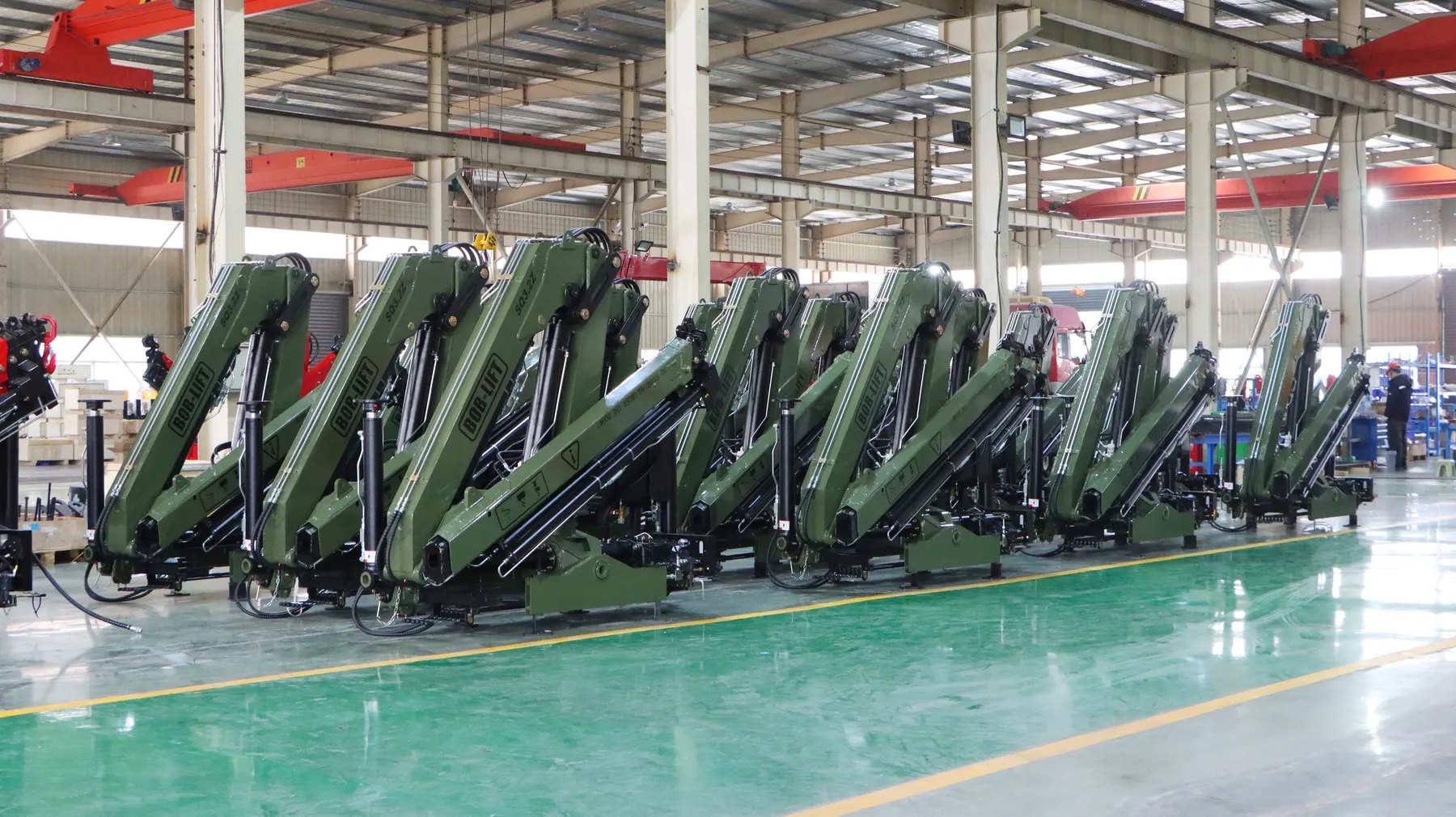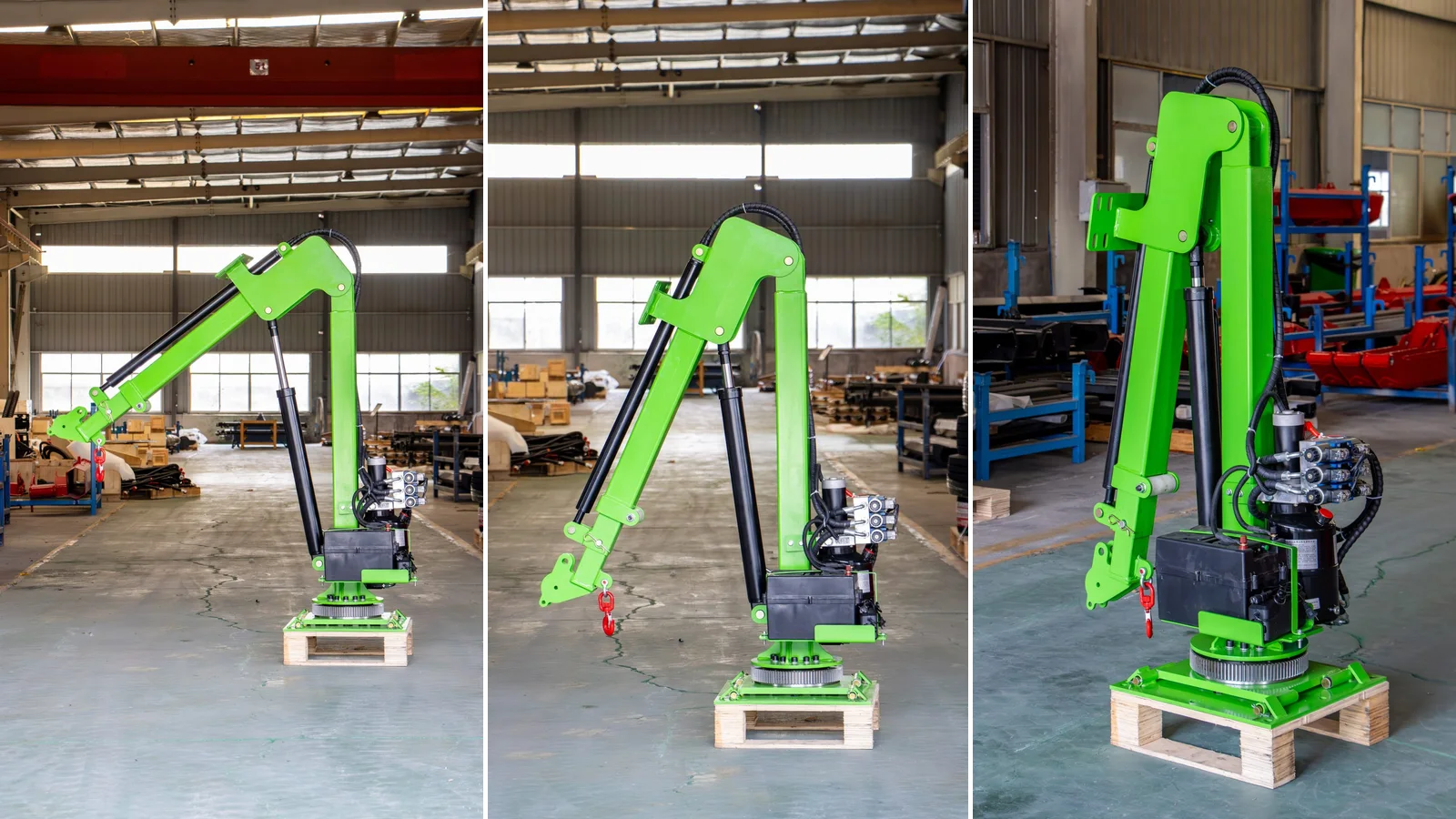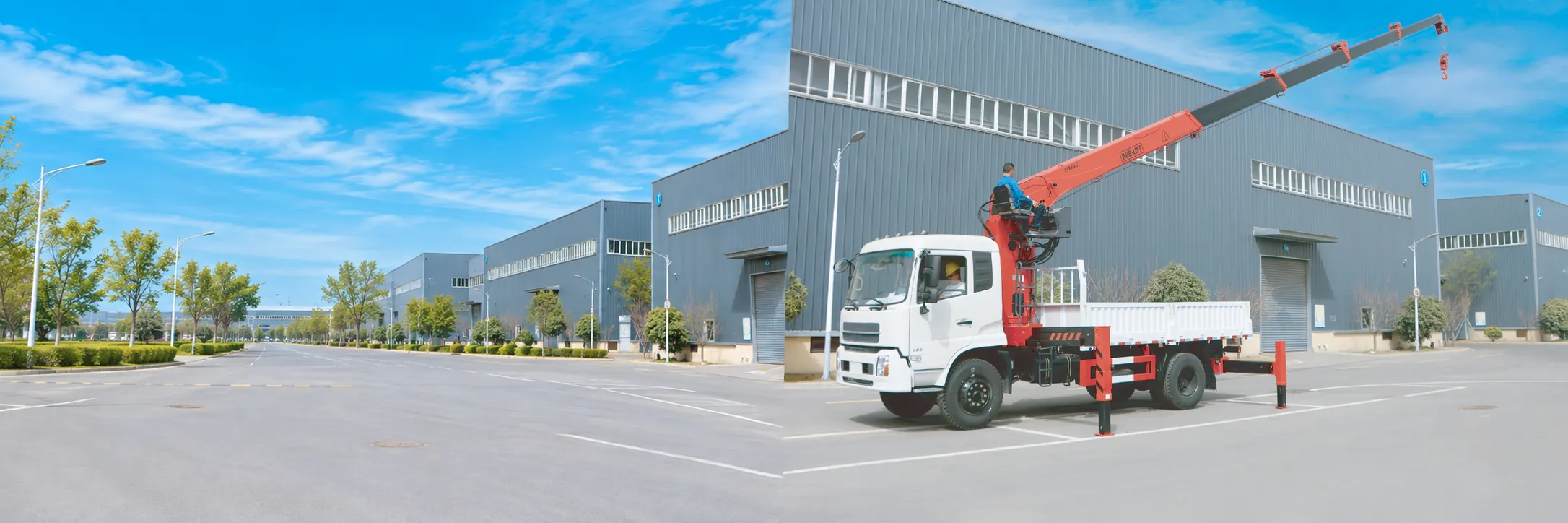

A small knuckle boom crane is a hydraulic crane with a jointed boom, rated at roughly 1 to 3 tonnes, that folds into a compact package when it is not working. On land it sits behind the cab of a light truck; on the water it stands on a pedestal on a boat, a pontoon or a quay. It is the crane that lets one person load and unload goods, tanks, engines or nets without waiting for a forklift or a mobile crane.
BOB-LIFT has manufactured truck mounted cranes since 2003 and exported them to 124 countries and regions. This guide compares our small knuckle boom cranes from 1.6 t to 3.2 t, seven truck-mounted models and four marine models, using the figures on each model’s technical drawings and load charts. It explains what each crane lifts at full reach, how the number of boom sections changes that reach, and which specifications a truck or a vessel needs before it can carry one.
Key takeaways
- Our small knuckle boom cranes are rated at 1.6 t, 2 t and 3.2 t, but at maximum reach they lift between 180 kg and 750 kg, so the right size depends on the load at your working radius rather than on the rating.
- Within one capacity class, additional boom sections extend the reach without reducing the load at any radius the shorter crane can reach: the 2 t SQ2ZA2 reaches 5.1 m, while the SQ2ZA4 reaches 7.54 m and weighs 100 kg more.
- The truck-mounted models weigh 470 kg to 1,450 kg and need 550 mm to 850 mm of chassis behind the cab, plus 15 to 25 L/min of oil from the power take-off.
- The marine versions stand on a bolted base plate instead of outriggers, and the current TJ models come with a winch.
- Our delivery records show these cranes on light trucks in Vietnam, Cyprus, Chile and the United States, and on workboats in India and the Netherlands.
What is a small knuckle boom crane?
A knuckle boom crane has an inner boom and an outer boom connected by a hinge, the “knuckle”. Hydraulic cylinders articulate the boom at that joint, much like an arm bending at the elbow, while telescopic extensions slide out of the outer boom to add reach. After the lift, the boom folds back on itself, and a small crane in its transport position stands roughly level with the truck cab, which keeps the entire load bed available. Our guide on what a knuckle boom crane is explains the parts in detail.
Small knuckle boom cranes are worth a look when the loads are frequent, mostly under a tonne, and need to be set down precisely: over a dropside, onto a deck or through a gap. The jointed boom can reach over an obstacle and then down, which a straight telescopic boom cannot do. If you are still deciding between the two boom types for a truck, our small truck crane guide compares both.
Our model codes tell you most of the design at a glance. In SQ2ZA4T, for example, “2” is the capacity class in tonnes, “Z” means knuckle boom, “A4” counts the boom sections and “T” marks the marine version. A “J” after the T means a winch is fitted, and “+1” means one more extension section on top of the count, so SQ1ZA3+1 has three sections plus one.
Small knuckle boom crane models from 1.6 t to 3.2 t
The rating in a crane’s name is the maximum load it lifts close to the column. As the boom extends, the permitted load decreases, because the lifting moment, which is the load multiplied by its distance from the slewing centre, remains constant. The table below places the rating beside the maximum reach and the load at maximum reach for every truck-mounted model.
| Model | Rated load | Lifting moment | Max reach | Load at max reach | Crane weight |
|---|---|---|---|---|---|
| SQ1ZA3+1 | 1,600 kg at 1.39 m | 2.2 t·m | 4.23 m | 300 kg | 470 kg |
| SQ1ZA4 | 1,600 kg at 1.39 m | 2.2 t·m | 4.23 m | 180 kg | 490 kg |
| SQ2ZA2 | 2,000 kg at 2.1 m | 4.2 t·m | 5.1 m | 750 kg | 650 kg |
| SQ2ZA3 | 2,000 kg at 2.1 m | 4.2 t·m | 6.4 m | 460 kg | 710 kg |
| SQ2ZA4 | 2,000 kg at 2.1 m | 4.2 t·m | 7.54 m | 300 kg | 750 kg |
| SQ3.2ZA3 | 3,200 kg at 2.1 m | 6.8 t·m | 7.7 m | 680 kg | 1,330 kg |
| SQ3.2ZA4 | 3,200 kg at 2.1 m | 6.8 t·m | 9.4 m | 520 kg | 1,450 kg |
Two details are worth noticing. The step from 1.6 t to 3.2 t increases reach as well as capacity, since the SQ3.2ZA3 still lifts 680 kg at 7.7 m, which is more than either 1.6 t model lifts at 3.25 m. The two 1.6 t models also look identical on paper, yet at 4.23 m the SQ1ZA3+1 lifts 300 kg against 180 kg for the SQ1ZA4, and the SQ1ZA3+1 is 20 kg lighter. For operators who regularly work at maximum reach, that difference is more important than the rating. Our guide to reading a crane load chart shows how to find the figure at your own radius.
How does the number of boom sections change reach?
Within one capacity class, each additional boom section extends the reach while preserving the rated load at every radius the shorter configuration can reach. The three 2 t models illustrate this clearly, because all of them lift 2,000 kg at 2.1 m and 1,000 kg at 4.1 m. The SQ2ZA2 finishes at 5.1 m, whereas the SQ2ZA3 continues to 6.4 m and the SQ2ZA4 to 7.54 m, where it still handles 300 kg. The 3.2 t pair behaves identically: the SQ3.2ZA4 matches the SQ3.2ZA3 point for point and then continues to 9.4 m.

The additional reach costs weight and installation space. Each step in the 2 t family adds 40 to 60 kg, the SQ3.2ZA4 weighs 120 kg more than the SQ3.2ZA3, and the SQ2ZA3 and SQ2ZA4 require 680 mm of chassis behind the cab compared with 650 mm for the SQ2ZA2. The practical conclusion is to specify only the sections you will actually use. When your loads land within about 5 m of the column, the shortest boom is lighter and simpler; when you regularly position loads on the far side of a truck, over a boundary wall or across a deck, the longer boom justifies its extra weight.
Small knuckle boom truck: what does the truck need?
A small knuckle boom truck is usually a light truck of a few tonnes with the crane mounted between the cab and the load bed. Four figures on the crane’s drawing decide which truck can carry it: the crane’s weight, the installation space it needs on the chassis, the hydraulic supply from the power take-off (PTO) and the width of the outriggers.
| Model | Crane weight | Installation space | Oil flow and pressure | Recommended power | Outrigger span |
|---|---|---|---|---|---|
| SQ1ZA3+1 | 470 kg | 550 mm | 15 L/min, 18 MPa | 7.5 kW | 1,565 to 3,095 mm |
| SQ2ZA2 | 650 kg | 650 mm | 20 L/min, 20 MPa | 9 kW | 1,870 to 3,020 mm |
| SQ2ZA4 | 750 kg | 680 mm | 20 L/min, 20 MPa | 9 kW | 1,842 to 3,500 mm |
| SQ3.2ZA3 | 1,330 kg | 850 mm | 25 L/min, 25 MPa | 14 kW | 2,250 to 3,513 mm |
| SQ3.2ZA4 | 1,450 kg | 850 mm | 25 L/min, 25 MPa | 14 kW | 2,250 to 3,513 mm |
- Payload. The crane’s weight is deducted from the truck’s legal payload, together with the mounting subframe and the body, and the remainder is the cargo capacity you actually keep.
- Chassis space. The installation space must be available behind the cab, with sufficient length remaining for the load bed your operation requires.
- Hydraulic supply. The power take-off and pump must deliver the crane’s specified oil flow at the engine speed you intend to operate at.
- Outriggers. The outriggers transfer the lifting load into the ground, so plan for their full extended span on site and for stable, compacted ground under every foot.

Mounting is a job for a qualified body builder, who checks the frame, fits the subframe and runs an axle-load calculation. Our truck mounted crane installation guide covers the chassis checks and the PTO, and the crane outriggers guide shows how to size pads for the ground. BOB-LIFT supplies the crane only. We can mount it on your own truck before shipping, or send the drawings and guidance for a local body builder.
Small marine knuckle boom cranes for boats and pontoons
A small marine knuckle boom crane is the same crane on a fixed column instead of a truck subframe. It bolts to a base plate on the deck, a pontoon or a quay, so it has no outriggers, and its stability comes from the structure underneath. That is why the marine versions are lighter than the truck versions of the same size. Our current small marine models are listed below.
| Model | Rated load | Max reach and load | Crane weight | Base plate | Winch |
|---|---|---|---|---|---|
| SQ1ZA3TJ+1 | 1,600 kg at 1.39 m | 300 kg at 4.23 m | 380 kg | 328 × 328 mm, 12 bolts | Yes |
| SQ2ZA2TJ | 2,000 kg at 2.0 m | 750 kg at 5.1 m | 590 kg | 780 × 500 mm, 20 bolts | Yes |
| SQ2ZA4T | 2,000 kg at 2.1 m | 300 kg at 7.54 m | 630 kg | 780 × 500 mm, 20 bolts | No |
| SQ3.2ZA3TJ | 3,200 kg at 2.1 m | 680 kg at 7.7 m | 1,236 kg | 550 × 550 mm, 16 bolts | Yes |
Folded, the SQ2ZA2TJ measures 2,104 mm long, 1,704 mm high and 609 mm wide, so it fits along the rail of a small workboat. The SQ3.2ZA3TJ folds to 2,271 by 1,951 by 684 mm. The 1.6 t and 2 t marine cranes need the same oil supply as their truck sisters, and the SQ3.2ZA3TJ asks for 15 kW, so check that the vessel’s hydraulic power pack or engine-driven pump can deliver it. The marine cranes also get a multi-layer anti-rust treatment for sea duty. The deck or pedestal under the base plate has to carry the crane’s lifting moment, so ask a naval architect or a structural engineer to check it.

For how a pedestal is sized and fixed, see our pedestal crane guide. If you are deciding between a knuckle and a straight boom for a vessel, our knuckle boom vs telescopic marine crane comparison covers it.
What do small knuckle boom cranes do in practice?
Our customer delivery records show what these cranes actually lift. The 3.2 t SQ3.2ZA3 appears most often. In Chile it lifts a generator set, a modular cabin and bundles of framing timber. In the United States it swings a utility trailer onto a flatbed, and in Sudan a whole batch was fitted to trucks for a fleet. Smaller models turn up on light trucks in Vietnam and the Philippines, with a grab on a light tipper in Uzbekistan, and on workboats in India and the Netherlands.
Generator sets are a demanding test for a small crane because they are compact but surprisingly heavy. Read the weight from the manufacturer’s nameplate, add the fuel in the tank, and compare the total with the load chart at the radius where the set will be positioned; the SQ3.2ZA3, for instance, is rated for 1,350 kg at 4.35 m and 910 kg at 5.9 m.
Example scenario (an illustration, not a customer record): a fish farm intends to transfer 600 kg feed bags from a pontoon onto a vessel moored alongside, with the landing position approximately 4.5 m from the crane. The SQ2ZA2TJ is rated for 1,050 kg at 3.76 m and still 750 kg at 5.1 m, so 600 kg at 4.5 m remains within its chart, and its winch can lower the bags into the hold. The 1.6 t SQ1ZA3TJ+1 would be undersized for this application, because it lifts only 300 kg at 4.23 m.
How do you choose a small knuckle boom crane?
- Write down your heaviest regular load and the furthest radius at which you need to lift or set it down, measured from where the crane column will stand.
- Pick the rating whose load chart covers that load at that radius with margin.
- Pick the number of boom sections from the reach you need, not the longest on offer.
- For a truck, check payload, chassis space behind the cab, PTO oil flow and outrigger room. For a boat, check the deck structure, the base plate footprint and the hydraulic power.
- Choose the extras: a winch for lowering below the base, a grab or another attachment, and levers or a wireless remote. Our guide to knuckle boom crane attachments lists the options.
- Ask for the drawing and load chart of the final model, and check the rules where the crane will work.
The rules depend on the country and the job. In the United States, OSHA’s construction crane standard lists knuckle-boom cranes in its scope, but excludes, with conditions, knuckle-boom truck cranes that only deliver material from the truck to the ground at a site [1]. The ASME B30.22 safety standard covers articulating boom cranes on trucks and on stationary installations, including those with a load hoist [2]. In Great Britain, lifting equipment must be thoroughly examined by a competent person every 6 or 12 months, depending on the equipment, or under an examination scheme [3]. HSE has also warned lorry loader operators about crush risks from powered tilting stabilisers, so keep clear of the outriggers while they move [4].
Frequently asked questions
What is the smallest knuckle boom crane you make?
Within the range covered here, the smallest is the 1.6 t class: the SQ1ZA3+1 for trucks and the SQ1ZA3TJ+1 for vessels, both offering a 2.2 t·m lifting moment and 4.23 m maximum reach. For pickup installations we also manufacture an 800 kg crane, which our small truck crane guide describes.
How much does a small knuckle boom crane weigh?
On our drawings, the truck-mounted models weigh from 470 kg (SQ1ZA3+1) to 1,450 kg (SQ3.2ZA4). The marine versions are lighter because they have no outriggers: 380 kg for the SQ1ZA3TJ+1 and 1,236 kg for the SQ3.2ZA3TJ.
How far can a small knuckle boom crane reach?
Maximum reach ranges from 4.23 m on the 1.6 t models to 9.4 m on the SQ3.2ZA4. The permitted load at maximum reach is only a fraction of the rating, between 180 kg and 750 kg across the range, so always consult the load chart at your actual working radius.
What truck do I need for a 2 ton knuckle boom crane?
You need a light truck whose payload covers the crane’s 650 kg to 750 kg in addition to the subframe, the body and your cargo, with 650 mm to 680 mm of unobstructed chassis behind the cab and a power take-off delivering 20 L/min at 20 MPa. Send us the manufacturer, model and wheelbase of your truck, and our engineers will confirm the compatibility.
Can a small knuckle boom crane be fitted to a boat?
Yes. The marine versions are bolted to a base plate on the deck or on a pedestal and operate from the vessel’s hydraulic supply. The structure underneath must withstand the crane’s lifting moment, so have it assessed by a qualified engineer before installation.
Does a small knuckle boom crane need a winch?
For loading and unloading a truck, the hook on the boom tip is usually sufficient. A winch becomes valuable when you lower loads below the level of the crane base, for example into a hold or onto a boat from a quay, which is why our current small marine TJ models include one as standard.
How we compiled this guide
We compiled every figure from the BOB-LIFT technical-department dimension drawings and load charts of the SQ1ZA3+1, SQ1ZA4, SQ2ZA2, SQ2ZA3, SQ2ZA4, SQ3.2ZA3, SQ3.2ZA4, SQ1ZA3TJ+1, SQ2ZA2TJ, SQ2ZA4T and SQ3.2ZA3TJ, in November 2026. The photos and the video come from our customer delivery records, and the rules are summarised from the official pages linked above as they stood in November 2026. The guide was reviewed by Achord Chan, Product Operations Director. Specifications can change without notice, so ask for the current drawing before you order.
Find the right small knuckle boom crane
Tell us your heaviest load, how far you need to reach and the truck or vessel you plan to use, and we will suggest models with the drawing and load chart for each. Every crane carries a 12-month warranty on the whole machine, common spare parts are dispatched within 48 hours, and our service team replies within 12 hours. Browse our knuckle boom truck cranes and knuckle boom marine cranes, or contact us to start.