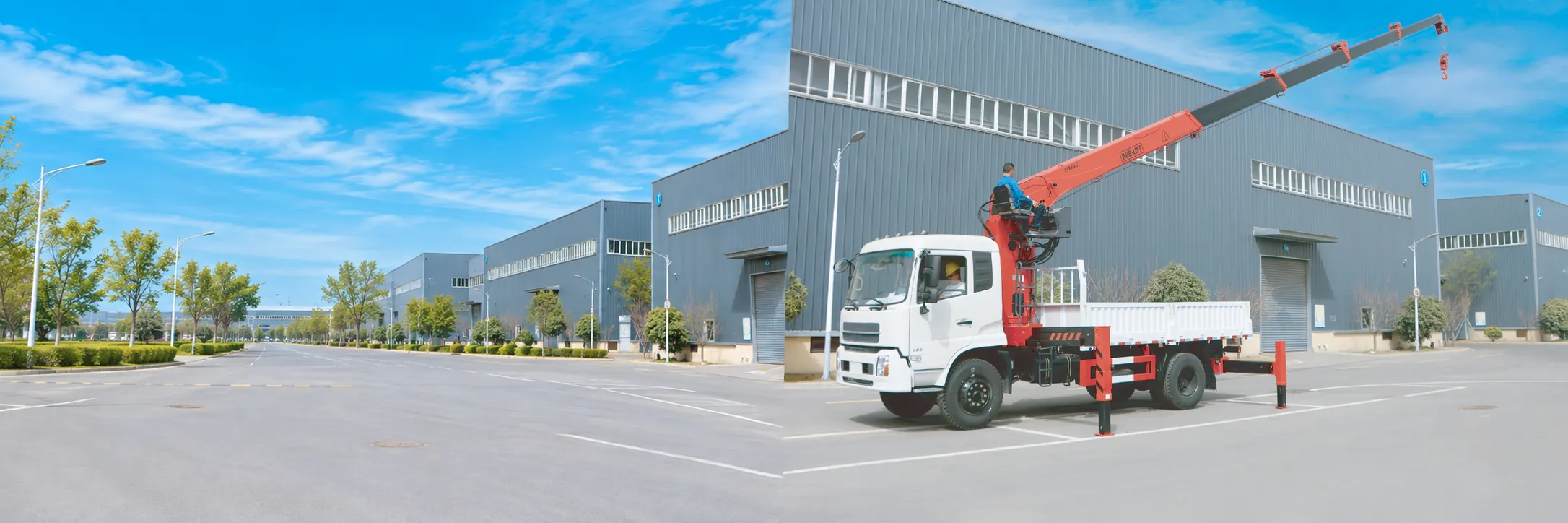
Knuckle boom crane attachments are tools fitted to the boom tip or the crane base that let a truck mounted crane do more than lift on its hook. The four that buyers ask about most are a winch, a grapple, an earth auger and a man basket. Each one adds a job the crane can do, but each also takes some of the crane’s capacity, needs hydraulic power and, for the basket, brings strict rules about lifting people.
BOB-LIFT has built truck mounted cranes since 2003 and exported them to 124 countries and regions. A winch, an auger, a basket or a grapple is available on request for our knuckle boom and telescopic truck cranes, and we confirm the right set-up for each model in the quotation. This guide explains what each attachment does, what it needs from the crane, and what to check before you order one.
Key takeaways
- A winch adds hook height and lets the crane lift from below ground level or over high obstacles. Both the load chart and the winch’s own line pull apply, and the lower one governs.
- A grapple needs a rotator and an extra hydraulic function at the boom tip. Its weight counts as part of the load.
- An earth auger drills holes for posts and poles. It needs high hydraulic torque and suits cranes with enough flow and reach.
- A man basket lifts people. In the United States it is allowed only when conventional means are more hazardous or impossible, and the total load is limited to half of the crane’s rated capacity for that radius and configuration.
- Order attachments with the crane where possible, so the valve, hoses and load chart are set up for them from the start.
Which attachments can a knuckle boom crane use?
The table sums up the four common attachments, what they are for and what they ask of the crane.
| Attachment | Typical jobs | What the crane needs | Main thing to check |
|---|---|---|---|
| Winch | Lifting into pits and over high walls, pulling, lowering pipes and pumps | Winch drum and motor on the boom, wire rope, a hydraulic function on the valve | Line pull, rope length and daily rope inspection |
| Grapple (grab) | Timber, scrap, rocks, pipes, waste, building materials | Rotator, hoses to the boom tip, two extra hydraulic functions | Grapple weight and the load at your working radius |
| Earth auger | Holes for fence posts, signs, utility poles and foundations | Auger drive, a hydraulic circuit with enough flow and pressure | Hole diameter and depth against the drive torque |
| Man basket | Short work at height where other access is not possible | A certified personnel platform and an overload protection device | The rules for lifting people where you work |
The European loader crane standard, EN 12999, treats tools such as a grapple, a clamshell bucket and a pallet clamp as interchangeable equipment for a loader crane, as its published scope shows. The same scope says it does not cover the hazards of lifting people, which is why the man basket has its own section below.
When does a crane with a winch make sense?
A crane with a winch makes sense when the hook has to go where the boom tip cannot: deep into a pit, down a shaft, over a tall wall or high above the truck. On a knuckle boom crane without a winch, the hook hangs directly from the boom tip, so the hook height is set by the boom position. A winch adds a wire rope that pays out from a drum, so the hook can travel well below or above the boom tip.

Two limits apply when you lift on the winch. The crane’s load chart sets the safe load at each radius, and the winch has its own maximum line pull. The lower of the two is your limit. A winch also adds a part that needs daily care. In the United States, OSHA’s wire rope rule, 29 CFR 1926.1413, says “a competent person must begin a visual inspection prior to each shift the equipment is used”. In the European Union, Annex I of the Machinery Directive 2006/42/EC sets a working coefficient for complete ropes that, “as a general rule”, is equal to 5.
For buyers in North America, ASME B30.22 covers articulating cranes “equipped with a load hoist mechanism”, so a knuckle boom crane with a winch stays within the same standard, as the ASME B30.22 scope states.
Example scenario (an illustration, not a customer record): a water contractor needs to lower submersible pumps into a 6 m deep well chamber. With the hook on the boom tip, the crane cannot reach the bottom. With a winch, the operator places the boom tip over the chamber and lowers the pump on the rope, keeping well inside both the load chart and the winch’s line pull.
What do you need for a crane with a grapple?
A crane with a grapple needs three things at the boom tip: the grapple itself, a rotator that turns it, and hydraulic hoses to open, close and rotate it. On the control valve, that means two extra functions beyond the standard boom and slewing controls. A grapple turns a truck crane into a self-loading truck for timber, scrap, rocks, pipes or bundled building materials, so one person can load and unload without slings.
The grapple and rotator have weight, and that weight counts as part of the load on the load chart. A heavy grapple on a small crane can use up much of the capacity at full reach. So size the crane from the grapple weight plus the heaviest load, at the radius where you will work. Our guide on how to read a crane load chart shows how to find that number.
Grapples come in several types: two-shell timber grapples, multi-tine grapples for scrap and waste, clamshell buckets for loose material, and pallet clamps or forks for packaged goods. Tell us the material and the size of the pieces, and we will suggest a type that suits the crane.
Can a truck crane drill holes with an auger?
Yes. An earth auger hangs from the boom tip and is driven by a hydraulic motor, so the crane can drill holes for fence posts, signs, small foundations and poles, then lift the post into the hole. The crane positions and stabilises the auger above the marked location, while the hydraulic auger drive provides the rotational torque that does the cutting.
The practical limit is usually the hydraulic performance of the crane, not its lifting capacity. A large hole in hard ground needs high torque, and the auger drive needs enough oil flow and pressure from the crane’s circuit. Our technical drawings list the flow and pressure for each model; for example, our 20 t SQZ430 knuckle boom crane is drawn for 63 L/min at 33 MPa. Give us the hole diameter, the depth and the ground type, and we will check the drive against the crane.
For utility work in the United States, note that OSHA treats digger derricks separately. Under 29 CFR 1926.1400(c)(4), digger derricks used for augering holes for electric or telecommunication poles and placing the poles are excluded from the crane rules, provided the work complies with the utility rules. Check which rules apply to your job before you plan pole work with a crane.
Is a man basket on a crane allowed?
A man basket on a crane is allowed in many countries, but only under strict conditions, and it should be a last choice rather than a normal way to work at height. The main rules are these.
- United States. 29 CFR 1926.1431 prohibits hoisting employees with a crane “except where the employer demonstrates” that conventional means “would be more hazardous, or is not possible”. The total load must not exceed 50 percent of the rated capacity for the radius and configuration. The platform must support its own weight and at least five times the maximum intended load. A trial lift is made with the empty platform loaded at least to the planned weight, and the platform and rigging are proof tested to 125 percent of the platform’s rated capacity. For articulating cranes, the rule adds that they “must be equipped with a properly functioning automatic overload protection device”.
- North American standards. ASME B30.23 covers personnel lifting systems, including platforms mounted on the boom of hoist equipment.
- Great Britain. HSE guidance on lifting people says that using equipment not designed for lifting people “should only occur in exceptional circumstances”.
- European Union. The Machinery Directive says the working coefficients used for lifting goods are not enough for lifting people and “must, as a general rule, be doubled”.
If your team needs regular access to height, a purpose-built machine is usually the better buy. We also make truck mounted aerial work platforms designed to carry people from the start.
What should you check before ordering crane attachments?
Attachments perform best when the crane’s hydraulic system, control valve and hose routing are configured for them during factory assembly. Before you confirm the order, agree these points:
- The jobs. List the attachments you need now and the ones you may add later, so the valve can have spare functions.
- The heaviest load at your radius, plus the attachment weight. This sets the crane size.
- Hydraulic flow and pressure. Check them against the auger drive or any other powered tool.
- Hoses and quick couplings at the boom tip. Agree how attachments will be changed on site.
- Controls. Decide whether the attachment functions will be on the levers, a high seat or a wireless remote control.
- Inspection. Add the winch rope, grapple, rotator and hoses to your daily check. Our truck mounted crane inspection checklist shows the routine.
Our article on truck mounted crane parts shows where the valve, the boom tip and the hoses sit on the crane, and our guide to what a knuckle boom crane is explains the boom layout.
Frequently asked questions
Does an attachment reduce a crane’s lifting capacity?
Yes, in practical terms. The combined weight of a grapple, rotator, auger or basket counts as part of the load, so the payload you can lift falls by that weight at every radius. Always size the crane from the attachment weight plus the load.
Can I add a winch or a grapple to my crane later?
Often, provided the control valve has spare hydraulic functions and the boom has room for additional hose routing. If not, the valve may have to be changed. Ordering the attachment with the crane is simpler, because the hydraulics and controls are set up for it in the factory.
What is the difference between a grapple and a grab?
They are the same equipment under two regional names: “grapple” is the usual term in North America, while “grab” is more common in Britain, Australia and many export markets. Both mean a hydraulic tool at the boom tip that closes around the load.
Can a man basket be used on any knuckle boom crane?
No. The crane must be suitable and the rules where you work must allow it. In the United States, articulating cranes used to hoist personnel must have a working automatic overload protection device, and the total load is limited to half of the rated capacity. Ask us before you plan to lift people with a crane.
How do I operate a grapple or an auger?
From the crane’s standard operating controls. Each additional attachment function, such as open, close or rotate, gets its own lever or joystick. Many operators prefer a remote control or a high seat for grapple work, because they can watch the grapple closely.
How we compiled this guide
The attachment options come from the BOB-LIFT product range, and the BLZ90K4 and SQZ430 figures from their technical drawings. The photo shows a real crane in our Xuzhou workshop. The rules and standards are summarised from the official texts linked in the guide, as they stood in October 2026. The guide was reviewed by Achord Chan, Product Operations Director, in October 2026. It does not replace the crane’s operating manual, the attachment maker’s instructions or the rules where you work.
Get a crane set up for your attachments
Tell us the attachments you need, the heaviest load and the radius you work at, and we will suggest a crane model with its drawing and load chart. Every crane carries a 12-month warranty on the whole machine, common spare parts are dispatched within 48 hours, and our service team replies within 12 hours with video guidance when needed. You can read more about us on the About us page. Browse our knuckle boom truck cranes, or contact us to start.