
Crane rigging is the combination of equipment and technique used to connect a load to a crane hook: the slings, the hitch configuration in which they are arranged, and the hardware, such as shackles, master links and spreader beams. Correct rigging keeps the load balanced and every component within its rated capacity, whereas incorrect rigging can release a load even when the crane itself is operating well inside its load chart.
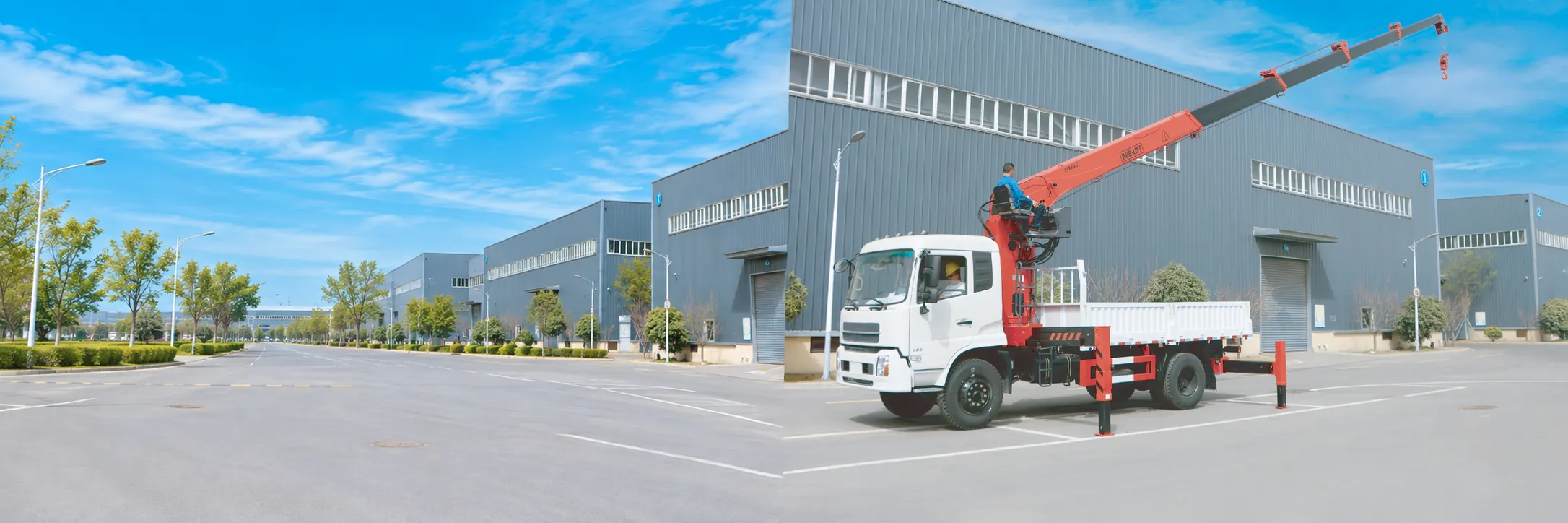
We have built truck mounted cranes in Xuzhou since 2003, and every crane we ship is run through lifting, slewing and outrigger functions under load on our test bay before packing. This guide explains the principal types of crane slings, the three basic rigging hitches, how the sling angle increases leg tension, which hardware is appropriate, how to inspect it, and how rigging weight affects the load chart of a truck mounted crane.
Key takeaways
- Every sling must carry a legible identification tag, and US regulations prohibit using an untagged sling or loading any sling beyond its marked rating.
- A sling’s rated capacity depends on the hitch, so apply the vertical, choker or basket rating that corresponds to the actual configuration.
- The wider the angle between sling legs, the higher the tension in each leg; at 60° from vertical, each leg of a two-leg sling carries the entire weight of the load.
- Slings, shackles and hooks are considered part of the load, so their combined weight must be deducted from the crane’s rating at the working radius.
- Inspect slings before each day’s use and immediately remove any sling showing damage listed in the removal criteria.
What is crane rigging?
Crane rigging comprises every component between the crane hook and the load, together with the decisions about how those components are arranged. The US sling standard, 29 CFR 1910.184, defines a sling as “an assembly which connects the load to the material handling equipment” and a hitch as the way a sling “is fastened to an object or load, either directly to it or around it”. UK law uses the term “accessory for lifting”, which regulation 2 of LOLER 1998 defines as “work equipment for attaching loads to machinery for lifting”.
In practice, every rigging arrangement consists of three elements:
- The sling: wire rope, alloy steel chain, synthetic webbing, a round sling or fiber rope.
- The hitch: vertical, choker or basket, alone or in a multi-leg bridle.
- The hardware: shackles, hooks, master links, eyebolts and spreader beams, which connect the sling to the hook and to the load.
Types of crane slings
No single sling is suitable for every load. The OSHA regulations cover slings manufactured from alloy steel chain, wire rope, metal mesh, natural or synthetic fiber rope, and synthetic webbing of nylon, polyester or polypropylene, and each material has distinct advantages and distinct limitations.
| Sling type | Strengths | Limits to watch |
|---|---|---|
| Wire rope sling | Strong and hard wearing; handles rough steel, timber and heat better than synthetics | Stiff, can kink or bird cage; broken wires cut hands; fiber core slings must be scrapped after exposure above 200 °F |
| Alloy steel chain sling | Very tough, wraps around odd shapes, copes with heat and rough handling | Heavy, which adds rigging weight; needs a documented thorough inspection at least every 12 months; heat above 1000 °F means permanent removal |
| Synthetic web sling | Light, soft and wide; protects painted or machined surfaces | Cut easily by sharp edges; nylon must avoid acids, polyester must avoid caustics; not above 180 °F |
| Round sling | Light and flexible; the cover shields the load-bearing yarn | Not named in the OSHA scope list, so follow the maker’s tag and instructions; protect from edges and heat |
| Fiber rope sling | Light and easy to handle | Rated range is minus 20 °F to 180 °F; repaired fiber rope slings may not be used |
The temperature and chemical limits in the table are taken from 29 CFR 1910.184. For most truck crane applications, wire rope and synthetic slings handle the everyday work, while chain slings are justified mainly for hot, abrasive or sharp-edged loads. The cover photo shows a pair of orange round slings on the hook of our SQ10ZA4 during a test lift in the factory.
Rigging hitches: vertical, choker and basket
The same sling has a different rated capacity in each hitch, so the rigger must identify the configuration before selecting the sling. OSHA defines the three basic rigging hitches in 1910.184(b):
- Vertical hitch: “supporting a load by a single, vertical part or leg of the sling”. A single leg carries the entire load, so the load may rotate and requires a properly designed lifting point.
- Choker hitch: one end “passing under the load and through an end attachment, handle or eye on the other end”. The sling tightens around the load as it is raised, which makes it effective for gripping bundles of pipe or timber.
- Basket hitch: the sling “is passed under the load and has both ends, end attachments, eyes or handles on the hook or a single master link”. Two parts of the sling share the load, provided the load is balanced. OSHA states that basket hitch loads “shall have the loads balanced to prevent slippage”.
Because the rating changes with both the hitch and the angle, the regulations require that information to appear on the identification tag. A wire rope sling must carry markings that show “the recommended safe working load for the type(s) of hitch(es) used, the angle upon which it is based, and the number of legs if more than one”. Read the rating for the hitch you intend to use, and never assume that the vertical figure also applies to a choker or basket configuration.
Two or more legs gathered in a single fitting form a bridle sling. A bridle stabilises long or wide loads, but each leg then operates at an angle, and that angle has a significant effect on leg tension.
Sling angle and leg tension
When sling legs spread apart, each leg must pull horizontally as well as vertically, and its tension therefore increases. The UK regulator, the HSE, puts it plainly: “the load in the legs of a sling increases as the angle between the legs increases”. OSHA measures the angle of loading from either the vertical or the horizontal plane, and permits an angle of 5° or less from vertical to be treated as a vertical loading.
The underlying trigonometry is straightforward. Measure the angle θ between each leg and the vertical; for a balanced lift in which n legs share the load equally:
Tension in each leg = load ÷ (n × cos θ)
The vertical components of the leg forces must still add up to the weight of the load. As θ increases, cos θ decreases, so each leg must develop a greater tension to provide the same vertical support.
Example scenario (an illustration, not a customer record): a 2,000 kg machine is suspended on a two-leg sling. With each leg at 30° from vertical, cos 30° is approximately 0.866, so each leg carries 2,000 ÷ (2 × 0.866), or approximately 1,155 kg. If the legs are spread to 60° from vertical, cos 60° is 0.5, and each leg then carries 2,000 ÷ (2 × 0.5) = 2,000 kg, which is equivalent to the weight of the entire machine.
Wide angles also generate horizontal compression in the load and apply considerable side loading to lifting eyes, so use longer legs or a spreader beam to keep the angle small. HSE specifically advises: “when using multi-slings make sure the sling angle is taken into account”. If the rigger cannot keep the legs within the angle stated on the tag, the sling is unsuitable for that particular lift.
Rigging hardware: shackles, hooks and spreader beams
A sling is only as strong as the hardware connecting it to the hook and the load. The principal components are:
- Shackles. US construction rules, 29 CFR 1926.251(f), prohibit loading a shackle beyond the working load limit permanently marked on it. Use a correctly rated shackle to gather several sling eyes rather than crowding them onto a hook.
- Hooks. Hook ratings must follow the manufacturer’s recommendations, and where none are available, the hook must be tested to twice the intended safe working load before it is first used. Our crane hook guide covers hook types, the safety latch and hook removal limits.
- Master links and coupling links. These must have a rated capacity at least equal to that of the chain, otherwise the sling is limited to the capacity of its weakest component. Makeshift links fabricated from bolts or rods are prohibited.
- Spreader beams and eyebolts. HSE lists both as lifting accessories. A spreader beam keeps the legs close to vertical, which reduces leg tension and prevents long, flexible loads from being compressed or damaged.
Special custom-design grabs, hooks, clamps and other lifting accessories, such as those made for modular panels or prefabricated structures, must be marked with their safe working load and proof tested to 125 percent of rated load before use, under 1926.251(a)(4). In the UK, HSE adds that accessories must be marked with “any characteristics that might affect their safe use”, including their weight where it is significant.
Sling inspection and removal criteria
Slings deteriorate relatively quickly in service, so inspections are frequent. Under 1910.184(d), “each day before being used, the sling and all fastenings and attachments shall be inspected for damage or defects by a competent person”. The construction rule asks for rigging checks “prior to use on each shift”. Damaged or defective slings must be removed from service immediately.
| Sling type | Remove from service if you find (29 CFR 1910.184) |
|---|---|
| Wire rope | Ten randomly distributed broken wires in one rope lay, or five broken wires in one strand in one rope lay; wear of one-third of the original diameter of outside wires; kinking, crushing or bird caging; heat damage; cracked or worn end attachments; corrosion |
| Alloy steel chain | Cracked or deformed master links, coupling links or other parts; link wear below the minimum size in OSHA Table N-184-1; hooks opened more than 15 percent or twisted more than 10 degrees |
| Synthetic web | Acid or caustic burns; melting or charring; snags, punctures, tears or cuts; broken or worn stitches; distorted fittings |
| Fiber rope | Abnormal wear; powdered fiber between strands; broken or cut fibers; uneven strands; discoloration or rotting; distorted hardware |
Chain slings also need a thorough periodic inspection “in no event” more than 12 months apart, with a record of the month each sling was last checked. In the UK, LOLER regulation 9 requires a thorough examination of lifting accessories exposed to conditions that cause deterioration at least every 6 months, unless an examination scheme sets other intervals. HSE guidance notes that accessories do not normally need a formal inspection between those examinations, provided proper pre-use checks are made.
Store slings off the ground and away from heat and chemicals. US regulations also require rigging equipment that is not in use to be “removed from the immediate work area”. Add a sling check to your truck mounted crane inspection checklist so that the inspection is carried out at the beginning of every shift.
Rigging weight counts toward the crane’s load
The crane cannot distinguish between the load and the rigging, so the regulations treat them as a single combined weight. The US crane standard, 29 CFR 1926.1401, defines load as “the object(s) and the load-attaching equipment, such as, the load block, ropes, slings, shackles, and any other ancillary attachment”. The general industry rule for truck cranes says “the weight of all auxiliary handling devices such as hoist blocks, hooks, and slings shall be considered a part of the load rating”. HSE agrees that lifting accessories “may need to be taken into account in determining the overall weight of the load”.
Accordingly, the gross load equals the object plus the hook block plus every sling, shackle and spreader beam. Our guide to ways to calculate crane capacity shows how to build that total, and how to read a crane load chart shows how to find the rating at your radius.
Rigging on a truck mounted or knuckle boom crane
A truck mounted crane lifts in one of two ways, and each method influences the rigging. A knuckle boom crane without a winch suspends the load from a hook attached directly to the boom tip. There is no hoist rope to pay out, so the slings alone set how far the load hangs below the tip. Riggers working close to the boom often reach for short slings, and short legs on a wide load mean wide sling angles. Determine the required sling length during planning, not when the crew is already standing at the hook.
A telescopic crane, or a knuckle boom crane with a winch, lifts on a hook block that runs on wire rope. That hoist rope is a component of the crane, not a sling. OSHA’s truck crane rule, 29 CFR 1910.180, says “the hoist rope shall not be wrapped around the load” and the load “shall be attached to the hook by means of slings or other approved devices”. It also asks for a thorough inspection of running ropes at least once a month, with a signed record. Our guide to knuckle boom crane attachments explains when a winch is worth adding.

Rigging weight has the greatest effect at long reach, where rated capacity is smallest. Take our SQ10ZA4 10 ton knuckle boom crane. Its load chart drawing rates it at 10,000 kg at 2,000 mm radius but 1,880 kg at its full 10,495 mm reach. At that reach, every kilogram of rigging is deducted directly from the permissible payload.
Example scenario (an illustration, not a customer record): a crew must place an 1,800 kg steel frame at the full 10,495 mm reach of an SQ10ZA4. They intend to use a four-leg chain sling with shackles, which weighs 95 kg on the scale. The gross load would therefore be 1,895 kg, exceeding the 1,880 kg rating, so the plan is rejected. They substitute a lighter two-leg web sling and shackles weighing 20 kg, producing a gross load of 1,820 kg; preferably, they also reposition the truck to reduce the radius and increase the safety margin. Where a load is limited by structure, 1910.180 also asks that its weight be known within plus or minus 10 percent before the lift.
Who can rig a crane load?
US construction rules use the term qualified rigger: “a rigger who meets the criteria for a qualified person”. A qualified person has “a recognized degree, certificate, or professional standing”, or has shown through “extensive knowledge, training and experience” that they can solve problems in the work. Under 29 CFR 1926.1425(c), when workers hook, unhook or guide a load inside the fall zone, the load must be rigged by a qualified rigger, hooks must have self-closing latches, and the materials must be “rigged to prevent unintentional displacement”. Rigging for crane assembly and disassembly also needs a qualified rigger under 1926.1404(r)(1).
In the UK, LOLER regulation 8 requires every lifting operation to be “properly planned by a competent person”, supervised and carried out safely. HSE’s planning guidance notes that a routine lift may be planned by “a slinger or crane operator”, while complex lifts need a written plan. The rigger frequently acts as the signal person as well; see our guide to crane hand signals. Operator qualification requirements are explained in our article on the crane operator license.
Crane rigging checklist
Work through the following steps before every lift with a truck mounted crane:
- Determine the weight. Establish the load’s weight and the position of its center of gravity. HSE says: “never lift a load if you doubt its weight”.
- Include the rigging. Add the hook block, slings, shackles and any spreader beam to calculate the gross load.
- Consult the load chart. Compare the gross load with the crane’s rated capacity at the planned operating radius.
- Select the sling and hitch. Match the sling material to the load and apply the tag rating for that particular hitch.
- Verify the angle. Keep the legs within the angle stated on the tag, using longer legs or a spreader beam where necessary.
- Inspect. Check every sling, shackle, hook and latch, and reject anything without a legible tag.
- Protect the sling. Pad sharp edges, and never shorten a sling with knots, bolts or other makeshift devices.
- Test lift. Raise the load a few inches and pause to check balance and grip.
- Clear the area. Keep all personnel away from the suspended load and use one agreed signalling system.
- Land and store. Never pull a sling from under a load resting on it, and remove rigging from the immediate work area afterwards.
Frequently asked questions
What is rigging for cranes?
Rigging for cranes is the slings, hitches and hardware that connect a load to the crane hook, plus the planning behind them. It includes choosing the sling, checking its rating for the hitch and angle, and adding the rigging weight to the load.
What are the three basic rigging hitches?
The vertical hitch, where one leg holds the load; the choker hitch, where the sling passes around the load and through its own eye; and the basket hitch, where both ends go to the hook and the sling cradles the load. Each has its own rating on the sling tag.
How does sling angle affect capacity?
Leg tension equals the load divided by the product of the number of legs and the cosine of the angle from vertical. At 30° from vertical, each leg of a two-leg sling carries a little over half the load; at 60°, each leg carries the full load. Wider angles therefore require slings with a higher rated capacity.
How often must crane slings be inspected?
In the US, a competent person must inspect slings each day before use, and alloy chain slings also need a recorded thorough inspection at least every 12 months. In the UK, LOLER requires lifting accessories exposed to wear to be thoroughly examined at least every 6 months, unless an examination scheme sets other intervals.
What is the difference between crane wire rope and a wire rope sling?
Crane wire rope is the hoist rope on the winch, which is part of the crane and is inspected under crane rules. A wire rope sling is a separate lifting accessory with its own tag. The hoist rope must never be wrapped around the load in place of a sling.
How we compiled this guide
We compiled the rules from the official eCFR text of 29 CFR 1910.180, 1910.184, 1926.251, 1926.1401, 1926.1404 and 1926.1425, from LOLER regulations 2, 8 and 9 on legislation.gov.uk, and from four HSE guidance pages, all read in November 2026. The SQ10ZA4 figures come from its BOB-LIFT load chart and dimension drawing. The sling angle maths and example are our own illustrations. The photos were taken at our Xuzhou factory in 2026. Achord Chan, Product Operations Director, reviewed the guide. It does not replace your sling maker’s ratings, your crane manual or a qualified rigger’s judgement.
Plan your lifts with the right crane
Tell us your heaviest load, the reach you need and the rigging you plan to use, and we will recommend a crane from our knuckle boom truck cranes or telescopic boom truck cranes, with its drawing and load chart. Every crane carries a 12-month warranty on the whole machine, common spare parts leave the factory within 48 hours, and our service team answers within 12 hours. Contact us for a quotation.