
A webbing sling is a flat lifting strap woven from synthetic yarn, most often polyester or nylon. What it may lift depends on two things: the rating on its label and the way it is hitched. A choker hitch cuts the rating, a basket hitch can raise it, and wide leg angles cut it again. In Europe the colour tells you the rating at a glance: under EN 1492-1, violet is 1 t, green 2 t, yellow 3 t, grey 4 t, red 5 t, brown 6 t, blue 8 t and orange 10 t and over. US rules ask for the rating on the sling’s marking instead, so the label always has the final word. This guide covers the colour code, capacity in each hitch, the 3 ton and 5 ton slings buyers search for, round slings, inspection, and how to use webbing slings under a truck mounted crane. For chain, wire rope and other sling types, start with our guide to crane rigging and slings.
Key takeaways
- Read the label first. US rules forbid using a sling without legible identification markings or loading it beyond its marked rating.
- The EN 1492-1 colour code (violet 1 t to orange 10 t and over) is a European convention. Outside Europe, choose by the tag, not by the colour.
- Hitch changes capacity: a choker hitch gives 0.8 times the vertical rating, a basket with parallel legs 2 times, and a basket with legs up to 45° from vertical 1.4 times.
- A 3 t yellow sling lifts 2,400 kg in a choker hitch; a 5 t red sling lifts 4,000 kg.
- Remove a webbing sling at once if it shows acid or caustic burns, melting or charring, snags, punctures, tears or cuts, broken or worn stitches, or distorted fittings.
- Slings and shackles count as part of the load on the crane’s load chart.
What is a webbing sling?
A webbing sling is a flat, woven synthetic strap used to connect a load to a crane hook. US rules and OSHA guidance call it a synthetic web sling. Types include slings with a stitched eye at each end, endless (loop) versions and slings with metal end fittings. US rules cover synthetic web slings made of “nylon, polyester, and polypropylene” [2]. OSHA’s guidance notes that “the most commonly used synthetic web slings are made of nylon- or polyester-type yarns” [3].
OSHA lists strength, convenience, load protection and economy as the properties these slings share [3]. A wide, soft strap suits loads such as pipes, machinery skids, precast parts and painted steel. The limits are just as clear: webbing must be protected from sharp edges, and heat and some chemicals weaken it, as the sections below set out.
Polyester or nylon webbing sling?
The main difference is chemical resistance. US rules state: “Nylon web slings shall not be used where fumes, vapors, sprays, mists or liquids of acids or phenolics are present” and “Polyester and polypropylene web slings shall not be used where fumes, vapors, sprays, mists or liquids of caustics are present” [1]. In Europe the label colour shows the material: German statutory accident insurance guidance for EN 1492 slings lists a blue label for polyester (PES), green for polyamide (PA, nylon) and brown for polypropylene (PP) [6]. Ask your sling supplier which material suits your chemicals, and check the label before each lift.
How to read a webbing sling label and colour code
Under the US general industry rule, “Each sling shall be marked or coded to show the rated capacities for each type of hitch and type of synthetic web material” [1]. The construction rule adds the “Name or trademark of manufacturer” to the required marking [2]. The same general industry rule says “Employers must not use slings without affixed and legible identification markings” [1]. A sling with a missing or unreadable label goes out of service, whatever its colour.
Slings made to the European standard EN 1492-1 also carry a colour code for the working load limit (WLL) in a straight vertical lift. The values below come from the load table for EN 1492-1 flat woven slings with reinforced eyes in DGUV Information 209-061, the German statutory accident insurance guidance on textile slings [6].

Treat the colour as a quick check, not as the rating. It is a European convention. In the US, OSHA’s guidance on round slings says that colour guidelines are “not followed by some manufacturers” and tells riggers: “Always select and use roundslings by the rated load as shown on the sling identification; never by color” [5]. The same habit works for flat webbing slings anywhere in the world: read the label, find the line for the hitch you will use, and lift no more than that.
What a rating means for a sling, a shackle or a crane is explained in our guide to safe working load (SWL) vs working load limit (WLL).
Webbing sling capacity by hitch: vertical, choker and basket
The figure on the label in large print is the straight (vertical) rating. Every other hitch changes it. Under EN 1492-1, the working load limit in a given hitch is the vertical rating multiplied by a mode factor (M), a multiplier set for each hitch that assumes the load is shared evenly. DGUV Information 209-061 tables these factors for EN 1492-1 slings [6]:
| Hitch | How the sling is rigged | Mode factor M |
|---|---|---|
| Straight (vertical) | One eye on the hook, the other on the load | 1 |
| Choker | Passed round the load and through its own eye | 0.8 |
| Basket, legs parallel | Under the load, both eyes on the hook, legs vertical | 2 |
| Basket, legs 0° to 45° from vertical | Under the load, legs spread | 1.4 |
| Basket, legs 45° to 60° from vertical | Under the load, legs spread wider | 1 |
| Two slings as a two-leg sling, 0° to 45° | One sling per lifting point, eyes gathered on the hook | 1.4 |
| Two slings as a two-leg sling, 45° to 60° | As above, legs spread wider | 1 |

A choker hitch always costs capacity: 0.8 times the vertical rating. A basket doubles the rating only while both legs hang straight down. Once the legs spread, part of the pull goes sideways, so each leg carries more than its share of the weight; our rigging and slings guide shows the leg tension formula and a worked example.
US practice reaches similar ratios in a different way. OSHA’s Table 21 for one-ply synthetic webbing lists, for a 1 in wide sling, 1,100 lb vertical, 880 lb choker and 2,200 lb vertical basket, so the choker is 0.8 times and the vertical basket 2 times the vertical value [5]. US tables measure two-leg angles from the horizontal, not the vertical, so do not mix the two systems. OSHA’s guidance also says the choker rating applies “provided that the angle of the choke is 120 degrees or more” [3]. Below that, the sling maker’s reduced value applies.
Webbing sling 3 ton and 5 ton: what the rating means in each hitch
Searches for a “webbing sling 3 ton” or “webbing sling 5 ton” are about the vertical rating on the label. A 3 t sling is yellow and a 5 t sling is red under EN 1492-1. What each one may lift depends on the hitch. These are the values in the DGUV table for EN 1492-1 slings [6]:
| Hitch | 3 t sling (yellow) | 5 t sling (red) |
|---|---|---|
| Straight (vertical) | 3,000 kg | 5,000 kg |
| Choker | 2,400 kg | 4,000 kg |
| Basket, legs parallel | 6,000 kg | 10,000 kg |
| Basket, legs 0° to 45° from vertical | 4,200 kg | 7,000 kg |
| Basket, legs 45° to 60° from vertical | 3,000 kg | 5,000 kg |
| Two slings as a two-leg sling, 0° to 45° | 4,200 kg | 7,000 kg |
So a “5 ton” sling is a 5 t sling only in a straight lift. Choked round a bundle of pipe, the same red sling is good for 4,000 kg. Choose the sling for the hitch you will actually use, not for the number on the label. Where the label lists a different value for a hitch, follow the label.
Round sling vs flat webbing sling
A round sling is an endless sling in which the load is carried by a bundle of yarn inside a protective cover. New Zealand’s approved code of practice for rigging describes it this way: “Round slings comprise of a hank of polyester yarn of one or more strands wound together continuously to form an endless sling protected by an outer sleeve” [8]. A flat webbing sling, by contrast, carries the load in the woven strap itself, which is also its outer surface.
Under the European standard for round slings, EN 1492-2, the cover uses the same colour code and the same mode factors as flat slings: the DGUV table for EN 1492-2 round slings matches the one above, violet 1 t through orange 10 t and over [6]. The difference shows up in inspection. For round slings, OSHA’s guidance looks for “holes, tears, cuts, abrasive wear, or snags, that expose the core yarn”, “broken or damaged core yarns” and “welding splatter that exposes core yarns” [4]. Damage to the cover matters because the yarn that carries the load is hidden underneath. A flat sling shows its damage directly on the load-bearing surface.

The same code of practice describes the endless (loop) sling as “most suitable for bulky and awkward loads where stability and easy contour are important factors”, and a wide load loop sling as giving “the greatest possible bearing surface for delicate loads” [8]. Round or flat, both types need edge protection and a readable label.
Protecting webbing slings from edges, heat and chemicals
The US rule on edges is short: “Slings shall be padded or protected from the sharp edges of their loads” [1]. OSHA’s guidance asks riggers to “ensure that sharp edges in contact with slings are padded with material of sufficient strength to protect the sling” [3]. Use edge protectors or wear sleeves wherever the sling meets a hard edge, for example on cut steel plate, angle sections or precast concrete.
- Heat: the US construction rule states that “Synthetic web slings of polyester and nylon shall not be used at temperatures in excess of 180 °F (82.2 °C). Polypropylene web slings shall not be used at temperatures in excess of 200 °F (93.33 °C)” [2]. OSHA’s guidance gives a working range for nylon and polyester of minus 40 °C (minus 40 °F) to 90 °C (194 °F) [3], and the German guidance gives minus 40 °C to plus 100 °C for green and blue labels [6]. Where rules differ, follow the stricter one that applies on your site, and keep slings away from hot work.
- Chemicals: nylon must avoid acids and phenolics, polyester and polypropylene must avoid caustics (quoted above). German guidance says a sling that has touched acids, alkalis or other aggressive substances must be cleaned before storage and be fully dry before its next use [6].
- Sunlight: OSHA’s guidance warns that “long-term exposure to sunlight or ultraviolet radiation can affect the strength of synthetic webbing slings” [3]. Store slings dry, in the shade and off the floor.
- Handling: OSHA’s guidance says not to drag slings on the floor or over abrasive surfaces, not to shorten or lengthen a sling by knotting or twisting, and not to pull a sling from under a load that is resting on it [3].
Inspecting a webbing sling and when to remove it
Before every use, the US rule requires that “Each day before being used, the sling and all fastenings and attachments shall be inspected for damage or defects by a competent person designated by the employer” [1]. Periodic inspections are set by use: OSHA’s guidance says to make periodic inspections of synthetic web slings “at intervals no greater than 12 months” [3]. In Great Britain, LOLER requires an accessory for lifting that is exposed to deterioration to be thoroughly examined “at least every 6 months”, or under an examination scheme [7]; our LOLER guide for lorry loaders explains how that works with the crane’s own examinations.
The US removal criteria for synthetic web slings are a fixed list. A sling “shall be immediately removed from service if any of the following conditions are present” [1]:
- “Acid or caustic burns;”
- “Melting or charring of any part of the sling surface;”
- “Snags, punctures, tears or cuts;”
- “Broken or worn stitches; or”
- “Distortion of fittings.”
OSHA’s guidance adds missing or illegible identification, excessive abrasive wear, knots, and “discoloration and brittle or stiff areas on any part of the sling” [3]. The German guidance sets a measurable limit: remove a woven sling when broken or cut yarns exceed 10 % of its cross-section [6]. Repairs belong to the maker: US rules say repaired slings may not be used “unless repaired by a sling manufacturer or an equivalent entity” [1]. For the crane side of the daily check, use our truck mounted crane inspection checklist.
Using webbing slings with a truck mounted crane
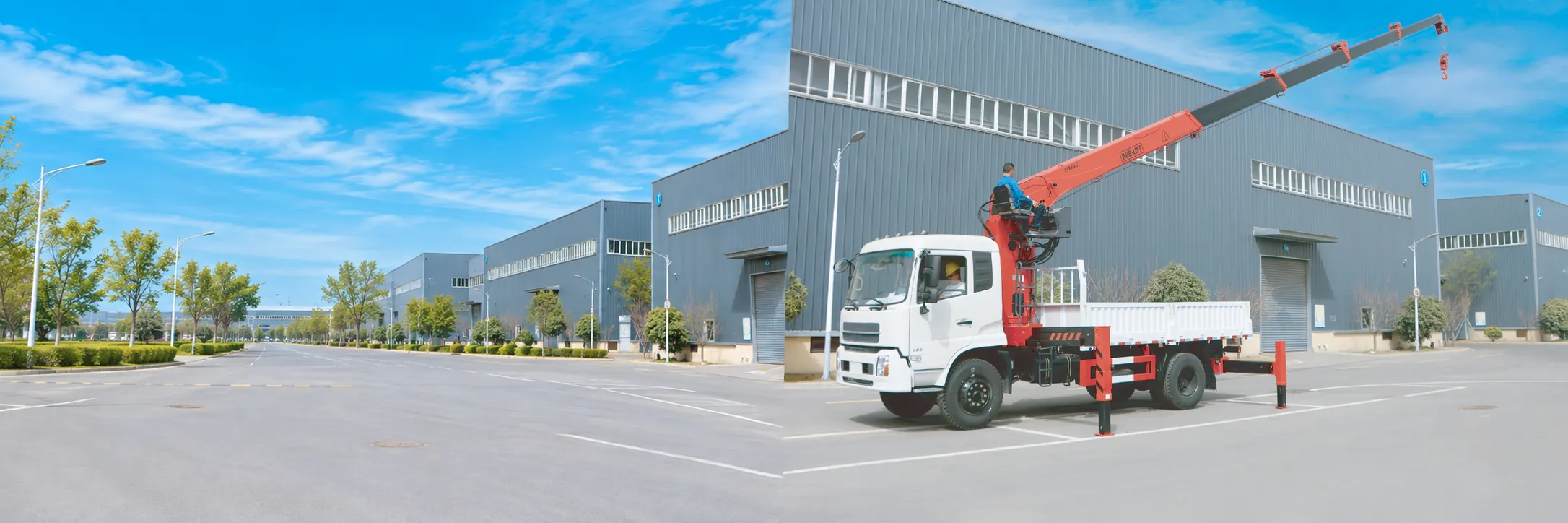
BOB-LIFT builds truck mounted cranes, not slings: you buy slings and other rigging from a lifting-gear supplier. What we can tell you is how the sling and the crane work together. Check these points when you plan the lift:
- The hook: seat the sling eyes in the bowl of the hook with the safety latch closed. Do not crowd several eyes on one hook; gather them in a shackle. Our crane hook guide covers latches and hook wear.
- Rigging weight counts: slings, shackles and any lifting beam are part of the load on the crane’s chart. Add them before you compare with the rated load at your radius, as our guides to safe working load and reading a crane load chart explain.
- Shackles and lugs: where the load has designed lifting points, connect the sling eyes with correctly rated rigging shackles to the lifting lugs.
- Long loads: a spreader bar keeps the legs near vertical and stops the slings squeezing the load. Use tag lines to control rotation.
- Other tools: plate is often better lifted with lifting clamps, and palletised goods with crane pallet forks. Devices that hang between hook and load are covered in our guide to below-the-hook lifting devices.
- The crane’s limiter does not check the sling: every BOB-LIFT crane is listed with a load moment limiter, which protects the crane. It does not know the rating of the sling in your hitch, so the rigger still has to choose a sling that is strong enough.
For lifts with more than one sling, tight space or an unknown centre of gravity, write it into a crane lift plan before the truck arrives on site.
Example scenario: choosing a webbing sling for a 1,800 kg lift
Example scenario (an illustration, not a customer record). A contractor in Johor, Malaysia, delivers a pump skid with a lorry crane, a BOB-LIFT SQ6.3ZA4 knuckle boom crane. The skid weighs an ASSUMED 1,800 kg and has two lifting lugs. The truck can park so that the landing point is an ASSUMED 6.0 m from the crane’s slewing centre. The rigging, two webbing slings and two shackles, weighs an ASSUMED 20 kg.
Step 1: check the crane. The SQ6.3ZA4 load chart lists 3,010 kg at 4.4 m, 2,020 kg at 6.3 m and 1,500 kg at 8.3 m. A radius of 6.0 m falls between two chart points, so the value at the larger radius applies: 2,020 kg. The rigged load is 1,800 + 20 = 1,820 kg, which leaves 200 kg spare. If the truck had to stand so that the radius grew to 8.0 m, the 8.3 m value of 1,500 kg would apply and the lift would not be allowed.

Step 2: choose the sling for the hitch. Using the EN 1492-1 mode factors, the smallest sling that holds 1,800 kg in each hitch is:
| Hitch | Smallest EN 1492-1 sling | Its limit in that hitch |
|---|---|---|
| Straight (vertical), one sling | Green 2 t | 2,000 kg |
| Choker, one sling | Yellow 3 t (green gives only 1,600 kg) | 2,400 kg |
| Basket, legs 0° to 45° from vertical | Green 2 t (violet gives only 1,400 kg) | 2,800 kg |
| Two slings as a two-leg sling, 0° to 45° | Two green 2 t slings | 2,800 kg |
With two lugs, the contractor rigs two green 2 t slings as a two-leg sling, one shackle per lug, and keeps each leg within 45° of the vertical. At exactly 45°, each leg carries 1,800 ÷ (2 × cos 45°), about 1,273 kg, so each shackle needs a working load limit of at least that. Had the skid no lugs, a single sling choked round its frame would need to be yellow 3 t, and the frame’s edges would need protection.
Frequently asked questions
What does the colour of a webbing sling mean?
Under the European standard EN 1492-1, the colour shows the working load limit in a straight vertical lift: violet 1 t, green 2 t, yellow 3 t, grey 4 t, red 5 t, brown 6 t, blue 8 t and orange 10 t and over. Not every maker outside Europe follows it, so always confirm the rating on the label.
How much can a 5 ton webbing sling lift?
5,000 kg in a straight vertical lift. Under the EN 1492-1 mode factors, the same sling lifts 4,000 kg in a choker hitch, 10,000 kg in a basket with parallel legs and 7,000 kg in a basket with legs up to 45° from vertical.
Is polyester or nylon better for a webbing sling?
It depends on the chemicals around the job. US rules keep nylon slings away from acids and phenolics and polyester slings away from caustics. Both are limited to 82.2 °C (180 °F) under the US construction rule.
How often should webbing slings be inspected?
Before each day’s use by a competent person, during use where conditions warrant, and periodically: OSHA’s guidance says at intervals of no more than 12 months, and LOLER in Great Britain requires a thorough examination of lifting accessories at least every 6 months unless an examination scheme applies.
Does BOB-LIFT supply webbing slings with its cranes?
No. We build truck mounted cranes; slings, shackles and other rigging come from a lifting-gear supplier. We can tell you the rated load of our crane at your radius, so you know how much weight the rigging and load together may have.
How we compiled this guide
The US rules are quoted from 29 CFR 1910.184 and 1926.251 on eCFR, and the practice notes from OSHA’s Guidance on Safe Sling Use, all read in November 2026. The EN 1492-1 and EN 1492-2 colour code, mode factors, label colours and temperature range come from DGUV Information 209-061, and the round sling description from WorkSafe New Zealand’s approved code of practice for load-lifting rigging. The LOLER interval is quoted from regulation 9 on legislation.gov.uk. Crane ratings come from the BOB-LIFT SQ6.3ZA4 load chart. Keyword research for this guide (Google Keyword Planner, November 2026) shows buyers in the Philippines, Malaysia, Indonesia, South Africa, Singapore, Nigeria and Kenya searching for “webbing sling”, “webbing sling 5 ton” and “webbing sling 3 ton”, which is why the guide gives ratings by hitch for those sizes. The example uses clearly marked assumed values. Achord Chan, Product Operations Director, carried out the editorial review.
Need a crane for your lifting job?
Tell us the heaviest load, the radius you need to place it at, how you rig it and the truck you plan to use. We will suggest a model from our knuckle boom truck mounted cranes or the wider truck mounted crane range and send its load chart with the quotation. Contact us to start.