
A crane tag line is a rope attached to a suspended load and held by a worker on the ground, so that the load can be prevented from spinning or swinging and guided into its final position. It controls rotation and drift, and it never supports any of the weight. Use one whenever rotation or swinging of the load would be hazardous or the load needs guidance, for example with long beams, pipe bundles and materials landed close to a structure. Attach it to the end of the load and hold it from outside the fall zone, never wrapped around a hand or arm.
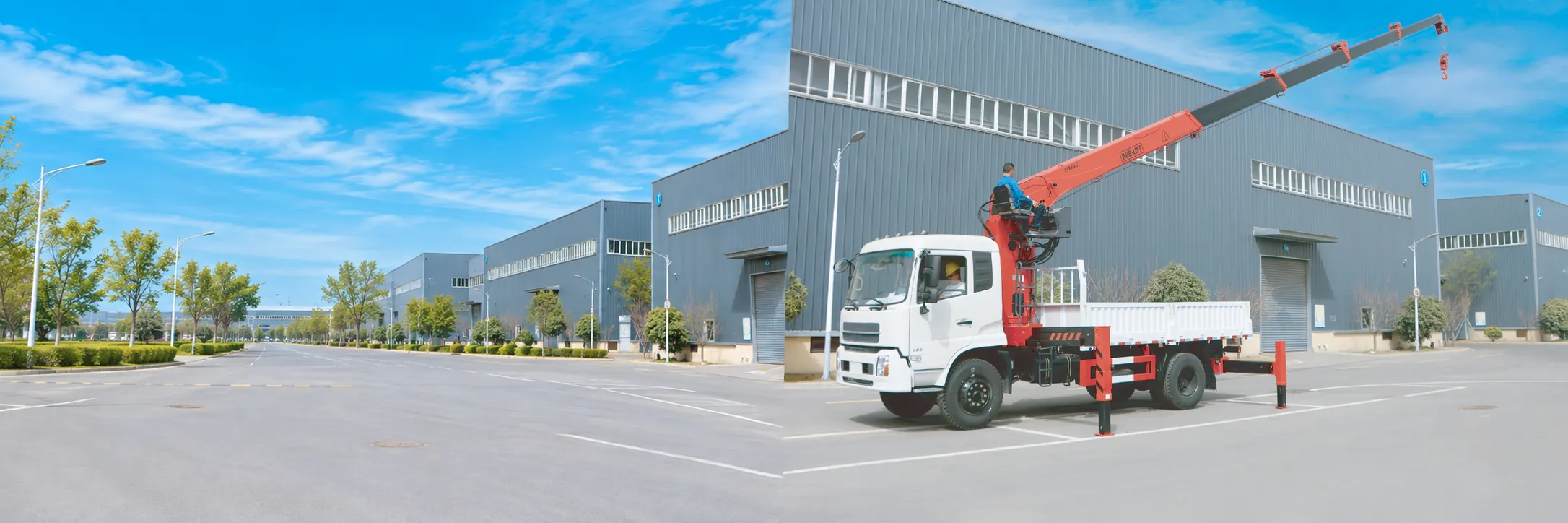
BOB-LIFT has manufactured truck mounted cranes in Xuzhou since 2003. This guide explains the regulatory requirements, the appropriate rope, the attachment points, the necessary length and the correct handling technique. It finishes with a calculated example based on a real BOB-LIFT load chart. Planning the complete lifting operation is covered in our crane lift plan guide.
Key takeaways
- OSHA defines a tagline as “a rope (usually fiber) attached to a lifted load for purposes of controlling load spinning and pendular motions”.
- Under 29 CFR 1926.1417(w), “A tag or restraint line must be used if necessary to prevent rotation of the load that would be hazardous” on construction sites.
- Near power lines, where encroachment precautions apply, the tag line “must be non-conductive”, so a wire rope or chain is never used as a tag line there.
- Attach the lines to the ends of the load and apply the force at right angles to it. On a 6 m bundle, a line at the end provides twice the leverage of one attached at a sling point 1.5 m from the centre.
- In our example with an SQ5ZA4 knuckle boom crane, each handler is positioned 3.5 m from the load, outside the designated fall zone, which requires a line of approximately 7 m.
What is a tag line on a crane?
OSHA’s crane rule for construction defines a tagline as “a rope (usually fiber) attached to a lifted load for purposes of controlling load spinning and pendular motions or used to stabilize a bucket or magnet during material handling operations” [1]. Operators and riggers also call it a guide rope or a restraint line.
The practical purpose of the rope is separation between the worker and the suspended load. A US Department of Energy hoisting and rigging manual states that “The safest method for a rigger to control a load suspended from a hook is with a tagline or a restraining device” [2]. It explains that a tagline “will give the rigger the distance he need if the load shifts or moves unexpectedly”. The crane supports, hoists and positions the load, while the person on the line only prevents unwanted rotation and drift.
When do you need a tag line, and when not?
The federal regulation is brief: under 29 CFR 1926.1417(w), “A tag or restraint line must be used if necessary to prevent rotation of the load that would be hazardous” [3]. The shipyard rule is broader: “Tag lines shall be provided on loads likely to swing or to need guidance” [4]. Washington State’s construction rule says “Tag lines or restraint lines must be used when rotation or swinging of the load is hazardous or if the load needs guidance” [5].
Washington’s enforcement directive on that regulation is particularly useful, because it also identifies situations where a tag line is not necessary. It states that “All loads that suspend from a crane or similar equipment do not require a tag line”. According to the directive, the line is required when a static load “swings, or is likely to swing back and forth (due to wind or other external factors)”. It is also required when crane movement is likely to make the load “swing out of control”, or when the load “rotates, has rotated, or is likely to rotate” out of control [5]. In practice that description covers most long or irregular loads, such as structural beams, pipe bundles, timber packs, roof trusses and precast panels.
A tag line is never an acceptable method of moving the load horizontally. OSHA says “The equipment must not be used to drag or pull loads sideways” [3], and pulling on a line to reach a position the hook cannot reach does exactly that. If the load will not land where it should, the crane is in the wrong position or working at the wrong radius, so stop the operation and reposition the equipment. The DOE manual also warns that “pinch and crush” injuries occur every year when individuals attempt to stop a swinging load manually [2].
What rope should a crane tag line be?
Use synthetic or natural fibre rope. OSHA’s definition says “usually fiber” [1], and the NSW Government’s dogging and rigging guide defines a tagline as “A fibre rope attached to a suspended load to control the load during lifting, minimum 16mm diameter” [6]. That diameter is the NSW requirement, so check the regulations in your jurisdiction, although a rope of that size is also considerably easier to grip with work gloves than a thin cord.
Near energized power lines, the material becomes a legal requirement: where encroachment precautions are required under Option (2) or Option (3) of 29 CFR 1926.1408, “If tag lines are used, they must be non-conductive” [7]. The identical sentence applies near transmitter or communication towers that can induce an electrical charge. It also appears in the regulations for equipment assembly and disassembly near power lines, 1926.1407(b)(2) [8]. Inside the Table A distance, 1926.1410(d)(7) says “If a tag line is used, it must be of the nonconductive type” [9], a requirement that a metallic wire rope or chain can never satisfy. Minimum clearance distances and the additional precautions are explained in our crane power line safety guide.
Where should tag lines be attached, and how many?
The DOE manual says to “Place the tagline(s) at points on the load for control during lift-off, traveling and placement” [2], which on a long load usually means the ends. The physics is identical to using a spanner, because torque equals force multiplied by the lever arm, and Wikipedia notes that when the force is perpendicular, “torque will be a maximum for the given force” [10]. A line attached to the end of a 6 m bundle operates 3 m from the hook. Attached to a sling point 1.5 m from the centre, the identical pull produces only half the turning effect, and the line can also interfere with the sling legs.
For long loads, use two separate lines at opposite ends: the Texas Department of Insurance crane safety program says to “Identify the tagline or push/pull stick attachment point on the load”. It adds that “A minimum of two tag lines should be used to control the swinging of the load” [11]. The Brookhaven National Laboratory rigging workbook recommends the round turn and two half hitches to “secure tag line to object”. It also says that if the only attachment points are below the centre of gravity, you should “stabilize the load using taglines” [12]. Attach the lines before the lift begins, while the load is still resting on the ground or on its supports.
How long should a crane tag line be?
None of the regulations and manuals we reviewed specifies a fixed length, so calculate it from the position where the handler must stand. OSHA defines the fall zone as the area “in which it is reasonably foreseeable that partially or completely suspended materials could fall in the event of an accident” [1]. The handler remains outside that area, so the line must reach from the attachment point at its highest position to the handler’s hands, with additional spare length to release if the load drifts away.
- Reach to the hands = √(horizontal distance² + height difference²).
- Line length = reach + additional spare length + the length consumed by the hitch.
- Line angle: the flatter the line, the more of the handler’s effort rotates the load. At 36° below horizontal, 81 percent of the pull acts horizontally, but at 59° only 51 percent does.
A handler who stands too close creates a steep line, wastes about half of the effort pulling the load downwards, and is positioned exactly where a falling load could land. An excessively long line leaves loose rope on the ground, which creates a tripping and snagging hazard, so coil the surplus beside you instead of allowing it to trail.
How do you handle a tag line safely?
- Never loop or wrap the line: the DOE manual specifies that the tagline person “should never loop the line around his arm or body” [2]. If the load pulls harder than you can resist, allow the line to slide through your gloved hands.
- Remain outside the fall zone: while the operator is not moving a suspended load, OSHA permits only employees “Engaged in hooking, unhooking or guiding a load” and a few other categories inside the fall zone. When they are present, the load must be rigged “to prevent unintentional displacement” by a qualified rigger [13]. A tag line is precisely what allows you to guide the load from outside that area.
- Never go underneath the load: the DOE manual instructs workers: “Do not perform work on a suspended load or place any body part under a load” [2].
- Maintain visibility of the travel path and the signal person: the handler “should have a clear view of his travel path and the signaler so he can anticipate the load’s movement” [2]. The same manual says the handler has the best control when “trailing the load while traveling with it”.
- Identify pinch points: never position yourself between the load and walls, material stacks, the truck body or the crane itself, especially during landing.
- Hold, do not haul: maintain light, steady tension to resist rotation, because the crane positions the load and the line only corrects its orientation.
- Anybody may stop the operation: under 1926.1417(y), “The operator must obey a stop (or emergency stop) signal, irrespective of who gives it” [3]. Agree on the communication method before the operation, using our crane hand signals guide.
- One person per line: two individuals sharing one line tend to work against each other, and a handler occupied with slings cannot simultaneously control the load.
Do tag lines work in wind?
Tag lines work only up to a point, because wind pressure on a long load grows with its exposed side area, while a person on a rope can only contribute a limited, steady pull. The DOE manual reminds handlers to “be aware of his abilities and limitations” [2], and once the line cannot hold the load steady, the correct response is to suspend the operation rather than add more people to the rope. Our crane wind speed limits guide explains how to determine the permissible wind speed for a particular lift.
What are the alternatives to a tag line?
The Texas program lists the “tagline or push/pull stick” side by side [11], and 29 CFR 1926.1417(w) names “A tag or restraint line” as interchangeable options where hazardous rotation must be prevented [3]. Our spreader bar guide describes lifting beams that keep long loads horizontal and stable.
Does a knuckle boom crane with remote control still need tag lines?
Usually yes, particularly for long or irregular loads, even though a radio remote control allows the operator to stand beside the landing position instead of at the crane. An articulating knuckle boom can also position the hook precisely, which reduces how much manual guidance a load requires, but it does not eliminate rotation. Slewing the boom inevitably starts a long load rotating, and OSHA requires that “Rotational speed of the equipment must be such that the load does not swing out beyond the radius at which it can be controlled” [3].
The operator therefore slews slowly while the tag line handlers control whatever rotation remains, and the two responsibilities stay separate, because an operator who also holds a tag line leaves nobody observing the load from a distance. Our knuckle boom crane operation guide covers preparation and smooth operation. For roof trusses, the truss crane guide illustrates tag lines on prefabricated trusses, and for two cranes sharing one load, see our tandem lift guide.
Example: an SQ5ZA4 setting a 6 m bundle with two tag lines
Example scenario (an illustration, not a customer record): a builder’s merchant unloads a 6 m bundle of steel pipe from its own truck. The bundle goes to a ground-level stack beside the road. The crane is a BOB-LIFT SQ5ZA4 knuckle boom crane, a 5,000 kg, 10.5 t·m model. All load, rigging and site figures are ASSUMED; the crane figures come from BOB-LIFT drawings.
- Load: a bundle 6.0 m long, 1.0 m wide and weighing 1,200 kg, suspended on a two-leg sling attached at the quarter points, with the sling and shackles adding 30 kg (assumed).
- Radius: the destination stack is located 6.2 m from the slewing centre. The SQ5ZA4 load chart specifies 1,600 kg at 6,200 mm, so the total hook load of 1,230 kg represents 77 percent of the rated capacity.
- Fall zone: the lift planner defines it as the bundle footprint plus 2.0 m in every direction (assumed).
- Handlers: two workers, each controlling one line attached to opposite ends, positioned 1.0 m outside the fall zone and therefore 3.5 m from the bundle’s centre line.
- Heights: the attachment point reaches a maximum of 3.5 m above the ground while the bundle clears the vehicle side, and the handler’s hands are approximately 1.0 m high (assumed).
| Item | Calculation | Result |
|---|---|---|
| Reach from tie point to hands | √(3.5² + 2.5²) | 4.3 m at 36° below horizontal |
| Share of the pull that turns the load | cos 36° | 81 percent |
| Line length | 4.3 m + 2.0 m spare + 0.5 m for the hitch | 6.8 m, so use lines of 7 m or more |
| Handler inside the fall zone, 1.5 m from the centre line | angle = arctan(2.5 ÷ 1.5) | 59°, only 51 percent of the pull turns the load |
| Tie at the end vs at the sling point | lever arm 3.0 m vs 1.5 m | The end gives twice the turning effect |

The example also demonstrates what a tag line cannot correct: at 8.05 m the SQ5ZA4 chart specifies 1,100 kg, so the identical 1,230 kg hook load would represent 112 percent of the rated capacity. Pulling the bundle further outwards with a line would drag the load sideways and overload the crane, so the only acceptable solution is to position the truck closer to the stack. Every BOB-LIFT crane is listed with a load moment limiter, as our article on the lifting moment of a crane explains, but the limiter only reads its own crane and cannot detect a sideways pull from the ground.

According to its dimension drawing, the SQ5ZA4 weighs 2,386 kg, operates across a working range of 4,535 to 9,900 mm and has an adjustable outrigger span of 2,272 to 5,122 mm. Its full load chart is on the SQ5ZA4 product page. Our guide on how to read a crane load chart explains why you use the chart point at or beyond your radius. Slings and sling angles are covered in our crane rigging and slings guide.
Frequently asked questions
What is a tag line on a crane?
It is a rope, usually fibre, attached to a suspended load and held by a worker on the ground to prevent spinning or swinging and to guide the load into position. It controls rotation and does not carry any of the load’s weight.
Does OSHA require tag lines on every crane lift?
No, because 29 CFR 1926.1417(w) requires a tag or restraint line only if necessary to prevent hazardous rotation of the load. Near power lines, where encroachment precautions apply, any tag line used must also be non-conductive.
What kind of rope is used for a crane tag line?
Fibre rope is the standard choice: NSW rigging guidance specifies a minimum diameter of 16 mm, and near energized power lines the line must be non-conductive, which excludes wire rope and chain.
How long should a tag line be?
It must be long enough to reach from the attachment point at its highest position to the handler’s hands outside the fall zone, plus additional spare length. In our example of a 6 m bundle raised 3.5 m high, that calculation produced approximately 7 m per line.
Can a tag line be used to pull a load into position?
No, because it only controls rotation and drift, and OSHA prohibits using the equipment to drag or pull loads sideways. If the load cannot reach its position, relocate the crane or change the working radius.
How we compiled this guide
The rules come from the official eCFR text of 29 CFR 1926.1401, 1926.1407, 1926.1408, 1926.1410, 1926.1417 and 1926.1425 and of 29 CFR 1915.116. Washington’s rule and its enforcement policy come from the Department of Labor and Industries directive on tag line use. The handling advice is taken from the US Department of Energy manual “Hoisting and Rigging Fundamentals” and the Brookhaven National Laboratory basic rigging workbook. We also used the Texas Department of Insurance program on cranes and derricks in construction and the NSW Government dogging and rigging guide. The lever-arm explanation follows Wikipedia’s article on torque, and all sources were read in November 2026. The crane figures come from the current BOB-LIFT SQ5ZA4 load chart and dimension drawing, while the example uses clearly identified assumed figures. Achord Chan, Product Operations Director, reviewed the guide before publication, and it does not replace a lift plan, the operator’s manual for the crane or the regulations applicable in your location.
Choosing a crane for long loads?
Tell us the load dimensions and weight, the distance from the truck to the delivery position and the height of any obstacles the load must clear. We will evaluate the application against our knuckle boom truck mounted cranes and provide the relevant dimension drawings and load charts. BOB-LIFT supplies the crane only, while tag lines, slings, shackles and the truck are supplied separately. If you buy the truck in China, we can fit the crane at our factory; if you buy it locally, we ship the crane, a local body builder fits it and we support the work remotely. Contact us for a quotation; every crane carries a 12-month warranty on the whole machine.