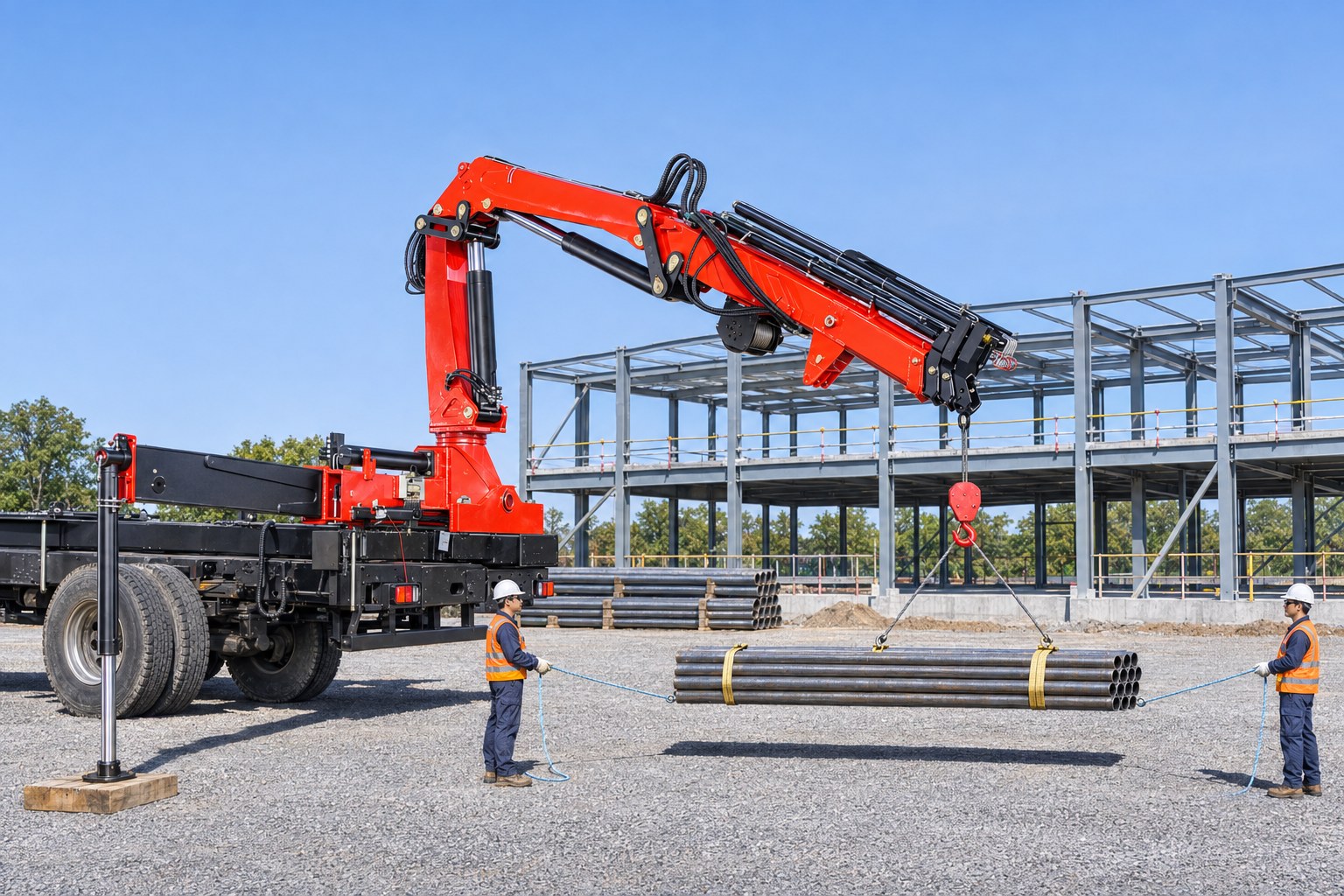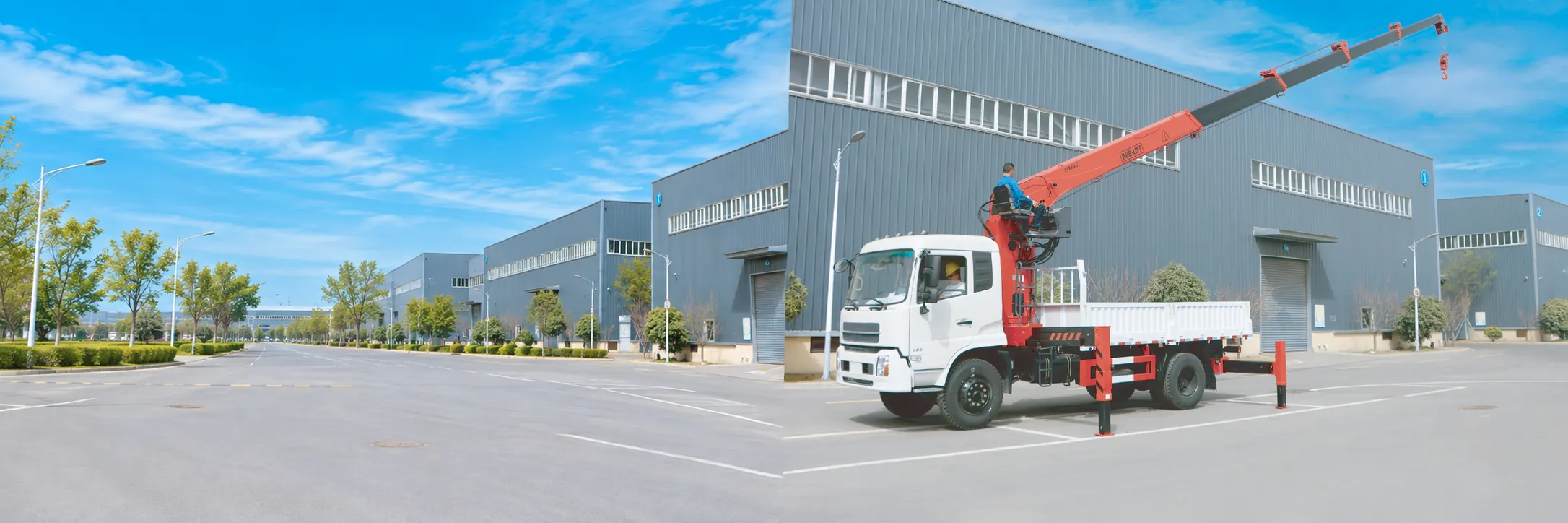

A crane man basket is a guarded platform that lets a crane raise people for short work at height. It is also called a personnel platform, a personnel basket, a work basket or a man cage, and it either hangs from the crane’s hook or is fixed to the boom tip. In the United States, 29 CFR 1926.1431 allows a crane to hoist workers only when conventional access such as an aerial lift or scaffold would be more hazardous or is not possible. The loaded basket must then stay within 50 percent of the crane’s rated capacity, and a trial lift and a 125 percent proof test come before anyone steps in.
BOB-LIFT has built truck mounted cranes in Xuzhou since 2003. As standard our cranes lift materials; a work basket is an option, charged separately, and its specification is confirmed with the quotation for the crane model. This guide explains the two kinds of man basket, when the US rules allow one, what they require of the crane and of the basket, and the order of meeting, trial lift and proof test. It ends with a check of a two-person basket against the load chart of a real BOB-LIFT SQ8ZA6 knuckle boom crane.
Key takeaways
- OSHA prohibits hoisting employees with a crane unless conventional means of reaching the work “would be more hazardous, or is not possible” [1].
- A loaded man basket fixed to the boom, or a hung basket together with its hook and rigging, may weigh at most 50 percent of the crane’s rated capacity for the radius and configuration.
- The basket must be designed by a qualified person, hold its own weight and at least five times the maximum intended load, and carry a plate with its weight and rated capacity.
- Before people ride, the crew holds a pre-lift meeting, makes a trial lift and proof tests the basket and rigging to 125 percent of the basket’s rated capacity for at least five minutes.
- In our example, a 450 kg loaded basket passes the 50 percent check on a BOB-LIFT SQ8ZA6 out to 12.63 m but is 25 kg over at 14.68 m, the crane’s longest chart radius.
What is a crane man basket?
OSHA’s rule calls it a personnel platform, and it separates two designs [1]. A suspended man basket hangs from the hook or load line on a sling bridle, so the crane lifts it like any other load. A boom-attached man basket is fixed to the boom tip, which is how the work basket option on our SQ8ZA6 is fitted. The ASME B30.23 standard on personnel lifting systems covers both: a platform lifted “by wire rope or chain, from hoist equipment, or by a platform that is mounted on a boom of the hoist equipment” [2]. ASME adds that “the lifting of personnel is not allowed using some ASME B30 Standard equipment”, so the standard for the crane type decides first.
In Australia the same item is a workbox. The NSW Government’s Dogging and Rigging guide separates boxes for tools and materials from “man boxes”, which “are used for lifting and hoisting personnel” [3]. A basket for materials is therefore not a man basket, even if it looks similar. Our guide to knuckle boom crane attachments places the man basket next to the winch, grapple and auger; this page covers the basket in depth.
When does OSHA allow a man basket on a crane?
Paragraph (a) of 29 CFR 1926.1431 starts with a prohibition. Hoisting employees with a crane is not allowed “except where the employer demonstrates” that conventional access will not do. The rule lists that access as “a personnel hoist, ladder, stairway, aerial lift, elevating work platform, or scaffold”. Their erection, use and dismantling must be shown to be “more hazardous, or is not possible because of the project’s structural design or worksite conditions.”
The burden sits with the employer. Before planning a crane man riding basket, the crew should ask whether an aerial lift, a mobile elevating work platform or a scaffold can reach the job, and write down why not if the answer is no. The rule then names exceptions where a platform is not required, such as drill shafts up to 8 feet in diameter, pile driving and marine personnel transfer; they have their own paragraphs and are outside this guide.
In Great Britain, HSE says that the use of lifting equipment not specifically designed for lifting people “should only occur in exceptional circumstances (eg for rescue purposes)” [4].
What does the crane need before it lifts people?
Set-up comes first. The crane “must be uniformly level, within one percent of level grade”, on footing a qualified person has judged firm and stable. Equipment with outriggers “must have them all extended and locked”, with the same extension on every outrigger [1]. Uneven outrigger settings are therefore out for personnel work. Our guide to crane outriggers and ground bearing pressure covers the footing.
Then capacity. For a suspended basket, the total load counts the loaded platform plus “the hook, load line and rigging”. It “must not exceed 50 percent of the rated capacity for the radius and configuration of the equipment, except during proof testing.” For a boom-attached basket, “the total weight of the loaded personnel platform must not exceed 50 percent of the rated capacity for the radius and configuration”. When the occupied basket is stationary, the load and boom hoist brakes, swing brakes and any secondary brakes or locks must be engaged.
Paragraph (d)(5) lists the devices, and they differ by crane type:
- Variable angle booms (except derricks and articulating cranes): a boom angle indicator readily visible to the operator and a boom hoist limiting device.
- Articulating (knuckle boom) cranes: “a properly functioning automatic overload protection device”.
- Telescoping booms: a device that shows the extended boom length, or measuring marks on the boom.
- Anti two-block: a device that automatically prevents “damage and load failure from contact between the load block, overhaul ball, or similar component, and the boom tip”; see our anti-two-block device guide.
- Controlled load lowering: a system on the load line hoist drum, other than the hoist brake, that regulates the lowering speed, used whenever personnel are hoisted.
Personnel hoisting “must not begin unless the devices listed in this section are in proper working order”, and if one fails during the work, the operator must safely stop; “alternative measures are not permitted” [1]. Every BOB-LIFT crane is listed with a load moment limiter, as our article on the lifting moment of a crane explains. During the trial lift, the competent person must determine that these devices are “activated and functioning properly”. Our load moment indicator guide describes what such systems sense and what they cannot see.
What must the man basket itself meet?
Paragraph (e) of 1926.1431 sets the platform criteria [1]. The main ones are:
- Design: “a qualified person familiar with structural design must design the personnel platform and attachment/suspension system”.
- Level: the connection must keep the platform “within 10 degrees of level, regardless of boom angle”.
- Strength: the platform must support “its own weight and at least five times the maximum intended load”.
- Welding: done “by a certified welder familiar with the weld grades, types and material specified in the platform design”.
- Guarding: a guardrail system, enclosure at least from the toeboard to the mid-rail with openings no greater than 1/2 inch (1.27 cm), and a grab rail inside the whole perimeter except at gates.
- Gates: they must not swing outward, except where a one-person platform makes that infeasible, and must have a device that prevents accidental opening.
- Overhead protection: required, in addition to hard hats, when occupants are exposed to falling objects.
- Marking: “the weight of the platform and its rated capacity must be conspicuously posted on the platform with a plate or other permanent marking”.
Loading has its own limits: the basket must not exceed its rated capacity, and the number of occupants must not exceed the number it was designed for or the number the work needs, whichever is less. The federal text does not certify baskets: in 1926.1431 the word “certified” appears only for the welder. What the rule demands is a qualified design, the five-to-one strength and a posted weight and rating, so ask the basket supplier for the design documents and the marking.
For a suspended basket, the rigging rules in paragraph (g) also apply. Hooks between the hoist line and the platform must be “of a type that can be closed and locked, eliminating the throat opening”, and must be closed and locked when attached; our crane hook guide covers latches and locking hooks. Shackles used instead of hooks “must be of the alloy anchor type”, with a bolt, nut and retaining pin, or a secured screw pin. Rigging hardware must support at least five times the maximum intended load, and the bridle may be used only for hoisting personnel. NSW asks for a stamped data plate on a workbox showing, in kilograms, the maximum hoisted load, the WLL, the tare mass, the “minimum allowable (rated) crane capacity” and an identification reference [3].
Pre-lift meeting, trial lift and proof test
The US rule fixes the order of the preparation steps [1]:
- Pre-lift meeting: held “prior to the trial lift at each new work location” and attended by the operator, the signal person if used, the employees to be hoisted and the person responsible for the task. It is repeated for anyone newly assigned.
- Trial lift: the unoccupied basket, “loaded at least to the anticipated liftweight”, travels from where people will get in to each work position. It is made immediately before each shift in which personnel will be hoisted, and again after the crane is moved and set up, or after the lift route changes unless the competent person finds no new factors affecting safety. The competent person confirms that the devices work, nothing interferes, the lift stays within 50 percent of rated capacity throughout and the radius “has been accurately determined”.
- Proof test: at each jobsite, and after any repair or modification, the platform and rigging “must be proof tested to 125 percent of the platform’s rated capacity”. The basket is held suspended “for a minimum of five minutes with the test load evenly distributed”, then inspected by a competent person. The proof test may run with the trial lift.
- Final check: immediately before each lift, the basket is “hoisted a few inches with the personnel and materials/tools on board” and inspected to make sure it is secure and balanced.
The proof test here is a personnel-specific test of the basket and its rigging, separate from the load test of the crane itself; our guide to crane load testing covers the crane side. The meeting, the trial lift results and the radius belong in the crane lift plan.
Rules while people are in the basket
Paragraph (k) governs the lift itself [1]. Hoisting must be “slow, controlled, cautious”, with no sudden movements. Occupants keep every part of the body inside the basket while it moves, do not stand on the rails or toeboard, and do not pull the basket out of plumb. If the basket is tied to a structure for people to get in or out, the operator waits for confirmation that it is freely suspended before moving it.
- Controls: without basket controls, the operator stays at the crane controls, on site and in view, while the basket is occupied. With basket controls, the occupant using them must be qualified, and the operator must still be at a set of controls with boom and swing functions.
- Fall protection: except over water, occupants use a personal fall arrest system “attached to a structural member within the personnel platform”.
- Communication: hoisted employees “must remain in direct communication with the signal person (where used), or the operator”; see our crane hand signals guide.
- Wind: above 20 mph at the platform, sustained or in gusts, a qualified person decides whether lifting people is safe. Our article on crane wind speed limits explains why that figure applies only to personnel platforms.
- No other lifts: no lifts on any other load line of the crane while personnel are hoisted, except in pile driving. Tag lines are used when needed to control the platform.
- No travel: hoisting while the crane travels is allowed only in narrow cases, and the exception “does not apply to rubber-tired equipment”. A truck mounted crane stays parked on its outriggers.
Paragraph (n) prohibits hoisting personnel “within 20 feet of a power line that is up to 350 kV” and “within 50 feet of a power line that is over 350 kV”, except for power transmission and distribution work. With a foot defined as exactly 0.3048 m [5], that is about 6.1 m and 15.2 m. Our guide to crane power line safety covers clearances for ordinary lifts.
Man baskets under UK and Australian rules
In Great Britain, LOLER regulation 5 sets extra duties for lifting equipment for lifting persons. One of them is that the equipment “is such that a person trapped in any carrier is not thereby exposed to danger and can be freed” [6]. The rescue plan for a basket stuck aloft is therefore part of the job. HSE asks for a thorough examination at six-monthly intervals “whether the lifting equipment is designed to lift them or not”. It also mentions extra measures such as “check valves and locking the tilt function” where equipment not designed for people is used [4]. Our LOLER guide for lorry loaders explains regulation 5 and the examination regime in full.
In New South Wales, the crane used with a man box must be fitted with a safety hook, controls that return to neutral, power lowering, a lockout to prevent freefall and an up-limit switch on the hoist [3]. At the maximum intended radius, the crane’s WLL “must be at least twice the total load of the workbox, or 1.5t, whichever is greater”. At least one person in the box must hold a dogging or rigging high risk work licence. The 1.5 t floor makes the NSW rule stricter than the US 50 percent rule for light baskets, as the example below shows.
Using a man basket on a knuckle boom truck mounted crane
OSHA defines an articulating crane as one “whose boom consists of a series of folding, pin connected structural members”, which is a knuckle boom [7]. On our SQ8ZA6 option the basket is fixed to the boom tip rather than hung from a hook, and three points follow. The basket and its mounting count as load at the tip radius, every time. The radius changes as the folding sections move, so the operator must know the tip radius at each work position. The 50 percent check uses the crane’s rated capacity “for the radius and configuration”, which means the chart for the basket configuration if the crane maker issues one.
The same goes for a boom truck man basket: whatever the crane is called, the same federal rule applies, and the device list depends on whether the boom is a variable angle boom, a telescoping boom or an articulating boom. On BOB-LIFT cranes the basket is an option priced separately from the crane. The basket specification and how it mounts are confirmed in the quotation for the model you choose.

Example: a two-person basket on a BOB-LIFT SQ8ZA6
Example scenario (an illustration, not a customer record): a contractor plans a boom-attached basket on a BOB-LIFT SQ8ZA6 knuckle boom truck mounted crane. The job is a facade fixing that no aerial lift can reach from the site. The basket, crew and tool weights are ASSUMED; the crane figures come from the SQ8ZA6 dimension drawing and load chart.
- Crane: the SQ8ZA6 drawing lists 8,000 kg maximum lifting capacity, a 16 t·m lifting moment, a 3,450 kg crane weight and a working radius of 4,509 to 14,680 mm.
- Basket: a two-person basket with its boom-tip mounting weighing 220 kg, with a marked rated capacity of 250 kg (ASSUMED).
- Occupants and tools: two workers with harnesses at 90 kg each, plus 50 kg of tools (ASSUMED). That is 230 kg, within the 250 kg rating.
- Loaded basket: 220 + 180 + 50 = 450 kg. Under 1926.1431(d)(2), the crane’s rated capacity at the working radius must be at least 2 × 450 = 900 kg.
| Radius | Rated load (load chart) | 50 percent limit | Loaded basket 450 kg |
|---|---|---|---|
| 8.51 m | 1,820 kg | 910 kg | Passes, 460 kg spare |
| 10.56 m | 1,420 kg | 710 kg | Passes, 260 kg spare |
| 12.63 m | 1,160 kg | 580 kg | Passes, 130 kg spare |
| 14.68 m | 850 kg | 425 kg | Fails, 25 kg over |

The basket can work out to 12.63 m with 130 kg in hand, but not at the crane’s longest chart radius. A crew that plans for full reach would need a lighter basket, one worker fewer or a different crane. The radius used must be the measured radius to the basket at the work position, which is why the trial lift asks the competent person to confirm it.
Next come the trial lift and proof test. The trial lift runs with the empty basket loaded to at least 450 kg along the planned route. The proof test needs 1.25 × 250 = 312.5 kg spread evenly in the basket, held for five minutes. The crane then carries 220 + 312.5 = 532.5 kg; the 50 percent limit does not apply during proof testing, and at 12.63 m that is 46 percent of the 1,160 kg rating.
Under the NSW workbox rule, the same 450 kg would need twice its weight, 900 kg, or 1.5 t, whichever is greater. The 1.5 t floor governs, so among the chart points only 8.51 m (1,820 kg) or a shorter radius would qualify. NSW writes that rule for crane-lifted workboxes; for a boom-mounted basket, follow the instructions of the basket and crane makers as well. Our guide on how to read a crane load chart shows where these radius figures come from, and the full drawing and load chart are on the SQ8ZA6 product page.
Frequently asked questions
Does OSHA allow a man basket on a crane?
Yes, but only under 29 CFR 1926.1431, and only where the employer shows that a personnel hoist, ladder, stairway, aerial lift, elevating work platform or scaffold would be more hazardous or is not possible. The crane, the basket, the trial lift, the proof test and the work practices must then all meet that section.
What is the 50 percent rule for a crane personnel basket?
The loaded basket may weigh no more than half of the crane’s rated capacity at the radius and configuration used. For a suspended basket, the hook, load line and rigging count too. The limit is lifted only during proof testing.
What is a certified man basket?
The US rule does not certify baskets. It requires a design by a qualified person familiar with structural design, a strength of at least five times the maximum intended load, welding by a certified welder and a permanent plate showing the basket’s weight and rated capacity.
What wind speed stops a man basket lift?
Under 1926.1431(k)(8), when wind at the basket exceeds 20 mph, sustained or in gusts, a qualified person must decide whether it is safe to lift personnel. If it is not, the lift must not begin, or must stop if already under way.
Can I order a BOB-LIFT crane with a man basket?
Yes. A work basket is available as an option, charged separately; as standard our cranes lift materials. Tell us the model, the work height and radius, and the number of people, and we confirm the basket specification with the quotation.
How we compiled this guide
The US requirements are quoted from the official eCFR text of 29 CFR 1926.1431 and the definitions in 1926.1401, read in November 2026. The UK points come from HSE’s page on lifting equipment used for lifting people and from LOLER regulation 5 on legislation.gov.uk, and the Australian points from the NSW Government Dogging and Rigging guide on crane-lifted workboxes. The ASME B30.23 scope is taken from the ASME website, and the foot to metre conversion from Wikipedia. The crane figures come from the BOB-LIFT SQ8ZA6 dimension drawing and load chart; the basket and crew weights in the example are assumed and marked as such. Achord Chan, Product Operations Director, carried out the editorial review. This guide does not replace the crane’s operator’s manual, the basket maker’s instructions or the rules where you work.
Planning work at height with a crane?
Tell us the work height, the radius from the truck to the work position, the number of people and their tools, and whether a basket is needed at all. We will check the job against the load chart of a suitable knuckle boom truck mounted crane and quote the crane with the basket option where it fits. If you buy the truck in China, we can fit the crane at our factory; if you buy it locally, we ship the crane, a local body builder fits it and we support the work remotely. Contact us for a quotation; every crane carries a 12-month warranty on the whole machine.