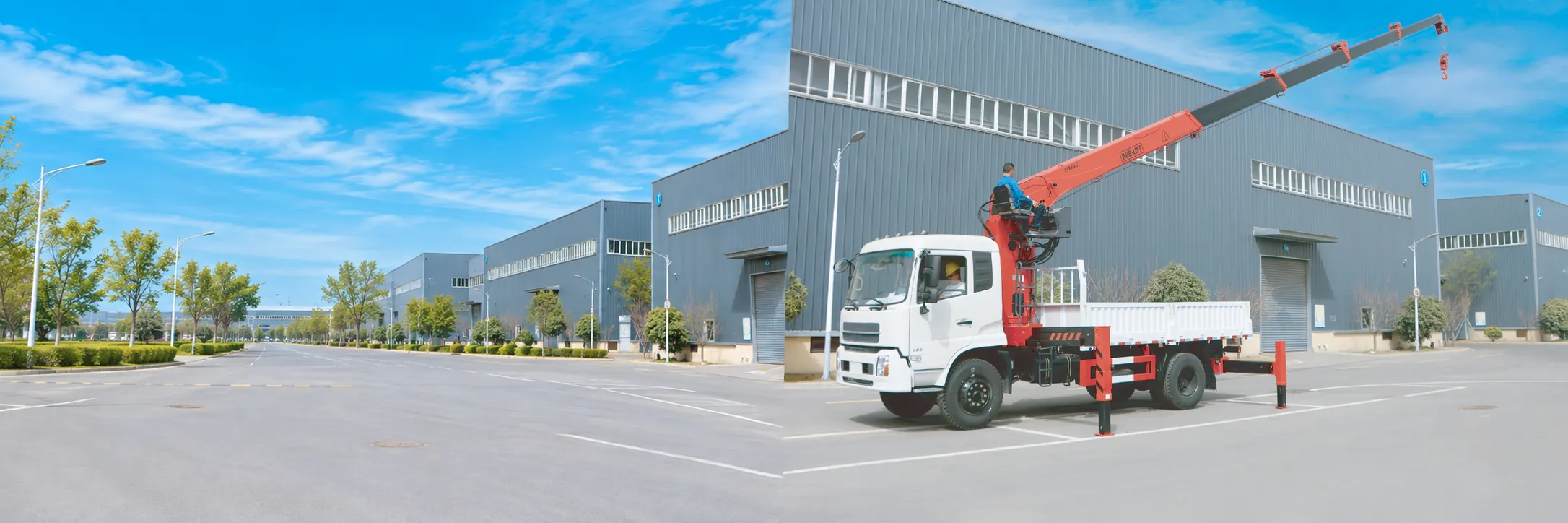

The wind speed limit for a crane is the in-service wind speed set by its manufacturer. You find it in the operator’s manual or the load chart notes, and the competent person on site applies it to the actual lift. There is no single number that fits every crane, because the limit depends on the crane, the boom set-up and how much surface the load shows to the wind. A crane wind speed limit is the highest wind speed, including gusts, at which the manufacturer allows the crane to keep lifting, and a lighter load with a large flat face may need to stop well before that figure.
We have built truck mounted and marine cranes in Xuzhou since 2003, and wind is one of the questions our customers raise most often. This guide explains what OSHA and the UK lifting rules say, why wind matters more than it seems, how to measure it at the height that counts, and how to run a lift on a windy day. Our own drawings and load charts do not state a separate wind figure, so for any BOB-LIFT crane the operator’s manual supplied with the crane is the reference.
Key takeaways
- The crane manufacturer sets the in-service wind speed limit, and the competent person applies it to the real load, boom set-up and site.
- OSHA gives no general mph limit for mobile cranes; 29 CFR 1926.1417(n) requires the competent person to adjust for wind, and the 20 mph figure applies only to hoisting personnel platforms.
- Wind force rises with the square of wind speed, so doubling the speed puts four times the force on the load.
- Large, light loads such as panels, sheets, roof trusses and empty containers act like sails and may need to stop well below the crane’s limit.
- Measure the wind and its gusts at the height of the boom tip, write a stop limit into the lift plan, and lower the load and stow the boom before the wind reaches it.
What is the wind speed limit for a crane?
The limit is the figure the crane manufacturer gives, read for the boom configuration and load you will actually use. In its Approved Code of Practice for lifting equipment, HSE states directly that “the crane manufacturer will be able to supply information on the maximum permissible in-service wind speeds and any derating for items with a large surface area” [1]. The same document adds that, where appropriate, “the maximum wind speed in which the lifting equipment can be used should be included in the instructions on use”.
Two terms from that guidance are useful when you plan a lifting operation. The in-service wind speed is the wind speed up to which a crane may keep working, as opposed to the out-of-service wind it must survive when it is parked. Derating means “adjusting the safe working load to take account of the circumstances or conditions in which lifting equipment is used”, and HSE gives the example of “lifting a large surface load in windy conditions”.
In practice, look for the wind figure in three places: the operator’s manual, the notes printed with the load chart, and any decal on the crane. Our guide on how to read a crane load chart shows where those notes usually sit. If you cannot find a wind figure for your crane, ask the manufacturer in writing before the job and record the answer in your crane lift plan, which already has a row for stop conditions.
What does OSHA say about wind speed for cranes?
OSHA’s construction crane standard does not set one wind speed in mph for mobile or truck mounted cranes; instead, it puts the duty on people and on the manufacturer’s procedures. These are the parts of 29 CFR 1926 subpart CC that mention wind, quoted from the official eCFR text:
| Rule | What it says about wind | Applies to |
|---|---|---|
| 1926.1417(n) | “The competent person must adjust the equipment and/or operations to address the effect of wind, ice, and snow on equipment stability and rated capacity.” | All cranes in subpart CC, during operation |
| 1926.1417(h) | When a local storm warning has been issued, the competent person must decide whether to apply “manufacturer recommendations for securing the equipment”. | All cranes, storm warnings |
| 1926.1404(h)(12) | The hazards to address include “the effect of wind speed and weather on the equipment”. | Assembly and disassembly |
| 1926.1435 | Wind “must not exceed the speed recommended by the manufacturer”, and a wind speed indicator is required on tower cranes. | Tower cranes only |
| 1926.1431(k)(8)(i) | When wind (sustained or gusts) exceeds 20 mph at the platform, a qualified person must decide whether it is safe to lift personnel. | Personnel platforms only |
Source: eCFR, 29 CFR 1926.1404, 1926.1417, 1926.1431 and 1926.1435, retrieved November 2026. The 20 mph figure is often quoted as “the OSHA crane wind limit”, but it belongs to the personnel platform rule, and since BOB-LIFT cranes never lift people it is context only here. For a truck mounted crane lifting materials, the OSHA answer is the manufacturer’s limit plus the judgement of the competent person under 1926.1417(n). The first line of the same section, 1926.1417(a), also requires employers to “comply with all manufacturer procedures applicable to the operational functions of equipment”.
What do LOLER and HSE guidance say about wind?
In Great Britain, regulation 8 of LOLER requires every lifting operation to be “properly planned by a competent person”, “appropriately supervised” and “carried out in a safe manner”. HSE’s page on planning and organising lifting operations lists “the effects of wind” among the points a plan must cover. The detail sits in HSE’s L113 guidance, second edition, published in 2014, and its main points on wind are summarised below.
- Detect and stop: where high wind may affect the equipment or its load, “appropriate devices should be made available and used so as to detect dangerous situations”.
- Forecasts are not enough: weather services give a general idea for an area, but they “cannot provide an accurate indication of the prevailing wind conditions at a particular moment”. HSE therefore adds that “some means of providing a reliable measure of the wind speed, including gusts, may therefore be necessary”.
- Load shape matters: “the larger the surface area of the load presented to the wind then the greater the effect a gust of wind will have”.
- Wind action levels: the plan may need set wind speeds “that require additional measures to be taken”, such as stopping until the wind dies down or lowering the load to the ground.
- Weather in general: lifting in the open air “should be halted where the weather (meteorological condition) deteriorates to the point that it could affect the integrity of the lifting equipment or expose people to risks”.
HSE also notes that “wind effects can be relevant both indoors and outdoors”. The UK text and the US text reach the same place by different routes: the crane maker gives the limit, and a competent person decides how it applies to the lift in front of them.
Why does wind make a crane lift dangerous?
Wind pushes sideways on the load and on the boom, and that push grows much faster than the wind speed itself. The standard drag formula is F = ½ρu²cdA, where ρ is the air density, u the wind speed, cd the drag coefficient and A the area facing the wind. As Wikipedia’s drag equation article puts it, “when flow velocity is doubled”, the force “is multiplied by four”. The effects you see on a crane job are listed below.
- Sail loads: a light load with a large flat face, such as a wall panel, a roof sheet, a roof truss or an empty container, catches far more wind than a compact steel part of the same weight. Our guide on how to lift a shipping container with a crane covers one of the most exposed loads a truck mounted crane handles.
- Load swing and spin: the load drifts away from the planned path, starts to rotate and becomes hard to land or to control with taglines.
- Side load on the boom: wind on the load and on the boom pushes the boom tip sideways, and HSE warns that the wind on a load “may affect the stability and rated capacity of the lifting equipment”.
- A longer effective radius: wind from behind the crane pushes the load outward and adds to the overturning moment.
- Gusts: a gust is “a brief, sudden increase in the wind speed” that usually lasts less than 20 seconds, according to Wikipedia’s wind gust article, so a calm average can hide short peaks.
Load charts show how little room there is once the load moves out: on the load chart of our SQ12ZA4 knuckle boom crane, the rating is 3,750 kg at 6.45 m and 2,750 kg at 8.2 m. A load that ends up 1.75 m further out than planned has therefore lost more than a quarter of its rating. Every BOB-LIFT crane is listed with a load moment limiter, as our article on the lifting moment of a crane explains, but a limiter reacts to load moment and is no substitute for stopping before the wind gets too strong.
How much force does wind put on a crane load?
Example scenario (an illustration, not a customer record): a crew needs to lift a flat wall panel with a truck mounted crane. For this illustration we assume the panel measures 6.0 m by 2.4 m, an area of 14.4 m², and weighs 600 kg, and that it hangs 5 m below the boom tip with its flat face square to the wind. We use a drag coefficient of 1.28, the value listed for a flat plate facing the flow in Wikipedia’s drag coefficient table. For the air density we use 1.225 kg/m³, the sea-level value at 15 °C given in Wikipedia’s density of air article. These are assumed figures for the illustration, not data for any real panel or crane.

| Wind speed | Force on the panel | Same force as a weight of | Hoist rope leans by | Panel drifts sideways by |
|---|---|---|---|---|
| 5 m/s (18 km/h, 11 mph) | 282 N | about 29 kg | 2.7° | about 0.24 m |
| 10 m/s (36 km/h, 22 mph) | 1,129 N | about 115 kg | 10.9° | about 0.95 m |
| 15 m/s (54 km/h, 34 mph) | 2,540 N | about 259 kg | 23.3° | about 1.98 m |
Source: BOB-LIFT calculation for the assumed panel above, November 2026, steady wind only. The rope angle comes from the ratio of wind force to the panel’s 5,886 N weight, and the drift assumes 5 m of rope below the boom tip. Gusts, spinning and the wind on the boom itself come on top of these figures.
Two results stand out from the table. Going from 5 m/s to 10 m/s, which is only a fresh breeze, quadruples the force and moves the panel almost a metre off line. And at 15 m/s the sideways push is close to half of the panel’s own weight, so the rope leans by more than 20° and the panel drifts about 2 m. A compact 600 kg steel part would hardly notice the same wind, which is why the load, and not only the crane, decides when to stop.
Height adds to the problem, because wind is usually stronger higher up. The wind profile power law estimates the speed at one height from the speed at another, with an exponent “approximately 1/7” for neutral conditions over open land. With that rule, a reading of 6 m/s taken by hand at 2 m becomes about 7.9 m/s at a boom tip 14 m up, which means about 1.74 times the force on the load. Near buildings and trees the rule can give “quite erroneous estimates”, so treat it as a warning, not a correction factor, and measure at the top where you can.
How do you measure wind speed at a crane job?
Use a forecast to plan the day and a measurement at the job to make the decision. HSE explains that “the most common way of providing an instantaneous indication of the wind speed is to fix an anemometer to the lifting equipment”, placed “in the most exposed position, usually on the top”. An anemometer is an instrument that measures wind speed and often wind direction, as Wikipedia’s anemometer article describes. HSE adds that a hand-held anemometer or a Beaufort scale estimate can be used instead, but “may not give an accurate indication of the wind speed in the most exposed position”.
Whatever instrument you use, compare like with like, and check that the reading and the manual’s limit use the same unit, and whether the limit refers to a mean speed or to gusts. Forecasts and the Beaufort scale describe wind at a standard height: Wikipedia’s Beaufort scale article gives its speeds as “the equivalent wind speed at 10 metres”. The chart below converts Beaufort forces 0 to 8 into four units and leaves space for your crane’s own figure.

For quick conversions, 1 m/s equals 3.6 km/h, and a knot is exactly 1.852 km/h, or about 1.151 mph and 0.514 m/s, according to Wikipedia’s knot article. The table gives the values that come up most often on crane jobs.
| m/s | km/h | mph | knots |
|---|---|---|---|
| 5.0 | 18.0 | 11.2 | 9.7 |
| 8.9 | 32.2 | 20.0 | 17.4 |
| 10.0 | 36.0 | 22.4 | 19.4 |
| 12.5 | 45.0 | 28.0 | 24.3 |
| 15.0 | 54.0 | 33.6 | 29.2 |
| 20.0 | 72.0 | 44.7 | 38.9 |
Source: BOB-LIFT conversion, November 2026, using 1 m/s = 3.6 km/h, 1 mph = exactly 1.609344 km/h (Wikipedia “Miles per hour”) and 1 knot = 1.852 km/h. Our drawings do not list a wind speed indicator, so if you need one on a new crane, raise it with the quotation and we will confirm what can be supplied for your order.
How do you run a crane lift on a windy day?
Decide the stop limit before the crane arrives, then keep checking it while you work. The sequence below sits alongside the operator’s manual, which always comes first:
- Check the weather forecast for the entire working period, including gusts and any storm or thunderstorm warning.
- Write the limits into the lift plan: the manual’s in-service wind speed, a lower action level for large-area loads, and who makes the stop call.
- Brief the crew on the stop signal and on how the load will be landed if the wind rises, using the signals in our crane hand signals guide.
- Measure at the top, with an anemometer at boom-tip height where possible, and keep checking during the lift, not only at the start.
- Attach taglines to any load that can rotate, and keep personnel out from under the load and away from its drift path.
- Keep the load low and close to the crane. A shorter radius and a lower hook position reduce drift and keep more of the rated capacity in reserve.
- Operate the controls gradually and avoid abrupt starts and stops when slewing, so the wind does not turn a small swing into a large one.
- Stop before the limit: land the load, then fold the boom into its transport position as the manual describes.
- Secure the crane when a storm warning is issued, following the manufacturer’s recommendations as 29 CFR 1926.1417(h) requires.
- Inspect after severe weather, and check the ground before you set up again.
On a truck mounted knuckle boom crane, lowering the boom and keeping the load close to the column is the quickest way to cut exposure. A high boom lifts its tip into stronger wind, as the wind profile rule above shows. Our guides on knuckle boom crane operation and the maximum angle for a crane boom explain the movements and the angle limits.
Bad weather also brings hazards other than wind, and HSE lists “lightning, heavy rain, sea state” among the conditions that can stop lifting. It also warns that “waterlogged and unstable ground following a period of heavy rain” can remain after the storm has passed. Check outrigger ground again with our guide to crane outriggers and ground bearing pressure, and keep clear of overhead lines as our crane power line safety guide sets out.
After a storm, treat the crane as possibly damaged until it has been checked. HSE notes that “exceptionally high winds may cause overload”, and PUWER requires an inspection “each time that exceptional circumstances which are liable to jeopardise the safety of the work equipment have occurred”. In the US, the severe service rule in 29 CFR 1926.1412(g) requires a qualified person to inspect for structural damage where conditions create “a reasonable probability of damage”, and our truck mounted crane inspection checklist lists what to look at.
What changes for a marine crane on a vessel?
On a vessel, wind rarely comes alone: it builds waves, and the vessel’s roll and pitch swing the load even before the wind pushes it. HSE names “sea state” next to wind speed as a reason to stop lifting. A marine crane plan therefore needs a limit for both, taken from the crane manual and the vessel’s own procedures, and a stowed and secured boom when the vessel is under way. Our guides to marine crane sizes and the deck crane guide cover outreach and set-up on deck.
What mistakes should you avoid in windy conditions?
Most wind incidents follow a short list of shortcuts, and our crane safety tips cover the wider picture:
- Using a ground-level reading or a town forecast instead of a measurement at the boom tip.
- Comparing a mean wind speed with a limit that refers to gusts, or mixing up m/s, km/h, mph and knots.
- Treating the 20 mph personnel platform rule as the limit for every crane lift.
- Lifting a large, light panel at the same wind speed as a compact steel part.
- Starting a lift that cannot be finished, or landed safely, before the forecast wind arrives.
- Leaving the boom raised during a break while the wind is rising.
Frequently asked questions
What wind speed is too high for crane lifting?
Any wind above the in-service limit in your crane’s operator’s manual is too high, and a large-area load may need to stop well below it. There is no single safe wind speed for all cranes, so take the figure from the manual and write it into the lift plan.
Is there an OSHA wind speed limit for mobile cranes?
No general mph figure applies: under 29 CFR 1926.1417(n), the competent person must adjust the equipment or the operation for the effect of wind on stability and rated capacity, and 1926.1417(a) requires the manufacturer’s procedures to be followed.
What is the wind speed limit for a man basket?
Under 29 CFR 1926.1431(k)(8)(i), when wind exceeds 20 mph at a personnel platform, sustained or in gusts, a qualified person must decide whether it is safe to lift personnel, although BOB-LIFT cranes never lift people.
Do I need an anemometer on a truck mounted crane?
HSE recommends a reliable measure of wind speed, including gusts, where wind may affect a lift, and says the usual way is an anemometer at the most exposed point. A hand-held unit or a Beaufort estimate can be used, but it may read low compared with the boom tip.
How do I convert wind speed for my crane manual?
Multiply m/s by 3.6 for km/h, by about 2.24 for mph and by about 1.94 for knots. For example, 10 m/s is 36 km/h, about 22.4 mph or about 19.4 knots.
How we compiled this guide
We took the US rules from the official eCFR text of 29 CFR 1926.1404, 1926.1412, 1926.1417, 1926.1431 and 1926.1435, retrieved in November 2026. The UK guidance comes from HSE’s L113 “Safe use of lifting equipment” (second edition, 2014) and HSE’s page on planning lifting operations. The drag formula, the flat-plate drag coefficient, the air density, the wind profile rule, the gust definition, the knot and the Beaufort speeds come from the Wikipedia articles linked in the text. The load chart figures come from the current BOB-LIFT technical drawing of the SQ12ZA4, which, like our other drawings, states no wind speed. The panel scenario and both charts are our own calculations with clearly marked assumptions. The guide was reviewed by Achord Chan, Product Operations Director, before publication. It does not replace your crane’s operator’s manual or the regulations where you work.
Planning lifts on an exposed site?
Tell us what you lift, its size and weight, the radius and height you need, and whether the site is inland, on the coast or on a vessel. We will recommend a knuckle boom or telescopic boom truck mounted crane, or a marine crane, and send its dimensions drawing and load chart. Every crane carries a 12-month warranty on the whole machine, common spare parts leave the factory within 48 hours, and our service team answers within 12 hours. You can read more about us on the About us page, or contact us for a quotation.