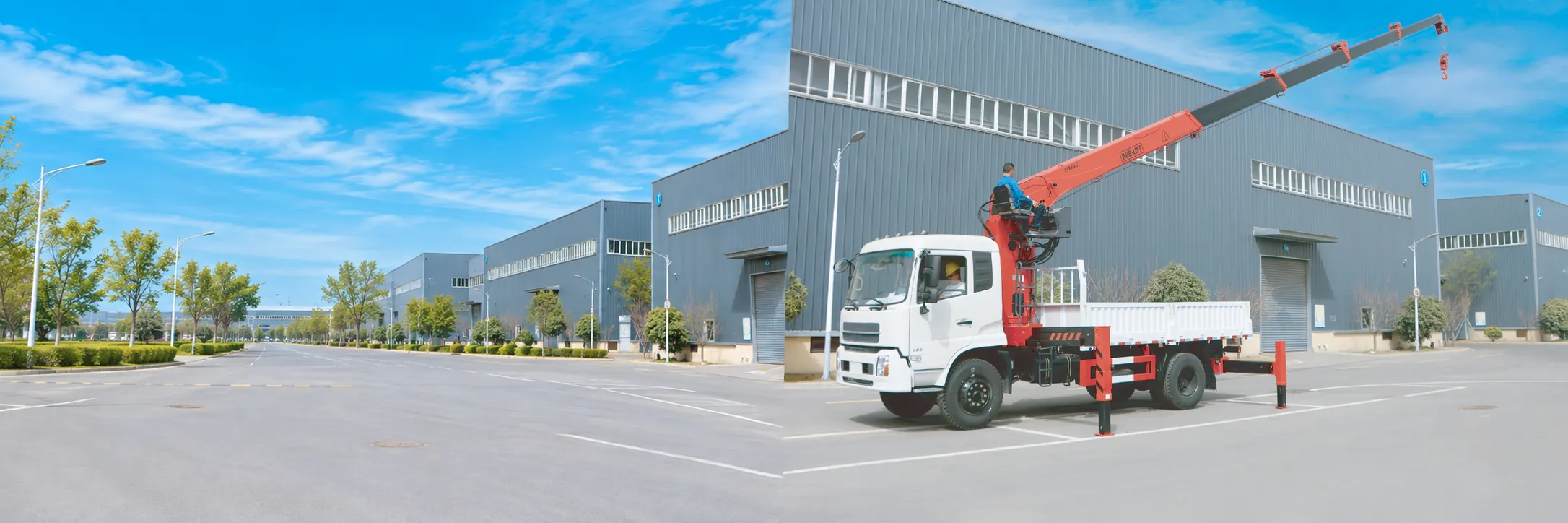

Crane power line safety is the set of controls that keeps every part of a crane, its load line, the load and the rigging outside a minimum clearance distance from overhead power lines. Contact is not needed for a fatal shock: the HSE guidance note GS6 warns that electricity can “jump, or arc, across small gaps”. So the safe distance depends on the line voltage, and the planning starts long before the boom goes up.
We have built truck mounted cranes in Xuzhou since 2003, and many of them work on streets, farms and building sites where overhead lines run close to the job. This guide explains the clearance distances in the US and UK rules, how far a truck mounted crane can actually reach, how to set up a work zone, and what the crew should do if a crane touches a line.
Key takeaways
- Assume every overhead line is live until the line owner confirms it is de-energised and visibly grounded.
- US rules require precautions if any part of the crane, load line or load could come within 20 feet (6.1 m) of a line up to 350 kV while working up to the crane’s maximum radius.
- The minimum clearance under OSHA Table A rises from 10 feet for lines up to 50 kV to 45 feet for lines up to 1,000 kV.
- In the UK, HSE GS6 says to manage the risk for any work within 10 m of the nearest wire, measured horizontally at ground level.
- If a crane touches a line, stay in the cab, or jump clear without touching the vehicle and the ground at the same time.
Why truck mounted cranes are at risk near power lines
Truck mounted cranes often work where overhead lines are common: kerbside deliveries, farm buildings, utility work and small building sites. The HSE guidance note GS6, “Avoiding danger from overhead power lines”, says incidents with live overhead lines “often involve” machinery such as “cranes, lorry-loader cranes”. Three things make a lorry crane exposed:
- Reach: a long telescopic boom can put the tip more than 20 m above its base, well above many distribution lines.
- Set-up on arrival: the driver often chooses the parking spot on the day, without a site survey.
- Operator position: with levers at the crane base, the operator stands on the ground touching the crane, which is the most dangerous place if the boom contacts a line.
Minimum clearance distances from power lines
In the US, the construction crane rule 29 CFR 1926.1408 sets the minimum clearance by voltage in its Table A. The figures below are copied from Table A, with our metric conversions. For lines over 1,000 kV, the distance must be set by the utility or a registered professional engineer.
| Line voltage (nominal, AC) | Minimum clearance (OSHA Table A) | Metric equivalent |
|---|---|---|
| Up to 50 kV | 10 ft | 3.05 m |
| Over 50 to 200 kV | 15 ft | 4.57 m |
| Over 200 to 350 kV | 20 ft | 6.10 m |
| Over 350 to 500 kV | 25 ft | 7.62 m |
| Over 500 to 750 kV | 35 ft | 10.67 m |
| Over 750 to 1,000 kV | 45 ft | 13.72 m |
Table A only applies once you know the voltage. Under 1926.1408(c), the utility must provide the voltage within two working days of a request. Until then, the default distance is 20 feet for lines up to 350 kV, and 1926.1409 raises it to 50 feet for lines over 350 kV up to 1,000 kV. Outside construction, the general industry rule 29 CFR 1910.333(c)(3) requires 10 feet for vehicles and mechanical equipment, plus 4 inches for every 10 kV over 50 kV.
In Great Britain, GS6 tells you to manage the risk if you intend to work within 10 m of the nearest wire, measured at ground level. Where ground-level barriers are used, the safety zone “should extend 6 m horizontally from the nearest wire”. For short work that cannot be avoided, GS6 points to the Energy Networks Association exclusion zones: 1 m for low-voltage lines, 3 m for 11 kV and 33 kV, 6 m for 132 kV and 7 m for 275 kV and 400 kV lines.
How far can a truck mounted crane reach?
The US rule measures the work zone out to the crane’s maximum working radius, so the first question in any power line check is how far your crane can reach. The table uses the load charts of five of our cranes. The last column adds 20 feet (6.1 m) to the maximum radius: if a line up to 350 kV lies inside that distance from the slewing centre, and the work zone is not limited, precautions are required.
| Crane | Maximum radius | Rated load at maximum radius | Boom tip height at 75° (read from chart) | Maximum radius plus 20 ft |
|---|---|---|---|---|
| SQ5ZA3 knuckle boom | 8.05 m | 1,100 kg | about 10 m | 14.2 m |
| SQ5SA4 telescopic | 11.79 m | 600 kg | about 13 m | 17.9 m |
| SQ12ZA6 knuckle boom | 14.5 m | 1,000 kg | about 16.5 m | 20.6 m |
| SQ10SA4 telescopic | 15.5 m | 1,050 kg | about 17 m | 21.6 m |
| SQ20SA5 telescopic | 22.0 m | 1,500 kg | about 23.5 m | 28.1 m |
The point is simple: a common distribution line strung beside a road can sit well inside the reach of a mid-size truck mounted crane. The chart heights also matter for the rule on working under lines, which looks at the boom fully extended and vertical. Our guide on how to read a crane load chart explains where these figures come from.
The work zone and the 20-foot rule
Before work starts, 1926.1408(a) requires the employer to identify the work zone. There are two ways: mark boundaries, for example with flags or a range limiting device, and prohibit the operator from working past them; or define the work zone as the full 360 degrees around the crane up to its maximum working radius. Then check whether any part of the crane, load line or load, “including rigging and lifting accessories”, could get closer than 20 feet to a line. If it could, the employer must choose one of three options:
- De-energise and ground: the utility confirms the line has been de-energised and visibly grounded at the worksite.
- Keep 20 feet: make sure nothing gets closer than 20 feet, using the measures below.
- Use Table A: get the voltage, find the Table A distance, and make sure nothing gets closer than that, using the same measures.

Where options 2 or 3 are used, 1926.1408(b) requires all of the following: a planning meeting with the operator and other workers to review the line location and the controls; non-conductive tag lines; and an elevated warning line, barricade or line of signs with high-visibility flags, set at 20 feet or at the Table A distance. The employer must also use at least one of these measures:
- a proximity alarm set to give the operator enough warning;
- a dedicated spotter in continuous contact with the operator, with a visual aid such as a line painted on the ground;
- a range control warning device that warns the operator when to stop;
- a device that automatically limits the range of movement;
- an insulating link between the end of the load line and the load.
These measures belong in the written lift plan. Our crane lift plan guide includes a template with a hazards section for power lines. Note that GS6 warns that insulating guards and proximity warning devices fitted to the plant “are not adequate protection on their own”.
Working under power lines
Under 1926.1408(d), no part of the crane, load line or load may be below a power line unless the utility has de-energised and visibly grounded it. One exception matters for truck mounted cranes: work is allowed if, with an articulating or extensible boom “in the fully extended position, at true vertical”, the uppermost part of the crane would still be more than 20 feet, or more than the Table A distance, below the plane of the line. That is why the boom tip heights in the table above are worth checking before a job under any line.
Driving under power lines with the crane stowed
Travel needs care too. 29 CFR 1926.1411 requires the boom to be lowered and sets travel clearances in its Table T: 4 feet for lines up to 0.75 kV, 6 feet over 0.75 to 50 kV, 10 feet over 50 to 345 kV, 16 feet over 345 to 750 kV and 20 feet over 750 to 1,000 kV. If any part will get closer than 20 feet while travelling, a dedicated spotter is required. At night or in poor visibility, the lines must be lit or marked and a safe path identified.
On a site, GS6 recommends goalposts and barriers at crossing points, and instructing drivers to lower jibs and booms. A folded knuckle boom crane in its transport position is low, but check the stowed height of your own installation against the lowest wire on the route.
Material deliveries and the subpart CC exclusion
Some lorry crane work falls outside the US crane standard. 1926.1400(c)(17) excludes articulating truck mounted cranes delivering material to a construction site when they only place it on the ground, or place sheet goods or packaged materials on a structure with a fork or cradle and a working automatic overload prevention device. The exclusion does not cover holding material in place for construction, prefabricated components or structural steel. Whatever the legal scope, the electrical hazard is the same, and in Great Britain GS6 applies to any work near overhead lines.
What to do if a crane touches a power line
If contact happens, the crane, the load and the ground around the truck may all be live. GS6 sets out the key points for everyone involved:
- Never touch the wires, and assume they are live even if they are not sparking or seem dead.
- Remember lines can switch back on, automatically after a few seconds or remotely later.
- Call the emergency services, give the location, say that electricity wires are involved and ask them to contact the line’s owner.
- If you are in the vehicle, stay in it, or if you must get out, jump as far as you can and do not touch the vehicle while standing on the ground.
- Keep everyone else away from the truck, the load and any fallen wire until the line owner says it is safe.
US rules require this to be trained in advance. Under 1926.1408(g), each operator and crew member must be trained on the danger of touching the equipment and the ground at the same time, the importance of staying inside the cab unless fire or another emergency forces evacuation, the safest way to leave equipment that may be energised, and the danger of the energised zone around the crane, known as step potential.
For a lorry crane, operator position is part of the plan. A wireless remote control lets the operator stand away from the truck rather than at the base levers. It does not make work near a line safe, so it never replaces the clearance distance.
Power line checklist for truck mounted crane lifts
- Survey: look up before you park, and note every line within the crane’s maximum radius plus 20 feet.
- Ask the owner: request the voltage, or the de-energising and grounding of the line.
- Set the work zone: mark boundaries or treat the full 360 degrees as the work zone.
- Choose the clearance: 20 feet by default, or the Table A distance once the voltage is known.
- Brief the crew: hold the planning meeting and name the spotter.
- Mark the limit: set the warning line or barrier with flags in view of the operator.
- Add a measure: alarm, spotter, range control or limiting device, or insulating link.
- Use non-conductive tag lines and keep people away from the load.
- Rehearse the emergency: make sure everyone knows the contact procedure.
For the wider crane safety picture, see our crane safety tips and the crane hand signals chart for spotters and signal persons.
Frequently asked questions
How far must a crane stay from power lines?
Under OSHA construction rules, 20 feet from lines up to 350 kV and 50 feet from lines over 350 kV up to 1,000 kV, unless the voltage is known and the Table A distance is used. Table A starts at 10 feet for lines up to 50 kV.
Can a crane work under power lines?
Only if the utility has de-energised and grounded the line, or if the top of the crane, with the boom fully extended and vertical, would still stay more than 20 feet or the Table A distance below the line. Other narrow exceptions exist under 1926.1408(d)(2).
What is the clearance from power lines in the UK?
HSE GS6 says to manage the risk for work within 10 m of the nearest wire and to set ground-level barriers 6 m from it. For unavoidable short work it refers to exclusion zones of 1 m for low voltage up to 7 m for 275 kV and 400 kV lines.
What should a crane operator do after touching a power line?
Stay in the cab if possible and warn others to keep away. If the operator must leave, they should jump clear without touching the crane and the ground at the same time, then move away. Nobody should approach until the line owner confirms it is safe.
Does an insulating link make the work safe?
No. OSHA lists an insulating link as one of several measures to use together with a planning meeting and a marked limit, and GS6 says such devices are not adequate protection on their own. Keeping the clearance distance is the main control.
How we compiled this guide
We compiled the rules from the official eCFR text of 29 CFR 1926.1400, 1926.1401, 1926.1408, 1926.1409, 1926.1411 and 1910.333, and from the HSE guidance note GS6 (fourth edition), all read in November 2026. The reach figures come from the BOB-LIFT load charts of the SQ5ZA3, SQ5SA4, SQ12ZA6, SQ10SA4 and SQ20SA5; boom tip heights are read from the chart grid and rounded. Metric conversions and the work zone diagram are our own. Achord Chan, Product Operations Director, reviewed the guide. It does not replace local regulations, the line owner’s instructions or your crane manual.
Choose a crane that fits your sites
Tell us the loads, reach and typical site conditions you work with, including any overhead lines, and we will recommend a crane from our knuckle boom truck mounted cranes or telescopic boom truck mounted cranes, with its drawing and load chart. Every crane carries a 12-month warranty on the whole machine, common spare parts leave the factory within 48 hours, and our service team answers within 12 hours. Contact us for a quotation.