
A crane accident is any unplanned occurrence during crane work that injures a person or damages property: a load that falls, a crane that tips over, a boom that touches a power line, or a worker struck or crushed by the moving crane. Most of them have a short list of causes. Loads are heavier than the crew thought, the radius is longer than planned, the ground gives way, people stand in the fall zone, or a safety device is ignored or switched off.
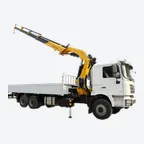
We have built truck mounted cranes in Xuzhou since 2003, and we run load tests on our cranes in the factory, like the one shown in this guide. This guide sets out what the US accident data says, the most common causes of crane accidents, the safety rules that address each one, and practical crane safety tips for truck mounted and lorry cranes.
Key takeaways
- The US Bureau of Labor Statistics counted 297 crane-related work deaths from 2011 to 2017, an average of 42 a year.
- Just over half of those deaths involved a worker struck by an object or equipment, most often a falling object.
- The main causes are overloading at long radius, poor ground under the outriggers, power line contact, people in the fall zone, rigging failure and two-blocking.
- Each cause has a matching control: a lift plan, the load chart, outrigger pads, a 20-foot power line check, barricades, inspected rigging and working safety devices.
- Inspect the crane before every shift and stop the lift whenever something does not match the plan.
How common are crane accidents?
The best public data comes from the US. The Bureau of Labor Statistics fact sheet Fatal Occupational Injuries Involving Cranes, based on the Census of Fatal Occupational Injuries, reports “297 total crane-related deaths, an average of 42 per year” from 2011 to 2017. The fact sheet also shows where the risk sits:
- Struck by objects: just over half of the deaths, 154 cases, involved a worker struck by an object or equipment. In 91 of these, the worker was struck by a falling object or equipment, and in 79 the object fell from or was put in motion by a crane.
- Other events: transportation incidents and falls to a lower level made up about 13 and 14 percent of the deaths.
- Industries: 43 percent of the deaths were in private construction and another 24 percent in manufacturing.
- Activities: in 22 percent of the cases the worker who died was operating the crane, so most victims were people working around it.

Two practical lessons follow from these statistics. First, the people at most risk are often the riggers, drivers and labourers near the crane, not only the operator. Second, a falling or swinging load is the single biggest hazard, so the most valuable precautions are the ones that keep suspended loads under control and keep personnel out from underneath them.
What are the most common causes of crane accidents?
Crane accidents rarely have a single cause. Most come from one of the hazards below, often combined with pressures such as a tight delivery schedule or an unplanned change to the original method. The table pairs each cause with the main control and the US rule that sets it.
| Cause | What goes wrong | Main control | US rule |
|---|---|---|---|
| Overloading | The load is heavier than estimated, or the radius is longer, so the crane tips or the boom fails | Verified load weight, load chart at the real radius, overload devices | 29 CFR 1926.1417(o), 1926.1416(d) |
| Ground and outrigger failure | An outrigger sinks into soft ground or a void and the crane overturns | Firm, level ground, outriggers fully set, pads or mats | 29 CFR 1926.1402 |
| Power line contact | The boom, load line or load touches or arcs to an overhead line | Work zone check, 20-foot rule or Table A distance, spotter | 29 CFR 1926.1408 |
| Falling loads | Poor rigging, a failed sling or an open hook drops the load | Qualified rigger, inspected slings, latched hooks | 29 CFR 1926.1425 |
| People in the fall zone | Workers stand under or beside a suspended load | Keep the fall zone clear, use tag lines | 29 CFR 1926.1425 |
| Swing and crush zones | The rotating crane strikes or pins a worker | Barriers or warning lines around the swing area | 29 CFR 1926.1424 |
| Two-blocking | The hook block is pulled into the boom tip and the rope breaks | Working anti-two-block device | 29 CFR 1926.1416(d)(3) |
| Signal errors | The operator cannot see the load or misreads a signal | One qualified signal person, agreed signals | 29 CFR 1926.1419 |
| Missed defects | A leaking cylinder, cracked weld or worn rope fails under load | Shift, monthly and annual inspections | 29 CFR 1926.1412 |
Overloading and long radius
The rated load of a crane is not one number. It falls as the radius grows, and many overload accidents happen when a crane that is “big enough” for the weight is used at a radius it was not planned for. Our SQ5SA4 5 ton telescopic crane shows the scale of the change: its load chart rates 5,000 kg at 2.5 m but 600 kg at its maximum radius of 11.79 m.
Under 29 CFR 1926.1416(d)(4), articulating cranes manufactured after November 8, 2011 must have at least one of these devices: an automatic overload prevention device, a load weighing device, a load moment indicator or a load moment limiter. These devices help, but they do not replace a verified load weight and a chart check. Our guide on how to read a crane load chart and our article on the lifting moment of a crane explain the numbers behind the limit.
Ground failure under the outriggers
A truck mounted crane puts most of its load on one or two outriggers when it slews over the side. If the ground under a pad is soft, wet or hollow, the crane can tip with a load well inside its chart. 29 CFR 1926.1402 requires ground that is “firm, drained, and graded” enough, with supporting materials if needed, to meet the manufacturer’s requirements. See our guide to crane outriggers and ground bearing pressure for pad sizing.
Power line contact
Electrocution does not require physical contact, because electrical current can arc across a small gap. US rules require a check of the whole work zone, and precautions if any part of the crane or load could come within 20 feet of a line up to 350 kV. Our guide to crane power line safety covers the clearance table, the work zone and what to do after contact.
Falling loads and the fall zone
The fall zone is the area, including but not limited to the area directly beneath the load, in which it is reasonably foreseeable that partially or completely suspended materials could fall in the event of an accident, as defined in 29 CFR 1926.1401. 29 CFR 1926.1425 says that while the operator is not moving a suspended load, no employee may be in the fall zone except those hooking, unhooking or guiding the load, making the initial connection, or operating a concrete hopper or bucket. When workers are in the fall zone for those tasks, the load must be rigged to prevent displacement, hooks must have self-closing latches or the equivalent, and the materials must be rigged by a qualified rigger. Our crane rigging guide and crane hook guide cover sling angles, hook latches and inspection.
Two-blocking
Two-blocking is the condition in which the hook block or overhaul ball is pulled into the boom tip, for example while the boom is extended without paying out rope. The wire rope can break and release the suspended load. Under 1926.1416(d)(3), telescopic boom cranes manufactured after February 28, 1992 must have a device that automatically prevents this, and so must articulating cranes manufactured after December 31, 1999 that are equipped with a load hoist. Never bypass or disconnect the device simply to complete a difficult lift.
12 crane safety tips to prevent accidents
These recommendations convert the causes above into a practical routine that a small crew can follow consistently on every delivery or installation.
- Plan the lift. Agree the load, crane position, radius, rigging, hazards and roles before the truck arrives. Our crane lift plan guide includes a template.
- Know the load weight. Use the manufacturer’s figure, a recognised calculation or a load weighing device, as 1926.1417(o)(3) requires. Include the weight of the hook block and all rigging accessories.
- Check the chart at the real radius. Measure to the furthest set-down point and use the figure at the next larger radius on the chart.
- Set the outriggers properly. Extend them as the load chart requires, place distribution pads on soft surfaces, and level the crane before lifting.
- Inspect before every shift. Under 1926.1412(d), a competent person must inspect the crane before or during each shift it is used, with a monthly inspection and a comprehensive one by a qualified person at least every 12 months. Our truck mounted crane inspection checklist lists the daily items.
- Test the safety devices. Check the overload device, anti-two-block device, hydraulic lock valves and emergency stop before work. Our article on the hydraulic lock valve explains how the boom is held if a hose fails.
- Look up for power lines. Check the full work zone before you park, and keep the clearance distance with a spotter if needed.
- Barricade the swing area. Under 1926.1424, mark the area where the rotating crane could strike or crush a worker.
- Keep people out of the fall zone. Use tag lines to guide suspended loads, and allow only the workers receiving the load to approach it.
- Use a qualified rigger and inspected gear. Examine slings, shackles and hook latches before each use, and immediately remove damaged accessories from service.
- Use one signal person. When the operator cannot see the load, use a single qualified signal person and agreed signals. See our crane hand signals chart.
- Stop when conditions change. Under 1926.1417(n), wind, ice and snow must be considered for stability and rated capacity. If the load is not as expected, the ground moves or the weather turns, stop and re-plan.

Crane safety for truck mounted and lorry cranes
Truck mounted cranes have a distinctive risk pattern, because the driver frequently operates alone, sets up on a public street and selects the parking position only on arrival. Three habits make the biggest difference:
- Choose the set-up spot first. The closer the truck parks to the set-down point, the shorter the radius and the larger the capacity margin.
- Stand where you can see. With levers at the crane base, the operator may not see the load. A wireless remote control lets the operator stand clear of the truck with a full view of the load, outside the swing and fall zones.
- Stow the crane before driving. Fold or retract the boom, raise and pin the outriggers, and check the height against bridges and overhead lines on the route.
Operator competence matters as much as equipment. Our crane operator license guide explains the training and certification rules for truck mounted cranes in the US, Australia and the UK, and our crane load test guide explains how a crane is proved before it goes into service.
What to do after a crane accident
If an accident happens, the immediate priority is to prevent additional injuries or damage. Stop crane movement, keep everyone away from a suspended or fallen load, and call the emergency services. If a power line is involved, treat the crane and the ground around it as live and follow the steps in our power line guide. Do not move the crane or the load unless it is needed to rescue someone or prevent further danger, so the cause can be investigated.
In the US, 29 CFR 1904.39 requires the employer to report a work-related fatality to OSHA within eight hours, and an in-patient hospitalization, amputation or loss of an eye within 24 hours. Other countries have their own reporting rules, so check the rules where you work. After any incident or near miss, review the lift plan, the crane’s inspection record and the rigging, and share what you learn with the crew.
Frequently asked questions
What is the most common cause of crane accidents?
In the BLS data for 2011 to 2017, the most common fatal event was a worker struck by an object or equipment, which covered just over half of crane-related deaths. Most of those cases involved a falling object, often a load dropped or moved by the crane.
How many people die in crane accidents each year?
The US Bureau of Labor Statistics counted 297 crane-related work deaths from 2011 to 2017, an average of 42 per year. The count covers work-related deaths in the US only, so it does not show global numbers.
How can crane tip-overs be prevented?
Check the load weight and the chart capacity at the actual radius, set the outriggers fully on firm ground with pads, level the crane, and keep overload devices working. Most tip-overs come from a longer radius than planned or ground that gives way under an outrigger.
How often should a crane be inspected?
Under US construction rules, a competent person inspects the crane each shift, a monthly inspection is recorded, and a qualified person carries out a comprehensive inspection at least every 12 months. Follow the manufacturer’s operating manual for any additional periodic checks.
Who is responsible for crane safety on site?
The employer is responsible for planning and supervision, the operator for safe operation within the chart, the rigger for attaching the load, and the signal person for clear signals. Every worker on site should feel entitled to stop a lift that appears unsafe.
How we compiled this guide
We took the accident figures from the BLS fact sheet Fatal Occupational Injuries Involving Cranes, which covers 2011 to 2017, and the rules from the official eCFR text of 29 CFR 1926.1401, 1926.1402, 1926.1408, 1926.1412, 1926.1416, 1926.1417, 1926.1419, 1926.1424, 1926.1425 and 1904.39, all read in November 2026. The SQ5SA4 figures come from its BOB-LIFT load chart. The photos were taken at our Xuzhou factory. Achord Chan, Product Operations Director, reviewed the guide. It does not replace your crane manual, local regulations or a competent person’s judgement on site.
Work safely with the right crane
Many crane accidents start with a crane that is too small for the radius the job really needs. Send us your heaviest load, the reach you need and a photo of a typical site, and we will recommend a crane from our knuckle boom truck mounted cranes or telescopic boom truck mounted cranes, with its drawing and load chart. Every crane carries a 12-month warranty on the whole machine, common spare parts leave the factory within 48 hours, and our service team answers within 12 hours. Contact us for a quotation.