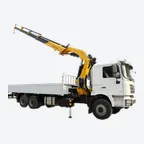

A crane hook is the forged steel hook at the end of a crane’s hoist line or boom that holds the load through slings, chains or a shackle. Because it is the final connection between the crane structure and the suspended load, every lift depends on its condition. On a truck mounted crane it is usually either a swivel hook attached directly to the boom tip or a hook block that travels on the winch rope.
We have built truck mounted cranes in Xuzhou since 2003. This guide explains the anatomy of a hook, the common configurations, the purpose of the safety latch, how much rated capacity the hook assembly consumes, and how to inspect it systematically before operation.
Key takeaways
- The load must be seated in the saddle (bowl) of the hook, never supported on the tip, where bending stress is greatest.
- The safety latch prevents a slack sling from escaping the throat; it is a retaining device, not a load-bearing component.
- The combined weight of the hook, hook block and slings is included in the rated capacity shown on the load chart.
- Inspect the hook and latch every shift. Under US regulations, a hook with cracks, a throat opening more than 15 percent wider than normal, or more than 10° of twist must be removed from service.
- Never weld, heat or straighten a damaged hook; replace it with an identical, correctly rated component.
What is a crane hook?
A crane hook is a curved, forged load-bearing component that connects the crane to the rigging, and its geometry allows a sling eye or shackle to be positioned quickly and to remain securely seated while the load is lifted. Most crane hooks are manufactured from drop-forged alloy steel, because forging produces a continuous grain structure through the curved section that resists fatigue cracking.
Every hook has the same basic parts:
- Shank or eye: the upper section, which attaches the hook to the crane, the hook block or a swivel assembly.
- Saddle or bowl: the lowest point of the curve, which is the correct and intended bearing position for the load.
- Throat: the opening between the tip and the shank, whose width is the primary measurement in any inspection.
- Tip or point: the unsupported free end, which is the weakest location at which to suspend a load.
- Safety latch: a spring-loaded gate that closes the throat opening.
- Swivel: a thrust bearing that allows the hook to rotate under load, preventing the rigging from twisting.
Types of crane hooks
Crane hooks differ mainly in how they are attached to the crane and whether the throat can be closed, and the configurations below are the ones a truck crane operator is most likely to encounter.
| Hook type | What it is | Where you see it |
|---|---|---|
| Shank or eye hook | A single hook with a threaded shank or a closed eye at the top | Fixed points, chain blocks, small cranes |
| Swivel hook | A single hook on a swivel bearing so it can rotate | Boom tip of most knuckle boom truck cranes |
| Hook block (load block) | A hook, swivel, sheaves, pins and side plates in one frame, carried by the hoist rope | Telescopic cranes and cranes fitted with a winch |
| Overhaul ball | A heavy ball above a single hook, used to keep a single-part rope taut | Single-line winch lifts |
| Self-locking hook | A hook whose latch locks shut so the throat cannot open under load | Lifts where a hook must be closed and locked, such as hoisting a personnel platform |
The US general industry standard for truck cranes, 29 CFR 1910.180, defines a lower load block as “the assembly of hook or shackle, swivel, sheaves, pins, and frame suspended by the hoisting ropes”. That is exactly the red hook block in the cover photo. A larger crane may also have double hooks, called ramshorn hooks, but those are rare on loader cranes.
Hooks on a truck mounted crane
The hook arrangement on a truck crane depends on its lifting principle. A knuckle boom crane without a winch raises the load by moving its articulated boom, so the hook is suspended from a link at the boom tip, whereas a telescopic crane, or a knuckle boom crane equipped with a winch, raises the load by reeling in wire rope, so the hook is mounted in a hook block on that rope.

Boom tip hook (knuckle boom). Because the hook is suspended close to the boom, the operator positions it precisely by folding and extending the boom sections, which makes rigging quick and gives generous hook height relative to the crane’s size. When the crane is folded for transport, the hook must be secured so that it cannot swing against the vehicle. Our knuckle boom truck cranes from 1.6 t to 50 t use this layout, unless a winch is ordered.
Hook block on a winch rope (telescopic). The rope passes over the boom head sheaves and through the hook block, which allows the operator to lower the hook below ground level or deep into a building and to lift at any boom extension. Our telescopic boom truck cranes lift this way. A winch can also be added to a knuckle boom crane; our guide to knuckle boom crane attachments explains when that makes sense.

What the safety latch does
The safety latch, also called a safety catch or keeper, is a spring-loaded gate across the throat of the hook. Its function is straightforward: if a sling becomes slack, for example when a load is landed, the latch prevents the sling eye from lifting out of the hook, so the rigging remains in position between lifts.
The latch is not a load-bearing component, and if the load ever bears against it, the rigging arrangement is incorrect. A distorted latch, a weakened spring or a latch fastened open with wire completely defeats its purpose. That is why the US construction crane standard includes “hooks and latches for deformation, cracks, excessive wear, or damage such as from chemicals or heat” in the inspection a competent person must carry out each shift, under 29 CFR 1926.1412(d)(1)(v).
Certain lifting operations require more than a standard latch. When a crane hoists a personnel platform, 29 CFR 1926.1431(g)(1)(i) requires hooks “of a type that can be closed and locked, eliminating the throat opening”, and they must be closed and locked when attached. A self-locking hook satisfies that requirement, whereas an ordinary spring latch does not.
The hook counts as part of the load
A load chart specifies the total weight the crane may support at each operating radius, and the hook, the hook block and all rigging accessories are included in that weight. The US crane standard for construction, 29 CFR 1926.1401, defines the load as “the object(s) and the load-attaching equipment, such as, the load block, ropes, slings, shackles, and any other ancillary attachment”. Overlooking this requirement can turn a lift close to the rated limit into an overload.
The effect becomes most significant at long radius, where the rated capacity is relatively small. Consider our SQ10SA4 10 ton telescopic crane. Its technical drawing rates it at 10,000 kg at 2.4 m radius, but at 15.5 m radius, with the 15.87 m boom horizontal, the rating decreases to 1,050 kg, and that figure must accommodate the hook block, the slings and the payload together.
Example scenario (an illustration, not a customer record): a crew plans to lift a 1,000 kg pallet at 15.5 m with the SQ10SA4. If the hook block and slings weigh 70 kg together, the total is 1,070 kg. That exceeds the 1,050 kg rating, so the crew repositions the truck and lifts at a shorter radius. Always weigh the hook block or confirm its documented weight for your specific crane rather than estimating it.
Our guide on how to read a crane load chart demonstrates how to determine the rated capacity for any combination of radius and boom length, and the guide to the lifting moment of a crane explains why the permissible load decreases as the working radius increases.
How to inspect a crane hook
Inspect the hook visually before every shift and remove it from service at the first indication of damage. The US rule for truck cranes in general industry, 29 CFR 1910.180(d)(3)(v), lists “crane hooks with deformations or cracks” as a frequent inspection item. It gives clear limits: hooks “with cracks or having more than 15 percent in excess of normal throat opening or more than 10° twist from the plane of the unbent hook” must be dealt with. The same section calls for monthly certification records on critical items such as brakes, crane hooks and ropes.
A practical hook inspection takes approximately two minutes and covers the following points:
- Throat opening. Measure between two punch marks or with a gauge and compare the result with the original dimension, because a wider throat indicates that the hook has begun to open under overload.
- Twist. Sight along the hook; the tip should remain in the same plane as the shank.
- Cracks and nicks. Examine the saddle, the inside of the curve and the shank, since gouges from chains or sharp edges initiate fatigue cracks.
- Wear in the saddle. Slings repeatedly bearing in one position gradually reduce the section where the load is carried.
- Latch. It must close automatically under spring pressure and seal the throat completely.
- Swivel and nut. The hook should rotate freely, and the retaining nut and locking pin must be secure.
- Hook block. Check the side plates, sheaves, pins and rope guards for damage.
Do not repair a damaged hook by welding, heating or bending it back. The overhead crane rule, 29 CFR 1910.179, says hooks with these defects “shall be discarded” and that “repairs by welding or reshaping are not generally recommended”. Heating alters the steel’s heat treatment, and a deformed hook has, by definition, already been overloaded. Our truck mounted crane inspection checklist puts the hook check in the daily routine, and the guide to truck mounted crane parts shows where the hook sits among the other wear parts.
Using the hook safely
Most hook failures originate in the way the hook is used rather than in a manufacturing defect. The operating requirements in 29 CFR 1910.180(h), together with established rigging practice, emphasise the following precautions:
- Attach the load to the hook with slings or other approved lifting accessories, and never wrap the hoist rope itself around the load.
- Seat the sling eye or shackle centrally in the saddle, because loading the tip generates excessive bending stress and progressively opens the hook.
- Avoid stacking several sling eyes in a small hook; instead, collect them in a correctly rated shackle or master link.
- Lift vertically, since side pulls apply lateral forces to the hook and the boom for which neither component was rated.
- Nobody may ride on the hook or the load; the regulation explicitly prohibits hoisting, lowering or swinging “while anyone is on the load or hook”.
- Lash or otherwise restrain the empty hook before the vehicle travels, so that it cannot swing into the cab, the bodywork or a pedestrian.
Rigging equipment must also be correctly identified. In the UK, regulation 7 of LOLER 1998 requires lifting machinery and accessories to be “clearly marked to indicate their safe working loads”. A sling or shackle with no readable mark should not go on the hook.
Standards that cover crane hooks
In the United States the voluntary consensus standard for hooks is ASME B30.10, Hooks, published by ASME in a 2024 edition. It addresses hook identification, inspection, repair limitations and operating practices. OSHA’s crane rules quoted above set the legal minimums for inspection, latches and personnel lifting. In the UK, LOLER covers the marking and thorough examination of lifting equipment, including the hook. Wherever you work, the crane manufacturer’s manual adds the limits for your exact hook and hook block.
Before shipping, every BOB-LIFT crane is mounted on our test bay and run through lifting, slewing and outrigger functions under load. That test load is lifted on the crane’s own hook. The crane load test guide explains what the standards require for testing after delivery.
Frequently asked questions
What is the latch on a crane hook called?
It is usually called a safety latch, safety catch or keeper: a spring-loaded gate across the throat of the hook that prevents a slack sling from escaping. It is a retaining device and does not support any portion of the load.
How often should a crane hook be inspected?
Check the hook and latch visually before every shift. US rules also require periodic inspections and, for general industry truck cranes, monthly certification records on hooks. Follow the crane manual if it asks for more frequent checks.
Can a crane hook be repaired by welding?
No. A cracked, opened or twisted hook should be replaced. US rules say such hooks shall be discarded and that welding or reshaping is not generally recommended, because heat and bending change the strength of the forged steel.
Does the weight of the hook count against the crane’s capacity?
Yes. The hook, hook block, slings and shackles are all considered part of the load, and at long radius, where the rated capacity is relatively small, they can represent a significant proportion of it. Subtract their combined weight before determining the maximum permissible payload.
What is a crane ball and hook?
It is an overhaul ball, sometimes called a headache ball: a heavy weight fitted above a single hook. Its mass keeps a single-part hoist rope under tension, so the hook descends under gravity when no load is attached.
How we compiled this guide
We compiled the SQ10SA4 load figures from its BOB-LIFT technical drawing and load chart. The photos show an SQ10ZA4 hook block, an SQ12ZA6 boom tip hook and an SQ12SA4 hook block, all taken at our Xuzhou factory in 2026. The quotations come from the official eCFR text of 29 CFR 1910.179, 1910.180, 1926.1412 and 1926.1431, from legislation.gov.uk and from the ASME website. Achord Chan, Product Operations Director, reviewed the guide in November 2026. It does not replace your crane manual, your rigging supplier’s ratings or the law where you work.
Get the right hook and crane for your work
Tell us your heaviest load, the radius you need and whether you lift with the boom or with a winch, and we will recommend a crane and hook arrangement with its drawing and load chart. If you already own a BOB-LIFT crane and need a replacement hook or hook block, send us the model and serial number. Every crane carries a 12-month warranty on the whole machine, common spare parts leave the factory within 48 hours, and our service team answers within 12 hours. Contact us for a quotation.