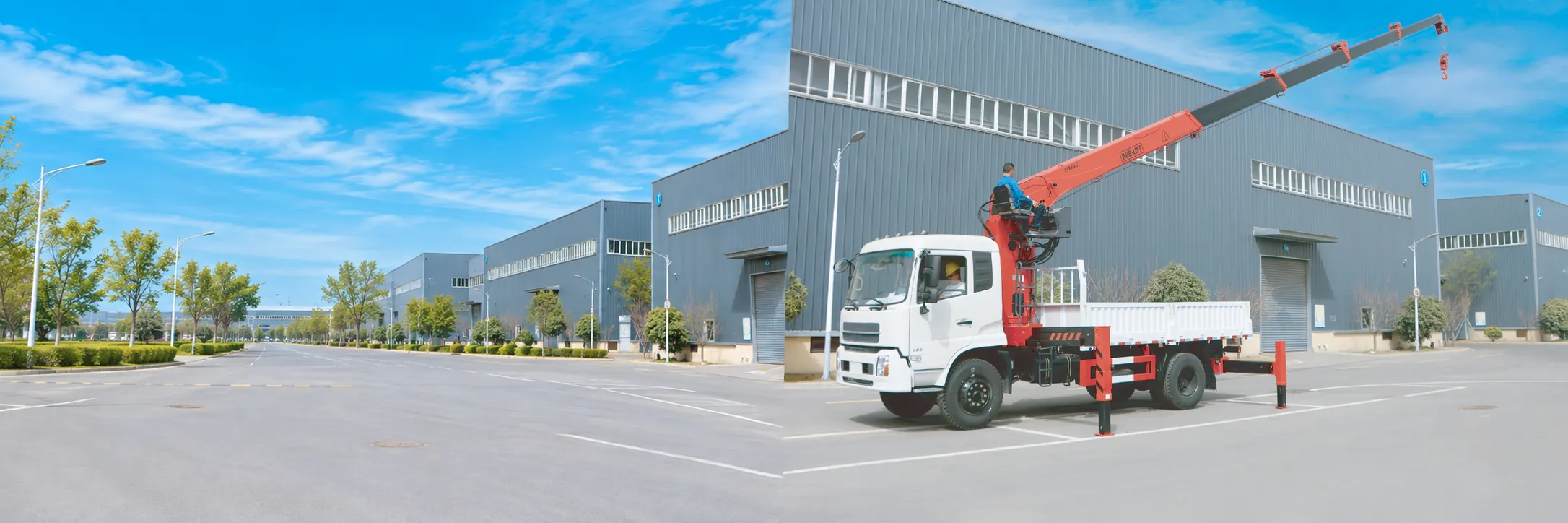

A grab crane is a truck mounted knuckle boom crane that carries a hydraulic grab or grapple on a rotator at the boom tip, instead of the hook or alongside it. The operator closes the grab around the load, so scrap, rock, soil, aggregate, logs, pipes and waste can be loaded without anyone on the ground fitting slings. One rule sizes a crane with a grab: the weight of the grab, the rotator and the link that hangs them from the boom comes off the rated load at every radius on the load chart. This guide explains the grab types, the rotator and hydraulics a grab needs, and the capacity check, using the real load chart of our SQ8ZA4 knuckle boom crane. BOB-LIFT has built truck mounted cranes in Xuzhou, China, since 2003.
Key takeaways
- A grab crane is a knuckle boom crane with a grab or grapple on a rotator at the boom tip; grab and grapple are two names for the same kind of tool.
- Choose the grab by material: a clamshell bucket for soil and aggregate, an orange peel (multi-tine) grab for scrap and rock, a log grapple for timber and a pipe grab for pipes and poles.
- A grab needs two extra hydraulic functions on the crane, one to rotate and one to open and close. Grab and rotator ratings must match the crane’s flow and pressure, such as 40 L/min at 28 MPa on the SQ8ZA4.
- Net capacity for material = rated load at that radius minus grab, rotator and link. With an assumed 520 kg hanging from an SQ8ZA4, 1,820 kg at 8.465 m leaves 1,300 kg for material.
- Grab type, size and weight are confirmed with the quotation, once you send us the material, the weight of a full bite, the radius and your truck.
What is a grab crane?
Wikipedia describes a grab as “a mechanical device with two or more jaws (sometime clamshell-shaped), used to pick things up or to capture things” [1]. Put that tool on a hydraulic knuckle boom truck mounted crane and you have a grab crane, also called a crane with grab, a crane grabber or, in North America, a grapple crane. In Malaysia the same machine is often a lorry crane with a grab; our crane lorry guide explains the local names.
The European standard for loader cranes, EN 12999, treats the grab as part of the crane’s equipment. Its published scope says it “also applies to loader cranes equipped with special tools or interchangeable equipment (e.g. grapple, clamshell bucket, pallet clamp, etc.), as specified in the operator’s manual” [2]. For a buyer, the practical point is to agree the grab’s weight, hydraulic supply and controls before the crane is built.
A grab is one of several attachments a knuckle boom crane can carry, and our overview of knuckle boom crane attachments compares it with the winch, auger and work basket, and covers the naming question of grab versus grapple.
Grab types: match the grab to the material
From the 1.6 t knuckle boom crane upward, our product pages offer four grabs on request: a hydraulic gripper, a clamshell bucket, an orange peel grab and a timber grapple. The table below sets out which material each grab suits; the grab itself is specified for each order, and its type, size and weight are confirmed with the quotation.
| Grab type | Typical material | What to check |
|---|---|---|
| Clamshell (two-shell) bucket | Soil, sand, gravel, aggregate, chippings, loose waste | Bucket volume times the bulk weight of your material |
| Orange peel or multi-tine grab | Scrap metal, rock, demolition waste, refuse | Weight of a full bite of your heaviest scrap |
| Log or timber grapple | Logs, poles, bundled timber | Weight of fresh wood per bite and the reach to the pile |
| Pipe and pole grab | Pipes, poles, round bar | Length and balance point of the longest piece |
| Block clamp or pallet forks | Packs of bricks and blocks, palletised goods | Pack weight and how the load is secured |

Clamshell bucket for soil, sand and aggregate
A clamshell bucket is a grab with two shells that close into a closed bucket, so it holds loose material without spilling. This is what most buyers mean by a grab bucket crane or a crane with grab bucket; it loads and unloads sand, gravel, crushed stone, chippings and soil, and it can do light digging. The weight of a full bucket is the bucket volume multiplied by the bulk weight of the material. Wet sand and crushed rock are far heavier than wood chips, so give us the material and, if possible, a weighbridge figure for one full bucket.
Orange peel grab for scrap, rock and waste
An orange peel grab has four or more curved tines that close from all sides, like the segments of a peeled orange. Because the tines wrap around irregular pieces, it is the usual choice for scrap metal, rock, demolition waste and refuse. It does not hold fine material well, since sand runs out between the tines. Bites vary a lot with scrap type, so weigh several typical bites before you size the crane.

Log grapple for timber
A log grapple has two long curved arms that close around one log or a bundle. Dedicated timber cranes are built around it, often with a high seat, a boom that can work below horizontal and a slewing range beyond a full circle. Our timber crane guide covers log weights and how to choose a log crane. The drawings of our ZT160Z-2A and ZT120Z-2A timber cranes state their maximum lifting capacity of 1,800 kg and 1,300 kg as including the gripper. A general purpose knuckle boom crane’s chart gives the load at the hook, so the grab has to be deducted separately, as shown below.
Pipe grabs, block clamps, pallet forks and magnets
A pipe and pole grab holds long round pieces at two points, so it suits pipes, poles and round bar, while packed building materials are usually handled from the hook instead. Our guides to lifting clamps and crane pallet forks cover brick and block clamps and palletised loads. In a scrap yard, a lifting magnet is the other common tool; it handles steel only, while an orange peel grab also takes mixed scrap. For loose concrete, a concrete bucket hangs from the hook rather than a grab.
Palm oil estates in Southeast Asia also load fresh fruit bunches with grabs, and the Malaysian Palm Oil Board describes its own infield Grabber as “a two-section crane and a three-webbed finger-gripper”. It has a reach of about 3.5 m and can lift “a maximum weight of 100kg (approximately, 3 bunches at one lift)” [3]. A truck mounted crane loading bunches at a collection point works the same way on a larger scale: the bite weight and reach set the crane size.
The rotator and the link: what hangs between boom and grab
Three parts hang at the boom tip of a grab crane. The link is a short hinged piece that lets the grab hang plumb while the boom angle changes. Below it, the rotator is a hydraulic motor that turns the grab, so the operator can line a log up with the truck bed or turn a bite of scrap to clear a bin edge. A hydraulic swivel inside the rotator passes oil through to the grab cylinder while the grab turns, and the grab itself hangs below the rotator.
Some rotators turn continuously and others through a limited angle, and their torque and weight differ by size. Ask the grab supplier which type comes with your grab, and check its rated load against the heaviest bite. All three parts count as load on the crane before any material is picked up.

Hydraulics: the two extra functions a grab needs
A hydraulic function is one section of the crane’s control valve with its own pair of hoses, driving one movement. A crane that only lifts on a hook uses its valve sections for slewing, the booms, the extensions and the outriggers. A grab crane needs two more functions: one to rotate the grab and one to open and close it. Each takes a section on the control valve, a pair of hoses along the boom and a lever, a seat control or a remote control channel. That is why it is simpler to order the grab functions with the crane than to add them later.
The grab and rotator also have to suit the crane’s oil supply: our SQ8ZA4 dimension drawing gives a hydraulic system flow of 40 L/min at a system pressure of 28 MPa, with 25 kW of recommended power. The ZT160Z-2A timber crane drawing gives 80 L/min at 28 MPa. The rated pressure and flow of the grab cylinder and the rotator motor must match the crane they hang from, which the grab supplier confirms against our drawing. The pump on the truck has to deliver the crane’s flow in the first place; our article on the hydraulic system of a truck mounted crane explains the power take-off and pump.
Capacity: deduct the grab at every radius
This is the check that decides whether a grab crane works. The load chart of a knuckle boom crane gives the rated load at the hook for each working radius, and anything hung at the tip is part of that load. So the capacity left for material is:
Net capacity for material = rated load at that radius − (grab + rotator + link).
The rated load is the maximum load the load chart allows at the hook for one radius and boom position. The tare is everything hung at the tip before material is picked up: grab, rotator, link and fittings.
The deduction is the same in kilograms at every radius, but it takes a much larger share of the rating far out, where the chart is lowest. Read the chart at the farthest radius the grab will work, not where the material sits closest to the truck; if your radius falls between two chart points, use the point farther out. Our guides on how to read a crane load chart and crane safe working load explain the chart and the terms.
Here is the SQ8ZA4 load chart, with an assumed 520 kg of grab, rotator and link deducted. The rated loads come from our SQ8ZA4 load chart drawing, and the 520 kg is an assumed figure for illustration, not the weight of a particular grab.
| Working radius | Rated load at the hook | Assumed grab + rotator + link | Net for material | Share of rating taken by the grab |
|---|---|---|---|---|
| 2.0 m | 8,000 kg | 520 kg | 7,480 kg | 7 % |
| 4.461 m | 3,700 kg | 520 kg | 3,180 kg | 14 % |
| 6.445 m | 2,470 kg | 520 kg | 1,950 kg | 21 % |
| 8.465 m | 1,820 kg | 520 kg | 1,300 kg | 29 % |
| 10.515 m | 1,420 kg | 520 kg | 900 kg | 37 % |

Every BOB-LIFT crane is listed with a load moment limiter. The limiter sees the grab and the material together as one load, so it protects the crane from overload but cannot tell you how much of the rating the grab has already used. The capacity check above has to be done before the crane is ordered. Our guide to the load moment indicator explains how the limiter works, and our article on the lifting moment of a crane explains why the rating falls with radius.
Example scenario: a scrap yard lorry crane in Malaysia
Example scenario (an illustration, not a customer record). A scrap dealer near Port Klang wants a lorry crane with an orange peel grab to load mixed steel scrap from yard piles onto its own lorry. The farthest pile is 8.4 m from the crane column, and the dealer weighs ten typical full bites on the yard weighbridge. The heaviest is 1,100 kg (assumed); this bite weight is the material alone, without the grab. The grab supplier’s figures, also assumed here, are 450 kg for the grab, 55 kg for the rotator and 15 kg for the link and fittings.
- Total load at the tip: 1,100 + 450 + 55 + 15 = 1,620 kg.
- Chart point to use: 8.4 m falls between two chart points, so read the farther one, 8.465 m, which gives 1,820 kg.
- Check: 1,620 kg is 89 % of 1,820 kg, so a full bite at the far pile is within the chart.
- Limit farther out: at the maximum radius of 10.515 m the chart gives 1,420 kg. After the 520 kg tare, a bite there may weigh no more than 900 kg, so the operator takes part-filled bites or moves the lorry closer.
The SQ8ZA4 suits this yard, but if the farthest pile were 10 m away and full bites were needed there, the dealer would need a crane with a higher rating at that radius, or a lighter grab. The SQ8ZA4 weighs 3,050 kg on its drawing, and that weight comes out of the lorry’s payload together with the grab, so the body builder checks axle loads before fitting. The full chart is on the SQ8ZA4 knuckle boom truck mounted crane page.
The same check works for any crane and grab. For example, a buyer in South Africa loading crushed stone with a clamshell bucket would use the weight of one full bucket of their aggregate as the bite weight and read the same chart at their radius.
Controls for grab work: high seat or remote control
Grab work is a long sequence of small movements (open, lower, close, lift, slew, rotate, open again), and the operator needs to see into the bin or onto the pile. Our knuckle boom product pages list three operation modes: manual levers at the crane base, an aerial (high) seat, and a wireless remote. From a high seat on the column, the operator looks down into the load bed and the pile, and our ZT timber cranes have this seat on top of the column as standard, as their drawings show.

A wireless remote lets the operator walk to the best viewpoint, which helps when loading over high truck sides or into a container, and the grab functions sit on their own remote channels. Our guide to remote controls for truck mounted cranes compares levers, seat and remote in more detail.
Safety with a grab crane
A grab can drop material when it opens, when a tine slips or when a piece of scrap shifts in the bite. Nobody should stand under a suspended grab or in the area where material could fall. The OSHA crane rule for US construction sites says: “While the operator is not moving a suspended load, no employee must be within the fall zone”, with exceptions for workers hooking, unhooking or guiding a load [4]. A grab removes the need for workers to fit slings by hand, so in grab work the area under the load should stay empty.
- Treat the grab as rigging: a grab is equipment hung below the boom, like the devices in our below-the-hook lifting devices guide; follow its supplier’s manual and marked limits.
- Check it daily: add the grab tines or shells, pins, the rotator, the link and the hoses to the crane’s daily check. Our truck mounted crane inspection checklist covers the routine for the crane itself.
- Set up on firm ground: grab work repeats the same lift hundreds of times a day, so the outriggers must sit on firm ground every time.
- Never use the grab to drag or push: pulling a load sideways or pushing a pile with the grab puts a side load on the boom, and the load chart is written for a load hanging straight down.
What to send us for a grab crane quotation
We supply the crane, not the truck. If you buy the truck in China, it can be delivered to our factory and we fit the crane there. If you buy the truck locally, we ship the crane and a local body builder fits it, with remote support from us; our truck mounted crane installation guide explains that route. To quote a grab crane, we need:
- The material: scrap, rock, soil, aggregate, logs, pipes or packed goods, and its bulk weight if you know it.
- The weight of one full bite: weighed if possible, or the volume you want per bite.
- The radius: the farthest point the grab must reach from the crane column, and the lift height over truck sides or bins.
- The truck: make, model, wheelbase and gross vehicle weight, or your plan to buy a truck in China.
- The grab: whether you need us to arrange one with the crane or already have a grab and rotator, with their weights and hydraulic ratings.
- Controls and destination: levers, high seat or remote, and the destination port.
Frequently asked questions
What is the difference between a grab crane and a grapple crane?
There is no technical difference: both are knuckle boom cranes with a hydraulic tool at the boom tip that closes around the load. Grapple is the usual word in North America, while grab is more common in Britain, Australia and many export markets.
How much does a grab reduce crane capacity?
A grab reduces the capacity for material by the full weight of the grab, rotator and link at every radius. With an assumed 520 kg on an SQ8ZA4, that is 7 % of the rating at 2.0 m but 37 % at the maximum radius of 10.515 m, where the chart gives 1,420 kg.
Can I fit a grab to a crane that only has a hook?
Only if the crane has, or can be given, two extra hydraulic functions for rotate and open/close, with hoses along the boom. Without spare valve sections the control valve may need to change, which is why ordering the grab functions with the crane saves work.
Which grab is best for scrap metal?
An orange peel (multi-tine) grab is the usual choice for mixed scrap because its tines close around irregular pieces. For steel plate and clean steel scrap, a lifting magnet is the alternative; a magnet does not pick up non-ferrous metal.
Do you supply the grab with the crane?
A grab, clamshell bucket, orange peel grab or timber grapple can be specified with the crane on request. Its type, size and weight are confirmed with the quotation, together with the hydraulic functions and controls the crane needs for it.
How we compiled this guide
The crane figures come from the BOB-LIFT SQ8ZA4 dimension drawing and load chart and the ZT120Z-2A and ZT160Z-2A dimension drawings, read in November 2026. The list of optional grabs and the three operation modes come from our knuckle boom product pages. The grab, rotator and link weights and the bite weight in the example are assumed values, clearly marked; they are not specifications of any grab. External quotes come from four pages read in November 2026: Wikipedia on grabs, the EN 12999 scope on the Estonian standards body’s site, the Malaysian Palm Oil Board page on its Grabber, and 29 CFR 1926.1425 in the eCFR. The photos and the video show real SQ8ZA4 cranes in our Xuzhou factory. Achord Chan, Product Operations Director, carried out the editorial review.
Get a knuckle boom crane set up for your grab
Tell us the material, the weight of a full bite, the farthest radius and your truck. We will then recommend a crane from our truck mounted crane range with its dimension drawing and load chart. Every crane comes with a 12-month warranty on the whole machine. Common spare parts are dispatched within 48 hours, and our service team replies within 12 hours with video guidance when needed. Contact us to start.