
A lifting clamp is a below-the-hook device that grips the load itself, so a crane can lift steel plate, beams or stone where the load has no lifting point. Plate clamps hold the plate between a toothed cam and a pad and rely on friction. Beam clamps do a different job: they fix to the flange of a steel beam and give a hoist or rigging a temporary anchor point. Every clamp is used only within its marked rated load, its grip range and the angle limits in its manufacturer’s instructions.
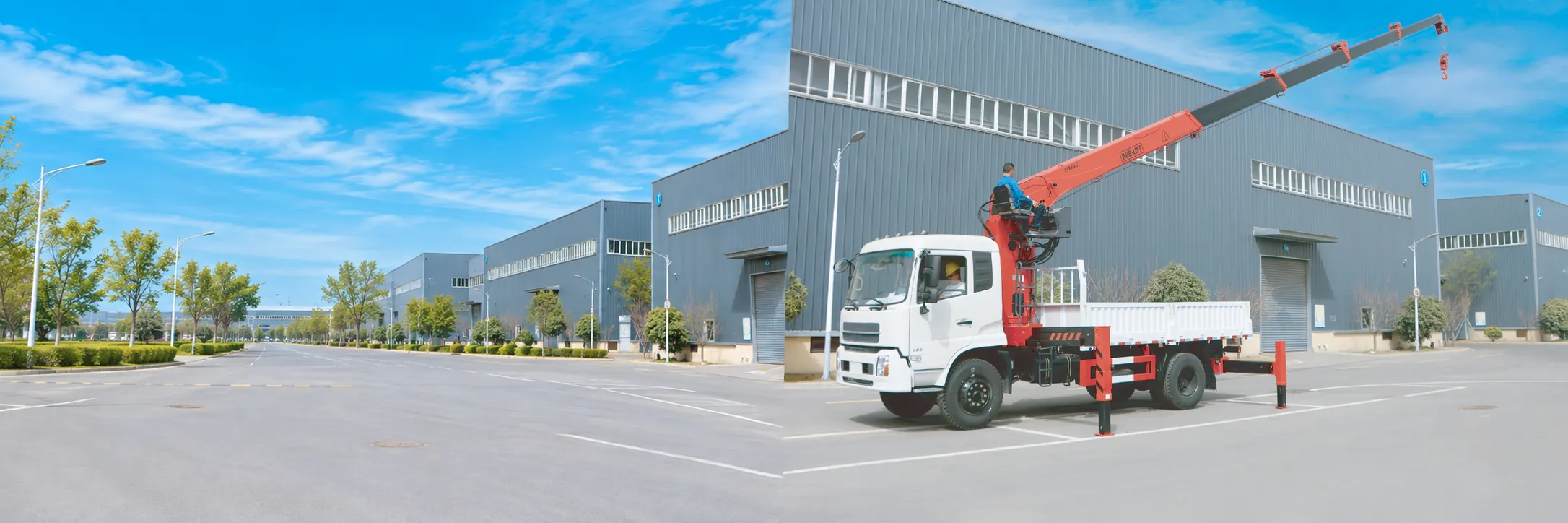
BOB-LIFT has built truck mounted cranes in Xuzhou since 2003. This guide explains the clamp types, the difference between vertical and horizontal plate clamps, how a beam clamp differs from a plate clamp, how to choose and inspect a clamp, and how to use one under a crane. It ends with a worked check of a pair of horizontal plate clamps under a real BOB-LIFT knuckle boom crane. We build the cranes only; clamps, slings and shackles come from lifting gear suppliers.
Key takeaways
- Plate clamps are friction devices. WorkSafe Queensland asks you to consider a positive connection, such as a latched hook through a lifting hole, before you use one.
- Vertical plate clamps lift one plate on edge and need a locking device; horizontal plate clamps lift flat plate and are used in pairs, within the manufacturer’s sling angle limit.
- A beam clamp is a fixed anchor point on a beam flange, not a gripper for lifting the beam, unless it is a type made for that job and positively attached.
- CCOHS says to replace the cam and pad when the teeth are flattened by 50% or more, and never to overload or underload a clamp [1].
- In our example, two 1,413 kg plates would still pass the BOB-LIFT SQ12ZA4 load chart at 6.45 m, but they would violate the one-plate rule and exceed the assumed clamp rating, so verify the clamp before the crane.
What is a lifting clamp?
A lifting clamp hangs from the crane hook on a sling or shackle and closes on the load; in a plate clamp, a toothed cam holds the plate against a pad, and springs keep the cam in contact with the plate. WorkSafe Queensland warns: “All plate clamps are friction type lifting devices”, which means “they are not positive lifting devices” [2]. If the clamping force is too light, or the plate knocks into something, the grip can fail and the plate drops.
The ASME B30.20 volume covers the marking, construction, inspection, testing, maintenance and operation of below-the-hook lifting devices, and ASME adds: “The requirements in this Volume also apply to clamps used for positioning and anchoring.” [3]. Our guide to below-the-hook lifting devices covers that standard, the BTH-1 design standard and the other devices in the family. Where the load has a designed lifting lug or a hole for a shackle, use it: our guide to lifting lugs and pad eyes explains how to rig to one.
Types of lifting clamps
CCOHS, the Canadian Centre for Occupational Health and Safety, groups plate clamps by direction of lift: “There are clamps for vertical, horizontal or universal (multidirectional) lifting.” It adds that clamps “are also rated for the thickness of the plate they are designed to lift” [1].
| Clamp type | What it holds | Typical use | Key rule |
|---|---|---|---|
| Vertical plate clamp | One plate, gripped at its top edge and hanging on edge | Lifting a single plate on edge | Use a locking device, lift one plate at a time and never apply a side load |
| Horizontal plate clamp | A flat plate, gripped at its edges | Lifting flat plate from a stack or a truck bed | Use in pairs or sets; keep the sling angle within the manufacturer’s limit |
| Screw-type (screw-locking) clamp | Plate, gripped by a tightened screw | Lifts where the manufacturer specifies a tightened screw | Tighten to the manufacturer’s specification |
| Universal plate clamp | Plate in more than one direction | Lifts in more than one direction with one clamp | Follow the rating for each direction |
| Beam (girder) clamp | The flange of a fixed beam | Anchor point for a hoist or rigging | Match it to the beam flange and the hoist, and never substitute it for a plate clamp |
Clamps are also made for other shapes, such as stone blocks. In a German stone workshop, for example, a customer hangs a scissor-type stone clamp from the hook of a BOB-LIFT pedestal crane to lift stone blocks. Whatever the shape, the same three checks apply: the rated load, the grip range and the manufacturer’s instructions for that load.
Vertical vs horizontal plate clamps
A vertical plate clamp grips one edge of a plate and lets it hang on edge below the hook. CCOHS gives three rules for it: “When using a vertical type of plate clamp, use a locking device to prevent unintentional loosening”; “Do not lift from the side with a vertical clamp”; and “Do not lift more than one plate at a time with a vertical clamp” [1].
A horizontal plate clamp grips a flat plate at its edge. CCOHS gives two rules for it: “Use horizontal types of plate clamps in pairs” and “Use two or more clamps to balance a long or flexible load” [1]. The pair hangs from a two-leg sling, so the legs pull the clamps inward as well as up, and the inward pull grows as the legs get flatter. WorkSafe Queensland adds that “the angle of the clamp must not exceed the manufacturer’s instructions” [2].
Long, flexible plate can deflect between two clamps, so both sources call for additional clamps on long loads, and WorkSafe Queensland asks that “the correct number of plate clamps are used to lift long loads” [2]. Where the clamps hang from a lifting beam, our spreader bar and lifting beam guide covers the beam.
Beam clamps: an anchor point, not a load gripper
The NSW Government’s Dogging and Rigging guide states that girder clamps “are also known as beam clamps”, adding: “They are used for the suspension of hoisting and rigging equipment to an overhead beam or girder”. It adds that “girder clamps create a single fixed connection point and do not allow the load to be moved along a beam or monorail”, and lists adjustable, angle, universal and trolley beam clamps among the types [4]. The guide also says beam trolleys and clamps “should always be matched to the applicable chain block or lever block”. In rigging, a beam clamp is therefore a temporary anchor for a hoist under a beam, not an attachment hung from a crane hook.
Lifting the beam itself with a clamp is a different matter, as an Ontario Ministry of Labour alert shows. It describes two construction workers “struck and killed when a structural steel beam being hoisted over them slipped out of a lever-action beam clamp”. The single clamp “was too large for the beam”, and when the hoist tension was released, its jaws “could open automatically” [5]. The alert says a beam clamp used for hoisting “must be positively attached to the beam”, must carry an identification plate that “clearly indicates the load rating and the method of attachment to the beam”, and that long or irregular beams need “a two-point beam attachment and a spreader beam”.
How do you choose the right plate clamp?
Selection starts with the plate rather than the clamp: WorkSafe Queensland asks you to confirm that “the plate clamp is suitable for the load to be lifted (consider plate thickness, mass, hardness and surface condition)” [2].
- Thickness: the plate must fall within the clamp’s specified jaw range. CCOHS warns: “Do not use a clamp having a minimum jaw opening larger than the thickness of the load” [1].
- Mass: the plate must not exceed the clamp’s rating. For a horizontal pair, check whether the rating is given per clamp or per pair, and at which sling angle. CCOHS also says “Do not overload or underload a clamp” [1], so check the manufacturer’s load range, including any minimum load.
- Hardness and surface: both affect how the clamp grips the plate, so check the manufacturer’s limits for each. For finished and polished plates, CCOHS advises non-marring (rubber pad) clamps used in pairs.
- Marking: on US construction sites, 29 CFR 1926.251(a)(2) requires rigging equipment to have “permanently affixed and legible identification markings as prescribed by the manufacturer that indicate the recommended safe working load”, and forbids its use without them.
The rating marked on a clamp is a working load limit, and our guide to safe working load vs working load limit explains the terms and the design factor behind them.
How do you use a plate clamp safely during a crane lift?
The following sequence combines the CCOHS fact sheet [1] and the WorkSafe Queensland alert [2], arranged in the order a lifting crew encounters each requirement.
- Check the clamp: CCOHS says “Inspect clamps visually before each lift” and to follow the manufacturer’s operating instructions. WorkSafe Queensland adds that a damaged clamp is never used.
- Rig it correctly: CCOHS says “Use a sling between the clamp and the crane or hoist hook” and advises fitting the clamp or clamps over the plate’s centre of gravity. The clamp shackle should sit on the hook so that, in WorkSafe Queensland’s words, it “cannot come off the lifting hook when lowering a plate”. Our crane hook guide covers the latch, and our guide to rigging shackles covers the shackle.
- Lock before lifting: “Lock a clamp closed before lifting a load.” WorkSafe Queensland asks that a screw-type clamp is tightened to the manufacturer’s specification, for example with a torque wrench.
- Single plates, from the top: handle one plate at a time, and never extract a plate from the bottom of a stack.
- Lift smoothly: CCOHS says “Lift smoothly; avoid jolts”, and the clamp must never be used to drag the load. If a tag line is necessary, CCOHS advises attaching it to the clamp before lifting the plate; see our guide to crane tag lines.
- Keep people clear: never lift over workers or leave a suspended load unattended. WorkSafe Queensland asks people to “stay away from the plate by a total distance of two times the height of the plate”, because a dropped plate can bounce.
WorkSafe Queensland also asks that “the lifting system has been approved by a competent person”, such as a rigger or an engineer [2]. For a repeat delivery, that approval belongs in the crane lift plan.
How do you inspect a lifting clamp, and when is it retired?
Under 29 CFR 1926.251(a)(1), rigging equipment “shall be inspected prior to use on each shift”, and the rule adds: “Defective rigging equipment shall be removed from service.” CCOHS lists what to look at on a plate clamp [1]:
- forging or weld fractures, wear and distortion on internal and external surfaces, and wear in all pin holes;
- the throat (clamp opening): if its width measured at the base, where the pad is located, exceeds the width at the top, “the body has been overloaded”, and the clamp is tagged and removed from service;
- the cam teeth: “If the teeth are flattened by 50% or more, replace the cam and pad”, and otherwise keep the teeth sharp and free of foreign material;
- the springs: the cam spring must be strong enough to hold the cam against the pad, and there should be “definite tension” in the locked position;
- body pins or bolts showing wear or bending due to overloading, and play or wear in spacers, rivets and other internal parts;
- the shackle, which “must not show signs of elongation or wear”.
CCOHS also says: “Do not grind, weld or modify a clamp.” A clamp used repeatedly on a single plate thickness concentrates wear on one area of the cam, so it may need replacement parts sooner than a clamp used across a range of thicknesses.
In Great Britain, HSE defines a lifting accessory as equipment that attaches a load to the lifting equipment and “is not a permanent part of the load” [6]. LOLER regulation 9 requires an accessory for lifting exposed to deterioration to be thoroughly examined “at least every 6 months”, or under an examination scheme; our LOLER guide for lorry loaders explains those examinations. In the US, 29 CFR 1926.251(a)(4) also requires special custom-design clamps to be marked and proof-tested to 125 percent of their rated load before use, a rule our below-the-hook guide covers.
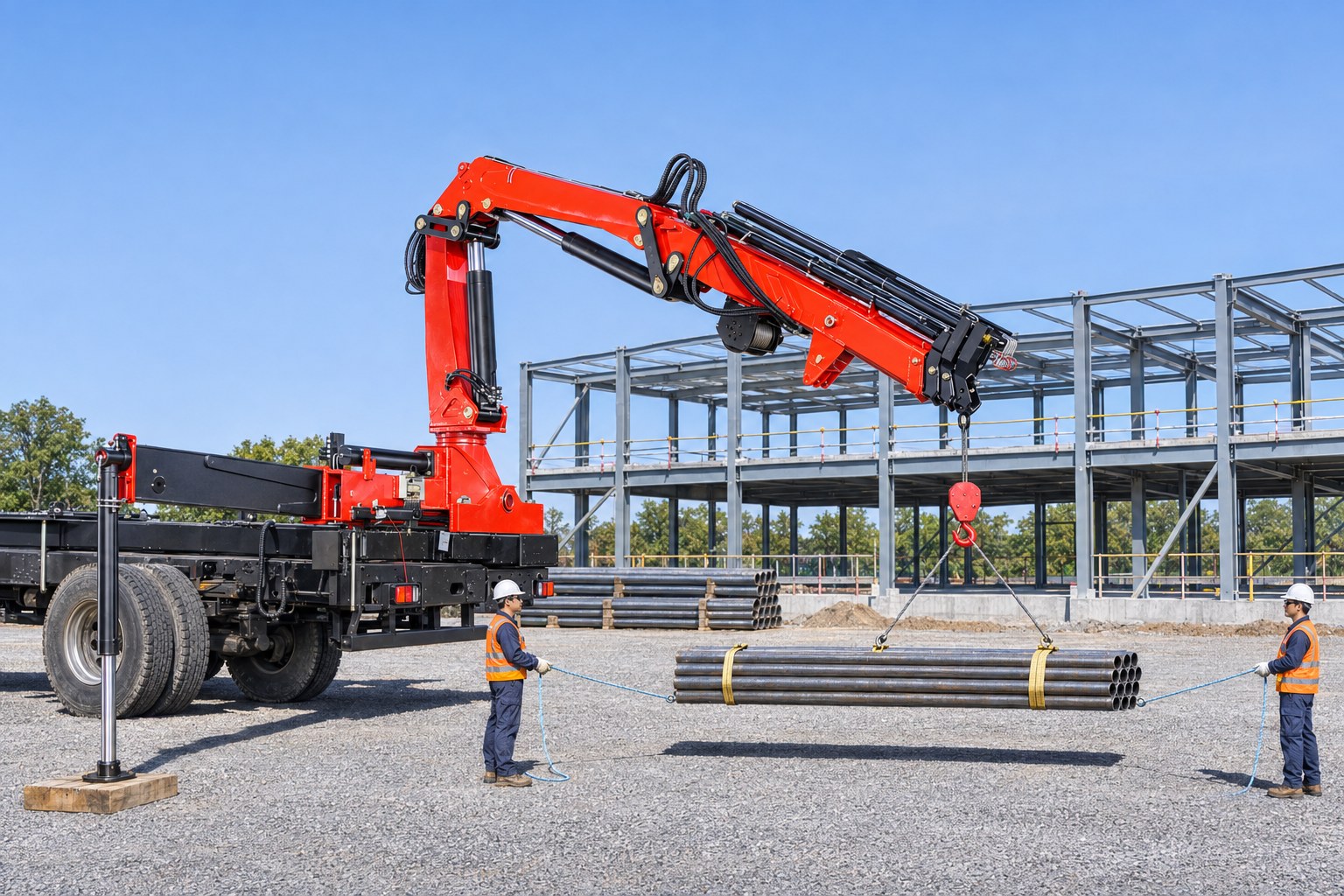
Example: unloading steel plate with a pair of horizontal clamps under a BOB-LIFT SQ12ZA4
Example scenario (an illustration, not a customer record): a BOB-LIFT SQ12ZA4 knuckle boom truck mounted crane unloads steel plates from its own truck bed onto a stack beside the truck. All plate, clamp and rigging figures are ASSUMED; the crane figures come from the SQ12ZA4 dimension drawing and load chart.
- Plate: 3,000 × 2,000 × 30 mm, so 0.18 m³. At an ASSUMED density of 7,850 kg/m³, inside the 7,750 to 8,050 kg/m³ range Wikipedia gives for steel [7], the plate weighs 0.18 × 7,850 = 1,413 kg.
- Clamps: a pair of horizontal plate clamps positioned on the two 2,000 mm edges, separated by 3.0 m. The pair is ASSUMED to be marked 2,000 kg per pair, with the manufacturer’s limit ASSUMED as sling legs at least 45° from horizontal. Each clamp weighs an ASSUMED 15 kg.
- Rigging: a two-leg chain sling with a master link, ASSUMED 25 kg. The load chart does not state whether the hook weight is already deducted, so the hook is included as an ASSUMED 25 kg.
- Gross load on the crane: plate, clamps, sling assembly and hook together total 1,413 + 30 + 25 + 25 = 1,493 kg.
- Leg tension: the two legs together support the plate and clamps, 1,443 kg. Tension per leg = 1,443 ÷ (2 × sin θ), with θ measured from horizontal; the inward pull on each clamp is the leg tension × cos θ.
| Sling leg length | Leg angle θ | Tension per leg | Inward pull per clamp | Against the ASSUMED 45° limit |
|---|---|---|---|---|
| 2.5 m | 53.1° | 902 kg | 541 kg | Inside the limit |
| 1.8 m | 33.6° | 1,305 kg | 1,088 kg | Outside the limit: do not lift |
Shortening the legs from 2.5 m to 1.8 m reduces the overall rigging height by about 1 m, but it roughly doubles the horizontal force at each clamp and takes the pair outside its permitted angle range. The crane registers none of this, because the hook load remains 1,493 kg. Select the sling length to suit the clamps, and verify the sling’s own rating at that angle in our crane rigging and slings guide.

Then check the crane. OSHA’s crane rules define the load as the object plus “the load-attaching equipment, such as, the load block, ropes, slings, shackles, and any other ancillary attachment” (29 CFR 1926.1401), so the clamps count. The SQ12ZA4 drawing lists a 12,000 kg maximum lifting capacity, a 27 t·m lifting moment and a 4,480 kg crane weight. Its load chart gives the rated loads below with the boom horizontal.
| Radius | Rated load | One plate, 1,493 kg | Two plates at once, 2,906 kg |
|---|---|---|---|
| 6.45 m | 3,750 kg | Passes, 2,257 kg spare | Crane passes with 844 kg spare, but the clamp pair rating is exceeded |
| 8.2 m | 2,750 kg | Passes, 1,257 kg spare | Fails by 156 kg |
| 10.15 m | 2,100 kg | Passes, 607 kg spare | Fails by 806 kg |
One plate is an easy lift at every radius on the chart, so the real trap is the temptation to take two plates at once to save time. Close to the truck the crane would accept 2,906 kg, but the clamp guidance does not: it allows one plate at a time, and the ASSUMED pair rating of 2,000 kg is exceeded anyway, so on this lift the clamp reaches its limit before the crane does. Our guides on how to read a crane load chart and on the lifting moment of a crane explain the crane side. Every BOB-LIFT crane is listed with a load moment limiter; it weighs the whole hook load, but it cannot know the clamp’s rating, its grip or its angle limit, as our load moment indicator guide describes.
Finally, a suspended plate can rotate as it leaves the stack. 29 CFR 1926.1417(w) states: “A tag or restraint line must be used if necessary to prevent rotation of the load that would be hazardous”. The full drawing and load chart are on the SQ12ZA4 product page.
Frequently asked questions
What is the difference between a plate clamp and a beam clamp?
A plate clamp grips the load itself, typically a steel plate, so the crane can lift it. A beam clamp attaches to the flange of a structural beam and provides a hoist or rigging with a single fixed anchor point. Lifting a steel beam with a clamp requires a clamp designed for that purpose and positively attached.
Can a vertical plate clamp lift a plate lying flat?
Only if the manufacturer rates it for that direction, as with a universal clamp, because CCOHS says not to lift from the side with a vertical clamp. Flat plate is lifted with horizontal clamps used in pairs, or with clamps on a lifting beam for long plate.
Can I lift two plates at once with a plate clamp?
No, unless the clamp and the method are specifically approved for it. CCOHS says to lift one plate at a time and never to lift more than one plate with a vertical clamp. The lower plate would be held only by friction against the upper one.
When should a plate clamp be taken out of service?
When the throat is wider at the base than at the top, when the cam teeth are flattened by 50% or more (replace the cam and pad), when springs, pins or the shackle are bent, worn or weak, when there are cracks, or when the rating marking cannot be read.
Does BOB-LIFT supply lifting clamps with its cranes?
No. We build truck mounted and marine cranes, while clamps, slings and shackles come from specialist lifting equipment suppliers. Send us the plate size and weight, the clamp and rigging weights and the radius, and we will check them against the load chart of the crane you are considering.
How we compiled this guide
The plate clamp guidance comes from the CCOHS fact sheet “Materials Handling – Plate Clamp Inspection and Use” and the WorkSafe Queensland alert “Plate clamps and dropping loads” (2014). The beam clamp material comes from the NSW Government Dogging and Rigging guide and the Ontario Ministry of Labour alert on lever-action beam clamps, and the scope of ASME B30.20 from the ASME website. HSE’s lifting equipment questions page gave the definition of a lifting accessory. We quoted the rules from the official eCFR text of 29 CFR 1926.251, 1926.1401 and 1926.1417 and from LOLER regulation 9 on legislation.gov.uk, all read in November 2026. The crane figures come from the BOB-LIFT SQ12ZA4 dimension drawing and load chart, and the example uses clearly marked assumed weights and clamp ratings. Achord Chan, Product Operations Director, carried out the editorial review. This guide does not replace the clamp manufacturer’s instructions, the crane’s operator’s manual or the regulations where you work.
Need a crane for unloading steel plate?
Tell us the heaviest plate or beam, the weight of the clamps, slings and any lifting beam, and the radius at which the load must land. We will recommend a knuckle boom truck mounted crane or a telescopic crane and send its dimension drawing and load chart. If you buy the truck in China, we can fit the crane at our factory; if you buy it locally, we ship the crane, a local body builder fits it and we support the work remotely. Contact us for a quotation; every crane carries a 12-month warranty on the whole machine.