
The safe working load (SWL) is the maximum load that the manufacturer allows a piece of lifting equipment to carry in normal service, and the working load limit (WLL) is the same idea under a newer name. For a sling, shackle or hook it is one number marked on the item. For a crane it is never one number, because the rated load changes with the radius, the boom configuration and the outriggers, so the crane’s safe working load is its load chart.
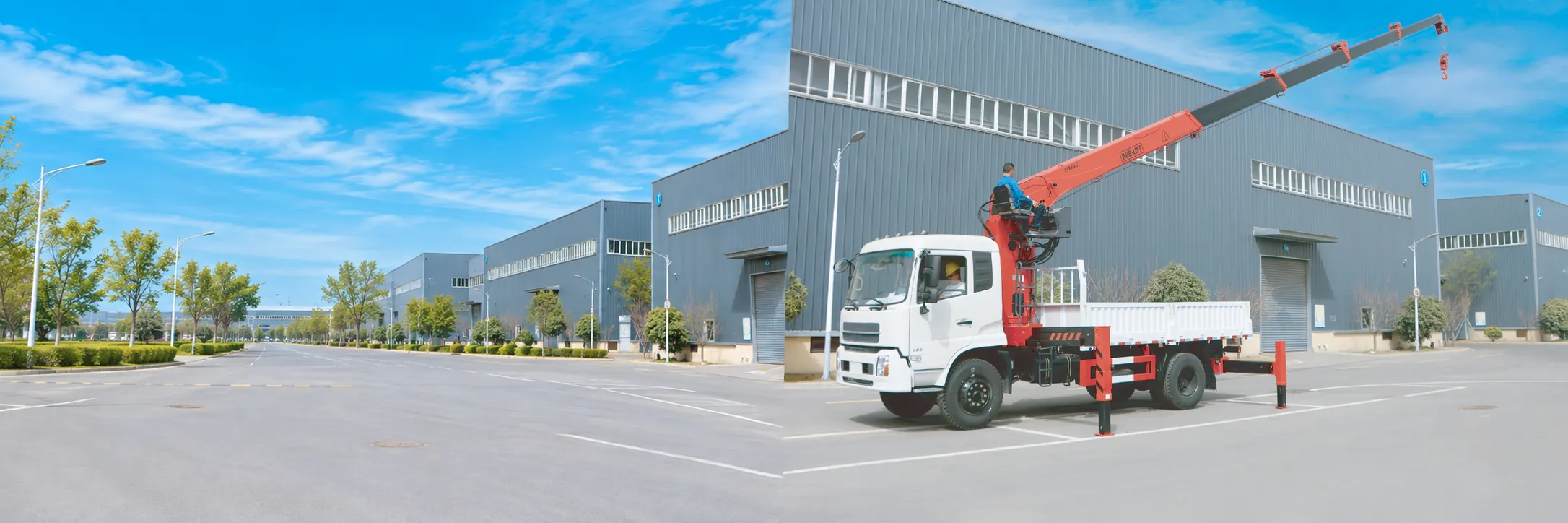
We have built truck mounted cranes in Xuzhou since 2003, and buyers often ask what the “SWL” of a crane is or how to calculate it. This guide explains the terms and how a working load limit is set from the breaking strength. It also shows why a crane’s rating falls with reach, what counts against it, and how the weakest link in the rigging sets the limit of the whole lifting operation.
Key takeaways
- SWL, WLL and rated capacity all describe the maximum load the manufacturer permits in service; US rules use “rated capacity (i.e., working load limit)”, while UK law uses “safe working load”.
- For slings and other gear, the working load limit is the minimum breaking load divided by a design factor, and the US sling tables use a design factor of 5.
- A crane has a different rated load at every radius: our SQ8ZA5 knuckle boom is rated 8,000 kg at 2.0 m but 1,160 kg at 12.63 m.
- The hook block, slings, shackles and attachments all count against the crane’s rating.
- The safe working load of a lift is the lowest rating in the chain, and that weakest link can change when the radius changes.
What is the safe working load (SWL)?
The safe working load is the heaviest load that a manufacturer permits on its lifting equipment under stated conditions. It is far below the load that would break the equipment, because a design margin is built in. The US general industry sling rule, 29 CFR 1910.184, puts the two current names side by side: “Rated capacity or working load limit is the maximum working load permitted by the provisions of this section” [2].
Several related terms appear on certificates, tags and load charts, and because they are not interchangeable, it helps to know exactly which one you are reading.
| Term | What it means | Where you see it |
|---|---|---|
| Safe working load (SWL) | The maximum load the manufacturer permits in service | UK law (LOLER), older tags, US rule 1926.251(a) |
| Working load limit (WLL) | The same maximum, the term most sling and shackle makers now mark | Sling tags, shackle bodies, US sling rules |
| Rated capacity or rated load | The maximum load for a stated configuration of a crane or a hitch | Crane load charts, US crane rules |
| Minimum breaking load (MBL) | The load at which a new item is expected to fail, also called minimum breaking strength or force | Rope and chain certificates |
| Design factor | The ratio of minimum breaking load to working load limit | Standards and rope specifications |
| Proof load | A test load applied once to verify manufacture, above the working load limit | Test certificates |
Is SWL the same as the working load limit?
In practice, yes: both terms name the maximum load the manufacturer permits, and the regulations use them for the same marked figure. The US construction rigging rule, 29 CFR 1926.251, even uses both in one section. Paragraph (a)(2) requires markings “that indicate the recommended safe working load”, while later paragraphs forbid loads above “the rated capacities (i.e., working load limits)” marked on chain, wire rope, fibre rope slings and shackles [1].
UK law keeps the older term: regulation 7 of the Lifting Operations and Lifting Equipment Regulations 1998 (LOLER) requires machinery and accessories to be “clearly marked to indicate their safe working loads” [8]. Wikipedia’s entry on lifting equipment explains why many makers prefer WLL: the alternative term “is sometimes avoided due to giving the connotation of safety, which may not be guaranteed” [11].
The practical rule is to read the figure that the manufacturer marked on the item or printed on the chart, whatever it is called, and never to lift more than that figure. If a tag shows no rating at all, the equipment is not used.
How is a working load limit set from the breaking strength?
For slings, ropes and other lifting gear, the working load limit is the minimum breaking load divided by a design factor. Wikipedia states that the working load limit “is calculated by dividing the ‘minimum breaking load’ of the equipment by a safety factor”, and that the minimum breaking load is also called “minimum breaking strength” or “minimum breaking force” [11]. In short, WLL = MBL ÷ design factor.
The design factor is set by the standard for each product, not chosen on site. OSHA’s Guidance on Safe Sling Use gives rated loads for wire rope slings, metal mesh slings and nylon, polyester and polypropylene rope slings “Based on Design Factor = 5” [7]. As an illustration only, a sling with a minimum breaking load of 10,000 kg and a design factor of 5 has a working load limit of 2,000 kg.
The crane’s own hoist rope follows similar rules. Under 29 CFR 1926.1414, rotation-resistant ropes “must have an operating design factor of no less than 3.5”, and Types I, II and III need no less than 5 unless the stated exceptions apply [4]. Our crane wire rope guide covers rope construction and discard criteria.
Two cautions follow from this: a breaking strength is never a working figure, so never lift up to it, and a working load limit also assumes the equipment is undamaged and used as intended. That is why worn or deformed equipment is removed from service instead of being “derated” by guesswork.
Why does a crane have no single safe working load?
A crane’s rating depends on where the hook is, so it has a different safe working load at every radius and boom configuration. LOLER regulation 7 recognises this: where the safe working load “depends on its configuration”, the machinery must be marked for each configuration, or “information which clearly indicates its safe working load for each configuration is kept with the machinery” [8]. For a truck mounted crane, the document that contains that information is the load chart.
The US crane rule says the same in its definition of rated capacity, which is “the maximum working load permitted by the manufacturer under specified working conditions”, including “equipment configuration, radii, boom length, and other parameters of use” [3]. The figure in a model name, such as 8 t, is only the rating at the shortest radius.

The table below shows how far the rating falls on four of our cranes, using figures from each model’s technical drawing. In every case the rating at full reach is a small fraction of the nameplate tonnage.
| Crane | Maximum rated load | Rated load at the longest chart radius | Share of maximum |
|---|---|---|---|
| SQ4ZA4 knuckle boom | 4,000 kg at 2.1 m | 600 kg at 9.4 m | 15 % |
| SQ8ZA5 knuckle boom | 8,000 kg at 2.0 m | 1,160 kg at 12.63 m | 14.5 % |
| SQ6.3SA4 telescopic | 6,300 kg at 2.5 m | 600 kg at 12.6 m | 9.5 % |
| SQ16SA5 telescopic | 16,000 kg at 2.5 m | 1,050 kg at 22.3 m | 6.6 % |
Radius is not the only variable, because on a telescopic crane the boom length changes the rating even at the same radius. The SQ16SA5 table gives 4,000 kg at 9 m with the 14.5 m boom at 50°, but 3,700 kg at 9 m with the 18.55 m boom at 60°, because the longer boom adds its own weight further out. Our article on how to read a crane load chart shows how to find the right row.
Outriggers and ground matter as much, since each chart applies to a stated outrigger setting, such as the 2,310 to 5,610 mm span on our SQ8ZA5 drawing. For truck and wheel mounted cranes on outriggers fully extended, US general industry rule 29 CFR 1910.180 caps load ratings at 85 percent of the tipping load [6]. It also lists “wind, or ground conditions” among the stability factors that the user must take into account. Our guide to crane outriggers and ground bearing pressure covers the ground side.
What counts against the crane’s rating?
Everything hanging from the boom tip counts, not just the object you intend to move. The US crane rule defines the load as the object and “the load-attaching equipment, such as, the load block, ropes, slings, shackles, and any other ancillary attachment” [3]. Rule 1910.180 adds that “the weight of all auxiliary handling devices such as hoist blocks, hooks, and slings shall be considered a part of the load rating” [6].
- Hook or hook block: on a telescopic crane the hook block hangs on the winch rope, and its weight is part of every lift, as our crane hook guide explains.
- Slings, shackles and master links: light on their own, but they add up on a long reach.
- Spreader beams and lifting frames: frequently the heaviest individual component of the rigging.
- Attachments: pallet forks, grabs, clamshell buckets and rotators hang under the boom tip and take their weight off the chart.
The check itself is one comparison: the gross load, meaning the object plus all of this rigging, must not exceed the rated load at the largest radius of the lift. Our guide on how to calculate crane capacity sets out that arithmetic step by step, with a printable worksheet and three worked examples from our load charts. The US rule also states plainly that “the equipment must not be operated in excess of its rated capacity” [5].
What is the safe working load of the whole lift?
The safe working load of a lift is the lowest rating in the chain from the crane to the object: the crane at that radius, the hook block, each shackle, the sling at its hitch and angle, and any attachment. The US sling rule states this directly for chain slings. Attachments must be rated at least equal to the chain, “or the sling shall not be used in excess of the rated capacity of the weakest component” [2].
A sling’s rating also depends on how it is used, and under 1926.251(c)(16) a wire rope sling must be marked with its “rated capacity for the type(s) of hitch(es) used and the angle upon which it is based” [1]. HSE’s brief guide to LOLER warns that “the load in the legs of a sling increases as the angle between the legs increases” [10]. Our guide to crane rigging and slings shows how to work out leg tension.

Example scenario (an illustration, not a customer record): a contractor must place a steel frame with an SQ6.3SA4 telescopic truck mounted crane. For this illustration we ASSUME the frame weighs 900 kg and the hook block, two-leg chain sling and shackles weigh 60 kg together. We also ASSUME the sling is marked 1,000 kg for its two-leg hitch at the angle used, each shackle is marked 1,000 kg and the hook block is marked 3,000 kg. These are assumed figures for illustration, not specifications of any real rigging equipment.
In Lift A the frame lands 8.7 m from the slewing centre, where the SQ6.3SA4 chart gives 1,200 kg with the 10.14 m boom at 30°, so the crane carries the 960 kg gross load with room to spare. The lowest rating in the chain is now the 1,000 kg sling, and the shackles match it, so the sling limits the frame to 1,000 kg and the 900 kg frame passes.
In Lift B a wall pushes the landing point out to 11 m, which needs the 12.84 m boom at 30°. The chart gives 800 kg there, so the crane becomes the weakest link, and 960 kg is more than 800 kg, so the lift fails even though the sling, shackles and hook block are unchanged. Lift B would therefore require a shorter radius, a lighter frame or a larger crane.
The same thinking applies to the crane’s own parts, since the hook block, the hoist rope and the winch are matched to the crane by the manufacturer, and the load chart already reflects them. Replacement hooks or ropes must therefore match the specification in the crane’s operating manual. BOB-LIFT supplies the crane; slings, shackles, spreader beams and attachments are supplied separately, so check every marking before the first lift.
What must be marked on lifting gear?
Every item in the chain must show its rating, and an item without a readable rating is not used. Under 29 CFR 1926.251(a)(2), rigging equipment must “Not be used without affixed, legible identification markings” [1]. The table summarises the identification that each paragraph of the US construction rule requires.
| Item | Required marking (29 CFR 1926.251) |
|---|---|
| All rigging equipment | Permanently affixed, legible markings that indicate the recommended safe working load, (a)(2)(i) |
| Welded alloy steel chain slings | Size, grade, rated capacity and sling manufacturer, (b)(1) |
| Wire rope slings | Size, rated capacity for the hitch types used, the angle it is based on, and the number of legs if more than one, (c)(16) |
| Natural and synthetic fibre rope slings | Rated capacity for the hitch types and angle, fibre material, number of legs, (d)(7) |
| Synthetic web slings | Manufacturer’s name or trademark, rated capacities for the type of hitch, type of material, (e)(1) |
| Shackles | Working load limit by permanently affixed, legible marking, (f)(1) |
| Custom grabs, hooks and clamps | Marked with safe working loads and proof-tested to 125 percent of rated load, (a)(4) |
In Great Britain, LOLER regulation 7 also requires accessories to be marked “in such a way that it is possible to identify the characteristics necessary for their safe use” [8]. Every report of thorough examination records “the safe working load of the lifting equipment”, or for configurable machines the safe working load “for the last configuration in which it was thoroughly examined” [9]. HSE’s advice is to “use only certified lifting equipment, marked with its safe working load, which is not overdue for examination” [10].

Does a proof test or load test raise the safe working load?
No, a proof test is a one-time load above the working load limit that verifies how an item was made, and it never becomes a new working figure. The US sling rule defines it as “a nondestructive tension test performed by the sling manufacturer or an equivalent entity to verify construction and workmanship of a sling” [2].
The test factors differ by item: custom grabs, hooks and clamps are proof-tested “to 125 percent of their rated load”, and welded end attachments on wire rope slings “at twice their rated capacity” [1]. New and repaired metal mesh slings are tested at “a minimum of 1½ times their rated capacity”, and repaired synthetic web slings “to twice the rated capacity” [2].
Cranes are treated more cautiously, and for rated load tests 29 CFR 1910.180 says that “test loads shall not exceed 110 percent of the rated load at any selected working radius”. The same rule adds that no crane “shall be rerated in excess of the original load ratings” unless the crane manufacturer or final assembler approves [6]. Our crane load test guide explains what EN 12999, ASME B30.22, LOLER and OSHA ask for.
Does a load moment limiter replace the rating?
No, a limiter enforces the rating but does not replace the operator’s check. The US crane rule describes a load moment limiter as a system that compares the overturning moment with the crane’s rated capacity. When the rated capacity is reached, it “shuts off power to those equipment functions which can increase the severity of loading” [3]. It intervenes at the limit, not during the planning of the lift.
Every BOB-LIFT crane is listed with a load moment limiter, as our article on the lifting moment of a crane explains. A limiter knows nothing about a sling rated below the crane, a shackle with a worn pin or a load heavier than the delivery note says. Those checks stay with the person who plans the lift, as described in our crane lift plan guide.
Which mistakes lead to overloading?
Most overloads come from reading the right number in the wrong place, and these are the most common examples.
- Treating the model tonnage as the crane’s safe working load at every radius.
- Reading the chart at the pick-up radius when the landing point is further out.
- Forgetting the hook block, slings, shackles, spreader beam or forks in the gross load.
- Using a sling’s vertical rating for a choker, basket or angled multi-leg hitch.
- Combining a strong sling with a lower-rated shackle or master link.
- Lifting up to a breaking strength or a proof load instead of the working load limit.
- Using lifting equipment with a missing or illegible identification tag.
- Relying on the limiter to identify an error in the rigging.
A short daily check catches many of these before work starts, and our truck mounted crane inspection checklist lists what to look at. When you choose a new crane, size it from the heaviest gross load at the longest radius, as our guide to selecting crane tonnage explains.
Frequently asked questions
What does SWL mean on a crane?
SWL means safe working load, the maximum load the manufacturer permits, but on a crane it is not one number: it is the rated load at each radius and boom configuration shown on the load chart. LOLER regulation 7 asks for exactly that information to be kept with a machine whose safe working load depends on its configuration.
What is the difference between SWL and WLL?
Both name the maximum load the manufacturer permits in service, and WLL is the term most sling and shackle manufacturers now mark, while US rules write “rated capacities (i.e., working load limits)”. SWL is the older term that UK law still uses, so always follow the figure marked on the item.
How do you calculate the safe working load of a crane?
You do not calculate it; you read it from the manufacturer’s load chart at the largest radius of the lift. Then add the object and all rigging to get the gross load and confirm it does not exceed that rating, as our crane capacity calculation guide shows.
How is the safe working load of a wire rope sling worked out?
The maker divides the minimum breaking load by a design factor, and OSHA’s sling tables use a design factor of 5. The result is marked on the tag for each hitch type and angle, so read the tag rather than calculating it yourself.
Can you exceed the safe working load for a test?
Only in a planned test by the manufacturer or a competent person, and never in normal work. The standard sets the test factor, such as 125 percent for custom lifting accessories or no more than 110 percent of rated load for crane tests under 1910.180.
How we compiled this guide
We compiled the regulations from the official osha.gov text of 29 CFR 1910.180, 1910.184, 1926.251, 1926.1401, 1926.1414 and 1926.1417, and the design factor tables from OSHA’s Guidance on Safe Sling Use. The UK wording comes from LOLER regulation 7 and Schedule 1 on legislation.gov.uk and from HSE’s brief guide INDG290, and the term history from Wikipedia, all as they stood in November 2026. The crane figures come from the current BOB-LIFT technical drawings and load charts of the SQ4ZA4, SQ8ZA5, SQ6.3SA4 and SQ16SA5, the example uses clearly marked assumed weights and ratings, and the diagrams are our own work. Achord Chan, Product Operations Director, reviewed the guide before publication. It does not replace the crane’s operator’s manual, the markings on your rigging or the regulations where you work.
Need a crane rated for your heaviest lift?
Tell us your heaviest item, the rigging or attachment you will use and the radius at which you must set it down. We will recommend a knuckle boom or telescopic boom truck mounted crane and send its dimension drawing and load chart, so you can see the rated load at your radius before you buy. Every crane carries a 12-month warranty on the whole machine, common spare parts leave the factory within 48 hours, and our service team answers within 12 hours. Contact us for a quotation and a load chart check.