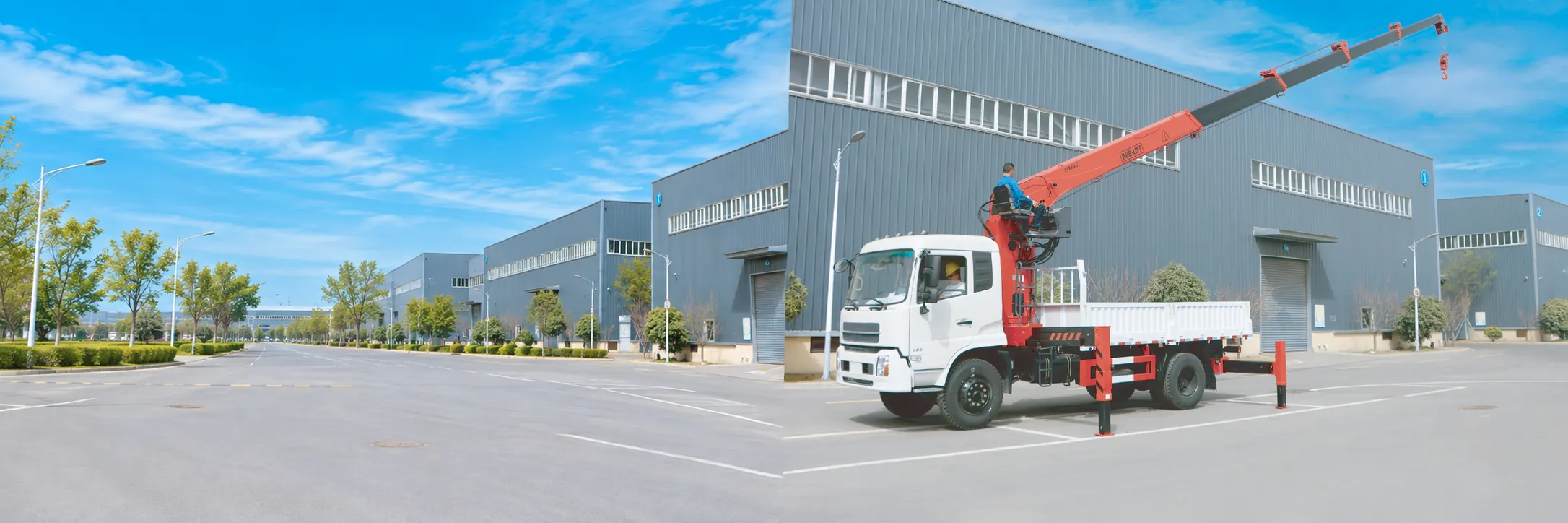

A drywall delivery crane is a truck mounted knuckle boom crane that lifts bundles of gypsum board off the truck deck onto the ground, a balcony or an upper floor, usually on pallet forks hung from the boom tip. To choose one, add up the weight of the boards, the forks and any rigging, then check that total against the load chart at the real radius and height of the drop. Buyers often call the finished truck a drywall boom truck or sheetrock boom truck, but the part that does the lifting is the crane, and that is the part we build.
BOB-LIFT has built truck mounted cranes in Xuzhou since 2003, and we supply the crane only: the truck chassis, the body and the pallet forks come separately. This guide covers board weights from industry data, the weight of the forks, reach and height, three of our knuckle boom cranes with their load charts, mounting and remote control. It also explains what the US delivery exclusion in 29 CFR 1926.1400(c)(17) actually says.
Key takeaways
- An industry-average 5/8 in Type X gypsum board weighs 991 kg per 1,000 sq ft, about 31.7 kg for a 4 × 8 ft sheet, so a 40-sheet lift is about 1.27 t before the forks.
- Pallet forks, a rotator and any slings are part of the load, so their weight comes off the rated load at every radius, and BOB-LIFT does not manufacture forks.
- Size the crane at the radius of the furthest drop, and check that the boom tip can rise high enough for the opening with the forks hanging below the hook.
- Our SQ8ZA5, SQ10ZA5 and SQ12ZA5 knuckle boom cranes are rated between 1,420 kg and 1,850 kg at radii of 10.15 m to 10.56 m.
- OSHA’s crane rule excludes knuckle boom deliveries only in narrow cases; holding material in place, or lifting trusses, wall panels or structural steel, brings the work back under the rule.
Who uses a drywall delivery crane, and why a knuckle boom?
Building supply yards and drywall or gypsum distributors are the main buyers, followed by roofing suppliers, brick and block yards and contractors who run their own delivery truck. They all need the same thing: to put a heavy, awkward load exactly where the crew will use it, often on an upper floor. Ireland’s Health and Safety Authority describes this kind of machine, which it calls a lorry loader crane, as “a crane mounted on a vehicle for the purpose of loading and unloading that vehicle”. Its information sheet on safe lorry loader crane operations names “building materials, (blocks, timber, bags, logs)” among the typical loads.
A knuckle boom suits this work because of its joint. Wikipedia’s article on cranes describes a loader crane as a hydraulically powered articulated arm whose “numerous jointed sections can be folded into a small space when the crane is not in use”. Folded behind the cab, the crane leaves most of the deck free for board, while unfolded the inner boom stays high while the outer boom reaches over a fence, under the eaves or into a window opening. Our guide on what a knuckle boom crane is explains the parts, and our knuckle boom vs telescopic boom comparison shows when a straight boom with a winch is the better choice, usually for taller, longer lifts.
How much does a load of drywall weigh?
A 4 × 8 ft sheet of 5/8 in Type X gypsum board weighs about 31.7 kg, based on industry-average data, but your supplier’s figure for the exact product is the one to use. The Gypsum Association’s industry-average environmental product declaration (EPD) for 5/8 in (15.9 mm) Type X conventional board gives a final weight of 991 kg per 1,000 sq ft (92.9 m²), including moisture [1]. The same EPD puts the weighted average density at 0% moisture at 10.4 kg/m², with a minimum of 9.9 and a maximum of 11.0 kg/m² [1].
| Board | Weight per 1,000 sq ft (source) | Per m² | Per 4 × 8 ft sheet |
|---|---|---|---|
| 5/8 in Type X, paper-faced | 991 kg [1] | 10.7 kg | 31.7 kg |
| 1/2 in glass-mat board | 943 kg [2] | 10.2 kg | 30.2 kg |
| 5/8 in Type X glass-mat board | 1,263 kg [2] | 13.6 kg | 40.4 kg |
Sheet size changes the count more than the thickness does. Wikipedia’s drywall article notes that the most common North American width is 48 in, the most common length is 8 ft and lengths up to 16 ft are common, in 1/2 and 5/8 in thicknesses [3]. A 12 ft sheet of the same 5/8 in Type X board covers 48 sq ft, which works out at about 47.6 kg. We found no industry-average figure for lightweight 1/2 in board, so take it from the maker’s data sheet.
Count the packaging too, since an earlier Gypsum Association EPD for 5/8 in Type X board, issued in 2014, lists bundling tape, shrink-wrap, edge protectors and “risers/spacers constructed of gypsum board” among the packaging. For brick, block, roofing or cement pallets, the weight varies so much by product that only the delivery note will do. Under 29 CFR 1926.1417(o)(3), the operator must verify the load weight from “a source recognized by the industry (such as the load’s manufacturer)” or a recognized calculation.
Crane pallet forks: what do they add to the lift?
Pallet forks add their own weight to every lift, so a crane carrying heavy forks lifts fewer boards at the same radius. Crane pallet forks are a frame with two tines that hangs from the crane hook or a rotator at the boom tip, so the load can slide onto a floor without slings. They are also sold as drywall forks or crane forks. Self-levelling designs keep the tines level as the load leaves the deck, while a hydraulic rotator lets the operator turn the load to line up with a narrow opening.
BOB-LIFT does not make forks, so you buy them from a fork supplier and check three points with us before you order. First, how the forks connect to the boom tip, either on the hook, on a link or on a rotator. Second, whether a rotator needs an extra hydraulic function and hoses to the tip. Third, how the fork weight and the fork’s own rated capacity combine with the crane’s load chart, because the lower limit governs. Under 29 CFR 1926.1417(a), the employer must comply with all manufacturer procedures “including its use with attachments”. Our guide to knuckle boom crane attachments covers grapples, winches and augers, which follow the same weight rule.
How far and how high does the crane need to reach?
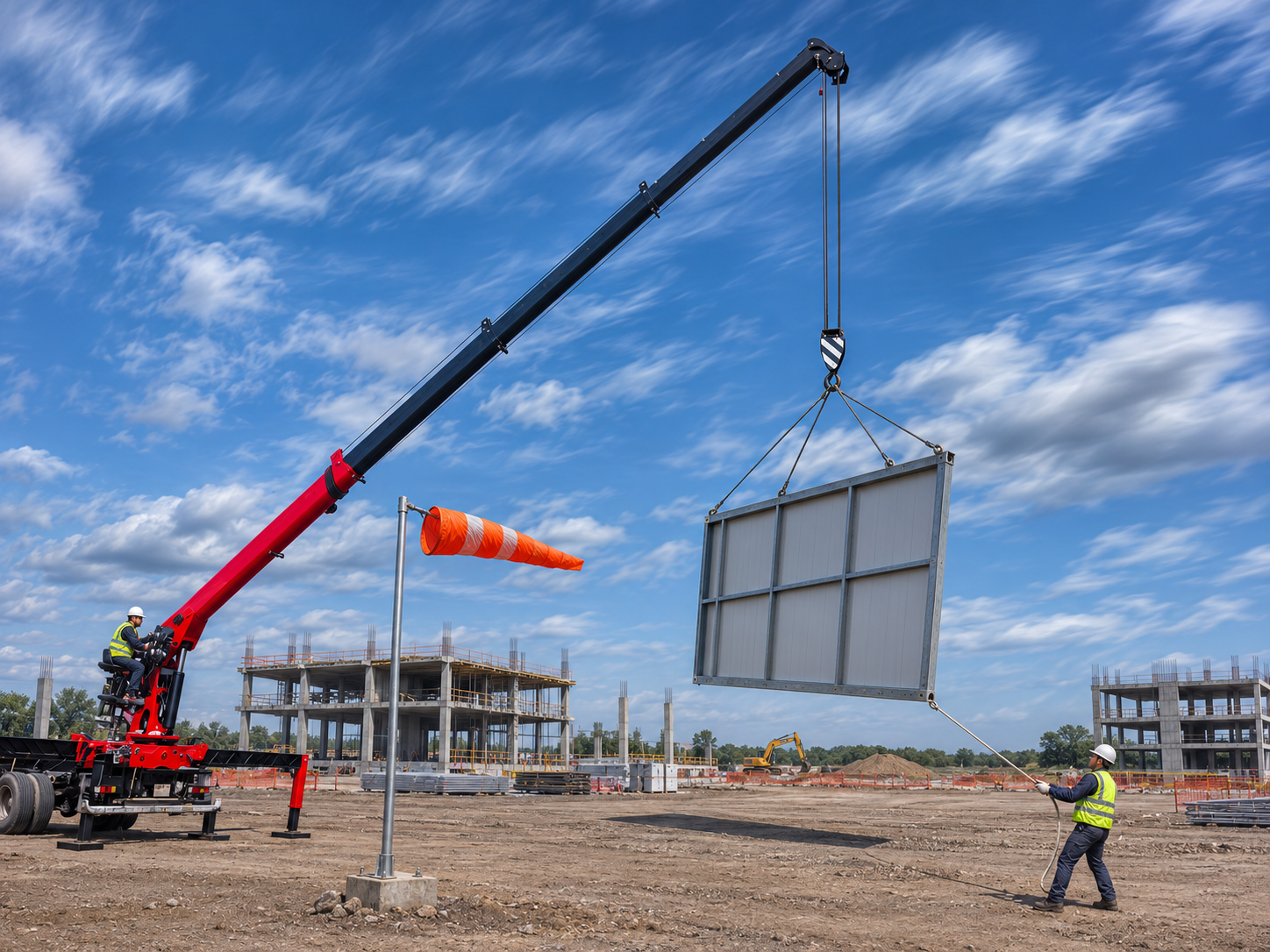
Measure two things on site before you choose a crane: the radius and the height of the drop. The working radius is the horizontal distance from the crane’s slewing centre to the hook at the set-down point. The height is the sill of the opening above the ground, plus the drop from the hook to the fork tines, plus a margin to clear the sill, as the diagram below shows.

A knuckle boom load chart rates the crane by radius, and the range diagram is the side view on the same drawing that shows how high the boom tip can be at each radius. On the SQ8ZA5 and SQ10ZA5 range diagrams, for example, the boom tip can sit more than 10 m above the crane’s mounting base out to about 9.5 m of radius. That base sits on the truck frame, above the ground. Measure the radius at the furthest set-down point, because that is where the rated load is lowest, and our guide on how to read a crane load chart shows how to read between two chart points. Also plan the slewing path, since 29 CFR 1926.1417(r) states that on wheel-mounted equipment “no loads must be lifted over the front area, except as permitted by the manufacturer”.
Which BOB-LIFT knuckle boom cranes suit drywall delivery?
For bundles of board on forks, our five-section 8 to 12 tonne knuckle boom cranes keep a useful rated load out past 10 m, which suits drops through second- and third-floor openings set back from the street. The table lists figures from the technical drawing and load chart of each crane.
| Crane | Working radius | Rated load |
|---|---|---|
| SQ8ZA5 (8,000 kg, 16.7 t·m, self weight 3,250 kg) | 6.49 m | 2,470 kg |
| SQ8ZA5 | 8.51 m | 1,820 kg |
| SQ8ZA5 | 10.56 m | 1,420 kg |
| SQ8ZA5 | 12.63 m | 1,160 kg |
| SQ10ZA5 (10,000 kg, 21 t·m, self weight 3,550 kg) | 6.49 m | 3,080 kg |
| SQ10ZA5 | 8.51 m | 2,280 kg |
| SQ10ZA5 | 10.56 m | 1,800 kg |
| SQ10ZA5 | 12.63 m | 1,480 kg |
| SQ12ZA5 (12,000 kg, 27 t·m, self weight 4,600 kg) | 6.45 m | 3,500 kg |
| SQ12ZA5 | 8.2 m | 2,500 kg |
| SQ12ZA5 | 10.15 m | 1,850 kg |
| SQ12ZA5 | 12.2 m | 1,500 kg |
The chart plots the same points from 4 m outward and shows the safe way to read a radius that falls between two of them.

Example scenario (an illustration, not a customer record): a drywall distributor delivers 40 sheets of 4 × 8 ft, 5/8 in Type X board to a second-floor opening 8.5 m from the slewing centre. At 31.7 kg a sheet the boards weigh 1,268 kg, and with forks we assume weigh 250 kg the total load is 1,518 kg; the fork weight is an assumed figure, not the weight of any real product.
At 8.5 m, the SQ8ZA5 is rated 1,820 kg at 8.51 m and the SQ10ZA5 is rated 2,280 kg, so both pass, with 302 kg and 762 kg to spare. The SQ12ZA5 has no chart point between 8.2 m and 10.15 m, so we read 1,850 kg at 10.15 m, which still passes. If the opening were 10.5 m away, the SQ8ZA5 at 1,420 kg would fail, the SQ10ZA5 at 1,800 kg would pass, and the SQ12ZA5 drops to 1,500 kg at 12.2 m, just short.

Every BOB-LIFT crane is listed with a load moment limiter, as our article on the lifting moment of a crane explains, but the limiter is a backstop and not a way to find the weight. Size the crane on your heaviest bundle, your heaviest forks and your longest regular drop, then add margin for the job that is a little further away than usual.
Behind-cab or rear mount: how much payload is left?
A behind-cab mount keeps the deck behind the crane clear for board, while a rear mount suits work off the back of the truck. Either way, the crane’s self weight comes out of the truck’s payload: 3,250 kg for the SQ8ZA5, 3,550 kg for the SQ10ZA5 and 4,600 kg for the SQ12ZA5, plus the subframe and the forks you carry. The SQ12ZA5 drawing lists an installation space of 1,400 mm along the chassis, and the SQ8ZA5 and SQ10ZA5 outriggers extend to a drawn span of 5,610 mm.
The chassis is supplied separately, so check its axle ratings and bodybuilder rules before you order the crane. The HSA sheet says a crane “should only be mounted to a vehicle in accordance with the vehicle manufacturer’s bodybuilding guidelines by a person competent to do so”. Our guide on selecting crane tonnage covers the truck and payload match, and our truck mounted crane installation guide covers the subframe and mounting work.
Why does remote control help when placing boards?
A radio remote lets the operator stand where the opening and the forks are both in view, instead of at levers on the side of the truck. Wikipedia notes that with a loader crane “the operator must move around the vehicle to be able to view his load”, which is why modern cranes “may be fitted with a portable cabled or radio-linked control system”. The HSA sheet suggests remote control “operated from the ground” to cut the risk of falls from the operating position, and it adds that a remote user should “stand clear of the operation”. Our guide to truck crane remote control compares the options, and a signal person using the signals in our crane hand signals guide helps when the opening is out of sight.
Does OSHA’s crane standard apply to drywall delivery?
Sometimes not, but only in two narrow cases, and the exclusion ends as soon as the crane does more than deliver. Paragraph (c)(17) of 29 CFR 1926.1400, headed “Material delivery”, takes these two activities out of the US construction crane standard, subpart CC.
- Delivery to the ground (c)(17)(i): articulating or knuckle-boom truck cranes that deliver material to a construction site, “when used to transfer materials from the truck crane to the ground, without arranging the materials in a particular sequence for hoisting”.
- Sheet goods onto a structure (c)(17)(ii): the same cranes when used “to transfer building supply sheet goods or building supply packaged materials from the truck crane onto a structure, using a fork/cradle at the end of the boom”. This applies “only when the truck crane is equipped with a properly functioning automatic overload prevention device”. The rule’s examples include “sheets of sheet rock, sheets of plywood, bags of cement, sheets or packages of roofing shingles, and rolls of roofing felt”.
Paragraph (c)(17)(iii) then lists four cases where the exclusion does not apply, so the full crane standard covers the work.
- The crane is used “to hold, support or stabilize the material to facilitate a construction activity”, such as holding material in place while it is attached to the structure.
- The material is a prefabricated component, for example precast concrete members or panels, roof trusses, or prefabricated floor, wall or roof panels.
- The material is a structural steel member, such as steel joists, beams, columns or steel decking, bundled or unbundled, or a component of a systems-engineered metal building.
- The activity is not one of the two excluded in (c)(17)(i) and (ii).
In practice, a driver who lowers bundles to the ground, or forks sheetrock through a window onto a floor with a working automatic overload prevention device, is outside subpart CC. The same truck lifting roof trusses or wall panels, or holding a board while the crew fixes it, is inside it, and 1926.1400(d) says all sections of subpart CC then apply. Whether a particular crane and set-up meets the overload device condition is for the employer to confirm against the rule and the crane’s documentation. In Great Britain, regulation 8 of the Lifting Operations and Lifting Equipment Regulations 1998 requires every lifting operation to be “properly planned by a competent person”, and our crane lift plan guide shows a template.
How do you keep a residential drywall delivery safe?
Residential drops add soft verges, kerbs, overhead lines, passers-by and wind on large flat boards, so check each one before the boom leaves its rest.
- Ground and outriggers: under 29 CFR 1926.1402(b), ground conditions must be “firm, drained, and graded” enough to meet the manufacturer’s support and level requirements. The HSA sheet says that if the operator is unsure about the ground, “they should not proceed”. Our guide to outriggers and ground bearing pressure shows how to size the pads under each leg.
- Stabiliser legs: an HSE safety notice reports three fatal incidents in Great Britain since 2019 in which a lorry loader operator was crushed by the retracting leg of a powered tilting stabiliser [4]. Keep everyone clear of the legs while they are moving.
- Power lines: look up before you unfold, and follow our crane power line safety guide for clearances.
- Wind: a bundle of boards has a large flat area, and 29 CFR 1926.1417(n) requires the competent person to adjust operations for “the effect of wind”. Our page on crane wind speed limits explains how to set a stop limit before the job.
- Fall zone: under 29 CFR 1926.1425(d), only the employees needed to receive a load may be in the fall zone while it lands. The HSA sheet adds that people should never stand “between the load and the vehicle”, and that public areas should be cordoned off.
- No dragging: 29 CFR 1926.1417(q) states that equipment “must not be used to drag or pull loads sideways”, so never use the forks to shove a bundle deeper into a room.
Nobody rides on the forks or the load, and BOB-LIFT cranes never lift people. The operator also needs the right training for the crane and the place of work, which our crane operator licence guide explains.
Frequently asked questions
What is a drywall boom truck?
It is a flatbed truck with a knuckle boom crane mounted behind the cab or at the rear, used to unload gypsum board and set it on the ground or through an upper-floor opening. The crane usually carries pallet forks at the boom tip, and BOB-LIFT supplies the crane, while the truck and forks come separately.
How much does a sheet of drywall weigh?
A 4 × 8 ft sheet of 5/8 in Type X board weighs about 31.7 kg, based on the Gypsum Association’s industry-average figure of 991 kg per 1,000 sq ft. A 12 ft sheet of the same board weighs about 47.6 kg. Use your supplier’s data sheet for the exact product you deliver.
What size crane do I need for drywall delivery?
It depends on the weight of your largest bundle plus the forks at your longest regular radius, not on the crane’s maximum tonnage. For example, our SQ10ZA5 is rated 10,000 kg close in but 1,800 kg at 10.56 m, which still carries a 40-sheet bundle of 5/8 in board on forks of an assumed 250 kg.
Can I fit pallet forks to any knuckle boom crane?
Only if the crane can carry the fork weight plus the load at your radius, and the tip connection suits the forks. A rotator also needs a spare hydraulic function and hoses to the boom tip, so agree the fork type with the crane supplier before you order both.
Is drywall delivery covered by OSHA’s crane standard?
Not when a knuckle boom truck crane only lowers material to the ground, or forks sheet goods onto a structure with a working automatic overload prevention device. It is covered when the crane holds material in place for fixing, or handles trusses, prefabricated panels or structural steel.
How we compiled this guide
We took the rules from the official eCFR text of 29 CFR 1926.1400, 1926.1402, 1926.1417 and 1926.1425, and from LOLER regulation 8 on legislation.gov.uk, as they stood in November 2026. The board weights come from the Gypsum Association’s industry EPDs for 5/8 in Type X conventional board and for glass-mat boards, and the sheet sizes from Wikipedia’s drywall article. The site advice comes from the HSA information sheet on lorry loader cranes and HSE safety notice EPD04-2023. The crane figures come from the current BOB-LIFT technical drawings and load charts of the SQ8ZA5, SQ10ZA5 and SQ12ZA5, and the example uses a clearly marked assumed fork weight. The diagrams and per-sheet weights are our own work, and Achord Chan, Product Operations Director, reviewed the guide before publication. It does not replace the crane’s operator’s manual, the fork maker’s instructions or the rules where you work.
Need a crane for building supply deliveries?
Tell us your heaviest bundle or pallet, the forks you plan to use, your longest regular drop and the truck you will mount the crane on. We will recommend a knuckle boom truck mounted crane and send its dimension drawing and load chart. Every crane carries a 12-month warranty on the whole machine, common spare parts leave the factory within 48 hours, and our service team answers within 12 hours. Contact us for a quotation and a load chart check.