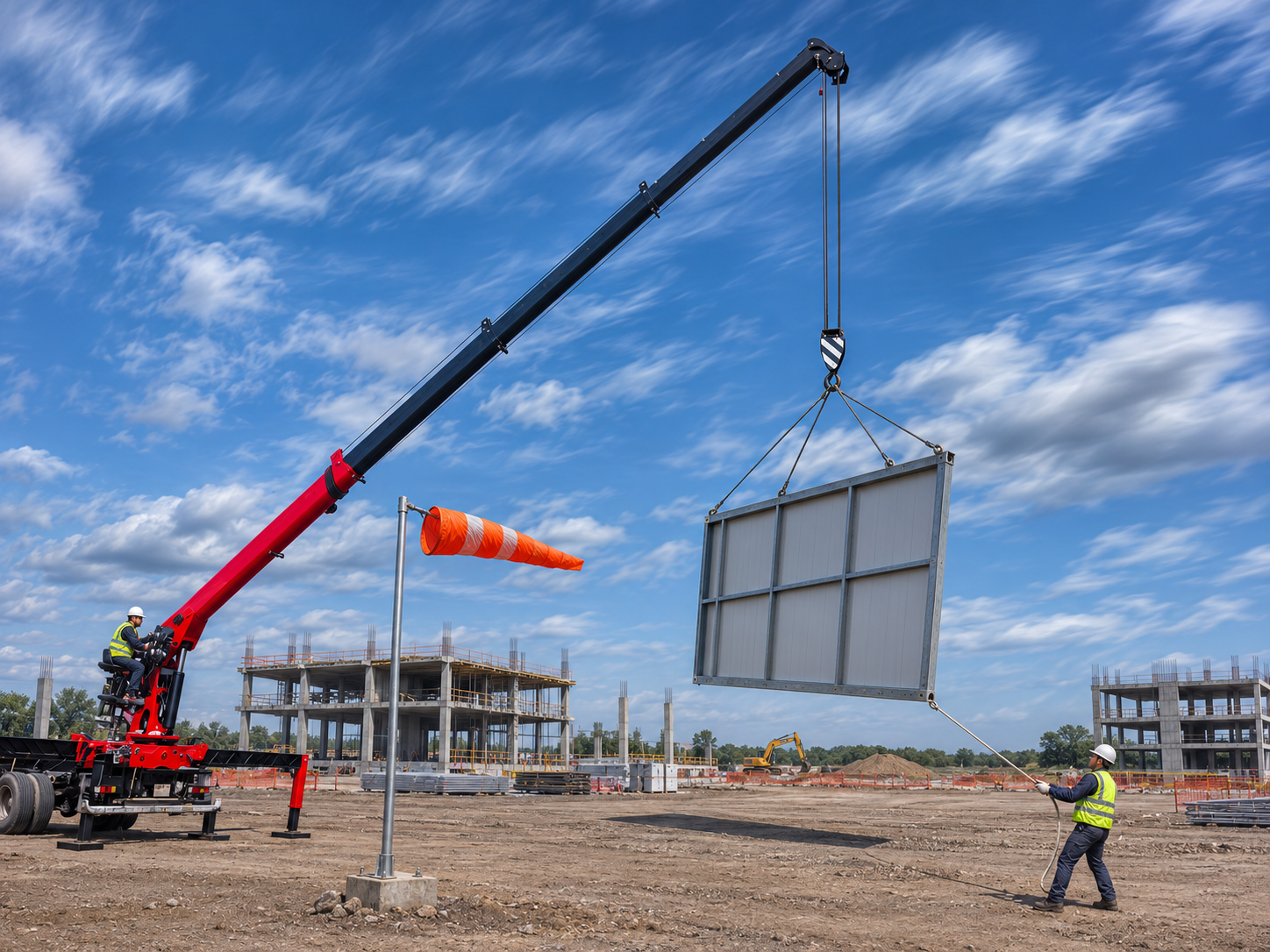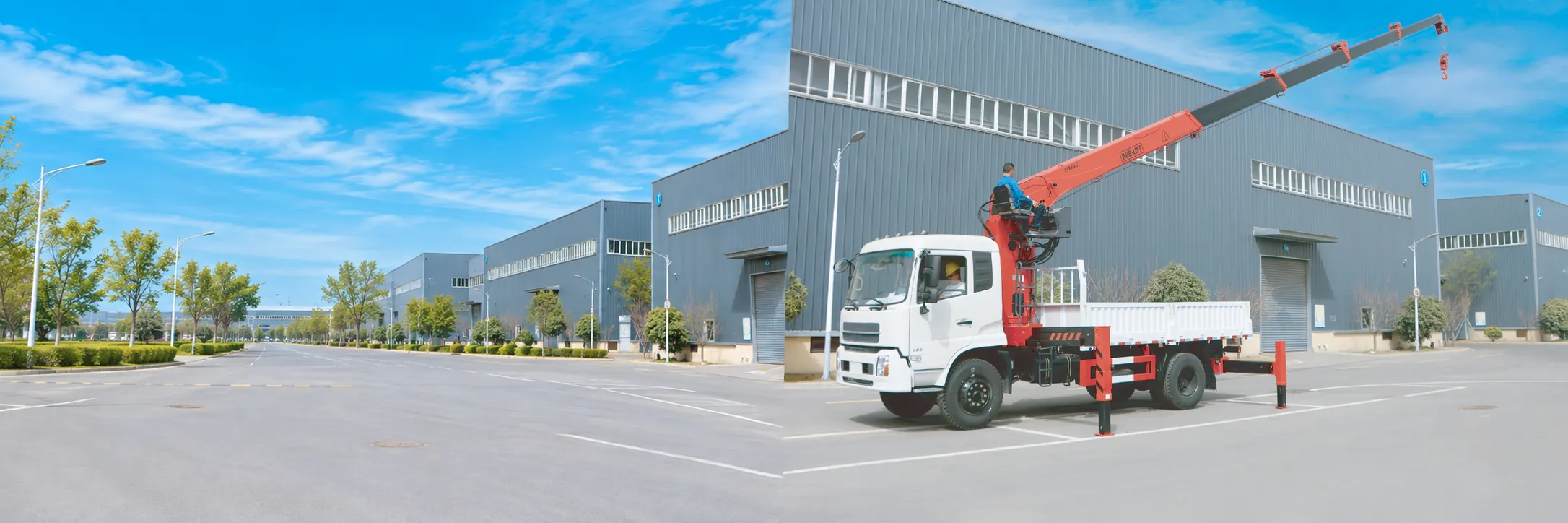

To lift a shipping container with a crane, read its weight from the container’s own markings and attach only at the four corner castings. Use rated twist-lock lifting lugs or container lifting hooks with a spreader frame or beam. Check that the container plus all the rigging is within the crane’s load chart at the largest radius of the lift, then make a short trial lift before you lift it properly. Lifting a shipping container with a crane means hoisting a whole ISO freight container on the crane hook, for example from the ground onto a truck deck or from a deck onto a site.
We have built truck mounted cranes in Xuzhou since 2003, and customers often ask us whether one of them can move an empty container, a storage box or a container office. This guide covers the weight markings, the corner castings, top and bottom lifting, the crane size check at the real radius and a step-by-step sequence. It also says plainly when a container is too heavy for a truck mounted crane.
Key takeaways
- Take the weight from the container: its markings show the empty (tare) weight, the maximum payload and the maximum gross weight, and a loaded container must be weighed or calculated before it is lifted.
- Attach only at the four top or the four bottom corner castings, with rated twist-lock lugs, container hooks and shackles, never at side rails, doors or the roof.
- Lift from the top with a spreader frame so the legs hang vertical; for a bottom lift, a US port rule sets a minimum leg angle of 45° to the horizontal for a 20 ft box.
- An empty 20 ft container weighs about 2,200 kg, which suits a 10-tonne class truck mounted crane at a short radius; a loaded one can weigh over 30 tonnes and needs far larger equipment.
- Size the crane on container plus rigging at the largest radius of the lift, and keep everyone out of, off and from under the container.
Can a truck mounted crane lift a shipping container?
Yes, if the container is empty or lightly loaded and its total weight with the rigging fits inside the crane’s load chart at the working radius. That covers the jobs our customers usually mean: placing an empty 20 ft container as site storage, moving a container office between sites or loading an empty container onto a truck deck. A loaded container is a different job, because its weight can be more than ten times the empty weight.
For loaded boxes and regular container work, other equipment is built for the job. Wikipedia’s article on intermodal containers lists forklifts, reach stackers, straddle carriers, container jacks and cranes for loading trucks outside terminals, and notes that sidelifters, tilt deck trucks and hook trucks transfer containers “with no extra equipment”. BOB-LIFT makes none of these machines, because we build and supply the crane only, not the truck or any container-handling attachment. If you need a truck that also carries the container, our guide to the flatbed crane truck explains how a crane, a deck and a payload share one chassis.
How much does a shipping container weigh?
An empty 20 ft standard container weighs about 2,200 kg and an empty 40 ft one about 3,800 kg, but the figure that counts is the one marked on your container. The table shows the common sizes and weights from Wikipedia, which notes that tare weight “is not determined by the standards, but by the container’s construction, and is therefore indicative”.
| Container | External size (L × W × H) | Empty (tare) weight, approx. | Common maximum gross weight |
|---|---|---|---|
| 20 ft standard | 6.058 × 2.438 × 2.591 m | 2,200 kg | 30,480 kg |
| 40 ft standard | 12.192 × 2.438 × 2.591 m | 3,800 kg | 30,480 kg |
| 40 ft high-cube | 12.192 × 2.438 × 2.896 m | 3,935 kg | 30,480 kg |
Every container in international traffic carries its identification and structural data on a plate. Wikipedia explains that the 1972 International Convention for Safe Containers (CSC) requires a “CSC safety-approval plate” that holds the container’s “dimensions and weights, as well as its strength and maximum stacking capability”. The weights must also be marked on the container itself, usually on the doors. The US marine terminal rule, 29 CFR 1917.71(a), and the longshoring rule for work on board ships, 29 CFR 1918.85(a), both require three markings on every intermodal container.
- Tare: “the weight of the container when empty”, which is the weight you lift when the container is genuinely empty.
- Payload (maximum cargo): “the maximum cargo weight the container is designed to carry”, a design limit and not the actual weight of whatever is inside.
- Maximum gross: “the sum of the weight of the container and the cargo”, which is the most the loaded container may weigh, not what it does weigh.
None of the markings tells you the actual weight of a loaded container, and the same rule says no container may be hoisted until the employer knows “whether a container to be hoisted is loaded or empty”. A loaded container needs its “actual gross weight”, either from a weighbridge or from a calculation of the contents plus the empty weight. For a converted container, for example a site office or workshop, ask the converter for the finished weight, because insulation, windows, furniture and equipment all add to the tare. Under 29 CFR 1926.1417(o), the crane operator must verify the load weight from “a source recognized by the industry” or a reliable calculation.
Where do you attach the rigging on a container?
Attach the rigging only at the corner castings, where a corner casting is one of the eight steel fittings at the corners of every ISO container, built to take the lifting, stacking and securing loads. Wikipedia’s twistlock article describes each casting as a 180 × 180 × 110 mm block “welded to the container itself” with an oval hole, defined in ISO 1161. The four top castings and the four bottom castings are the container’s designed lifting points.
Three kinds of hardware connect a sling to a casting, and each one must carry a rated working load.
- Twist-lock lifting lugs (also sold as container lifting lugs or lifting cones) lock into the oval hole of a top casting, usually for a vertical top lift.
- Container lifting hooks are side-entry hooks that engage the side aperture of a bottom casting, usually for a bottom lift with a spreader beam.
- Shackles join the lugs or hooks to the sling legs, and must be rated for the load on each leg.
US construction rules require rigging with “permanently affixed and legible identification markings” for its safe working load, and forbid loading it beyond that figure. Under 29 CFR 1926.251, rigging must also be “inspected prior to use on each shift”. Our guide to the crane hook covers the hook latch and the weight of the hook block, which both matter here.
Never sling a container by its side rails, door bars, roof or corrugated walls, and never choke a sling around the whole container. A sling pulled across the top edge, for example, can damage the side rail and slip off. Inspect the castings before you lift, since 29 CFR 1917.71(g) requires containers to be “inspected for defects in structural members or fittings before handling”. Look for cracked or distorted castings, heavy corrosion around the apertures and damaged corner posts, because any of these defects reduces the strength available for lifting. If the container sits on a trailer or chassis, release every twistlock first: the same rule says containers “shall not be hoisted unless all engaged chassis twist locks are released”.
Modified containers deserve particular attention. Converted offices, workshops and storage units often have additional windows, personnel doors or ventilation openings cut into the original walls, which can reduce the structural stiffness that the corner castings depend on during a lift. Before lifting a modified container, ask the converter to confirm in writing that it is still suitable for lifting by its corner castings, and request any specific lifting instructions.
Top lift or bottom lift: which rigging method?
Use a top lift with a spreader frame when you can, because it lets every leg hang vertically from a top corner casting. A spreader frame is a rigid steel frame hung below the crane hook, roughly the length and width of the container, with a lifting point above each corner. A bottom lift with a spreader beam above the container works too, as long as the legs meet a minimum angle and touch nothing but the castings. The diagram below compares the two arrangements side by side.

The clearest published limits are in the US marine terminal rule for loaded containers of 20 ft or more. Under 29 CFR 1917.71(f)(1), a top lift must apply the lifting forces “vertically from at least four such fittings”. A less than vertical top lift is allowed only for a sound ISO closed box with a lift angle of 80 to 90 degrees. The lifting beam must also sit at least 2.5 m above the load. The spreader beam must be at least 5 m long for a 20 ft container, or 11.1 m for a 40 ft one.
For a bottom lift, the same paragraph says the connections “shall bear on the fittings only, making no other contact with the container”. It also requires the four bridle legs to sit at no less than 45° to the horizontal for a 20 ft container, 37° for a 30 ft one and 30° for a 40 ft one. These numbers are written for marine terminals, but they are a sound benchmark anywhere, and the international standard on handling and securing is ISO 3874, so follow it and the container owner’s instructions where they apply.
Our own arithmetic shows why a four-leg sling taken straight from the hook to the top castings rarely works. The diagonal of a 20 ft box is about 6.53 m, so each top casting sits about 3.27 m from the centre. To bring a leg up to 80° from the horizontal, the hook would have to sit about 18.5 m above the roof (3.27 m × tan 80°). That is why a spreader frame or lifting beam is the normal tool, and for leg tension, hitches and sling types, see our guide to crane rigging and slings.
A container can still hang out of level even with perfect rigging, because the cargo decides where the centre of gravity sits. If the cargo sits at one end, the centre of gravity moves toward it, the container tilts as it leaves the ground and the legs at the heavy end carry most of the load. Close and secure the doors, secure or remove loose contents, and make the trial lift described below before you raise the container any higher.
What size crane do you need to lift a shipping container?
You need a crane whose load chart covers the container plus all the rigging at the largest radius of the lift. The rigging includes the spreader frame or beam, the slings, the lugs or hooks and the shackles, all of which the crane carries. The radius is the horizontal distance from the crane’s slewing centre to the hook, so measure it at the pick-up point and at the set-down point, and size the crane on the larger one.
The table shows how the rated load falls with radius on three of our truck mounted cranes that can handle an empty 20 ft container, using figures from each crane’s technical drawing and load chart.
| Crane and boom | Working radius | Rated load |
|---|---|---|
| SQ10ZA4 knuckle boom (4 sections) | 4.44 m | 4,700 kg |
| SQ10ZA4 knuckle boom | 6.425 m | 3,150 kg |
| SQ10ZA4 knuckle boom | 8.445 m | 2,350 kg |
| SQ10SA4 telescopic, 9.02 m boom at 50° | 5.7 m | 3,600 kg |
| SQ10SA4 telescopic, 9.02 m boom at 40° | 6.8 m | 3,100 kg |
| SQ10SA4 telescopic, 9.02 m boom at 30° | 7.6 m | 2,700 kg |
| SQZ330 knuckle boom, all sections out | 6.0 m | 4,220 kg |
| SQZ330 knuckle boom, all sections out | 7.8 m | 3,100 kg |
| SQZ330 knuckle boom, all sections out | 9.8 m | 2,410 kg |
The SQ10ZA4 and SQ10SA4 are both 10,000 kg cranes, rated at 21 t·m and 25 t·m respectively. The SQZ330 is a 16,000 kg, 33 t·m crane with a self weight of 4,900 kg, so it needs a considerably heavier truck than the 10-tonne models.

Example scenario (an illustration, not a customer record): a contractor needs to move an empty 20 ft storage container from the ground onto the deck of the truck that carries its crane. For this illustration we assume the container’s plate shows a tare of 2,200 kg and the spreader frame, slings, lugs and shackles weigh 400 kg, a total load of 2,600 kg. These are assumed figures, not the weight of any real container or rigging set, and the container stands 6 m from the slewing centre while the set-down point on the deck is closer.
Because 6 m falls between chart points, we read the next larger radius: the SQ10ZA4 is rated for 3,150 kg at 6.425 m, so the 2,600 kg lift passes with 550 kg to spare. The SQ10SA4 with its 9.02 m boom is rated for 3,100 kg at 6.8 m, which leaves a similar margin of 500 kg. If the container stood 8.4 m away, the SQ10ZA4 would drop to 2,350 kg and the lift would fail the check, so the truck would have to move closer.
The same table shows why larger or heavier containers are a stretch for a truck mounted crane. An empty 40 ft container at about 3,800 kg needs a much longer spreader. It fits the SQ10ZA4 only near its 4.44 m point, and the SQZ330’s 4,220 kg at 6.0 m leaves just 420 kg for all the rigging. A loaded 20 ft container can reach the 30,480 kg common maximum gross weight, which is almost twice the SQZ330’s 16,000 kg maximum lifting capacity. A loaded container usually needs a much larger crane or container-handling equipment.
Every BOB-LIFT crane is listed with a load moment limiter, as our article on the lifting moment of a crane explains, but a limiter is a backstop and not a substitute for knowing the weight. Read the chart for the exact boom and outrigger set-up you will use, as our guide on how to read a crane load chart shows. Then check the ground under each outrigger with our guide to crane outriggers and ground bearing pressure. For larger cranes than these, see our heavy duty truck mounted crane guide.
How do you lift a shipping container with a crane, step by step?
The sequence below is a general outline, and the crane’s operator’s manual and the container owner’s instructions take priority. The US crane rule, 29 CFR 1926.1417(a), requires users to “comply with all manufacturer procedures applicable to the operational functions of equipment”.
- Plan the lift: under regulation 8 of the Lifting Operations and Lifting Equipment Regulations 1998 (LOLER), every lifting operation must be “properly planned by a competent person”. The HSE planning guidance lists factors such as “overturning”, “proximity hazards” and “overload”, and our crane lift plan guide shows a template.
- Confirm the weight from the markings, the weighbridge or the converter, and add every piece of rigging.
- Inspect the container and rigging: check the corner castings for cracks and corrosion, and the lugs, hooks, shackles and slings for legible ratings and damage.
- Set up the crane on fully extended outriggers on firm ground, as close to the container as the job allows, and look up for power lines; our crane power line safety guide covers clearances.
- Prepare the container: doors closed and secured, loose contents removed or tied down, chassis twistlocks released, and nobody inside.
- Rig it at the four corner castings with the spreader frame or beam, with the hook above the centre of gravity and the latch closed.
- Clear the area: 29 CFR 1917.71(d) requires employees “to stay clear of the area beneath a suspended container”. Under 29 CFR 1926.1425, only the people needed to receive a load may be in the fall zone while it lands.
- Make a trial lift: raise the container a few centimetres, stop, and check that it hangs level, every leg is evenly loaded and the crane and outriggers are steady.
- Lift and slew slowly with taglines on two corners and one signal person in sight of the operator, using the signals in our crane hand signals guide.
- Land it on level supports that can carry it, then slacken and remove the rigging only once the container is stable.
A container’s flat sides catch the wind like a sail, so even an empty container can swing or turn on the hook. Under 29 CFR 1926.1417(n), the competent person must adjust operations for “the effect of wind” on stability and rated capacity. Never use the crane to drag a container into place, since 29 CFR 1926.1417(q) states that equipment “must not be used to drag or pull loads sideways”. No one rides on or inside the container during the lift, and BOB-LIFT cranes never lift people.
How gusts, wind speed and a load’s sail area decide when to stop lifting is explained in our guide to crane wind speed limits.
The method is the same as for other heavy single items, such as the machines in our guide on how to lift a forklift with a crane. The difference is that a container shows its own weight limits and has standard lifting points at every corner. In both cases the operator needs the right training, which our crane operator licence guide explains.
What mistakes should you avoid when lifting a container?
Most container lifting accidents start with one of these shortcuts, and each one is avoidable.
- Using the maximum gross weight or the payload figure as the lift weight, or guessing the weight of a loaded or converted container.
- Forgetting the weight of the spreader frame, slings, lugs and shackles.
- Running four slings straight from the hook to the top castings, which pulls the legs far below 80°.
- Lifting by side rails, door bars or forklift pockets with slings instead of the corner castings.
- Leaving a chassis twistlock engaged when lifting a container off a trailer.
- Reading the load chart at the pick-up radius only, when the set-down point is further away.
- Letting anyone stand inside, on top of or under the container while it hangs.
Frequently asked questions
How much does an empty 20 ft shipping container weigh?
About 2,200 kg for a standard steel 20 ft box, according to Wikipedia’s table of common sizes, but tare weight depends on how each individual container is built. Read the tare marked on the door or the CSC plate of your particular container and use that figure.
Can you lift a shipping container with four slings from the hook?
Not with the legs at an acceptable angle, because the geometry works against you. Taken straight to the top castings of a 20 ft box, the legs lean far from vertical, while the US port rule allows a top lift only at 80 to 90 degrees. Use a spreader frame for a top lift, or a spreader beam with legs at 45° or more for a bottom lift.
What are container lifting lugs?
They are fittings that lock into the oval hole of a top corner casting and give the sling or shackle a rated attachment point. The bottom castings take side-entry container lifting hooks instead, usually together with a spreader beam, and each piece must be marked with its working load limit and inspected before every use.
What size crane can lift a 20 ft container?
For an empty 20 ft box, a 10-tonne class truck mounted crane such as our SQ10ZA4 or SQ10SA4 can do it at a short radius, depending on the load chart and the rigging weight. A loaded 20 ft container, by comparison, can weigh more than 30 tonnes and needs much larger lifting equipment.
Can you lift a container office with people inside?
No, everyone leaves the container before it is rigged, and nobody stands on it or under it while it hangs. BOB-LIFT cranes never lift people, and a converted office also needs its finished weight confirmed before the lift.
How we compiled this guide
We compiled the rules from the official eCFR text of 29 CFR 1917.71, 1918.85, 1926.251, 1926.1417 and 1926.1425, and from LOLER regulation 8 on legislation.gov.uk, as they stood in November 2026. The planning factors come from HSE’s page on planning and organising lifting operations, while the container sizes, tare weights, the CSC plate and the corner casting details come from Wikipedia’s “Intermodal container” and “Twistlock” articles. The crane figures come from the current BOB-LIFT technical drawings and load charts of the SQ10ZA4, SQ10SA4 and SQZ330, and the example uses clearly marked assumed weights. The rigging diagram and the 18.5 m hook height are our own work, and Achord Chan, Product Operations Director, reviewed the guide before publication. It does not replace ISO 3874, the container owner’s instructions, the crane’s operator’s manual or the rules where you work.
Need a crane that can lift empty containers?
Tell us the container size and weight, the radius from the crane to the pick-up and set-down points, and the truck you plan to use. We will recommend a knuckle boom or telescopic boom truck mounted crane and send its dimension drawing and load chart. Every crane carries a 12-month warranty on the whole machine, common spare parts leave the factory within 48 hours, and our service team answers within 12 hours. Contact us for a quotation and a load chart check.