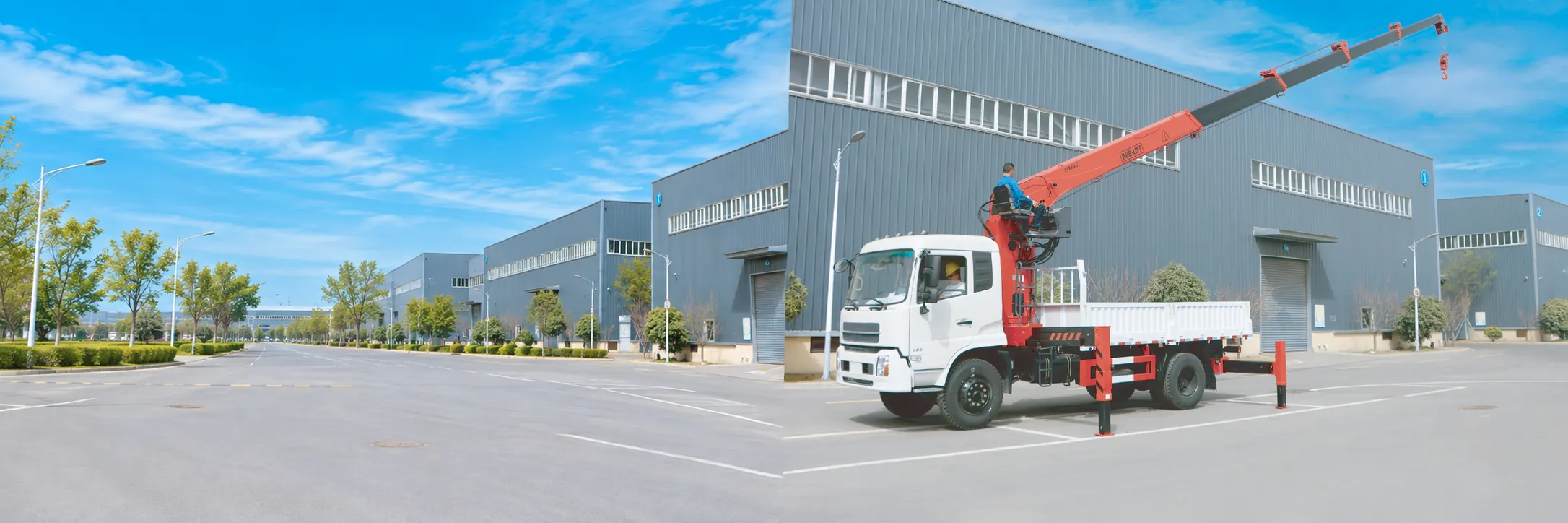

A flatbed crane truck is a flatbed truck with a hydraulic loader crane mounted on its chassis, so the same vehicle transports the goods and lifts them on and off the deck. The crane is usually installed behind the cab, although it can also be mounted at the rear of the bed. The mounting position and the crane model together determine how much deck you keep, how much payload remains and how far the hook can reach.
BOB-LIFT has manufactured truck mounted cranes since 2003 and exported them to 124 countries and regions. We manufacture the crane, not the truck: we can install the crane on your own truck at our factory before shipping, or deliver it with mounting drawings and remote support for a local body builder. This guide explains how to position a loader crane on a flatbed and how to select the right model, using figures from the technical drawings of six of our cranes from 3.2 t to 12 t.
Key takeaways
- A crane behind the cab keeps the deck behind it in one clear piece and loads the front axle; a crane at the rear reaches farther behind the truck but loads the rear axle.
- The crane occupies a fixed length of chassis. On our drawings, the installation space ranges from 750 mm (29.5 in) for a 3.2 t telescopic crane to 1,400 mm (55.1 in) for a 12 t knuckle boom crane.
- The crane’s own weight comes directly off your payload: from 1,330 kg (2,932 lb) to 4,600 kg (10,141 lb) for the six cranes in this guide, before the subframe and hydraulic oil.
- Select the crane by the load at the working distance you need, not by its rated capacity. Our 12 t telescopic crane still lifts 1,200 kg at 16.2 m.
- Send us your loads, your required reach and your truck specifications, and we will check the combination before you order.
What is a flatbed crane truck?
A flatbed crane truck, also described as a crane truck flatbed or a flatbed boom truck, combines three main components: a truck chassis, a flat deck, and a loader crane installed on a subframe between them. A hydraulic pump driven by the truck’s power take-off (PTO) supplies the crane, and outriggers extend from the crane base to stabilise the vehicle during lifting.
The flat deck is the important difference. Without side panels in the way, the crane can pick up steel, pallets, pipes, concrete blocks and machinery from any position on the bed, then place them directly on the ground, a roof or a trailer. If your vehicle has a closed or dropside body, our crane lorry guide covers those configurations, and if you need a compact crane on a mechanic’s vehicle, our service truck crane guide is the better starting point.
Should the crane go behind the cab or at the rear of the bed?
Most flatbed crane trucks have the crane installed behind the cab, while a rear mount is less common but suits particular applications. The decision affects three practical considerations: available load space, axle loads, and reach to the ground behind the vehicle.
- Load space. Behind the cab, the crane occupies a strip of chassis at the front, and the remaining deck stays continuous. At the rear, the crane occupies the end of the bed, so the deck in front of it remains available but long materials can no longer overhang the tail.
- Axle loads. A crane behind the cab places most of its weight on the front axle. A crane at the rear places its weight on the rear axle and the rear overhang, which can reduce the load on the steering axle when the truck is empty. In either layout, a body builder should complete an axle load calculation with the crane, subframe and a full load on board.
- Reach behind the truck. A crane behind the cab must reach across the entire deck before it passes the tailgate. A crane at the rear starts at the tailgate, so almost its whole reach is available behind the vehicle, which is useful when you regularly unload into a trench, a narrow gateway or a loading bay.
- Reach to the sides. From either position, the crane slews to both sides of the bed; the cranes in this guide rotate 360° or more, according to their drawings.
Example scenario (an illustration, not a customer record): a crane with 10.5 m of reach is mounted behind the cab, with its column 6 m from the tailgate, so only about 4.5 m of reach remains beyond the tailgate. The same crane mounted at the rear would have nearly the full 10.5 m available behind the truck, but would need about 6 m of reach simply to collect a load positioned next to the cab.
If you are uncertain, describe where loads are normally collected and delivered, and we will recommend a position and confirm whether the selected model suits that installation.

How much bed length does the crane take?
Our drawings specify an “installation space” for each crane, which is the length of chassis the crane base requires between the cab and the deck. On a flatbed, you either lose that length from the deck or choose a longer chassis to maintain the same deck length.
- SQ3.2SA4, 3.2 t telescopic: 750 mm (29.5 in).
- SQ3.2ZA3, 3.2 t knuckle boom: 850 mm (33.5 in); folded, the crane measures 725 mm on the plan view of its drawing.
- SQ8SA4, 8 t telescopic: 1,100 mm (43.3 in).
- SQ8ZA4, 8 t knuckle boom: the drawing does not state an installation space, but the folded crane measures 1,031 mm (40.6 in).
- SQ12SA4, 12 t telescopic: 1,100 mm (43.3 in).
- SQ12ZA5, 12 t knuckle boom: 1,400 mm (55.1 in).
The boom design also matters. A knuckle boom folds into a compact package beside the column, so the deck behind it stays clear, whereas a telescopic boom usually rests along the bed in the transport position. Check the transport position on the drawing of the model you are considering, and confirm that the stowed boom does not occupy space you need for cargo.
How much payload is left after the crane?
Every kilogram of crane is a kilogram of cargo you can no longer carry. Start from the truck’s rated payload, subtract the crane’s weight, and then subtract the subframe, the hydraulic oil and any toolbox or attachment; the remainder is your practical cargo capacity.
The crane weights on our drawings are 1,330 kg for the SQ3.2ZA3, 1,350 kg for the SQ3.2SA4, 3,050 kg for the SQ8ZA4, 3,600 kg for the SQ8SA4, and 4,600 kg for both the SQ12ZA5 and the SQ12SA4. The drawings also specify the oil tank capacity, from 60 L on the 3.2 t cranes to 200 L on the SQ12SA4, while the subframe weight depends on the individual truck and is calculated by your body builder.
Example scenario (an illustration, not a customer record): a flatbed truck has an assumed payload of 9,000 kg before the crane is installed. Fitting the SQ8SA4 at 3,600 kg leaves 5,400 kg, before the subframe and oil are deducted. Choosing the SQ8ZA4 at 3,050 kg instead leaves an additional 550 kg for cargo, in exchange for a shorter maximum reach.
Our truck mounted crane installation guide explains how the crane’s weight divides between the front and rear axles, together with the subframe and PTO requirements.
Which BOB-LIFT cranes fit a flatbed truck?
The table compares six of our cranes, three knuckle boom and three telescopic, arranged in three capacity pairs. Every figure comes from the model’s dimension drawing or load chart. The load at maximum reach shows what the crane lifts at the edge of its working range, while the weight and installation space show whether your flatbed can accommodate it.
| Model | Rated capacity | Load at maximum reach | Crane weight | Installation space | Outrigger span |
|---|---|---|---|---|---|
| SQ3.2ZA3 (knuckle) | 3,200 kg (7,055 lb) at 2.1 m | 680 kg (1,499 lb) at 7.7 m (25.3 ft) | 1,330 kg (2,932 lb) | 850 mm (33.5 in) | 2,250 to 3,513 mm |
| SQ3.2SA4 (telescopic) | 3,200 kg (7,055 lb) at 2.11 m | 200 kg (441 lb) at 10.5 m (34.4 ft) | 1,350 kg (2,976 lb) | 750 mm (29.5 in) | 1,720 to 3,120 mm |
| SQ8ZA4 (knuckle) | 8,000 kg (17,637 lb) at 2.0 m | 1,420 kg (3,131 lb) at 10.5 m (34.5 ft) | 3,050 kg (6,724 lb) | Not stated; folded 1,031 mm | 2,310 to 5,610 mm |
| SQ8SA4 (telescopic) | 8,000 kg (17,637 lb) at 2.5 m | 900 kg (1,984 lb) at 14.0 m (45.9 ft) | 3,600 kg (7,937 lb) | 1,100 mm (43.3 in) | 2,290 to 5,990 mm |
| SQ12ZA5 (knuckle) | 12,000 kg (26,455 lb) at 2.25 m | 1,500 kg (3,307 lb) at 12.2 m (40.0 ft) | 4,600 kg (10,141 lb) | 1,400 mm (55.1 in) | 2,316 to 5,706 mm |
| SQ12SA4 (telescopic) | 12,000 kg (26,455 lb) at 2.5 m | 1,200 kg (2,646 lb) at 16.2 m (53.1 ft) | 4,600 kg (10,141 lb) | 1,100 mm (43.3 in) | 2,300 to 7,500 mm |
Two patterns are visible. At the same rated capacity, the telescopic crane reaches farther, whereas the knuckle boom crane generally lifts more at its own, shorter maximum reach. Our guide on how to read a crane load chart explains how to find the permitted load at any intermediate radius, and our overview of boom truck sizes lists further models by capacity.
What size truck and wheelbase do you need?
We do not sell trucks, so we cannot recommend a single chassis for every crane. The appropriate truck depends on the crane’s weight, the cargo you carry and the regulations where you operate. Discuss these general points with your truck dealer or body builder:
- Weight class. In the United States, trucks are classified by gross vehicle weight rating (GVWR). The US Department of Energy’s vehicle weight class chart places Class 6 at 19,501 to 26,000 lb, Class 7 at 26,001 to 33,000 lb, and Class 8 above 33,000 lb. A 3.2 t crane weighing about 1,330 kg obviously suits a much lighter truck than a 12 t crane weighing 4,600 kg.
- Axle limits. On the US Interstate system, 23 CFR 658.17 sets 20,000 lb on any single axle and 34,000 lb on a tandem axle, within an 80,000 lb gross limit. A heavy crane behind the cab can bring the front axle close to its rating, so check both axles in loaded and unloaded conditions; other countries apply their own limits.
- Wheelbase and frame length. The chassis must provide the crane’s installation space behind the cab plus the deck length you require. A longer wheelbase provides more deck but also changes how the weight is distributed between the axles, so your body builder confirms the final wheelbase from the axle load calculation.
- Frame strength and PTO. The frame must resist the crane’s lifting moment, and the PTO must deliver the oil flow specified on the crane’s drawing, which ranges from 25 L/min on our 3.2 t cranes to 75 L/min on the SQ12SA4.
If you already own a truck, send us its model and chassis specifications. If you do not, describe the loads and reach you need, and we will provide the crane’s weight, installation space and hydraulic requirements so that your dealer can propose a suitable chassis.
How do outriggers work on a flatbed crane truck?
The outriggers are integrated into the crane base. They extend sideways and press down to support the vehicle while the crane is working, so on a flatbed they require clear space beside the truck on every site. Compare the spans in the table: the SQ12SA4 extends its legs to 7,500 mm (24.6 ft), while the SQ3.2SA4 requires only 3,120 mm (10.2 ft).
- Deploy them as the load chart specifies. Under OSHA’s 29 CFR 1926.1404(q), outriggers must be “either fully extended or, if manufacturer procedures permit, deployed as specified in the load chart”, and they must be set to remove the equipment weight from the wheels.
- Check the ground. 29 CFR 1926.1402 states that equipment must not be used unless ground conditions are firm, drained and graded sufficiently to meet the manufacturer’s specifications for support and level. Use suitable pads under the outrigger feet on soft surfaces.
- Observe every movement. The HSE safety notice on lorry loader stabilisers reports three fatal crushing incidents in Great Britain since 2019 involving powered tilting stabilisers, and advises operators to stand where they can observe the stabilisers but outside the danger zone.
A crane mounted at the rear of the bed, or a large crane on a long flatbed, may need additional support at the opposite end of the vehicle, so ask your installer whether your configuration requires an extra pair of stabilisers. Our guide to crane outriggers and ground bearing pressure explains how to size the pads.

Knuckle boom or telescopic crane on a flatbed?
Both types work well on a flatbed, and the better choice depends on how you lift.
- Choose a knuckle boom if you regularly place loads over walls, onto roofs or into confined positions. It folds compactly behind the cab, it is the lighter option in our 8 t pair, and it accepts attachments such as a grab, clamshell bucket, grapple or auger, as described in our guide to knuckle boom crane attachments.
- Choose a telescopic boom if you need long, straight reach, for example when lifting steel sections or poles some distance from the truck. In our table, each telescopic crane reaches farther than the knuckle boom crane with the same rating.
The regulations can also differ. In the United States, 29 CFR 1926.1400(c)(17) excludes certain material delivery by articulating (knuckle boom) truck cranes from the construction crane standard, under specific conditions, so confirm how it applies to your work before relying on it. Our knuckle boom vs telescopic boom comparison covers the differences in more detail.
What should you send in your enquiry?
A complete enquiry allows us to prepare an accurate proposal more quickly. Please include the following information:
- Your loads. The heaviest load and the most frequent load, including slings, forks or a grab.
- Your reach. The distance from the crane to where loads are collected and delivered, and whether that is beside or behind the truck.
- Crane position. Behind the cab or at the rear of the bed, or ask us for a recommendation.
- Your truck. Make, model, wheelbase, GVWR and axle ratings, cab-to-axle dimension and PTO details; if you do not have a truck yet, tell us.
- Deck length. The flatbed length you need to retain after the crane is installed.
- Options. Knuckle or telescopic boom, remote control, winch, grab, auger or basket.
- Operating location. The country, the regulations you must comply with, and the port of delivery.
- Installation. Whether you want us to install the crane on your truck before shipping, or to ship the crane separately for a local installer.
Our guide to buying a truck mounted crane from China covers the remaining steps, from quotation to shipping.
Frequently asked questions
Can I install a crane on my existing flatbed truck?
Often yes, provided the truck has sufficient payload, frame length and axle capacity for the crane, together with a PTO for the hydraulic pump. Send us the truck specifications and we will check them against the crane’s drawing before you order.
How much deck does a crane occupy on a flatbed?
It depends on the model. On our drawings, the installation space ranges from 750 mm (29.5 in) for the SQ3.2SA4 to 1,400 mm (55.1 in) for the SQ12ZA5, and a longer chassis allows you to keep the deck length you need.
Is a rear-mounted crane better than one behind the cab?
Neither is better for every application. A rear crane reaches farther behind the truck and places its weight on the rear axle, while a crane behind the cab keeps the deck continuous, allows long materials to overhang the tail and is the more common configuration.
Does BOB-LIFT supply the flatbed truck?
No. We manufacture and export new cranes only. We can install the crane on a truck you provide before shipping, or ship the crane with mounting drawings, installation guidance and remote support for your local body builder.
How much does the crane reduce my payload?
By the crane’s own weight plus its subframe and hydraulic oil. For the cranes in this guide, the crane alone weighs between 1,330 kg (2,932 lb) and 4,600 kg (10,141 lb), according to their drawings.
How we compiled this guide
The crane figures come from the BOB-LIFT dimension drawings and load charts of the SQ3.2ZA3, SQ3.2SA4, SQ8ZA4, SQ8SA4, SQ12ZA5 and SQ12SA4, as published in October 2026; the US units are converted from the metric values and rounded. The weight classes, axle limits and outrigger requirements are summarised from the official pages linked in the text, as they stood in October 2026. The photographs show real BOB-LIFT cranes on a customer’s truck and at our factory. The guide was reviewed by Achord Chan, Product Operations Director, in October 2026. It does not replace the crane’s operating manual, your body builder’s axle load calculation or the regulations where you work.
Get a crane matched to your flatbed
Tell us your loads, the reach you need and your truck details, and we will recommend a crane and a mounting position, with the drawing and load chart. Every crane carries a 12-month warranty on the whole machine, common spare parts are dispatched within 48 hours, and our service team replies within 12 hours with video guidance when needed. Browse our knuckle boom truck cranes and telescopic boom truck cranes, or contact us to start.