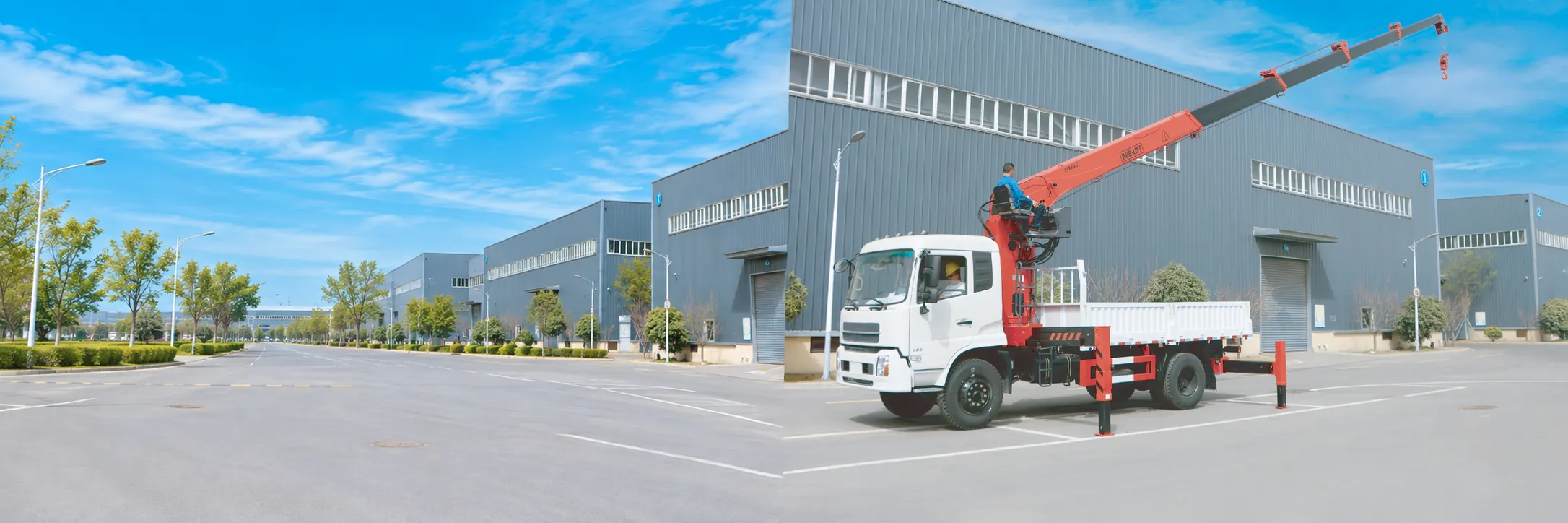

A self loader truck is a cargo truck with its own hydraulic loader crane, usually a knuckle boom crane mounted behind the cab, so the driver can load and unload goods without a forklift or a separate crane. The crane has to match the truck: its self weight comes out of the payload, its base needs a strip of chassis behind the cab, and its outriggers need room on site. BOB-LIFT supplies the crane, not the truck, and has manufactured truck mounted cranes in Xuzhou, China, since 2003. This guide shows how to size a self loader crane for the truck you have or plan to buy, using real figures from our drawings and load charts.
The name is also used for other machines: a self-loading concrete mixer fills its own drum with a front bucket, and a self-loader tow or recovery truck lifts vehicles onto its own bed. This guide is about the cargo truck with a loader crane.
Key takeaways
- A self loader truck is a cargo truck with a loader crane, most often a knuckle boom crane folded behind the cab.
- Pick the crane from the load and the radius first, then check it against the truck; our knuckle boom drawings run from 680 mm of chassis length and 850 kg (SQ2ZA4) to 1,400 mm and 4,480 kg (SQ12ZA4).
- Rated load falls quickly with radius: our SQ4ZA3 lifts 4,000 kg at 2.1 m but 850 kg at its full 7.7 m reach.
- The crane’s self weight, the subframe, the oil and any forks all come out of the truck’s payload, and the body builder checks the total against the truck’s gross weight and front axle rating.
- We supply the crane only: a truck bought in China can be brought to our factory for fitting; for a truck bought locally, we ship the crane and a local body builder fits it with our remote support.
What is a self loader truck?
A self loader truck combines four parts: the truck chassis carries the load, and a loader crane is a hydraulic crane built to sit on a subframe between the cab and the cargo deck. A power take-off (PTO) on the gearbox drives a hydraulic pump that powers the crane, and outrigger legs on each side of the crane base hold the truck steady while it lifts. The operator parks, extends the outriggers, unfolds the crane and moves pallets, bags, pipes or machinery between the deck and the ground.
Our SQ4ZA3 product page names builders’ merchants, scaffolding and fencing contractors, and equipment rental yards as typical users of a crane in its class. In our truck mounted crane range, the knuckle boom models alone run from 1.6 t to 50 t.
What a self loader is called in each market
Keyword research for this guide (Google Keyword Planner, November 2026) shows which terms buyers use in which countries, given here as average monthly searches.
| Country | Term | Monthly searches |
|---|---|---|
| Indonesia | self loader | 2,400 |
| Indonesia | self loader truck | 1,000 |
| Indonesia | self loader mini / tronton self loader | 90 / 70 |
| Philippines | self loader / self loader truck | 480 / 390 |
| Philippines | self loading truck with boom | 140 |
| Malaysia | self loader / self loader truck | 260 / 140 |
| Malaysia | self loader crane / self loader lorry | 50 / 50 |
| Singapore | self loader / self loader truck | 140 / 90 |
| Nigeria | self loader / self loader truck | 140 / 140 |
In Indonesian the term is “truk self loader”, and “tronton self loader” names a three-axle truck with a crane. In the Philippines, the same machine is a self-loading truck, and searches such as “self loader boom truck” (140 a month) and “10 wheeler self loading truck” (20) name the truck class too. In Malaysia and Singapore, the common names are lorry crane and self loader lorry; our crane lorry guide uses that vocabulary. In the UK, people often call any lorry with a loader crane a HIAB, a brand name used there as a generic term, as our page on what a HIAB is explains. In Nigeria, buyers search “self loader” and “self loader truck” in equal numbers.
Knuckle boom or telescopic crane on a self loader
Most self loaders carry a knuckle boom crane, because its boom folds into a compact package behind the cab and leaves the deck free for cargo. A telescopic crane has a straight boom that usually rests along the deck when stowed, and it suits long, open reach. Our comparison of knuckle boom and telescopic cranes covers the trade-off in detail; the rest of this guide uses our knuckle boom cranes for trucks.
Matching the self loader crane to the truck class
Buyers usually know their truck by class: a light 4-wheel truck, a 6-wheeler or a 10-wheeler (tronton in Indonesia). The chart groups eight of our knuckle boom cranes under those classes, and every crane figure in it comes from the model’s dimension drawing and load chart. The grouping is a starting point, not a rule, because trucks in the same class differ in wheelbase, rated weights and power take-off output.

| Truck class | Cranes to look at first | Lifting moment | Crane self weight | Space behind the cab |
|---|---|---|---|---|
| Light 4-wheel truck (two axles) | SQ2ZA4, SQ3.2ZA3 | 4.2 to 6.8 t·m | 850 to 1,330 kg | 680 to 850 mm |
| 6-wheeler / medium 4×2 (two axles, twin rear tyres) | SQ4ZA3, SQ5ZA3, SQ6.3ZA3 | 8.4 to 13.2 t·m | 1,350 to 2,286 kg | 850 to 1,050 mm |
| 10-wheeler / tronton 6×2 or 6×4 (three axles) | SQ8ZA4, SQ10ZA4, SQ12ZA4 | 16.7 to 27 t·m | 3,050 to 4,480 kg | 1,031 to 1,400 mm |
Start with the job, not the truck: write down the heaviest regular load and the radius where it must land, then find the smallest crane whose load chart covers that point. Lifting moment is the load multiplied by its distance from the crane column, in tonne-metres (t·m), and our article on the lifting moment of a crane explains the unit. The tonnage selection guide walks through the choice, and our guide to cranes for small trucks covers the light end in more detail. If you already know the size you want, our size guide lists the truck details to send.
Check the payload that is left
Everything fitted to the truck reduces the cargo it can carry, so the method is simple subtraction, and the body builder verifies the result against the truck’s registration papers. The worked figures below use one real number, the SQ4ZA3 self weight of 1,350 kg from its drawing, and every truck figure is assumed for illustration, because truck ratings differ by manufacturer and model.
| Item | Weight | Source |
|---|---|---|
| Gross vehicle weight (GVW) of the 6-wheeler | 10,000 kg | Assumed |
| Kerb weight of the truck | minus 3,500 kg | Assumed |
| Crane (SQ4ZA3) | minus 1,350 kg | Dimension drawing |
| Subframe | minus 300 kg | Assumed |
| Hydraulic oil for the 60 L tank | minus about 55 kg | Assumed |
| Cargo body | minus 600 kg | Assumed |
| Pallet fork carried on the truck | minus 120 kg | Assumed |
| Payload left for cargo | 4,075 kg | Calculated |
Payload is only half of the check, because the crane sits just behind the cab and a large share of its weight lands on the front axle. The body builder weighs or calculates the load on each axle and compares it with the axle ratings on the truck’s plate. If the front axle is near its limit, a lighter crane or a different chassis configuration solves the problem before money is spent.
Where the crane sits on a self loader truck
The installation space is the strip of chassis that the crane base takes behind the cab, and the deck starts behind it. On the SQ4ZA3 drawing the installation space is 850 mm, and the folded crane is 2,040 mm high and 2,450 mm wide. The deck length available for cargo is the chassis length behind the cab minus that space, so a longer crane base means a shorter deck.


The outriggers set the footprint on site: the SQ4ZA3 outriggers span 2,250 mm retracted and 3,513 mm extended, and the larger cranes in our chart reach spans of up to 5,706 mm. Plan the parking position for the full span and for firm ground under every outrigger foot. Our guides to outriggers and ground bearing pressure and to crane mats and outrigger pads show how to check the ground.
Some buyers want the crane at the rear of the deck instead; if that is your plan, ask us before you order the body. Our flatbed crane truck guide compares the two mounting positions in general terms.
How much a self loader lifts beside the truck and at full reach
Rated load is the heaviest load the crane may lift at a given radius, and it falls as the hook moves away from the crane column. The SQ4ZA3 knuckle boom crane load chart gives 4,000 kg at 2.1 m, 1,750 kg at 4.35 m, 1,250 kg at 5.9 m and 850 kg at its full reach of 7.7 m. The “4 t” in the class name only applies close to the column, while beside the truck, and at the far end of the deck, the figure that counts is much lower.
Between two points on the chart, use the rating at the next listed radius out: a load at 5.0 m is rated by the 5.9 m figure, 1,250 kg, not by a figure between 1,750 and 1,250 kg. The load on the hook includes the pallet fork, slings or clamp as well as the goods. Our guides on how to read a crane load chart and on the safe working load of a crane explain both rules.

Example scenario: a 6-wheeler self loader for building materials
Example scenario (an illustration, not a customer record). A building-materials distributor in the Philippines wants a self loading truck for cement deliveries to hardware stores and small sites. The truck is a 6-wheeler, and a full pallet holds 25 bags of 40 kg, so 1,000 kg of cement sits on a 25 kg pallet and is lifted with a 120 kg pallet fork. That puts 1,145 kg on the hook; the pallet, bag count and fork weight are all assumed.
The distributor looks at the SQ4ZA3, the first crane in the 6-wheeler group, and checks three drop points against its load chart:
- Beside the truck, 4.35 m (assumed): rated 1,750 kg, which leaves 605 kg spare with the full pallet.
- Off the rear of the deck, 4.8 m (assumed): the next listed radius is 5.9 m, rated 1,250 kg, which leaves 105 kg spare.
- Over a site fence, 7.0 m (assumed): the next listed radius is 7.7 m, rated 850 kg. The full pallet is too heavy, so the operator divides it: 17 bags make 680 kg, and with the pallet and fork that is 825 kg on the hook, only 25 kg under the rating.
The crane covers the daily work beside the truck with margin. The fence drop is close to the limit, so the distributor either keeps it occasional and splits the pallets, or asks us about a crane one capacity class up. The payload check from the section above applies to the same truck: with 4,075 kg left, the truck carries three full pallets (3,075 kg) plus one 17-bag pallet (705 kg), 3,780 kg in all. The body builder still confirms the front axle load.
Options that matter on a self loader crane
- Remote control: our 4 t knuckle boom product page lists three operation modes: manual levers, an aerial seat or a wireless remote. A remote lets the operator stand where the load lands, which helps on a delivery truck operated by one person, as our remote control guide explains.
- Winch: a J at the end of a model code means a hydraulic winch, as in the SQ4ZA3J. It raises or lowers the load on a rope without moving the boom, for example into a trench or over a wall, and the crane winch guide explains when it is worth adding.
- Manual extension (+1): a “+1” in a model code means a hand-pulled extension for extra reach with light loads. It is offered only on configurations whose drawing shows it, and none of the eight cranes in our chart has one. See our article on the fly jib on a crane for how extensions are used.
- Pallet forks and clamps: for palletised goods, crane pallet forks are the usual tool; for kerbs, blocks or slabs, lifting clamps, and both count as part of the load.
- Man basket: a man basket is available as a separately charged option, and where it is used, the local rules for lifting people apply.
Rules, inspection and the operator
A self loader is lifting equipment as well as a vehicle, so it needs crane checks as well as road checks. Every BOB-LIFT crane is listed with a load moment limiter; our page on the load moment indicator explains what it does. The SQ4Z series holds a CE certificate of conformity under the EU Machinery Directive 2006/42/EC [1], as its product page states. Before each shift, the operator should inspect the crane with our truck mounted crane inspection checklist.
Inspection intervals, certificates and operator licences are set by each country, so in Indonesia, the Philippines, Malaysia or Nigeria, check the lifting-equipment rules in your country before the truck goes into service. Our guide to the crane operator licence covers what operator training usually involves.
Getting the crane fitted to your truck
We supply the crane, not the truck: if the truck is bought in China, it can be brought to our factory and we fit the crane there before shipping. If the truck is bought locally, we ship the crane only, a local body builder fits it, and we support the fitting remotely.
The body builder fits a subframe that spreads the crane’s loads into the chassis, and connects a PTO and pump that match the crane’s drawing. The SQ4ZA3, for example, needs 25 L/min at 26 MPa, about 14 kW of hydraulic power. Our truck mounted crane installation guide covers the steps, and our article on the hydraulic crane for a truck explains the hydraulic circuit.
Every new BOB-LIFT crane comes with a 12-month whole-machine warranty and an English operating manual as standard; common spare parts are dispatched within 48 hours, and our after-sales team replies within 12 hours, with video guidance where it helps. For the buying steps and the freight, see our guides to buying a truck mounted crane from China and crane shipping. What drives the cost of a crane is covered in our truck mounted crane price guide.
What to send for a self loader crane quotation
- The heaviest regular load, with the pallet, fork or clamp, the radius where it lands and the lift height you need there.
- The farthest drop and its load, for example over a fence or onto a first-floor slab.
- Your truck’s make, model, wheelbase and GVW, or “truck to be bought in China”.
- The destination country and port, and the options you want: remote control, winch, pallet fork, clamp or man basket.
We reply with a recommended model, its dimension drawing and load chart, and a quotation, and if a term in the drawing is new to you, our crane terminology glossary explains it.
Frequently asked questions
What does self loader truck mean?
It is a cargo truck with its own hydraulic loader crane, usually a knuckle boom crane behind the cab, so the driver loads and unloads goods without a forklift or a separate crane at the delivery point.
Does BOB-LIFT supply the truck as well as the crane?
No, we supply the crane only: a truck bought in China can be brought to our factory for fitting, while for a truck bought locally, we ship the crane, a local body builder fits it, and we support the work remotely.
What size self loader crane fits a 6-wheeler?
Start by looking at our SQ4ZA3, SQ5ZA3 and SQ6.3ZA3, rated 8.4 to 13.2 t·m, with self weights from 1,350 to 2,286 kg. The final choice depends on your load and radius, and the body builder checks it against your truck’s GVW and front axle rating.
How much can a 4 t self loader crane lift at full reach?
Our SQ4ZA3 lifts 4,000 kg at 2.1 m but 850 kg at its full 7.7 m reach, so always check the load chart at the radius where the load lands, including the fork or slings.
How much deck length does the crane take?
Our drawings give installation spaces from 680 mm (SQ2ZA4) to 1,400 mm (SQ12ZA4) behind the cab, and the deck length left is the chassis length behind the cab minus that installation space.
How we compiled this guide
The crane figures come from the BOB-LIFT dimension drawings and load charts of the SQ2ZA4, SQ3.2ZA3, SQ4ZA3, SQ5ZA3, SQ6.3ZA3, SQ8ZA4, SQ10ZA4 and SQ12ZA4, read in November 2026, except the SQ2ZA4 self weight, which is from our current specification. Operation modes, the winch version and the CE statement come from the 4 t knuckle boom product page. Search figures come from Google Keyword Planner (November 2026); the warranty, spare parts and service figures are our standard after-sales terms. Truck weights, loads and radii in the payload check and the example are assumed and marked as such, and Achord Chan, Product Operations Director, carried out the editorial review.
Get a self loader crane matched to your truck
Send us your heaviest load and its radius, your truck details or your plan to buy the truck in China, and your destination port. We will recommend a crane from our knuckle boom range and send its drawing and load chart with the quotation, so contact us to start.