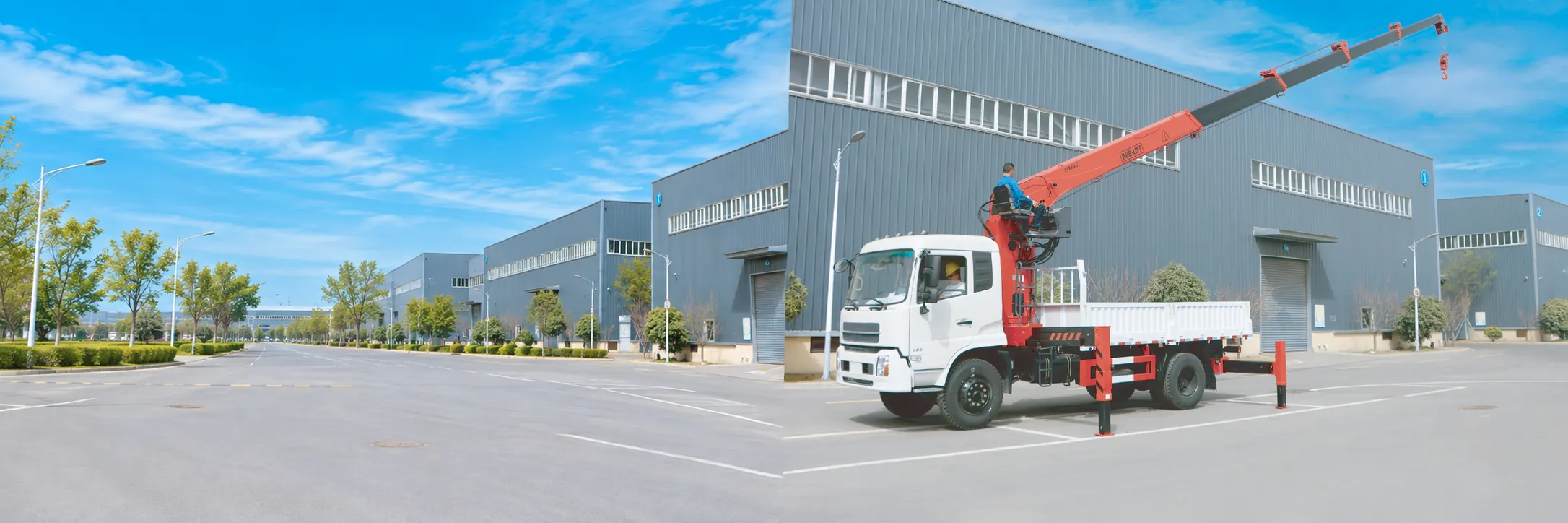

A 5 ton truck crane is a hydraulic crane rated to lift 5,000 kg close to its column, mounted on a rigid truck behind the cab. BOB-LIFT builds it in four configurations: the SQ5ZA3 and SQ5ZA4 knuckle boom cranes and the SQ5SA3 and SQ5SA4 telescopic boom cranes. Our 5 ton knuckle boom crane and telescopic range page lists every model of the class. This guide answers the next question buyers ask: what truck does the crane need? The answer comes from four figures on each dimension drawing: installation space, self weight, hydraulic supply and outrigger span. We supply the crane, not the truck.
Key takeaways
- All four BOB-LIFT 5 t configurations lift 5,000 kg close in. The knuckle boom models are rated at 10.5 t·m, the telescopic models at 12.5 t·m.
- The crane needs 1,050 mm of chassis length behind the cab (800 mm for the SQ5SA4). Whatever remains behind it is your body length.
- The crane weighs 2,100 to 2,400 kg. That weight, the subframe and the body all come out of the truck’s payload, and most of the crane’s weight lands on the front axle.
- The power take-off and pump must deliver 35 L/min at 28 MPa for the knuckle models, or 32 L/min at 20 or 21 MPa for the telescopic models.
- A truck bought in China can be delivered to our factory for fitting. For a truck bought locally, we ship the crane and a local body builder fits it with our remote support.
What a 5 ton truck crane is
The maximum rated load is the heaviest load the crane may lift, and the “5 ton” in the name refers to it. It is permitted only at the shortest radius on the load chart, and the rating decreases progressively as the radius increases. On our 5 t cranes, 5,000 kg is allowed at 2.1 m (knuckle boom) or 2.5 m (telescopic), while at full reach the rating is 600 to 1,100 kg. The lifting moment, the load multiplied by its radius, reaches its maximum of 10.5 t·m (knuckle boom) or 12.5 t·m (telescopic) close in; our guide to the lifting moment of a crane explains it.
Buyers search for this machine under many names. In Malaysia it is a lorry crane 5 ton, across Southeast Asia buyers also search for a crane truck 5 ton, and in the Philippines it is often advertised as a 5 ton boom truck. In Spanish-speaking Latin America it is a camión grúa de 5 toneladas, or a camión pluma in Chile. Our crane lorry guide sets out the names used in each market.
The 5 t class is available with two boom types. A knuckle boom is a boom that folds at an articulated joint, so it can reach over a wall, position a load at a low angle and stow compactly behind the cab. A telescopic boom is a straight boom that extends hydraulically in sections, reaches farther in a straight line and normally works with a hook on a winch rope. Our comparison of knuckle boom vs telescopic boom cranes on trucks covers the choice in detail.
The four 5 t configurations compared
Every figure in this table comes from the dimension drawing or load chart of the individual model, except the lifting heights, which come from the product pages. The specifications that determine the truck are in the last five rows.
| Figure | SQ5ZA3 | SQ5ZA4 | SQ5SA3 | SQ5SA4 |
|---|---|---|---|---|
| Boom type | Knuckle, 3 sections | Knuckle, 4 sections | Telescopic, 3 sections | Telescopic, 4 sections |
| Max rated load | 5,000 kg at 2.1 m | 5,000 kg at 2.1 m | 5,000 kg at 2.5 m | 5,000 kg at 2.5 m |
| Max lifting moment | 10.5 t·m | 10.5 t·m | 12.5 t·m | 12.5 t·m |
| Max radius and rating there | 8.05 m, 1,100 kg | 9.9 m, 700 kg | 8.68 m, 1,100 kg | 11.79 m, 600 kg |
| Lifting height (product page) | about 10.5 m | about 12 m | about 10.5 m | about 13.5 m |
| Slewing | 400° | 400° | 360° | 360° |
| Self weight | 2,286 kg | 2,386 kg | 2,100 kg | 2,400 kg |
| Installation space behind the cab | 1,050 mm | 1,050 mm | 1,050 mm | 800 mm |
| Hydraulic flow and pressure | 35 L/min, 28 MPa | 35 L/min, 28 MPa | 32 L/min, 20 MPa | 32 L/min, 21 MPa |
| Recommended power, oil tank | 22 kW, 100 L | 22 kW, 100 L | 18 kW, 90 L | 18 kW, 100 L |
| Outrigger span | 2,272 to 5,122 mm | 2,272 to 5,122 mm | 2,260 to 5,100 mm | 2,293 to 5,593 mm |
First, the two knuckle models have identical ratings out to 8.05 m, so the fourth section of the SQ5ZA4 adds reach to 9.9 m together with 100 kg of additional crane weight. Second, the telescopic models, with their higher lifting moment, carry more at intermediate radius: the SQ5SA4 chart gives 3,000 kg at 3.99 m, against 2,350 kg at 4.45 m on the knuckle models. Third, the SQ5SA4 requires only 800 mm behind the cab, which leaves 250 mm of additional chassis available for the cargo body. Every BOB-LIFT crane is listed with a load moment limiter.

The full load charts are on the 5 ton knuckle boom truck mounted crane and 5 ton telescopic boom truck mounted crane pages. Our guide on how to read a crane load chart explains the radius columns. For a side-by-side of the two telescopic models with lighter and heavier classes, see our size guide for telescopic boom cranes.
What truck does a 5 ton truck crane need?
None of our 5 t drawings names a truck model or a minimum chassis rating, so we do not quote one. Our product pages describe the knuckle models as fitting medium trucks and the telescopic models as suiting light and medium trucks. The exact chassis follows from six checks. A body builder runs them on your chassis; this section shows how.
1. Installation space and body length
The installation space is the length of chassis that the crane occupies directly behind the cab: 1,050 mm for the SQ5ZA3, SQ5ZA4 and SQ5SA3, and 800 mm for the SQ5SA4. The cargo body receives whatever chassis length remains. The usable length behind the cab must therefore accommodate the installation space, a small clearance to the cab and the body length your deliveries require. For 6 m bundles of reinforcing steel, for example, the minimum is 6,000 mm plus 1,050 mm plus that clearance.

2. Payload and gross vehicle weight
Every truck has a gross vehicle weight rating set by its maker. As one reference puts it, the GVWR “is the maximum operating weight/mass of a vehicle as specified by the manufacturer including the vehicle’s chassis, body, engine, engine fluids, fuel, accessories, driver, passengers and cargo” [1]. The crane counts as part of the vehicle, not as cargo. The payload left for goods is therefore the rating minus the chassis kerb weight, crew, crane, subframe and body.
Here is the calculation for an ASSUMED rigid truck with a 15,000 kg rating. The other assumed figures are a chassis kerb weight of 5,200 kg, 150 kg for the driver and crew, a 350 kg subframe and a 1,100 kg dropside body. With the SQ5ZA3 at 2,286 kg, the vehicle weighs 9,086 kg before loading, which leaves 5,914 kg of payload. The SQ5ZA4 leaves 5,814 kg, the SQ5SA3 6,100 kg and the SQ5SA4 5,800 kg, so the crane consumes approximately 15 percent of this assumed rating. Ask us whether the self weight on the drawing includes hydraulic oil; the tank holds 90 or 100 L.

3. Front axle load
Staying under the gross rating is not enough; each axle has its own limit. US federal vehicle rules define the gross axle weight rating (GAWR) as “the value specified by the vehicle manufacturer as the load-carrying capacity of a single axle system, as measured at the tire-ground interfaces” [2]. The truck maker sets one for the front axle and one for the rear. Because the crane sits right behind the cab, most of its weight goes onto the front axle. That share is found with the lever rule: crane weight multiplied by its distance to the rear axle, divided by the wheelbase.
Consider the same ASSUMED truck with a 5,200 mm wheelbase, and assume the crane’s centre of gravity is located 1,900 mm behind the front axle. The SQ5ZA3 then places 2,286 × 3,300 / 5,200, approximately 1,450 kg, on the front axle and approximately 835 kg on the rear axles. The heavier SQ5ZA4 places approximately 1,515 kg on the front axle. Add that to the front axle load of the bare chassis and compare the total with the front axle rating. If it is over, the body builder looks for a chassis with a higher front axle rating.
4. Wheelbase and subframe
The wheelbase sets two things: how the load splits between the axles, and how much chassis lies behind the crane. A longer wheelbase allows a longer body but puts a larger share of the crane’s weight on the front axle. A shorter one keeps the truck nimble in narrow streets. The crane does not bolt straight to the chassis rails. It sits on a subframe. The subframe is a steel frame that distributes crane forces along the chassis and carries the outrigger housing. Our truck mounted crane installation guide covers subframe design, fixing and the checks after fitting.

5. Power take-off, pump and oil flow
The crane runs on oil from a pump driven by the truck engine through a power take-off. A power take-off (PTO) is “one of several methods for taking power from a power source, such as a running engine, and transmitting it to an application such as an attached implement or separate machine” [3]. The truck’s gearbox must accept a PTO, and the PTO and pump together must deliver what the drawing asks for.
For the SQ5ZA3 and SQ5ZA4, the drawings specify 35 L/min at 28 MPa, with 22 kW of hydraulic power recommended. The SQ5SA3 requires 32 L/min at 20 MPa and the SQ5SA4 32 L/min at 21 MPa, both with 18 kW recommended. Insufficient flow makes the crane operate slowly, while excessive flow generates unnecessary heat in the hydraulic oil. Our article on the hydraulic crane for truck explains PTO ratios, pump size and how flow follows engine speed.
6. Outrigger span and stowed width
Before every lift the outriggers extend and lower, so the crane is supported on its own feet rather than on the truck’s suspension. Fully extended, the span between the feet is 5,122 mm on the knuckle models, 5,100 mm on the SQ5SA3 and 5,593 mm on the SQ5SA4; retracted, it is approximately 2.3 m. On a narrow street, measure whether the full span fits alongside parked vehicles and passing traffic. Every pad needs firm ground; see our guides to crane outriggers and ground bearing pressure and crane mats and outrigger pads.
Stowed for driving, the crane base measures 2,492 mm wide on the knuckle models, 2,460 mm on the SQ5SA3 and 2,476 mm on the SQ5SA4. Compare that dimension with the maximum vehicle width permitted in your country before ordering.
Local axle-load and width limits
Road authorities set their own limits on axle loads, gross weight and vehicle width, and these differ between Malaysia, the Philippines, South Africa, Chile and elsewhere. We could not fetch the current official text for these markets, so we give no figures here. Check your local axle-load limits with the road authority or your body builder, and use the lower of the legal limit and the truck maker’s rating.
Winch, controls and marine versions
The telescopic models include a winch as standard equipment. The knuckle models can be ordered without one or in the J version with a hydraulic winch, designated SQ5ZA3J and SQ5ZA4J. A winch allows the hook to descend below the boom tip, into a trench or from an elevated deck, and its additional weight means we confirm the self weight of a J version with the quotation. Our crane winch guide explains when a winch pays off.
The knuckle models can be run from manual levers, an aerial seat or a wireless remote. The telescopic models offer a control panel, a top seat or a wireless remote. A remote lets the operator stand where the load is visible; see our guide to truck crane remote control. None of the four 5 t drawings shows a manual extension. For work on a vessel, each of the four has a marine version: the SQ5ZA3T, SQ5ZA4T, SQ5SA3T and SQ5SA4T. Our marine crane sizes guide compares the marine classes.
Example scenario: SQ5ZA3 or SQ5ZA4 for a distributor in Cebu
Example scenario (an illustration, not a customer record). A building-materials distributor in Cebu, Philippines, wants a lorry with a 5 t knuckle boom crane for daily deliveries. The truck is the ASSUMED 15,000 kg rigid chassis from the payload example above, bought locally. The distributor has three regular lifts, all with ASSUMED weights:
- A pallet of 40 bags of cement at 40 kg each, with pallet and slings 1,650 kg, set down 4.0 m from the crane.
- A bundle of steel bar of 1,000 kg plus 25 kg of slings, placed 7.5 m out beside a site gate.
- A bundle of roofing sheets of 500 kg plus 25 kg of slings, lifted over a boundary wall to 9.5 m.
When a radius falls between two chart points, use the rating at the larger radius. The cement delivery uses the 4.45 m rating of 2,350 kg on either model, so the 1,650 kg pallet utilises 70 percent of the capacity. The steel delivery uses the 8.05 m rating of 1,100 kg, again identical on both models, and the 1,025 kg bundle utilises 93 percent: close to the limit, but within it. The roofing delivery determines the model, because the SQ5ZA3’s maximum radius of 8.05 m cannot reach 9.5 m at all. The SQ5ZA4 chart gives 700 kg at 9.9 m, so the 525 kg bundle utilises 75 percent.
From the truck’s perspective, the two cranes are nearly identical. Both require 1,050 mm behind the cab and 35 L/min at 28 MPa, so the same power take-off, pump and body length suit either model. The SQ5ZA4 reduces the payload by 100 kg, to 5,814 kg instead of 5,914 kg on the assumed truck, and adds approximately 65 kg to the assumed front axle load. If over-the-wall deliveries are regular, the SQ5ZA4 is the better choice. If they are rare, the SQ5ZA3 keeps 100 kg more payload, and the roofing sheets can go in smaller lifts or with a closer truck position.
Typical jobs for a 5 t truck crane
The 5 t class suits trucks that deliver and set down their own cargo. Builders’ merchants deliver blocks, bagged cement, steel and timber. Equipment suppliers lift pumps, generators and small machinery. Utility and maintenance crews set precast parts and poles at the roadside. In Kenya, a company in mining and engineering support services runs five SQ5SA4 cranes on its own 6×6 trucks with dropside bodies; the Kenya SQ5SA4 customer story shows them at work.
If your heaviest regular load is considerably below 5 t, a smaller crane preserves more payload; our small truck crane guide covers the lighter classes. If it is above, our guide on selecting the tonnage of a truck mounted crane shows how to size up. For a much larger class worked through the same way, see our 25 ton knuckle boom crane guide.
What to send for a quotation
- The lifts: heaviest load with its radius, the farthest load with its radius, and the highest lift height.
- The truck: make, model, wheelbase, gross vehicle weight rating, front axle rating and chassis length behind the cab. If you have no truck yet, tell us whether you will buy it in China or locally.
- The body: the cargo body length you need.
- Boom type and options: knuckle or telescopic, winch, controls, attachments, or a marine version.
- Delivery: destination port and country.
We supply the crane, not the truck. A truck bought in China can be delivered to our factory, and we mount the crane there before it ships. If you buy the truck locally, we ship the crane and a local body builder fits it with our remote support. Our guide to buying a truck mounted crane from China covers both routes, and our truck mounted crane price guide explains what moves a quotation.
Frequently asked questions
What size truck does a 5 ton truck crane need?
Our product pages describe the knuckle models as fitting medium trucks and the telescopic models as suiting light and medium trucks, but the exact chassis follows from a calculation. The truck needs 1,050 mm behind the cab (800 mm for the SQ5SA4) plus your body length. It must carry 2,100 to 2,400 kg of crane within its gross and front axle ratings, and supply the oil flow on the drawing.
How much payload does a 5 t crane take?
The crane itself weighs between 2,100 kg (SQ5SA3) and 2,400 kg (SQ5SA4), with the knuckle models at 2,286 and 2,386 kg. Add the subframe and any additional bodywork. On the assumed 15,000 kg truck in our example, approximately 5,800 to 6,100 kg of payload remains available.
Can a 5 ton truck crane lift 5 tons at full reach?
No. The full 5,000 kg is permitted only at the minimum radius: 2.1 m on the knuckle models or 2.5 m on the telescopic models. At maximum reach the rating is 1,100 kg on the SQ5ZA3 and SQ5SA3, 700 kg on the SQ5ZA4 and 600 kg on the SQ5SA4.
What hydraulic supply does the crane need from the truck?
The knuckle models need 35 L/min at 28 MPa, with 22 kW recommended. The SQ5SA3 needs 32 L/min at 20 MPa and the SQ5SA4 32 L/min at 21 MPa, with 18 kW recommended. The truck’s PTO and pump must deliver this flow at working engine speed.
Does BOB-LIFT supply the truck?
No, we supply the crane. A truck you buy in China can be delivered to our factory, where we mount the crane before shipping. If you buy the truck locally, we ship the crane alone and a local body builder fits it with our remote support.
How we compiled this guide
The crane figures come from the BOB-LIFT SQ5ZA3, SQ5ZA4, SQ5SA3 and SQ5SA4 dimension drawings and load charts, read in November 2026. Lifting heights, controls, winch versions and the truck classes the cranes suit come from the 5 t knuckle boom and telescopic product pages. All truck figures in the payload, front axle and Cebu examples are assumptions, marked as such, not data for any real chassis. The gross vehicle weight and PTO definitions are quoted from Wikipedia, and the gross axle weight rating definition from 49 CFR 571.3 on eCFR, all read in November 2026. Achord Chan, Product Operations Director, carried out the editorial review.
Request a quotation for a 5 t truck crane
Send us your loads and radii, your truck details or your plan to buy a truck, and your destination. We will recommend one of the four configurations and send its dimension drawing and load chart with the quotation. Every crane comes with a 12-month whole-machine warranty and an English manual. Common spare parts are dispatched within 48 hours, and our service team replies within 12 hours with video guidance. Contact us to start, or browse our truck mounted crane range, the knuckle boom truck mounted cranes and the telescopic boom truck mounted cranes.