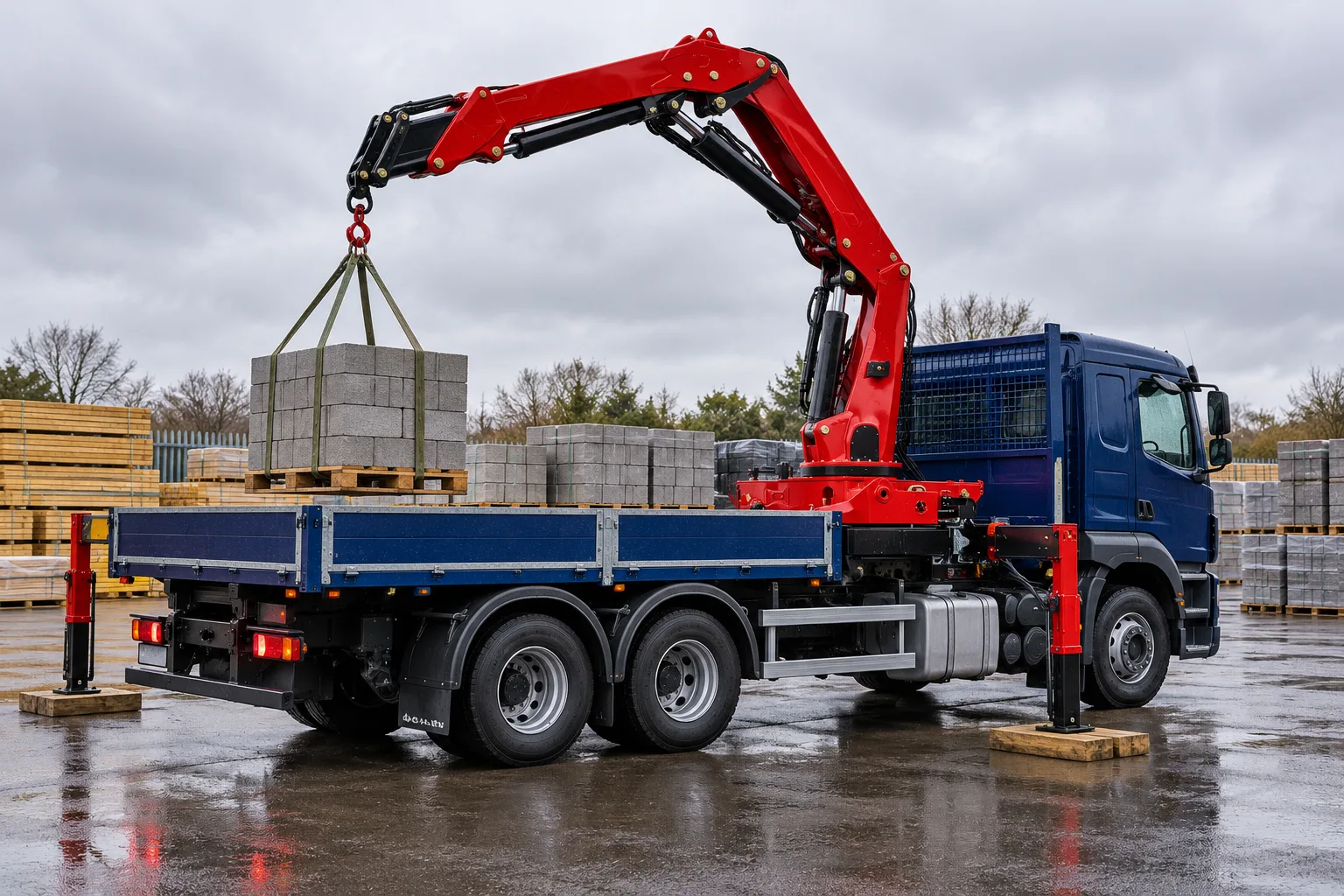
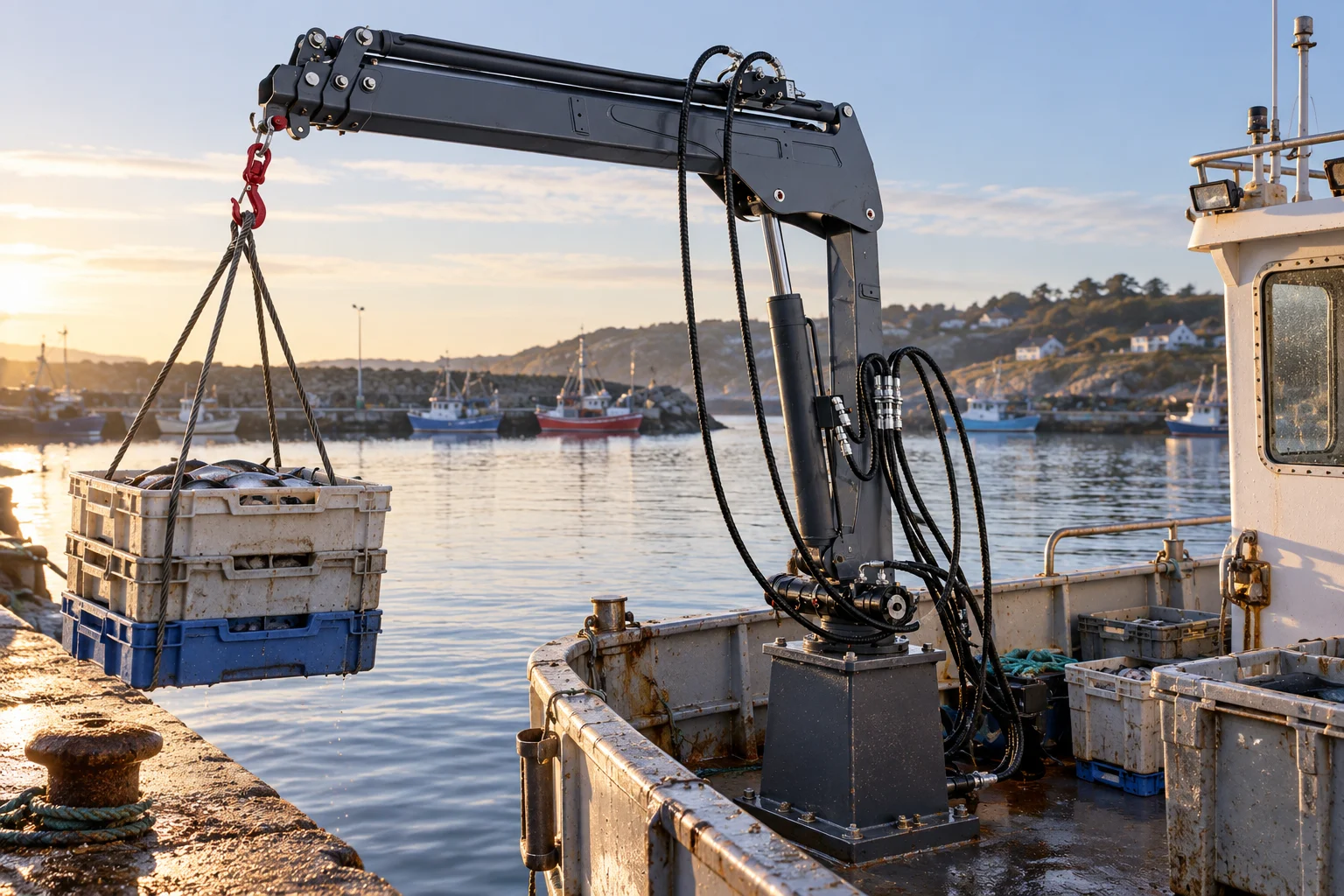
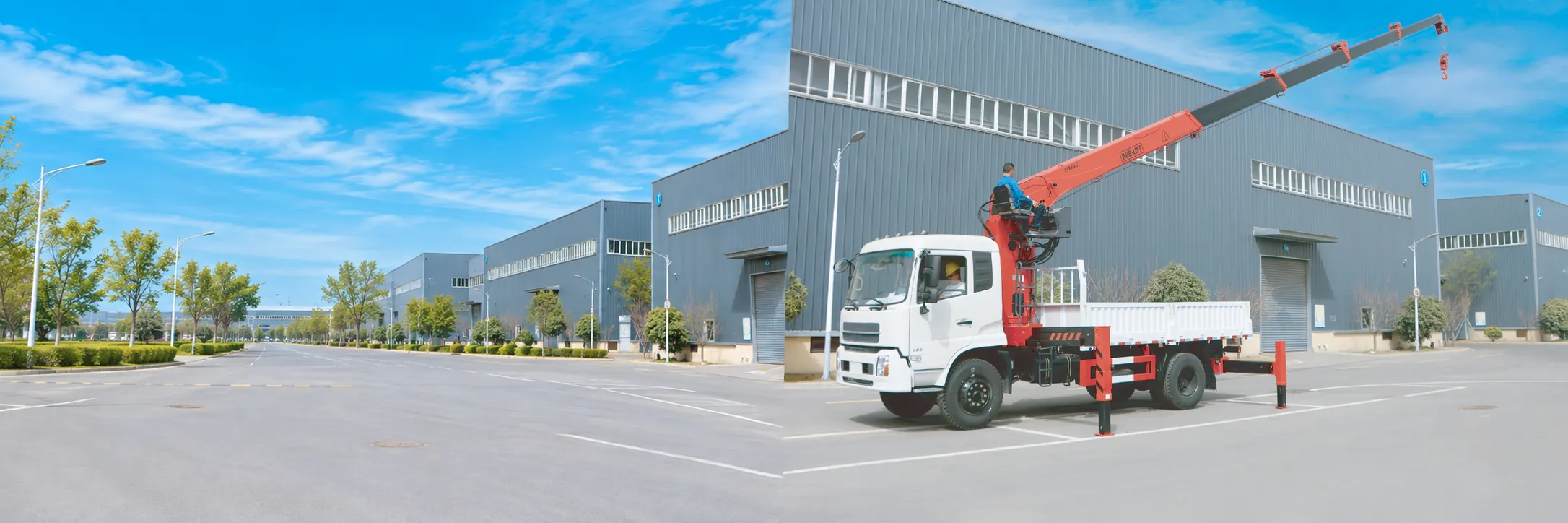
Boom trucks are sold by tonnage: a 3-ton, a 5-tonner, a 10-ton, a 20-ton. That number is the most the crane can lift with its boom short and the load close to the column. It tells you very little about what the crane lifts at the distance your job actually needs, how much the crane weighs, or what size of truck has to carry it.
This guide sets out the sizes we build, from 2 t to 20 t, and what changes from one size to the next: reach, the load at full reach, crane weight, mounting space, outrigger span and hydraulic power. Every figure comes from the technical drawings and load charts for our 12 current telescopic boom truck mounted cranes.
Key takeaways
- A boom truck’s size is its maximum rated load near the column. Our 10 t model lifts 10,000 kg up close but 1,050 kg at its full 15.5 m reach.
- Our telescopic sizes run from 2 t (8.2 m reach) to 20 t (22 m reach). The crane alone weighs from 950 kg to 7,300 kg.
- A bigger size is not always the longer reach. Our 8 t reaches 18.5 m, further than the 10 t, but lifts only 400 kg out there.
- Compare sizes at your own working radius. At 9 to 10 m, our cranes lift from 400 kg (4 t, at 9.4 m) to 6,300 kg (20 t, at 10.3 m).
- Check the truck’s payload, the space behind the cab and the PTO before you choose the crane.
How is boom truck capacity rated?
A boom truck’s size is its rated lifting capacity: the crane’s maximum rated load, measured with the boom retracted and raised, and the hook close to the column. On our 10 t crane that is 10,000 kg at about 2.5 m from the slewing centre. As the boom extends and the hook moves out, the rated load falls quickly. The load chart for each crane shows how far.
Two more figures help compare sizes. The lifting moment, in tonne-metres (t·m), is load multiplied by radius; it runs from 4.2 t·m on our 2 t crane to 50 t·m on our 20 t. The number of boom sections decides the reach. A 3-section boom is short and strong; a 5-section boom reaches much further but lifts less at the tip.
Watch the units. Our ratings are in metric tonnes of 1,000 kg (2,205 lb). In the United States a “ton” usually means a short ton of 2,000 lb, so a 10 t crane is about 11 US tons. In the Philippines buyers search for a “5-tonner” or “10-tonner boom truck”. In North America, “boom truck” also covers larger stick-boom cranes rated in US tons, with the boom length given in feet. This guide covers the 2 t to 20 t truck-mounted telescopic cranes we build.
Boom truck size chart: capacity, reach and specifications
The table lists our 12 current telescopic boom truck cranes in 11 sizes. “Full reach” is the boom fully extended and horizontal, the furthest the hook can go and the lightest load the crane can lift.
| Rated capacity | Model | Boom sections | Load at full reach | Crane weight | Mounting space | Outrigger span | Hydraulics |
|---|---|---|---|---|---|---|---|
| 2 t | SQ2SA3 | 3 | 250 kg at 8.2 m | 950 kg | 650 mm | 1,720–3,120 mm | 8 kW, 20 L/min |
| 3.2 t | SQ3.2SA4 | 4 | 200 kg at 10.5 m | 1,350 kg | 750 mm | 1,720–3,120 mm | 14 kW, 25 L/min |
| 4 t | SQ4SA4 | 4 | 400 kg at 9.4 m | 1,780 kg | 800 mm | 2,214–4,534 mm | 16 kW, 25 L/min |
| 5 t | SQ5SA3 | 3 | 1,100 kg at 8.68 m | 2,100 kg | 1,050 mm | 2,260–5,100 mm | 18 kW, 32 L/min |
| 5 t | SQ5SA4 | 4 | 600 kg at 11.8 m | 2,400 kg | 800 mm | 2,293–5,593 mm | 18 kW, 32 L/min |
| 6.3 t | SQ6.3SA4 | 4 | 600 kg at 12.6 m | 2,600 kg | 850 mm | 2,280–5,300 mm | 22 kW, 40 L/min |
| 8 t | SQ8SA5 | 5 | 400 kg at 18.5 m | 4,100 kg | 1,100 mm | 2,290–5,990 mm | 30 kW, 55 L/min |
| 10 t | SQ10SA4 | 4 | 1,050 kg at 15.5 m | 3,800 kg | 1,100 mm | 2,290–5,990 mm | 37 kW, 63 L/min |
| 12 t | SQ12SA4 | 4 | 1,200 kg at 16.2 m | 4,600 kg | 1,100 mm | 2,300–7,500 mm | 45 kW, 75 L/min |
| 14 t | SQ14SA5 | 5 | 800 kg at 19.33 m | 5,100 kg | 1,300 mm | 2,260–7,400 mm | 42 kW, 75 L/min |
| 16 t | SQ16SA5 | 5 | 1,050 kg at about 22 m | 6,600 kg | 1,300 mm | 2,300–8,000 mm | 55 kW, 80 L/min |
| 20 t | SQ20SA5 | 5 | 1,500 kg at 22.0 m | 7,300 kg | 1,400 mm | 2,450–8,050 mm | 55 kW, 80 + 63 L/min |

Two things stand out. Reach does not rise evenly with size: the 8 t SQ8SA5 reaches 18.5 m, further than the 10 t and 12 t, because it has five boom sections. And at full reach, every size from 2 t to 20 t lifts between 200 kg and 1,500 kg. The size buys you load closer in, not at the tip.
Small, medium and large boom trucks
Our range falls into three size bands. Use the band to narrow the choice, then pick the model from the load at your own working radius.
Small boom trucks: 2 t to 4 t
Small cranes suit light trucks: building materials, gas cylinders, generators, pallets and tools lifted from the truck bed to the ground beside it. They weigh 950 kg to 1,780 kg, need 650 mm to 800 mm behind the cab and run on 8 kW to 16 kW of hydraulic power. The 2 t and 3.2 t share the narrowest outrigger span we make, 1,720 mm to 3,120 mm, useful on a narrow street. At reach they are light: the 3.2 t lifts 450 kg at 8.1 m and 200 kg at 10.5 m.
Medium boom trucks: 5 t to 8 t
The 5 t is the smallest of our sizes that still lifts more than 1,000 kg at full reach. It handles heavier bundles of steel, concrete products, small machines and site cabins. Here the boom choice matters as much as the size. The 3-section SQ5SA3 reaches 8.68 m and still lifts 1,100 kg there. The 4-section SQ5SA4 reaches 11.8 m, but lifts 970 kg at 8.5 m and 600 kg at full reach. Close in, the two lift similar loads: 1,500 kg at 6.17 m on the SQ5SA3 and 1,650 kg at 6.6 m on the SQ5SA4. The SQ5SA3 is 300 kg lighter but needs 1,050 mm of mounting space against 800 mm. Choose the SQ5SA4 when your lifts go beyond 8.68 m. The 8 t SQ8SA5 is the reach specialist of this band, with 18.5 m and 400 kg at the tip.

Large boom trucks: 10 t to 20 t
Large cranes are for heavy loads at real distance: precast elements, steel beams, transformers and machinery set well away from the truck. They weigh 3,800 kg to 7,300 kg, need 1,100 mm to 1,400 mm of mounting space and 37 kW to 55 kW of hydraulic power, and their outriggers spread up to 8 m. The 20 t SQ20SA5 lifts 12,000 kg at 6.3 m and 1,500 kg at its full 22 m reach. These sizes go on heavy multi-axle trucks, and the truck has to be confirmed before the crane is ordered.
Compare boom truck sizes at your working radius
The right size is the smallest crane that lifts your heaviest load at your longest working radius, with a margin. Measure that radius horizontally, from where the crane column will stand on the truck to where the load must be picked or landed. Then read each candidate’s load chart at that distance.

At 9 to 10 m the spread is wide. The 4 t lifts 400 kg at 9.4 m, the 6.3 t 1,000 kg at 9.9 m, the 10 t 2,200 kg at 9.0 m, the 14 t 3,500 kg at 9.2 m and the 20 t 6,300 kg at 10.3 m. If your heaviest lift is a 2,000 kg load at 9 m, a 10 t crane is the starting point, not a 5 t one, even though the load is well under 5 t.
Raising the boom shortens the radius and increases the load, so lifts close to the truck are easier. Our guide to reading a crane load chart shows how boom angle, boom length and radius work together, with worked examples on our 5 t, 10 t and 20 t charts.
How much does a boom truck crane weigh?
Our telescopic cranes weigh from 950 kg (2 t) to 7,300 kg (20 t), before the truck, subframe and body. That weight comes out of the truck’s payload, so a larger crane leaves less room for the cargo you carry. It also sits high and just behind the cab, which loads the front axle.
Weight does not always follow size. The 8 t SQ8SA5 weighs 4,100 kg, 300 kg more than the 10 t SQ10SA4, and it has a fifth boom section that gives it 3 m more reach. Likewise the 5 t SQ5SA4 weighs 2,400 kg against 2,100 kg for the 5 t SQ5SA3. If you never use the extra reach, you are carrying it for nothing.
Before you choose a size, add up the crane, subframe, body and your heaviest cargo and compare the total with the truck’s rated payload and axle limits. Our truck crane installation guide covers the chassis checks, and an initial axle-load estimate should always be confirmed by the truck builder.
What size truck does each boom truck crane need?
Three measurements decide whether a crane size fits your truck: payload, mounting space and hydraulic supply.
- Payload. The crane’s own weight, from 950 kg to 7,300 kg, plus subframe and body must fit within the truck’s remaining payload, with room left for the load you carry.
- Mounting space. The crane sits between the cab and the body. It needs from 650 mm (2 t) to 1,400 mm (20 t). On a fixed body length, a bigger crane means a shorter load bed.
- Hydraulic supply. The crane is driven by a pump on the truck’s power take-off (PTO). The recommended supply rises from 8 kW and 20 L/min for the 2 t to 55 kW and a dual 80 + 63 L/min circuit for the 20 t. A PTO that cannot deliver the flow makes the crane slow, even if it is strong enough.
Whether your market calls it a six-wheeler or a ten-wheeler, the check is the same. Send us the chassis model, wheelbase and gross vehicle weight and we will confirm the size and mounting. We supply the crane on its own or mounted on a chassis in our workshop.

Boom truck dimensions on site: outrigger span
A boom truck lifts its rated loads only with the outriggers extended and set on firm ground. The span grows with size: from 1,720 mm to 3,120 mm on our 2 t and 3.2 t cranes, up to 2,450 mm to 8,050 mm on the 20 t. The lower figure is the outriggers retracted; the upper is fully extended. On a narrow street or a tight yard, check that the site has room for the full span before you choose a large size, and plan pads under the feet on soft ground.
Quick size check
- Write down your heaviest regular load, including slings, hooks or any attachment.
- Measure the longest working radius you need for that load, from the crane column to the landing point.
- Shortlist the sizes whose load chart covers that load at that radius, with a margin.
- Check the crane weight, mounting space and hydraulic supply against your truck.
- Check the outrigger span against the sites you work on.
Our telescopic boom truck crane range page has a fuller buying guide, including boom angle and slewing range.
If a straight boom does not fit your truck or your loads, compare the alternatives in our knuckle boom vs telescopic boom truck crane comparison. For more than 20 t, our 25 ton knuckle boom truck mounted crane is the next step up.
Frequently asked questions
What size boom truck do I need?
You need the smallest crane that lifts your heaviest load at your longest working radius. For example, an 800 kg load at 12 m needs at least our 8 t SQ8SA5, which lifts 1,300 kg at 12.0 m with the boom horizontal. The 6.3 t lifts only 600 kg at 12.6 m, and our 5 t cranes do not reach 12 m.
What is the capacity of a boom truck?
Our telescopic boom trucks are rated from 2,000 kg to 20,000 kg with the load close to the column. With the boom fully extended and horizontal, the same cranes lift from 200 kg to 1,500 kg, so always check capacity at your working radius.
How much can a 10 ton boom truck lift?
Our 10 t SQ10SA4 lifts 10,000 kg at about 2.5 m from the slewing centre. With the boom horizontal it lifts 4,500 kg at 5.0 m, 2,200 kg at 9.0 m, 1,500 kg at 12.0 m and 1,050 kg at its full 15.5 m. See all our 10 ton cranes, telescopic and knuckle boom.
What is a 5-tonner boom truck?
A 5-tonner is a truck with a crane rated for 5,000 kg near the column. We build two: the SQ5SA3 with a 3-section boom (8.68 m reach, 2,100 kg crane weight) and the SQ5SA4 with a 4-section boom (11.8 m reach, 2,400 kg).
How far can a boom truck reach?
Our telescopic cranes reach from 8.2 m (2 t) to about 22 m (22.0 m on the 20 t), measured from the slewing centre to the hook with the boom horizontal. With the boom raised to its maximum of 75°, the hook goes higher but closer to the truck.
Is a boom truck the same as a knuckle boom crane?
Not usually. “Boom truck” most often means a truck with a straight telescopic boom crane. A knuckle boom crane has a jointed boom that folds compactly behind the cab and can reach over obstacles. We build both types.
Get the size confirmed before you order
A boom truck size is a starting point, not a decision. Pick the size from the load at your working radius, then check the crane’s weight, mounting space, hydraulics and outrigger span against your truck and your sites. We have built truck mounted cranes in Xuzhou since 2003. Send us your heaviest load, working radius and chassis details through our contact page, and our engineers will recommend the size and send the load chart and drawing for it.