
A crane winch is a hydraulically powered drum that winds wire rope in and out, allowing a truck mounted or marine crane to raise and lower its hook on the rope. It does not have to rely solely on the movement of the boom. On a knuckle boom crane the winch is an optional configuration, whereas on a telescopic boom crane it is part of the standard equipment. Its principal advantage is that the hook can travel considerably below the truck or above the boom tip, positions the articulated boom alone cannot reach.
We have manufactured truck mounted cranes in Xuzhou since 2003, and the question buyers most frequently ask about this component is whether their application actually requires one. This guide explains how a hydraulic crane winch operates, when a crane with a winch is a worthwhile investment, how much additional weight it introduces, how the “J” designation works on our cranes, and which inspections an operator should complete every working day.
Key takeaways
- Choose a winch when the hook must go below ground, down a shaft, over a high wall or well above the boom tip. For everyday loading and unloading next to the truck, a knuckle boom crane without a winch is simpler.
- On BOB-LIFT knuckle boom truck cranes the winch is an option on every model, shown by a J in the model code, such as SQ12ZA6J. Our telescopic boom truck cranes have the winch as standard.
- Our technical department puts the extra self-weight of a winch at about 70 to 110 kg. That weight comes out of your truck’s payload.
- When you lift on the winch, two limits apply: the load chart and the winch’s own line pull. The lower one governs.
- On marine cranes the winch is optional for knuckle boom models (TJ) and standard on telescopic ones; it lets the hook reach a boat or the water.
- Check the wire rope every shift, keep at least two full wraps on the drum, and make sure the anti two-block device works.
What does a winch do on a truck mounted crane?
A knuckle boom crane without a winch lifts by folding and unfolding its articulated boom sections. The hook is suspended from a short link at the boom tip, so its position always corresponds exactly to the position of the boom tip. This arrangement is fast and precise for operations close to the vehicle, but it imposes a fixed limit on how low or how high the hook can travel.
A winch removes that limitation. The wire rope runs from the drum along the boom, passes over a sheave at the boom tip and descends to the hook. The operator first positions the boom tip above the work area and then pays out or retrieves rope. As a result, the hook can travel well below the boom tip into a pit or an underground chamber, or be positioned above a wall that the boom cannot fold over.

Telescopic boom cranes always lift on a winch, because a straight telescopic boom cannot articulate downwards to reach a load. For that reason every one of our telescopic boom truck cranes has a winch and a hook block as standard. On our knuckle boom truck cranes, the decision belongs to the buyer and depends on the intended application.
How a hydraulic crane winch works
Most winches fitted to truck mounted cranes are hydraulic, operating from the same oil supply as the boom cylinders and the slewing mechanism, so they require no separate engine or electrical power source. The principal components are:
- Drum: the cylindrical spool that stores the wire rope, whose diameter must be appropriate for the rope size so that the rope is not bent excessively.
- Hydraulic motor and gearbox: they rotate the drum; hydraulic flow determines the rope speed, while hydraulic pressure determines the available pull.
- Brake: it holds the drum automatically when the control lever is released, so the suspended load remains stationary.
- Wire rope: the steel rope that transmits the load from the drum to the hook.
- Boom tip sheave: the pulley that redirects the rope downwards towards the load.
- Hook block or hook with weight: its weight keeps the rope under tension, so the empty hook descends by gravity.
- Valve section: an additional lever on the control valve, or an additional function on the remote control, to operate the winch in both directions.

Because the winch draws oil from the same pump as the other crane functions, the hydraulic system must be specified with that additional consumer in mind. If you are still selecting a truck and power take-off, our guide to the hydraulic crane for a truck explains how pump flow and operating pressure are matched to the crane.
Crane with winch or without: how to choose
The decision depends primarily on where the hook needs to travel. If nearly every lift moves material from the truck bed to the ground beside it, a winch adds weight and components that will rarely be used. If even a small proportion of your jobs require the hook below ground level or high above the truck, the winch is usually what makes those operations possible at all.
| Job | Without winch | With winch |
|---|---|---|
| Loading and unloading pallets, blocks or pipes beside the truck | Best fit: quick and precise | Works, but adds weight you may not need |
| Lowering pumps or pipes into a well chamber, pit or trench | Limited by how low the boom tip can go | Best fit: the rope lowers the hook below ground |
| Lifting over a high wall, fence or roof edge | Hook stops at the boom tip | The hook can be raised close to the boom tip and placed over the obstacle |
| Lifting near the crane’s full reach | Hook height falls as the boom flattens out | The rope can lower the load from the boom tip to where it is needed |
| Marine work: lifting from a quay or the water | Limited by deck height above the water | Best fit: the rope reaches down to a boat or the water |
| Grapple or auger work | Uses the boom tip directly | The winch is not used for these tools |
Summary compiled by BOB-LIFT, November 2026. For the other tools you can fit at the boom tip, see our guide to knuckle boom crane attachments.
Example scenario (an illustration, not a customer record): a water utility contractor needs to install submersible pumps in chambers approximately 5 m below road level. With the hook attached to the boom tip, the crane cannot reach the floor of the chamber. With a winch, the operator positions the truck beside the chamber, places the boom tip over the opening and lowers each pump on the rope, remaining within both the load chart and the winch’s rated line pull.
What a winch adds: weight, payload and capacity
A winch inevitably increases the weight of the crane. According to our technical department, the additional self-weight of the winch on a knuckle boom truck crane is approximately 70 to 110 kg, covering the components that a crane without a winch does not carry. The exact weight of each J version is confirmed with your quotation.
Whether an additional 70 to 110 kg is significant depends largely on the size of the crane. On a heavy crane it represents a negligible proportion of the total, while on a compact crane it becomes a noticeable part of the weight the vehicle must carry. The chart compares the additional weight with the self-weight of seven of our knuckle boom models, taken from their technical drawings.

On the 1.6 t SQ1ZA3+1, which weighs 470 kg, a winch adds roughly one seventh to almost one quarter of the crane’s weight, whereas on the 25 t SQZ500, which weighs 6,300 kg, it adds less than one fiftieth. For a compact crane on a light vehicle, verify the available payload before specifying the winch, because the crane, the winch, the hydraulic oil and any accessories are all deducted from the truck’s legal payload.
Two further considerations apply whenever you lift on the winch:
- Two limits, the lower one wins. The load chart specifies the permissible load at each radius, while the winch has its own maximum line pull for a single rope, and the operator must never exceed the lower of the two values. Our guide on how to read a crane load chart shows how to find the chart value.
- The hook and rope count as load. The US crane rule 29 CFR 1926.1401 defines the load as the object plus “the load-attaching equipment, such as, the load block, ropes, slings, shackles”. Consequently, the hook block on a winch rope is part of the load the crane lifts. Our crane hook guide explains why this matters most at long radius.
The winch option on BOB-LIFT cranes
Our model designations indicate immediately whether a crane is equipped with a winch, because a J in the code means a winch is fitted. For example, the 12 t SQ12ZA6 without a winch becomes the SQ12ZA6J with one, and the 1.6 t SQ1ZA3+1 becomes the SQ1ZA3J+1. On each knuckle boom series page you can select “with winch” or “without winch” before requesting a quotation.
| Crane type | Winch | What it means for you |
|---|---|---|
| Knuckle boom truck cranes, 1.6 t to 50 t, including the BLZ series | Optional on every model (J) | Choose it on the series page; the J version’s self-weight is confirmed with your quotation |
| Pickup cranes, SQ08ZA3 and SQ08ZA3+1 | Optional (J) | Check the pickup’s payload first, because the crane is light and the winch is a bigger share of it. Our technical department puts the winch at about 70 kg on pickup cranes; the exact self weight is stated in your quotation |
| Telescopic boom truck cranes | Standard | The self-weight on the technical drawing already includes the winch |
| Knuckle boom marine cranes | Optional (TJ) | Choose it when the hook must reach a boat, a pontoon or the water |
| Telescopic marine cranes | Standard | Always supplied with the winch |
Source: BOB-LIFT technical department, November 2026. Model availability is shown on each product page.

Our technical drawings specify the crane’s capacity, lifting moment, outreach and self-weight, but they do not state the winch’s line pull, rope length or rope speed. We confirm those values for your particular model and application in the quotation, together with the load chart for the winch configuration. If you need a pickup-sized crane, start with our pickup cranes and the small truck crane guide.
Winches on marine cranes
On a vessel, a quay or a pontoon the winch matters even more, because the load is often far below the crane. A boat alongside, a buoy or a diver’s basket in the water may sit several metres under the deck, and the distance changes with the tide and the vessel’s draught. A knuckle boom marine crane without a winch can only lower the hook as far as its boom tip reaches, while the winch rope can follow the load down to the waterline.
Our marine crane codes work in the same way as the truck crane codes. T marks the marine version and J the winch, so an SQ10ZA6T becomes the SQ10ZA6TJ with a winch. On our knuckle boom marine cranes the winch is optional, and on our telescopic boom marine cranes it is standard. Where a marine model is drawn as a TJ version, the self-weight on that drawing already includes the winch. The figure of about 70 to 110 kg quoted above was given for truck mounted cranes, so for a marine crane we confirm the weight of the winch or no-winch version with your quotation.

Salt water and spray are hard on wire rope. Corrosion is one of the deficiencies that 29 CFR 1926.1413 tells the inspector to look for, and on a vessel it develops faster than on a truck. Rinse the rope and drum with fresh water after work at sea, keep the rope lubricated as its maker recommends, and replace it at the first sign of significant corrosion or broken wires. For choosing the crane itself, see our marine crane buying guide and the boat crane guide.
Winch safety: rope, drum and anti two-block
A winch introduces a wire rope, and wire rope requires regular attention. The following requirements are the most important ones for operators and supervisors.
Inspect the rope every shift. In the United States, 29 CFR 1926.1413 says “a competent person must begin a visual inspection prior to each shift the equipment is used”. The regulation lists the deficiencies to look for, including kinking, crushing, birdcaging, visible broken wires and significant corrosion, and a rope showing any of them should be removed from service until a competent person has assessed it.
Keep two full wraps on the drum. Never pay out the entire length of rope. Under 29 CFR 1926.1417(t), the load must not be lowered below the point where “less than two full wraps of rope remain” on the drum. The remaining wraps relieve the load on the rope anchorage, so confirm that the rope is long enough for your deepest lift.
Use the anti two-block device. Two-blocking occurs when the hook block is drawn up into the boom tip, which can sever the rope and release the load. Under 29 CFR 1926.1416(d)(3)(iii), articulating cranes made after December 31, 1999 “that are equipped with a load hoist” must have a device that automatically prevents this. Test it before every shift and never disable or bypass it.
Use rope with the right safety margin. In Europe, Annex I of the Machinery Directive 2006/42/EC says the working coefficient of complete ropes “as a general rule” is equal to 5. In practice, replace a worn rope only with the diameter, construction and grade specified by the crane manufacturer.
Have it examined. In the UK, regulation 9 of LOLER 1998 requires lifting equipment to be thoroughly examined at least every 12 months, and accessories for lifting at least every 6 months, unless an examination scheme sets other intervals.
Two further operating habits prevent most winch problems: never drag loads sideways with the rope, and test the brake by raising a heavy load a short distance and stopping before completing the lift. Our truck mounted crane inspection checklist adds the rope, drum and brake to the daily routine, and the crane rigging guide covers the slings below the hook.
What to tell us when you order a crane with a winch
We can specify the winch and rope correctly only when we understand the application, so please include the following information with your enquiry:
- The heaviest load you will lift on the winch, including the hook and slings.
- The deepest point or the highest point the hook must reach, measured from where the truck stands.
- The radius for that lift, so we can check it against the load chart.
- Your truck: its payload and the space for the crane, especially for pickup and small cranes.
- How you will control the crane: levers on the crane or a remote control, which then needs a winch function.
- Where the crane will work, so the rules for inspection and anti two-block devices are covered.
Ordering the winch together with the crane is considerably simpler than retrofitting it later, because the valve section, hydraulic hoses and load chart are configured for it from the beginning. If you are planning a full lift, our crane lift plan guide shows how to write it down step by step.
Frequently asked questions
Does a knuckle boom crane need a winch?
Not necessarily. A knuckle boom crane performs well without one for operations beside the truck. Specify a winch if the hook must travel below ground level, down a shaft, over a high wall or down to a vessel or the water.
How much weight does a winch add to a truck crane?
Our technical department puts it at about 70 to 110 kg on our knuckle boom truck cranes; on the SQ08ZA3 pickup cranes it is about 70 kg. The exact weight of each winch version is confirmed with your quotation. Count it against your truck’s payload.
What does the J mean in a BOB-LIFT model code?
J means the crane has a winch. SQ12ZA6 has no winch; SQ12ZA6J has one. On marine cranes the code shows T for the marine version and J for the winch, as in SQ10ZA6TJ. Knuckle boom marine cranes can be ordered with or without it; telescopic marine cranes always have it.
Do telescopic truck cranes come with a winch?
Yes. All our telescopic boom truck cranes have a winch as standard, and the self-weight on their technical drawings already includes it. A telescopic boom lifts on the rope, so it cannot work without one.
Can I lift the full load chart value on the winch?
Only if the winch’s line pull is at least as high. The load chart and the winch’s line pull both apply, and the lower one is your limit. The hook block and slings count as part of the load.
How we compiled this guide
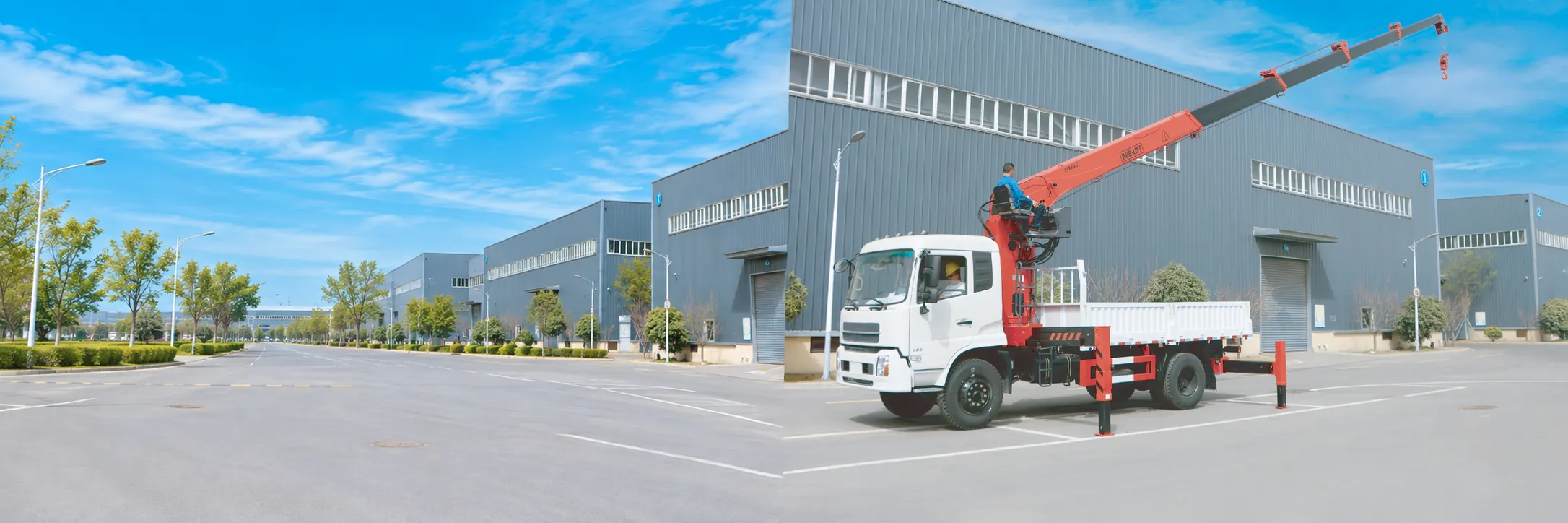
We compiled the self-weights in the chart from BOB-LIFT technical drawings. The winch weight of about 70 to 110 kg, the J option on every knuckle boom truck crane and the standard winch on telescopic models come from our technical department in November 2026. The photos show an SQ5ZA4, an SQ08ZA3+1, an SQ3.2ZA3TJ and an SQ10ZA6TJ at our Xuzhou factory. The quotations come from the official eCFR text of 29 CFR 1926.1401, 1926.1413, 1926.1416 and 1926.1417, and from legislation.gov.uk. Achord Chan, Product Operations Director, reviewed the guide in November 2026. It does not replace your crane manual or the law where you work.
Get a crane with the right winch for your work
Tell us your heaviest load, the depth or height the hook must reach and the truck you intend to use. We will then recommend a suitable crane, with or without a winch, together with its drawing and load chart. Every crane carries a 12-month warranty on the whole machine, common spare parts leave the factory within 48 hours, and our service team answers within 12 hours. Contact us for a quotation.