
A lifting eye bolt is a bolt with a forged ring, the eye, at one end. It screws into a tapped hole in the load, or passes through a hole and is held by a nut, so that a crane can lift machinery, motors, generator sets, moulds and precast items by a fixed point. A shoulder (collared) eye bolt can take an angled pull in the plane of its eye at a reduced rating; a shoulderless eye bolt is for vertical pulls only. A swivel hoist ring does the same job with a bail that pivots and swivels to face the sling. Whatever the type, the rating comes from its own marking and its maker’s data, and an angled sling leg cuts what an eye bolt can carry.
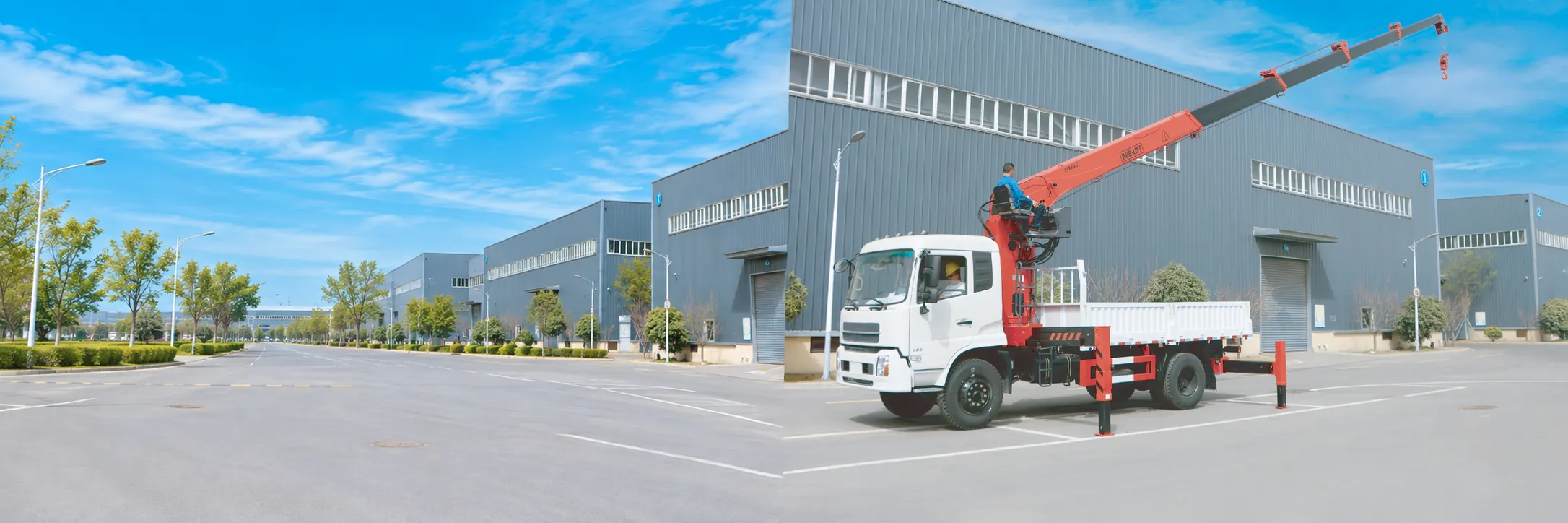
BOB-LIFT has built truck mounted cranes in Xuzhou since 2003. This guide explains the types of eye bolts, eye nuts and hoist rings, why the angle of pull matters so much, how to fit and inspect them, and what the crane side of the lift has to check. It ends with a worked example: a generator set on four lifting points under a real BOB-LIFT knuckle boom crane. We build the cranes only; eye bolts, hoist rings, slings and shackles come from lifting gear suppliers.
Key takeaways
- Use a shoulder eye bolt with its collar seated flush whenever the pull is not vertical. NSW rigging guidance says “Only collared eyebolts should be used where the pull is inclined from the vertical” [1].
- An angled pull costs a shoulder eye bolt most of its rating: the US Department of Energy’s 1996 table leaves 35% at 60° and 25% at 45° from the horizontal, and Brookhaven’s table leaves about half at 60°.
- A swivel hoist ring keeps its rated capacity at an angle, but the angled leg still pulls harder than a vertical one.
- Pull an eye bolt in the plane of the eye, never across it, and connect the sling with a shackle rather than a hook.
- In our example a 2,800 kg generator set passes the BOB-LIFT SQ12ZA5 load chart at 6.45 m, yet its angled eye bolts would fail; a lifting frame that keeps the legs vertical solves it.
What is a lifting eye bolt?
Wikipedia’s short definition is that “An eye bolt is a bolt with a loop at one end” [8]. For lifting, the loop matters: it notes that eye bolts made by bending a rod or wire into a loop “are only suitable for light duty applications, as heavy loads can cause the eye to open”. Lifting eye bolts are forged, and the 1996 US Department of Energy hoisting standard says plainly: “Do not use wire-type or welded eyebolts in DOE-lifting operations.” [2]
Eye bolts belong to the rigging hardware covered by the ASME B30.26 standard. ASME lists that hardware as “shackles, links, rings, swivels, turnbuckles, eyebolts, hoist rings, wire rope clips, wedge sockets, rigging blocks and load indication devices” [4]. The current DOE standard, DOE-STD-1090-2020, places eyebolts, eye nuts and swivel hoist rings in the same rigging hardware group and requires their use and inspection to follow OSHA, ASME B30.26 and the manufacturer, whichever is more stringent [5].
An eye bolt is screwed into the load and can be removed after the lift. A lifting point welded or bolted on as part of the structure is a lug or pad eye, covered in our guide to lifting lugs and pad eyes. Where the load has no lifting point at all, a clamp may grip it instead, as our lifting clamps guide explains.
Types of eye bolts, eye nuts and hoist rings
Four threaded lifting points cover most machinery lifts. A shoulder eye bolt is one with a collar below the eye that bears on the load. A shoulderless eye bolt is one with a plain shank. An eye nut is an eye with a threaded hole in place of a shank, screwed onto a stud. They differ in how they meet the surface of the load and in which direction they may be pulled.
| Type | How it is fitted | Direction of pull | Typical use |
|---|---|---|---|
| Shoulder (collared) eye bolt, also called a machinery eye bolt | Screwed in until the collar sits flush on a machined face | Vertical, or angled in the plane of the eye at a reduced rating | Motors, gearboxes, pumps, machine frames |
| Shoulderless (plain) eye bolt | Screwed in or through-bolted with a nut; no collar bears on the load | Vertical (in-line) only | Loads lifted with vertical legs, for example under a lifting frame |
| Eye nut (lifting eye nut) | Threaded onto a stud or bolt that is part of the load | As its marking and the maker’s data allow | Machinery with suitable studs |
| Swivel hoist ring | Bolted into a tapped hole and torqued; the bail pivots and swivels | Any direction the bail can align with, at its rating | Moulds, dies, machined parts, compact equipment |

NSW explains why its standard insists on the collar: “Australian Standard eyebolts must be collared. This is needed due to sideways pull.” [1]. The DOE 1996 standard gives the same preference. Its rule reads: “Use shouldered eyebolts for all applications, except where it is not possible due to the configuration of the item to be lifted.” It also warns against improvising a collar on a plain eye bolt with nuts, washers or drilled plates [2].
For eye nuts, NSW sets one condition: they “can be used for lifting so long as the material and thread that the eyenut is fitted to has the same or greater capacity than the eyenut itself” [1]. A swivel hoist ring is a different kind of fitting. Its bail must “pivot 180 and swivel 360”, in the words of the Brookhaven National Laboratory workbook, so it lines up with the sling instead of being bent by it [3].
Why does the angle of pull matter so much?
An eye bolt is strongest when the sling pulls straight along its shank. Brookhaven puts the limits clearly: “Non-shoulder eye bolts are only designed for vertical loads. When loaded at angles, a non-shoulder eye bolt will bend or break.” [3]
A shoulder eye bolt can take an angled pull only when its collar does the work. Brookhaven again: “For angular lifts, the shoulder must be flush, making full contact with the load. Otherwise, only vertical lifts are allowed.” The pull must also stay in line with the eye: “Shoulder eye bolts must always be positioned to take the load in the plane of the eye.” [3]. NSW gives the same rule in fewer words: “The pull should never be across the eye.” [1]
Even in the right plane, an angle costs capacity. Two published US tables show how much, with angles measured from the horizontal (90° is a vertical pull):
- DOE-STD-1090-96, Table 12-3 (shoulder type, forged carbon steel) reduces the vertical safe working load by 45% at 75°, by 65% at 60° and by 75% at 45°, and marks anything below 45° as not recommended. Its note adds that for plain (shoulderless) eyebolts “Angular loading is not recommended.” [2]
- The Brookhaven workbook lists shoulder eye bolt capacities in pounds at 90°, 60° and 30°. Worked out as percentages, a 3/4 inch eye bolt keeps 51% of its vertical rating at 60° and 30% at 30°, and most sizes from 1/2 inch up keep 46% to 51% at 60°. Small sizes keep less: a 1/4 inch eye bolt keeps 19% at 60° and has no 30° rating. Brookhaven adds that shoulder eye bolts “should not be loaded at angles below 30” degrees unless the manufacturer approves it [3].

The two tables do not agree, and that is the practical lesson: the reduction depends on the eye bolt’s design, size and standard. NSW makes the same point for the standards used in Australia, noting that “De-ration is required when using British Standard and DIN standard eyebolts and eyenuts” [1]. Use the table from the maker of the eye bolt you actually have; the public tables above only show the scale of the loss.
Swivel hoist rings behave differently. Brookhaven states: “Unlike eye bolts, the rated capacity of hoist rings is not reduced when loaded at angles.” It then adds a condition. The angle creates extra tension, and “This tension plus the actual load weight must not exceed the rated capacity of the hoist rings.” [3]
That extra tension comes from the sling. With n legs at an angle θ from the horizontal, each leg carries roughly W ÷ (n × sin θ). A leg at 60° therefore pulls about 15% harder than a vertical one, and a leg at 45° about 41% harder. Do not count on every leg sharing the load: NSW says that “Two, three and four leg slings (wire, alloy chain or synthetic) only ever rely on the capacity of 2 legs.” [7]. Our crane rigging and slings guide has the full angle factor tables.
How do you install an eye bolt or hoist ring?
The steps below combine the NSW guide [1], DOE-STD-1090-96 [2] and the Brookhaven workbook [3].
- Match the thread: NSW warns to “Take extreme care so that eyebolts are not screwed into threaded holes of a different size or thread type.” Clean the tapped hole and check it for worn or damaged threads.
- Engage enough thread: the DOE standard requires “a minimum of one-and-one-half diameters thread engagement” with a Class II fit. Where an eye bolt goes through the load and takes a nut, the nut must tighten securely against the load; Brookhaven allows washers to take up excess space between the load and the nut.
- Seat the collar: “Ensure shoulders seat snugly against the surface on which they bear,” says the DOE standard, which also calls for the surface to be spot-faced where needed. NSW: “If both faces are apart the collar is of no use.”
- Line up the eye: the eye must face the direction of the sling leg. NSW allows a washer or shim under the collar so that eye bolts tighten in line, provided it does not impede the thread.
- Tighten properly: “Do not tighten an eyebolt using a hammer. Use a podger bar.” A load lifted on a single eye bolt can spin and unscrew it, so NSW asks you to mouse the eye bolt to the load.
- Connect with a shackle: NSW: “Do not insert a hook into an eyebolt. Always use a shackle, unless the eyebolt is large enough to accept a direct connection.” Give each eye bolt its own sling leg. NSW also says: “Do not reeve a single sling through two eyebolts and then put both eyes on the hook.” Our guide to rigging shackles covers the shackle itself.
A swivel hoist ring has its own fitting rules, listed by Brookhaven [3]. “Spacers must not be used between the bushing flange and the mounting surface.” The “Drilled and tapped hole must be 90° to the load surface”, and its depth must be the threaded shank length plus half the shank diameter. The ring goes in with a torque wrench, “to the torque value recommended and provided by the manufacturer”. Its retention nuts, where used, need full thread engagement.
How do you inspect eye bolts and hoist rings?
On US construction sites, 29 CFR 1926.251(a)(1) requires rigging equipment to be “inspected prior to use on each shift and as necessary during its use to ensure that it is safe”. It adds: “Defective rigging equipment shall be removed from service.” Under 1926.251(a)(2), rigging equipment must carry “permanently affixed and legible identification markings as prescribed by the manufacturer that indicate the recommended safe working load”. Without them it must not be used. Brookhaven says eye bolts must be “forged, cast, or die stamped with the name or trademark of the manufacturer, size or capacity, and grade (alloy eye bolts only)” [3].
Brookhaven removes an eye bolt from service for any of the following [3]:
- “Nicks, gouges, bent or distorted eye, or shank”;
- “Obvious wear (10% reduction of original/catalog dimension at any point)”;
- “Worn, corroded and/or distorted threads”;
- “Indications of heat damage including weld spatter or arc strikes”;
- any alteration or repair, such as grinding, machining, welding, notching or stamping;
- missing or illegible markings.
For hoist rings it adds a bent, twisted or elongated bail, damaged threads on the shank or in the hole, corrosion or wear, and a bail that no longer moves freely. The DOE 1996 standard is blunt about the outcome: “Destroy eyebolts that are cracked, bent, or have damaged threads.” [2]. The tapped hole in the load wears too, so check it every time an eye bolt goes in.
Temperature matters as well. The Hanford Site Hoisting and Rigging Manual of the US Department of Energy lists the ASME B30.26 working temperature limits for carbon steel hardware, which “shall not be exceeded without the manufacturer’s written approval” [6]:
| Hardware | Temperature limit |
|---|---|
| Eyebolts | -1 °C to 135 °C (+30 °F to +275 °F) |
| Eye nuts | -40 °C to 204 °C (-40 °F to +400 °F) |
| Swivel hoist rings | -29 °C to 204 °C (-20 °F to +400 °F) |
The eyebolt range starts just below freezing, so on a cold morning, or near a hot exhaust, check the maker’s limits before lifting.
Lifting points fitted by the equipment maker
Generator sets, transformers, motors and pumps often arrive with lifting eyes already fitted. The DOE treats them as part of the machine. “All manufacturer-provided lift points designed for and installed on engineered or manufactured equipment are considered part of the equipment and are acceptable for their intended use.” They must meet the maker’s inspection criteria and be inspected by a competent person before use. They must also be used in accordance with the maker’s instructions [5]. The Hanford manual adds that such lift points “shall be inspected and evaluated by a qualified person before use for cracks, deformation, excessive wear, or damage” [6].
“Intended use” is the key phrase. NSW warns: “Eyebolts are often put on motors (or similar) to lift the casing off. It can be dangerous to lift loads with the eyebolts that are provided on the load. If no information is provided about an eyebolt lifting point, the load should be lifted with slings.” [1]. On a generator set, the eye on the engine or the alternator may be meant for that component only, not for the whole skid.
The crane side: hook, load chart and tag lines
US crane rules define the load as the object plus “the load-attaching equipment, such as, the load block, ropes, slings, shackles, and any other ancillary attachment” (29 CFR 1926.1401). So add the sling, the shackles, any lifting frame and the hook to the weight of the machine. Then check that total against the crane’s rated load at the radius where the load will be picked and landed. Our guide on how to read a crane load chart explains the method. The one on safe working load vs working load limit explains the ratings marked on each part.
The hook must also be rated for the total and have a working latch; see our crane hook guide. BOB-LIFT offers a load moment limiter as an option. It weighs the whole hook load against the chart, but it cannot see the force in one sling leg or the rating of one eye bolt, as our load moment indicator guide describes. A compact machine on four short legs can also turn as it leaves the ground. 29 CFR 1926.1417(w) states: “A tag or restraint line must be used if necessary to prevent rotation of the load that would be hazardous”. Our guide to crane tag lines covers where to attach them.
Where eye bolts must take a vertical pull, a lifting frame or spreader beam below the hook keeps the legs vertical. Our spreader bar and lifting beam guide covers the choice. The below-the-hook lifting devices guide covers the standards for such devices. For a repeat delivery, record the lifting points, the sling, the angle and the radius in the crane lift plan. If any term here is new, our crane terminology glossary defines it.
Example: setting a 2,800 kg generator set with a BOB-LIFT SQ12ZA5
Example scenario (an illustration, not a customer record): a contractor in the Philippines uses a BOB-LIFT SQ12ZA5 knuckle boom truck mounted crane to lift a generator set off the truck bed and onto a concrete plinth beside a building. All generator, eye bolt, hoist ring, sling and frame figures are ASSUMED; the crane figures come from the SQ12ZA5 dimension drawing and load chart.
- Load: generator set 2,800 kg, the ASSUMED mass on its data plate. Its manual names four lifting points on the top frame at the corners of a 2.4 m × 1.2 m rectangle, each a shoulder eye bolt marked 2,000 kg for a vertical pull (ASSUMED). Each corner is 1.34 m from the centre in plan.
- Rigging: a four-leg chain sling with a master link, ASSUMED 40 kg, and four shackles at an ASSUMED 2 kg each. The load chart does not state whether the hook weight is already deducted, so the hook is included at an ASSUMED 25 kg. On the hook: 2,800 + 40 + 8 + 25 = 2,873 kg.
- Leg angle: with 2.7 m legs, each leg rises at about 60° from the horizontal (cos θ = 1.34 ÷ 2.7). With 1.9 m legs the angle falls to about 45°.
- Leg tension: the legs carry the generator and the shackles, 2,808 kg. Following the NSW two-leg rule, each leg is checked for 2,808 ÷ (2 × sin θ).
| Sling | Leg tension (2 legs) | Leg tension (4 equal) | Shoulder eye bolt left, DOE-STD-1090-96 | Shoulder eye bolt left, Brookhaven | Swivel hoist ring, 2,000 kg |
|---|---|---|---|---|---|
| 2.7 m legs, about 60° | 1,618 kg | 809 kg | 35% = 700 kg: fails | about 50% = about 1,000 kg: fails | Passes, 81% used |
| 1.9 m legs, about 45° | 1,983 kg | 991 kg | 25% = 500 kg: fails | No 45° value listed | 99% used: no margin |
| Lifting frame, legs vertical | 1,404 kg | 702 kg | Full 2,000 kg vertical rating: passes, 70% used | Not needed | |
Rigged straight to the four eye bolts at 60°, each eye bolt needs to carry about 1,618 kg but keeps only 700 to 1,000 kg of its 2,000 kg rating once the leg is angled. Even if all four legs shared the load perfectly, 809 kg would still exceed the DOE figure. Shortening the legs to 1.9 m makes it worse. A shoulderless eye bolt would be wrong for any of the angled options, because it takes no angled pull at all.
There are two fixes. If the manual allows it, swivel hoist rings rated 2,000 kg each would carry the 60° rig with 19% to spare, though not the 45° rig. With the eye bolts kept, a lifting frame lets four legs hang vertically onto the eye bolts, so each eye bolt sees at most 1,404 kg of its full 2,000 kg. The frame, its top sling and the extra shackles add an ASSUMED 220 kg, giving 2,800 + 220 + 25 = 3,045 kg on the hook.

Then check the crane. The SQ12ZA5 drawing lists a 12,000 kg maximum lifting capacity, a 27 t·m maximum lifting moment and a crane self weight of 4,600 kg. Its load chart gives these rated loads with the boom horizontal:
| Radius | Rated load | Sling direct, 2,873 kg | With lifting frame, 3,045 kg |
|---|---|---|---|
| 4.7 m | 5,450 kg | Passes, 2,577 kg spare (53% used) | Passes, 2,405 kg spare (56% used) |
| 6.45 m | 3,500 kg | Passes, 627 kg spare (82% used) | Passes, 455 kg spare (87% used) |
| 8.2 m | 2,500 kg | Fails by 373 kg | Fails by 545 kg |
The crane is not the weak point here, provided the truck is set up so that both the pick and the landing point on the plinth fall within 6.45 m. If the plinth were at 7 m, the rating at the next chart point out, 2,500 kg at 8.2 m, applies, and the lift no longer fits. A 12 t class crane handles this generator easily close in; the eye bolts decide how it may be rigged. The full drawing and load chart are on the SQ12ZA5 product page.
Frequently asked questions
What is the difference between an eye bolt and a hoist ring?
An eye bolt is a solid forged eye on a threaded shank, and it loses much of its rating when pulled at an angle. A swivel hoist ring has a bail that pivots and swivels to line up with the sling, and Brookhaven says its rated capacity is not reduced at an angle, though the higher leg tension must still stay within that rating.
Can a shoulderless eye bolt be used for an angled lift?
No. Plain (shoulderless) eye bolts are designed for vertical loads, and an angled pull can bend or break the shank. Use a shoulder eye bolt seated flush, a swivel hoist ring, or a lifting frame that keeps the legs vertical.
How much capacity does an eye bolt lose at 45 degrees?
It depends on the eye bolt. DOE-STD-1090-96 reduces a shoulder eyebolt’s vertical rating by 75% at 45° from the horizontal and does not recommend lower angles. Other tables give different values, so the maker’s own data for your eye bolt decides.
Can I put the crane hook straight into an eye bolt?
No, unless the eye is large enough to take the hook properly. NSW and Brookhaven both say to connect the sling with a shackle, and never to load the point of a hook.
Does BOB-LIFT supply eye bolts or hoist rings?
No. We build truck mounted and marine cranes; eye bolts, hoist rings, slings and shackles come from lifting gear suppliers. Send us the load weight, the rigging weight and the radius, and we will check them against the load chart of the crane you are considering.
How we compiled this guide
The eye bolt, eye nut and hoist ring guidance comes from three sources. The first is the NSW Government Dogging and Rigging guide (shackles and eyebolts; shape, load and connections). The second is the US Department of Energy standard DOE-STD-1090-96 (Rev-1), Chapter 12.4 and Table 12-3, read from the scanned copy on OSTI. The third is the Brookhaven National Laboratory Basic Rigging Workbook. The scope of ASME B30.26 comes from the ASME website, the treatment of manufacturer-provided lift points from DOE-STD-1090-2020, and the temperature limits from the Hanford Site Hoisting and Rigging Manual. We quoted the rules from the official eCFR text of 29 CFR 1926.251, 1926.1401 and 1926.1417, all read in November 2026. The Brookhaven percentages are our own arithmetic from its pound values. The crane figures come from the BOB-LIFT SQ12ZA5 dimension drawing and load chart, and the example uses clearly marked assumed weights and ratings. Achord Chan, Product Operations Director, carried out the editorial review. This guide does not replace the eye bolt or hoist ring maker’s instructions, the equipment manual, the crane’s operator’s manual or the regulations where you work.
Need a crane for lifting machinery and generator sets?
Tell us the heaviest machine you lift, the weight of its slings, shackles and any lifting frame, and the radius where it must be picked and landed. We will recommend a knuckle boom truck mounted crane (a lorry crane, as it is often called in Malaysia) and send its dimension drawing and load chart. If you buy the truck in China, we can fit the crane at our factory; if you buy it locally, we ship the crane, a local body builder fits it and we support the work remotely. Contact us for a quotation; every crane carries a 12-month warranty on the whole machine.