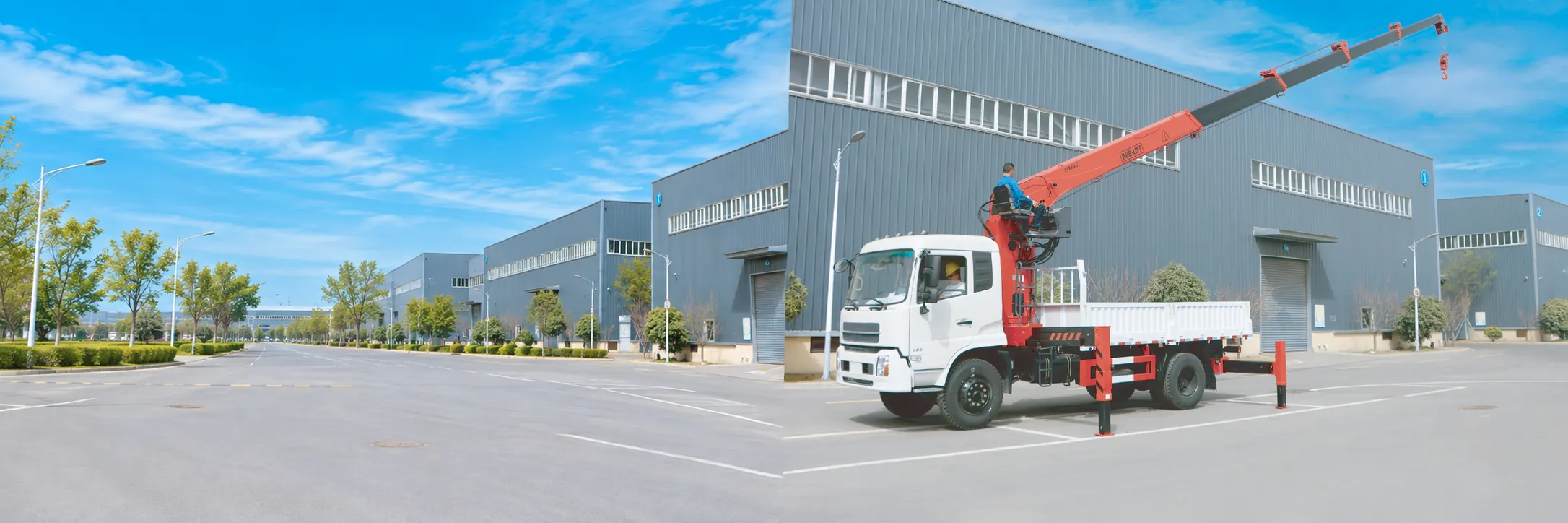

Crane terminology is the set of names for a crane’s parts, its load chart figures, its safety devices and the motions an operator makes. This glossary defines more than 60 crane terms used for truck mounted, knuckle boom and loader cranes. They are grouped under five headings: crane types, structure and parts, load chart and geometry, safety devices, and operation and rigging. Where the US construction crane rule, 29 CFR 1926.1401, defines a term, we quote its words exactly and say that the definition is OSHA’s [1].
Each entry links to our full guide on the subject where we have one. The last section explains the letters in a BOB-LIFT model name such as SQ8ZA4. BOB-LIFT has built truck mounted cranes in Xuzhou since 2003.
Key takeaways
- The part that OSHA defines as “an inclined spar, strut, or other long structural member which supports the upper hoisting tackle” is the boom [1].
- A knuckle boom crane folds at a hinge called the knuckle. The US rule calls it an articulating crane.
- Rated capacity is not one number. Our SQ8ZA4 is rated for 8,000 kg at 2,000 mm but 1,420 kg at 10,515 mm.
- Lifting moment is load multiplied by radius, in tonne-metres. The SQ8ZA4 drawing lists 16.7 t·m.
- In a BOB-LIFT model code, Z means knuckle boom, S telescopic boom, the figure after A the number of boom sections, T marine, J winch and +1 a manual jib.
Which crane part is “an inclined spar, strut, or other long structural member”?
It is the boom. The definitions section of 29 CFR 1926.1401 says that a boom “means an inclined spar, strut, or other long structural member which supports the upper hoisting tackle on a crane or derrick” [1]. Crane exam questions often shorten this to “incline spar, strut, or other long member”, and the answer is still the boom.
The same OSHA definition adds that booms “can usually be grouped into general categories of hydraulically extendible, cantilevered type, latticed section, cable supported type or articulating type”. A truck mounted crane has one of two: a hydraulically extendible (telescopic) boom or an articulating (knuckle) boom. Our crane boom guide explains boom sections and cylinders.
Crane types
These names describe the whole machine. Several of them mean the same crane in different markets.
Truck mounted crane: a hydraulic crane fitted to a truck chassis, usually behind the cab, that loads and unloads the truck and lifts loads around the site. Buyers often name one by capacity, such as a 10 ton truck crane; see our truck mounted crane range.
Knuckle boom crane: a crane whose boom folds at a hinge, the knuckle, so it stows in a small space behind the cab. OSHA calls it an articulating crane, “a crane whose boom consists of a series of folding, pin connected structural members, typically manipulated to extend or retract by power from hydraulic cylinders” [1]. Read more in what a knuckle boom crane is.
Loader crane (lorry loader): a crane built to load and unload the vehicle it is mounted on. Lorry loader is the usual name in the UK and Ireland; our crane lorry guide explains how the crane and the lorry work together.
Lorry crane: the everyday name for a truck with a loader crane in Malaysia and Singapore. In Chile the same machine is called a camión pluma.
Hiab: a word for a lorry loader in the UK, Ireland and Australia, taken from the short name of a Swedish company; see what a hiab is.
Telescopic boom crane: a crane with a straight boom of steel sections that slide out of one another, raised by one luffing cylinder and lifting on a winch rope. In the United States and the Philippines a truck with this crane is often called a boom truck; see our telescopic boom truck mounted cranes.
Mobile crane: in OSHA’s definition, “a lifting device incorporating a cable suspended latticed boom or hydraulic telescopic boom designed to be moved between operating locations by transport over the road” [1]. It is a dedicated lifting machine; our comparison of truck mounted cranes and mobile cranes sets out the differences.
Marine crane (deck crane): a crane that stands on a pedestal on a vessel, pontoon or quay instead of on a truck. A deck crane is a marine crane on a ship’s deck; see our deck crane guide.
Pickup crane: a small crane for the bed of a pickup truck. Our SQ08ZA3 lifts 800 kg at 1,337 mm; see how a pickup truck crane works.
Spider crane: a compact crane on tracks with four folding outrigger legs, used indoors and in tight spaces; see our guide to spider cranes.
Forklift jib crane (fly jib crane): a complete hydraulic crane that hangs on a forklift’s fork carriage, so the forklift can lift on a hook; see our forklift jib crane guide.
Crane structure and parts
The drawing below is our factory parts drawing of a knuckle boom crane, with its labels translated into English. Each part gets one sentence here. Our articles on the key components of a crane and truck mounted crane parts cover them in detail.


Crane base: the steel frame bolted to the truck chassis that carries the column, the outrigger beams, the oil tank and the control valve.
Subframe: a steel frame between the truck chassis and the crane base that spreads the crane’s forces along the chassis.
Outriggers (stabilisers): extendable legs that take the weight of the crane, the truck and the load off the tyres and widen the support base; see outriggers and ground bearing pressure.
Outrigger beams and jack cylinders: each outrigger has a fixed beam in the crane base and an extendable beam that slides out of it. A vertical jack cylinder at the end of the extendable beam pushes the leg and its foot down onto the ground.
Slewing ring (slewing bearing): a large ring bearing with gear teeth between the base and the column that carries the upper crane and the load.
Slewing drive: the part that turns the crane. On a knuckle boom crane like the one in the drawing it is a slewing rack cylinder, a hydraulic cylinder that pushes a toothed rack to turn the column. Other cranes use a hydraulic motor with a gearbox and pinion on a slewing ring.
Column: the upright post above the crane base that carries the boom pivot and turns with the boom. It is also called the king post or turret.
Main boom (inner boom): the first boom section, pinned to the top of the column. On a knuckle boom crane it ends at the knuckle.
Main boom cylinder: the hydraulic cylinder between the column and the main boom that raises and lowers it. Our factory drawings call it the first luffing cylinder, and the outer boom cylinder the second luffing cylinder.
Knuckle: the hinged joint between the main boom and the outer boom that lets the boom fold and unfold.
Outer boom (second boom): the boom section beyond the knuckle. Its own cylinder, the outer boom cylinder, moves it, and it carries the extension sections.
Extension sections: steel boxes nested inside the outer boom that hydraulic extension cylinders push out for more reach. They are the part of the crane that extends and retracts.
Extension cylinder: the long hydraulic cylinder along the outer boom that pushes the extension sections out and pulls them back.
Boom tip (boom head): the end of the last extension section, where the hook, a winch sheave or an attachment hangs.
Jib and fly jib: a jib is an extension at the boom tip for extra reach or height. A fly jib is a jib pinned to the tip of the main boom; see what a fly jib is.
Manual jib: an extra section at the boom tip that is extended by hand rather than by a hydraulic cylinder. In our model codes it is the “+1”.
Hook and hook block: the hook is the forged steel hook that holds the load through slings, chains or a shackle. A hook block is a hook in a frame with sheaves that travels on the winch rope; see our crane hook guide.
Winch (hoist): a hydraulically powered drum that winds wire rope in and out to raise and lower the hook. OSHA’s word is hoist, “a mechanical device for lifting and lowering loads by winding a line onto or off a drum” [1]. A winch is optional on a knuckle boom crane and standard on a telescopic one; see crane winch.
Wire rope: in OSHA’s words, “a flexible rope constructed by laying steel wires into various patterns of multi-wired strands around a core system to produce a helically wound rope” [1]. The hoist rope runs from the winch drum over the boom tip to the hook block; see crane wire rope.
Sheave: a grooved wheel that guides the wire rope, found in the boom head and the hook block.
Rotator: a hydraulic swivel between the boom tip and an attachment such as a grab, which turns the attachment; see knuckle boom crane attachments.
Control valve: the hydraulic valve block, usually on the crane base, that sends oil to each cylinder and motor when the operator moves a lever or a remote control switch.
Hydraulic oil tank: the tank on the crane base that holds the oil the pump draws from and the oil that returns from the cylinders.
High seat: a seat mounted high on the column, so the operator can see over the load and the truck while working the levers.
Remote control: a handheld or belly-box radio transmitter that lets the operator run the crane from anywhere around the truck; see crane remote control.
PTO and hydraulic pump: the truck’s engine turns a power take-off (PTO), which drives a pump that supplies oil to the crane. Our guide to the hydraulic crane for a truck explains flow and pressure.
Counterweight: OSHA defines it as “a weight used to supplement the weight of equipment in providing stability for lifting loads by counterbalancing those loads” [1]. A truck mounted crane normally carries none and relies on its outriggers and the truck’s weight; see crane counterweight.
Load chart and geometry terms
These terms describe what a crane may lift and where. The chart below uses the drawings of our SQ8ZA4 8 t knuckle boom crane, crane-knuckle-SQ8ZA4-dimensions.pdf and crane-knuckle-SQ8ZA4-load-chart.pdf.

Load chart: the manufacturer’s table or diagram of rated loads at each working radius, boom length and boom angle. Our guide on how to read a crane load chart works through one.
Rated capacity: OSHA defines it as “the maximum working load permitted by the manufacturer under specified working conditions” [1]. Those conditions “typically include a specific combination of factors such as equipment configuration, radii, boom length, and other parameters of use” [1]. The SQ8ZA4 is rated for 8,000 kg at 2,000 mm and 1,420 kg at 10,515 mm; see safe working load.
SWL and WLL: safe working load and working load limit, the maximum load the manufacturer allows in normal service. For a sling or shackle it is one marked number; for a crane it is the whole load chart.
Load (gross load): OSHA’s definition of load covers the object and “the load-attaching equipment, such as, the load block, ropes, slings, shackles, and any other ancillary attachment” [1]. That gross figure is what you compare with the chart, as our guide on how to calculate crane capacity shows.
Lifting moment: the load multiplied by the working radius, in tonne-metres (t·m) or kilonewton-metres (kN·m). The SQ8ZA4 drawing lists a maximum lifting moment of 16.7 t·m; see lifting moment of a crane.
Working radius (outreach): the horizontal distance from the slewing centre to the hook. On the SQ8ZA4 load chart it runs from 2,000 mm to 10,515 mm.
Lifting height (hook height): how high the hook can rise at a given radius and boom angle. The SQ8ZA4 load chart reaches about 13 m on its height scale, with the boom near 80°.
Boom angle: the angle between the boom and the horizontal. The SQ8ZA4 load chart is drawn from 0° to 84°. A boom angle indicator is “a device which measures the angle of the boom relative to horizontal” in OSHA’s words [1]; see maximum boom angle.
Boom length: the length of the boom from its pivot pin to its tip, which changes as the sections extend or retract.
Centre of gravity: OSHA describes it as “the point in the object around which its weight is evenly distributed” [1]. Rig the load so that the hook sits directly above it, or the load tilts as it leaves the ground.
Side load: a sideways force on the boom, for example from dragging a load or slewing too fast. Load charts are drawn for a load that hangs freely below the boom tip.
Dynamic load: the extra force from starting, stopping or swinging a load quickly, or from wind. Smooth control of every motion keeps it small.
Safety device terms
Operational aids: OSHA defines them as “devices that assist the operator in the safe operation of the crane by providing information or automatically taking control of a crane function” [1]. Our guide to crane safety devices explains what to check on each one.
Load moment indicator (LMI): in OSHA’s definition, a system that senses “the overturning moment on the equipment, i.e., load multiplied by radius” [1]. It “indicates to the operator the percentage of capacity at which the equipment is working”; see our load moment indicator guide.
Load moment limiter: the same sensing system, but “when the rated capacity is reached, it shuts off power to those equipment functions which can increase the severity of loading on the equipment” [1]. Every BOB-LIFT crane is listed with a load moment limiter.
Two-blocking: OSHA’s term for “a condition in which a component that is uppermost on the hoist line such as the load block, hook block, overhaul ball, or similar component, comes in contact with the boom tip, fixed upper block or similar component” [1].
Anti-two-block device (A2B): a limit switch at the boom head that stops the hook block from being pulled into the boom tip; see anti-two-block device.
Boom stop: under OSHA’s definition, devices that “restrict the boom from moving above a certain maximum angle and toppling over backward” [1]. On a hydraulic boom the luffing cylinder sets the top angle; see boom stop.
Hydraulic lock (pilot operated check valve): a valve between the control valve and a cylinder that traps the oil, so the cylinder holds its position if the pump stops or a hose fails. On outriggers it keeps each leg on the ground; see hydraulic lock valve.
Counterbalance valve: a valve on a load-holding cylinder, such as a boom cylinder, that holds the load and lets it down under control.
Relief valve (overflow valve): a valve that opens when hydraulic pressure reaches its setting, so the system cannot build more pressure than it was designed for.
Emergency stop: a button on the crane controls and on the remote that stops crane motions at once. Test it as part of the pre-use inspection checklist.
Operation and rigging terms
Slewing: rotation of the column and boom around a vertical axis, so the hook moves from one side of the truck to the other. Our knuckle boom cranes up to 5 t slew 330° to 400°, and the SQ8ZA4 drawing lists 360°; see truck mounted crane slewing.
Luffing (derricking): raising or lowering the boom to change its angle, which changes the radius and the hook height.
Telescoping: extending or retracting the boom sections with the extension cylinders.
Folding and unfolding: moving a knuckle boom between its transport position behind the cab and its working position; see knuckle boom crane operation.
Hoisting: “the act of raising, lowering or otherwise moving a load in the air”, in OSHA’s definition [1].
Tag line: OSHA’s tagline is “a rope (usually fiber) attached to a lifted load for purposes of controlling load spinning and pendular motions” [1]. A tag line never carries weight; see crane tag line.
Sling: a rope, chain or webbing strap that connects the load to the hook; see crane rigging slings.
Shackle: a removable U-shaped connector with a pin that joins slings, lugs, hooks and loads; see rigging shackles.
Spreader bar: a rigid bar hung below the hook that holds the sling legs apart, so a long load hangs level; see spreader bar.
Below-the-hook device: equipment between the hook and the load that holds, grips or balances it, such as lifting beams, clamps, magnets and pallet forks; see below-the-hook lifting devices.
Lift plan: a written or agreed method for one lift. It states the load, the crane and its position, the radius and chart figure, the rigging, the hazards and who does what; see crane lift plan.
Ground bearing pressure: the force an outrigger foot or pad puts on the ground divided by its area, in kilopascals (kPa) or tonnes per square metre.
Outrigger pads and blocking: a pad is a plate placed under an outrigger foot to spread its force. OSHA defines blocking as “wood or other material used to support equipment or a component and distribute loads to the ground” [1]. See crane mats and outrigger pads.
Signal person and hand signals: the signal person directs the operator when the operator cannot see the load or the landing point. In the US the standard signals are the “Standard Method” in Appendix A of the crane rule; see crane hand signals.
Tandem lift: a lift in which two cranes hold the same load at once, each taking a share set by the load’s centre of gravity; see tandem lift.
Fall zone: in OSHA’s words, “the area (including but not limited to the area directly beneath the load) in which it is reasonably foreseeable that partially or completely suspended materials could fall in the event of an accident” [1].
How to read a BOB-LIFT model code
Our model names follow one pattern, and each part describes the configuration. Take the SQ8ZA4 8 t knuckle boom truck mounted crane and its variants:
- 8 is the rated class in tonnes: the SQ8ZA4 drawing lists a maximum lifting capacity of 8,000 kg. A leading zero marks a decimal, so the SQ08ZA3 is a 0.8 t crane.
- Z means a knuckle boom and S a telescopic boom, as in the SQ10SA4 10 t telescopic crane.
- A with a figure gives the number of boom sections: four on the SQ8ZA4, six on the SQ8ZA6.
- T marks the marine version for vessels, as in the SQ8ZA4T.
- J means a winch is fitted, as in the SQ8ZA4TJ.
- +1 means a manual jib is added at the boom tip, as in the SQ8ZA6+1.
J and +1 describe how a crane is equipped, not whether a model is older or newer. A telescopic marine crane always has a winch, while on a knuckle boom marine crane the winch is optional. Our larger SQZ and BLZ series use other names, so check the drawing of each model in our knuckle boom truck mounted crane range.

The factory test film below shows several of these terms in motion on a real SQ8ZA4: the boom unfolds at the knuckle and the extension sections telescope out one by one.
Frequently asked questions
With reference to crane operations, what does the term slewing refer to?
Slewing refers to rotating the crane’s column and boom around a vertical axis, so the load moves in a circle around the crane. A slewing drive turns the column on a slewing ring or with a rack. It is different from luffing, which raises or lowers the boom, and telescoping, which extends it.
What is the hook on a crane called?
It is called the hook, or crane hook. When the hook hangs in a frame with sheaves on the winch rope, the whole assembly is a hook block, also called a load block. On a knuckle boom crane without a winch, the hook usually hangs straight from the boom tip.
What is the portion of the crane that extends and retracts called?
It is the boom, and more exactly its extension sections, also called telescopic sections. Hydraulic cylinders inside the boom push the sections out and pull them back. On a knuckle boom crane the extensions sit inside the outer boom.
Is a knuckle boom crane the same as a loader crane?
The two names overlap but are not identical. A loader crane is named for its job, loading and unloading its own truck, and it can have a knuckle boom or a straight telescopic boom. A knuckle boom crane is named for its folding boom.
What do J and +1 mean in a BOB-LIFT model name?
J means the crane has a winch, and +1 means a manual jib is added at the boom tip. Both are configuration choices, so a crane with J or +1 is not an older or newer model. T marks the marine version.
How we compiled this guide
We took the US definitions from 29 CFR 1926.1401 and the scope of the crane rule from 29 CFR 1926.1400 [2], both read on the eCFR on 25 November 2026. The other definitions are our own and agree with the BOB-LIFT guides linked from the entries. Crane figures come from the BOB-LIFT drawings crane-knuckle-SQ8ZA4-dimensions.pdf and crane-knuckle-SQ8ZA4-load-chart.pdf; the hook height of about 13 m is read from the load chart’s height scale. The model-code rules are BOB-LIFT’s own naming system. Achord Chan, Product Operations Director, carried out the editorial review.
Need help choosing a truck mounted crane?
Tell us the heaviest load, the farthest radius, the lifting height you need and the truck you plan to use. We will recommend a knuckle boom or telescopic boom model and send its drawing and load chart, so every term above has a number. Every BOB-LIFT crane is listed with a load moment limiter, and the SQ8Z and SQ10Z series hold a CE certificate under 2006/42/EC. If you buy the truck in China, we can fit the crane at our factory. If you buy it locally, we ship the crane only, a local body builder fits it and we support the work remotely. Contact us for a quotation. Every crane carries a 12-month warranty on the whole machine.