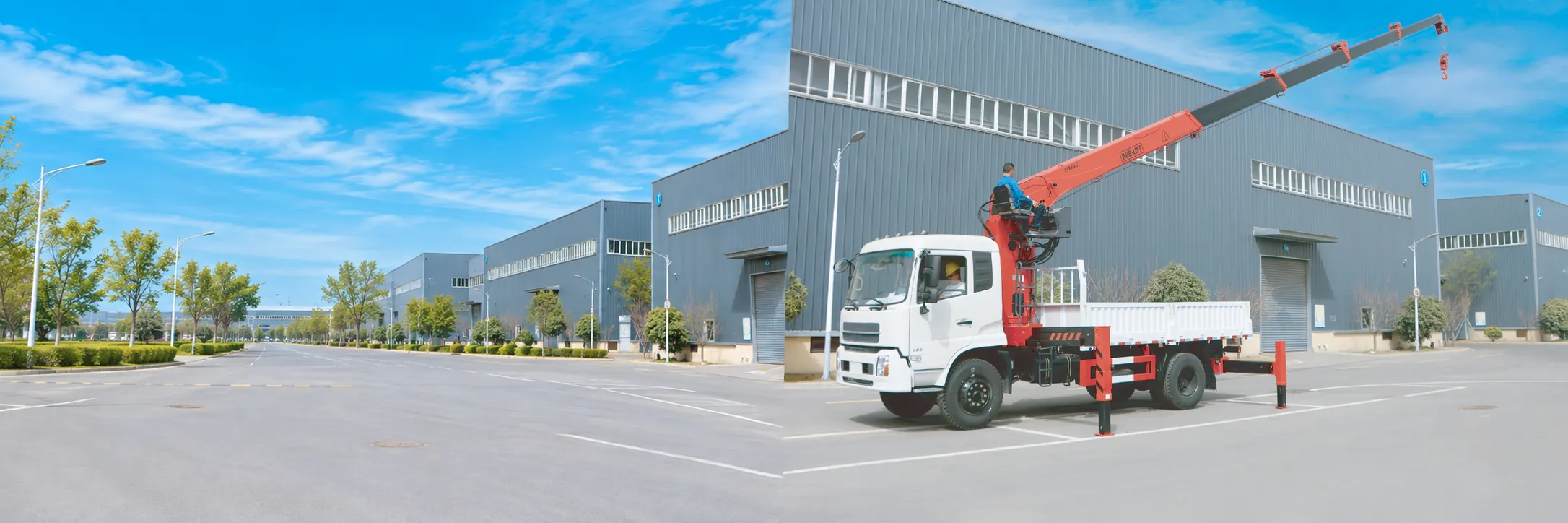

A spider crane is a compact, self-propelled crane on crawler tracks that stands on fold-out outrigger legs when it lifts. Folded, it is narrow enough to drive through a doorway or a gate; set up, its legs spread wide like a spider’s to form a stable base. This combination lets it lift glass, steel, timber and machinery in places a truck mounted crane cannot reach, such as building interiors, atriums and enclosed courtyards.
We have manufactured cranes in Xuzhou since 2003, and our current range includes two spider cranes: the SQ4ZG3T knuckle boom model and the BLS3.0T telescopic model. This guide explains how a spider crane operates, which applications it suits, how to select one by the load you need at your working radius, and how to plan lifts safely. Every BOB-LIFT figure below is taken from the live product page of the model concerned.
Key takeaways
- A spider crane travels on its own tracks, folds narrow for access and lifts on spread outrigger legs.
- Typical applications are glazing, curtain walls, indoor installation of plant and machinery, atriums and courtyards.
- Select by the load at your working radius, not the headline rating: our BLS3.0T is rated 2,950 kg but lifts 120 kg at its full 8.46 m reach.
- Before buying, check the narrowest opening on the access route, the outrigger footprint and the bearing capacity of the floor.
- Every lifting operation must be planned, supervised and carried out safely, and a spider crane is never used to lift people.
- BOB-LIFT sells new spider cranes only, with a 12-month warranty on the whole crane.
What is a spider crane?
A spider crane is a small slewing crane built on a tracked undercarriage, with its own power unit, a boom, a hook and, usually, four outrigger legs. The legs fold against the body for travel and fold out for lifting. The same machine appears under several names: mini crawler crane, small crawler crane, mini tracked crane, mini spider crane or, with an alternative spelling, spyder crane. In practice, buyers use these terms for the same category of equipment.
The concept is not a recent invention. In its feature Small is beautiful, Cranes Today dates the first spider crane to 1982, when a Japanese manufacturer reportedly designed it to work in the narrow spaces between headstones in crowded cemeteries [1]. The same requirement still defines the category today: a crane that fits and operates where no larger machine can be positioned.

How a spider crane works
A spider crane performs three operations in sequence: it travels to the lifting position on its tracks, sets up on its outrigger legs, and then lifts and slews like any other hydraulic crane. Each of these stages affects which machine is suitable for a particular site.
Tracks and travel
The crane drives itself to the worksite on rubber crawler tracks, so no carrier vehicle is needed on site and it can pass through entrances, along corridors and into industrial halls. Overall width is the critical dimension: our BLS3.0T is 850 mm wide when folded, while our SQ4ZG3T measures 1,400 mm over its tracks. Operating weight is equally important, because the crane must cross slabs, ramps and sometimes goods lifts on its way to the lifting position.
Outriggers and set-up
At the lifting position, the operator deploys the outrigger legs and levels the crane, so that the legs, not the tracks, carry the machine and its load. A wider stance provides greater stability. Our SQ4ZG3T, for example, stands on four fold-out legs across a footprint of 3,686 × 3,423 mm. Allow for that area in your site layout before the crane arrives, and confirm what lies beneath each leg.
Knuckle or telescopic boom
Spider cranes are manufactured with two different types of boom. A telescopic boom is a boom that extends in a straight line, which provides longer reach and greater lifting height. A knuckle boom is a boom that articulates at a joint, so the hook can operate close in beneath a ceiling or reach over an obstruction; our knuckle boom crane guide explains that design in detail. Both of our spider cranes rotate through a full 360°.
Power options
Across the industry, Cranes Today notes that the power source of a mini crane can be specified as electric, hybrid or diesel to suit the application [1]. For indoor operation, ask about exhaust emissions, noise and non-marking tracks before ordering. For a BOB-LIFT spider crane, describe where the machine will work and we confirm the power unit in your quotation.
What are spider cranes used for?
Spider cranes are most valuable where access is restricted and the load must be positioned precisely. The following applications are the ones listed on our spider crane product pages:
- Glazing and curtain walls: installing glass panels and curtain-wall units on a façade or from inside a building.
- Plant and machinery indoors: positioning equipment inside workshops and factory halls beyond the reach of an overhead crane.
- Atriums and courtyards: lifting within enclosed spaces that a truck cannot enter.
- Building services: lifting beams, pipes and HVAC units on sites without vehicle access.
- Confined urban sites: handling steel and timber where the street is too narrow for a larger crane.
Cranes Today makes the same observation about glazing, describing the installation of glazing panels or light curtain walling in a high-rise building from the inside as typical mini crane work [1].

BOB-LIFT spider cranes: SQ4ZG3T and BLS3.0T
Our spider crane range comprises two models. The SQ4ZG3T knuckle spider crane lifts more at short radius, while the BLS3.0T telescopic spider crane, which sits in the 3 ton spider crane class, reaches further and folds narrower. The table reproduces the figures published on each product page.
| Figure | SQ4ZG3T (knuckle boom) | BLS3.0T (telescopic boom) |
|---|---|---|
| Max lifting capacity | 1,600 kg (at 3 m) | 2,950 kg (boom retracted and raised) |
| Max working radius | 5.6 m | 8.46 m |
| Load at max radius, boom horizontal | 580 kg | 120 kg |
| Max lifting height from ground | 5.7 m | 9 m |
| Boom angle | 0–65° | 0–70° |
| Rotation | 360° | 360° |
| Width for access | 1,400 mm over the tracks | 850 mm folded |
| Outrigger footprint | 3,686 × 3,423 mm | Confirmed for your site |
| Machine weight | 2,460 kg | 2,200 kg |
The chart below demonstrates why the headline rating is only a starting point: both cranes lose capacity rapidly as the hook moves away from the slewing centre.

Raising the boom shortens the radius and increases the permitted load. The BLS3.0T load chart gives a figure for each boom extension at every 10° of elevation, and the SQ4ZG3T chart marks two raised positions, 65° and 56°. Our guide on how to read a crane load chart explains these tables step by step.
How do you choose a spider crane?
Begin with the lifting operation rather than the catalogue: measure the location and the load, then match a crane to those measurements. Four checks determine most selections.
1. Load at your working radius
Identify the heaviest load and the furthest point it must reach from the position where the crane can stand, then read the load chart at that radius. For instance, a 500 kg glass unit placed 5 m out falls within the SQ4ZG3T chart, which permits 580 kg at 5.6 m, whereas the same unit at 6.86 m exceeds the 300 kg the BLS3.0T permits there. Remember to add the weight of the lifting accessories, such as a vacuum lifter or slings, to the load.
2. Width, weight and the access route
Inspect the route from the delivery point to the lifting position, measuring the narrowest door, gate or corridor and noting any steps, ramps or lifts. A crane 850 mm wide passes through openings that would stop a 1,400 mm machine. Confirm that every slab, ramp and goods lift along the route can support the crane’s weight, which is 2,200 kg for the BLS3.0T and 2,460 kg for the SQ4ZG3T.
3. Outrigger footprint and floor bearing
During a lift, the outrigger legs carry the weight of the crane plus the load, concentrated through small pads, so a suspended slab, a basement void or soft ground can fail beneath them. In the United States, 29 CFR 1926.1402 prohibits using a crane unless the ground is firm, drained and graded sufficiently, with supporting materials such as mats or blocking where necessary, to meet the manufacturer’s specifications for support and level [2]. Our article on crane outriggers and ground bearing pressure shows how to estimate pad loads.
4. Lifting height and boom type
Establish how high the hook must travel and whether a ceiling or beam restricts the boom. The BLS3.0T reaches a lifting height of 9 m from the ground, which suits high glazing and tall halls, whereas the SQ4ZG3T reaches 5.7 m and its articulated boom performs well beneath a low roof.
Before requesting a quotation, prepare the following information:
- Heaviest load, including lifting accessories, and its dimensions.
- Working radius and hook height for the most demanding lift.
- Narrowest door, gate, corridor or lift on the access route, with photographs.
- Type of floor or ground beneath the outrigger legs.
- Indoor or outdoor operation, and any restrictions on emissions or noise.
- Destination country and port.
Spider crane vs other compact cranes
A spider crane is one of several compact lifting options, and the right choice depends on whether a vehicle can reach the lifting position and how far the equipment must travel between jobs. Our overview of the types of cranes covers the complete family; the table compares the compact alternatives.
| Option | How it reaches the job | Best application |
|---|---|---|
| Spider crane | Delivered to site, then drives in on its own tracks | Building interiors, atriums, courtyards and confined urban sites |
| Small truck mounted crane | Travels on public roads on its own truck | Delivering and placing loads at the kerbside or in a yard |
| Electric mini crane | Mounted on a pickup bed or a base | Light lifts where an electrical supply is available |
| Forklift jib | Fitted to the forks of a forklift | Yards and warehouses that already operate a forklift |
Where a truck can park beside the lifting position, a small truck mounted crane is often simpler, because it transports its own load to site. For light lifting from a pickup, read our electric mini crane guide, and for sites that already operate a forklift, see our forklift jib crane guide. A spider crane is the better choice when the lift is behind a door, beneath a roof or across a slab that no vehicle can use.
Spider crane safety
A compact crane is still a crane, and the same legal obligations apply. In Great Britain, regulation 8 of LOLER 1998 requires every lifting operation to be properly planned by a competent person, appropriately supervised and carried out in a safe manner [3]. The HSE guidance on lifting operations adds that operators and slingers must be trained and competent, and that cranes must be thoroughly examined at the prescribed intervals [4].
Indoor and urban projects place people close to the machine, so the slewing area must be controlled. The US rule 29 CFR 1926.1424 requires control lines, warning lines or barriers around the swing area of the rotating superstructure, so that nobody is struck or crushed [5]. On every job, follow these basic precautions:
- Deploy all outrigger legs and level the crane before lifting.
- Consult the load chart at the actual radius and never exceed the permitted load.
- Establish one set of crane hand signals or radio calls before the lift begins.
- Keep personnel clear of the suspended load and of the slewing area.
- Never lift people with the crane: no BOB-LIFT crane is designed to lift people.
For further site regulations, see our crane safety tips.
Should you rent or buy a spider crane?
Many users first encounter these machines through spider crane rental. Renting suits a single project, or a business that wants to evaluate the equipment before committing. Buying suits a contractor that lifts in confined spaces every week, such as a glazing or building services company, because an owned crane is available whenever the work requires it.
Legal responsibilities also change with this decision. The HSE explains that when a crane is hired, the user is responsible for planning, supervising and carrying out the lift unless the hire company explicitly assumes those duties under a “contract lift” [4]. An owner carries those duties on every job and therefore needs a trained operator and a competent person to plan lifts. Before deciding, compare expected utilisation, the competence of your crew and how frequently the crane will be required.
Buying a new spider crane from the factory
If you are comparing spider cranes for sale, note that we manufacture and export new cranes only, from our factory in Xuzhou, and accept orders from one unit. Lead time and container loading are confirmed in writing with your quotation, and each order ships with a commercial invoice, packing list and bill of lading, together with the product documents for the confirmed configuration. Before packing, every crane runs its lifting, slewing and outrigger functions under load on our test bay, as our quality and testing page shows.
After delivery, the complete crane is covered by a 12-month warranty. Common spare parts are dispatched within 48 hours, and our service engineers reply within 12 hours and can guide repairs by video. Operator training is not provided at delivery; however, your technicians are welcome at our factory to learn the machine, and the operating manual is supplied in English. For a broader view of importing directly, read our guide to buying a crane from China.
Example scenario (an illustration, not a customer record): a glazing contractor must install glass units weighing about 350 kg, including the vacuum lifter, inside a shopping-centre atrium whose only entrance is a service door approximately 1 m wide. The units must be placed up to 5.6 m from the position where the crane can stand. The BLS3.0T passes through the door at 850 mm wide, and its chart permits 400 kg at 5.62 m with the boom horizontal. Before ordering, the contractor would still weigh the complete rig and verify the atrium floor beneath each outrigger leg.
Frequently asked questions
What is a spider crane used for?
It lifts and positions loads in locations that larger cranes cannot physically access. Typical applications include glazing and curtain walls, positioning machinery inside buildings, lifting in atriums and courtyards, and handling steel, timber, pipes and HVAC units on confined sites.
How much can a spider crane lift?
Capacity depends on the model and the working radius. Our SQ4ZG3T lifts 1,600 kg at 3 m and 580 kg at 5.6 m, while our BLS3.0T is rated 2,950 kg with the boom retracted and raised and lifts 120 kg at its full 8.46 m reach.
Will a spider crane fit through a door?
Usually it will, since restricted access is the primary reason this category of machine exists. Our BLS3.0T is 850 mm wide when folded and the SQ4ZG3T measures 1,400 mm over its tracks. Measure the clear opening on your route and send it to us with photographs.
Is a mini crawler crane the same as a spider crane?
In most searches, yes: both names describe a small tracked crane that lifts on outrigger legs. Some suppliers reserve “mini crawler crane” for tracked machines intended for rougher ground, so compare the specification rather than the name.
Can a spider crane lift people?
A BOB-LIFT spider crane cannot, because none of our cranes is designed to lift people. For work at height, use equipment specifically designed and approved for carrying people.
How we compiled this guide
We rewrote this guide in November 2026 to replace a shorter version published in 2024. Every BOB-LIFT figure comes from the live SQ4ZG3T and BLS3.0T product pages and their load charts, and we removed statements from the earlier version that those pages do not support. The history and power options of mini cranes come from the Cranes Today feature “Small is beautiful”. The safety requirements come from the official texts of LOLER 1998 regulation 8, the HSE guidance on lifting operations, and 29 CFR 1926.1402 and 1926.1424 on eCFR, all read in November 2026. Both photographs show our BLS3.0T in our Xuzhou factory. The guide was reviewed by Achord Chan, Product Operations Director. It does not replace your crane manual, your lift plan or the law where you work.
Need a spider crane for your site?
Send us the heaviest load, the working radius and height, the narrowest door or passage on the route and the destination country. Our engineers will recommend the SQ4ZG3T or the BLS3.0T, supply its dimension drawing and load chart, and confirm the configuration with you. Contact us for a quotation.