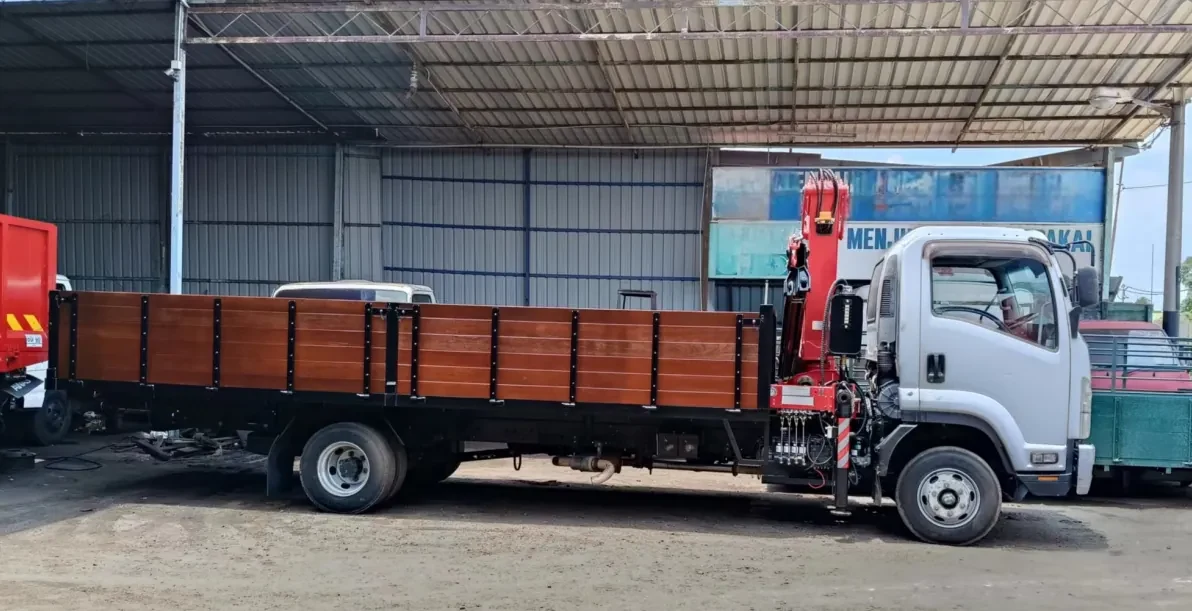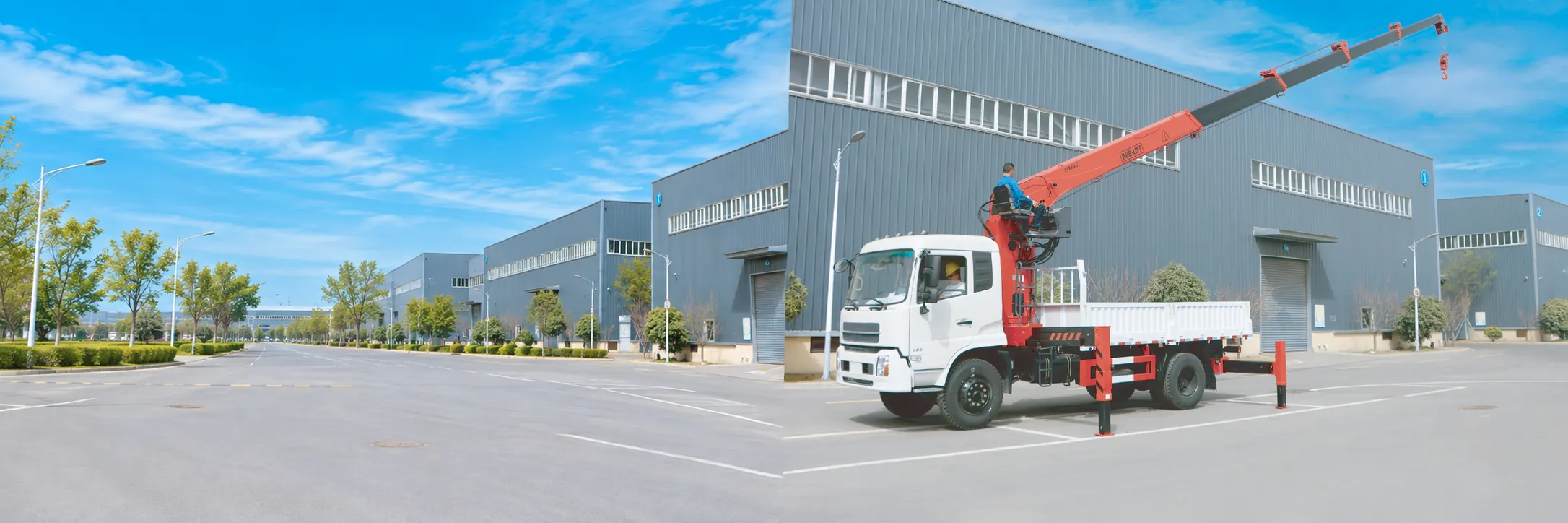

To buy a truck mounted crane from China, start from your lift, not from a catalogue. Work out the heaviest load and the reach you need, and check the truck that will carry the crane. Then confirm that the supplier really builds the crane and can show its drawings, load chart, certificates and test before you pay the balance. Lead time, container loading and freight are confirmed in the written quotation, so you compare like with like.
BOB-LIFT has built truck mounted cranes in Xuzhou, Jiangsu, since 2003, and our cranes now work in more than 120 countries. Most of our buyers import from us for the first time. This guide follows the same seven steps our sales team goes through with them, from the first inquiry to the spare parts after delivery, and lists the questions worth asking any Chinese crane manufacturer.
Key takeaways
- Choose the crane by the load it must lift at your working radius, read from its load chart, not by the tonnage in the model name.
- Plan early how the crane will be fitted to your truck: send the truck model so the factory can confirm the payload, frame length and power take-off.
- Check that the supplier is the manufacturer: a video call from the workshop, the technical drawings for your exact model and a factory visit are the strongest proof.
- Ask for the documents your market needs, such as CE for Europe or EAC for the Eurasian Economic Union, before you order, not after the crane has shipped.
- Agree the warranty, spare parts dispatch and service reply time in writing. Ours are 12 months on the whole crane, parts dispatched within 48 hours and a reply within 12 hours.
Step 1: Size the crane from your heaviest lift
Write down the heaviest load you will lift and how far from the truck you will place it. Those two numbers decide the crane. A crane’s rated capacity, the figure in its name, applies only close to the column; at full reach it lifts a fraction of that. Our SQZ500 knuckle boom crane, for example, is rated at 25,000 kg but lifts 2,840 kg at its full reach of 15.9 m, as our 25 ton knuckle boom crane guide shows. Our guide on how to read a crane load chart walks through three real charts.
Then pick the boom type. A knuckle boom crane folds into a compact block behind the cab and places loads precisely over walls and into buildings. A telescopic boom crane reaches further for its size and suits long, straight lifts. Our comparison of knuckle boom and telescopic boom truck cranes covers the trade-offs. If the crane will work on a ship or a barge, ask for a marine version with corrosion protection rather than a road crane.
Be precise about the words you search with, too. In some markets “truck crane” means a mobile crane on its own all-terrain carrier. A truck mounted crane is a hydraulic crane fitted to a cargo truck, so the same vehicle carries the load and lifts it. It is also called a crane truck, loader crane or lorry crane. That is what most Chinese crane factories, including ours, build and export.
In the UK, Singapore and Malaysia the same vehicle is usually called a crane lorry; our crane lorry guide explains how to match the crane to the lorry.
Step 2: Match the crane to your truck

We ship the crane on its own, wrapped and loaded into a container, and a local body builder fits it to your truck. Buying the truck in your own market keeps its registration, emission standard and steering side right for your roads.
Send your truck model and chassis specification with your inquiry. The factory needs three things to match the crane. They are the payload left after the crane’s own weight, the free length of frame behind the cab, and a power take-off that delivers the crane’s oil flow and pressure. We have mounted cranes on Dongfeng, Isuzu and Sinotruk chassis; for other brands our engineers check the fit from the drawings. Our truck mounting and shipping page shows the process, and our installation guide explains what a local fitter has to do.
Step 3: Make sure the supplier is the factory
Many sellers of Chinese cranes are trading companies, and some show photos of cranes they did not build. A trader is not always a bad choice, but you should know who is responsible for the design, the welding and the test. Four checks sort it out quickly:
- Look up the company. China’s National Enterprise Credit Information Publicity System shows a company’s registered name, address, date of founding and business scope. A manufacturer’s scope includes manufacturing.
- Ask for a live video call from the workshop. Ask the salesperson to walk to the crane you are buying, or one of the same model, and show the nameplate.
- Ask for the technical drawings of your exact model. A factory has a dimension drawing and a load chart for each crane; a reseller often has only a brochure page.
- Check the photos. Our guide on how to tell if a crane supplier’s photos are really theirs shows the tell-tale signs of borrowed or edited images.
The strongest check is a visit. Many of our buyers combine a trip to the Canton Fair with a day in Xuzhou. One buyer from Nigeria had three hours between trains for a factory visit in Xuzhou. He watched a live crane demonstration and inspected a truck-and-crane set about to ship. He paid his deposit at the station before leaving.
Step 4: Ask for the documents your market needs
Rules for lifting equipment differ by country, and the importer usually carries the risk if a crane cannot be registered or used. Settle the documents before you order. The table below lists the ones buyers most often ask us for.
| Market | What to ask for | Rule behind it |
|---|---|---|
| European Union | CE marking and the EU declaration of conformity | Machinery Directive 2006/42/EC, replaced from 20 January 2027 by Machinery Regulation (EU) 2023/1230 |
| Russia, Kazakhstan and other EAEU countries | EAC certificate or declaration | Technical regulation TR CU 010/2011 “On safety of machinery and equipment” |
| United States | Design to the articulating boom crane standard; load chart and operator manual in English | ASME B30.22; OSHA 29 CFR 1926 Subpart CC for construction use |
| United Kingdom | UKCA or CE marking, and records for thorough examination | LOLER 1998 |
| Every market | Dimension drawing, load chart, operator manual, hydraulic diagram and spare parts list | Needed to register, insure, inspect and service the crane |
BOB-LIFT cranes carry CE and EAC certificates, and the factory works to ISO 9001 and ISO 14001; the certificates are shown on our about us page. Our operator manual is in English as standard, and other languages are available if you ask for them when you order. Your local rules may add more, such as a periodic inspection by an approved body, so ask your importer or inspection company what they will need to see.
Step 5: Read the quotation line by line
Two quotations for the “same” 12 t crane can describe different machines. Compare them on what they include, not on the headline figure. A complete quotation names the model and its load chart, the boom type and number of sections, the control type, the outriggers, the options such as a winch, a basket or a remote control, and the paint colour.
It also states the trade terms. The Incoterms rules published by the ICC decide where the seller’s costs and risks end. FOB means the seller delivers the crane on board the vessel at the port of loading, and risk passes to you there. CFR means the seller also pays sea freight to your port, but risk still passes at loading. CIF means the same as CFR plus marine insurance paid by the seller. For container shipments the ICC recommends the matching rules FCA, CPT and CIP. Most of our orders leave from Lianyungang, Qingdao or Shanghai. Tell us your destination port and we confirm the route, the lead time and how many cranes fit in a container with your quotation.
Finally, check the payment terms and when each payment is due, and keep them tied to milestones you can verify: the order, the test video and the shipping documents. The usual methods are a bank transfer (T/T) split into a deposit and a balance, or a letter of credit. Ask your customs broker for the HS code and import duty on the crane before you order, because both affect your landed cost. You can order a single crane; you do not need a full container to buy from us.
Step 6: See the crane tested before it ships

Every BOB-LIFT crane is mounted on our test bay and run through lifting, slewing and outrigger functions under load before it is packed. Ask for a video of your own crane’s test, with the serial number visible, before you pay the balance, or send an inspection company of your choice. Our quality and testing page shows load tests filmed on the bay.
On arrival, check the crane against the packing list and the drawings, and inspect it before its first lift. Our truck mounted crane inspection checklist covers the daily, monthly and annual checks, including the first one.
Step 7: Agree the after-sales terms in writing
A crane bought from overseas is only as good as the support behind it. Ask every supplier the same four questions and get the answers in writing. How long does the warranty run, and what does it cover? How fast do spare parts leave the factory? How fast does the service team reply? Can an engineer come to your country?
Our answers are on the service and operation page. We give a 12-month warranty on the whole crane and dispatch common spare parts within 48 hours. We reply to service requests within 12 hours, with video guidance. On-site engineers are a paid service, agreed before the trip. We do not run operator training at delivery, but your technicians are welcome at our factory to learn installation, operation and maintenance.
Questions to send a Chinese crane supplier
Copy this list into your first email. A manufacturer can answer all of it within a day or two; a supplier who cannot is telling you something.
- Can you send the dimension drawing and load chart for this exact model?
- What does the crane weigh, and what payload, frame length and PTO flow does my truck need?
- Which certificates does this model carry for my country?
- Can you show me the crane on a live video call from your workshop?
- What exactly is included: options, remote control, spare parts kit, manuals?
- Which Incoterms rule and port is the quotation based on, and what is the lead time?
- Will I receive a test video of my crane, with its serial number, before shipping?
- What warranty, spare parts dispatch time and service reply time do you commit to?
Frequently asked questions
Is it safe to buy a truck mounted crane from China?
Yes, if you buy from a manufacturer you have checked. Confirm the company is registered as a manufacturer, and see the crane on a live video call or in person. Get the drawings and certificates for your model, and tie the final payment to a test video and the shipping documents.
Can I buy just one crane?
Yes. We accept single-unit orders. The crane is wrapped and loaded into a container, sometimes together with other cargo.
How long does it take to get a crane from China?
It depends on the model, the options and your destination port. We confirm the production lead time and the shipping route in writing with each quotation, so ask for both before you compare offers.
Can a Chinese crane be fitted to a truck I already own?
Usually, if the truck has enough payload, a free frame length behind the cab and a suitable power take-off. Send the truck model and chassis specification and the factory will check the fit before you order.
What should I check when the crane arrives?
Compare the crane with the packing list and drawings, and check the nameplate and serial number against the test video. Look for transport damage to hoses and paint. Then carry out the pre-use inspection in the operator manual before the first lift.
Start with your lift
Buying a crane truck from China works when the order is built on facts: your load and reach, your truck, the factory’s own drawings and test, and after-sales terms in writing. Send us what you need to lift, how far, and the truck or chassis you plan to use. Our sales team will suggest a model from our truck mounted crane range and send the drawings with a quotation. You can reach us through the contact page.
Editorial note: this guide was written by Achord Chan, Product Operations Director at BOB-LIFT. The warranty, spare parts and service figures were checked against our factory’s written answers of October 2026.