When you buy a truck mounted crane from another country, the supplier’s photos are often the only part of the factory you see before you pay a deposit. Those photos are not always the supplier’s own. We have found our own factory photos re-branded on other suppliers’ websites.
This guide shows you how to verify a crane manufacturer, starting with whether the crane supplier photos you have been sent are really theirs. We use one of our own photos to make a demonstration fake, so you can see exactly where a re-branded image gives itself away. Then we list the checks you can run yourself in ten minutes, what to ask the seller for, and what a real factory should be able to show you on request.
Key takeaways
- A re-branded photo often shows a patch: flat paint with no reflections, or a faint outline of the old logo.
- Lettering that does not follow the boom’s angle, light or curve was added later.
- The nameplate, load chart label and model codes often still belong to the real maker. Zoom in and read them.
- A reverse image search shows where else a photo appears. TinEye can sort matches from oldest to newest.
- Ask for a photo taken today with your company name and the date beside the crane, or a live video call walking through the factory.
Why do re-branded crane photos matter to a buyer?
A photo is a promise about who builds your crane. If a seller shows you another company’s machine with a new name on it, you cannot be sure who will weld the boom, test the hydraulics or supply spare parts in five years.
A different logo is not always a fake. We have built truck mounted cranes since 2003, and over the years we have also built cranes for other factories under their own brands, with our agreement. Those cranes really are what the photos show. The problem is a factory that takes our photos without permission: the cranes it actually builds may not look like the ones in the pictures.
Buying through a trading company is not wrong in itself. Many buyers do it on purpose. The problem is when a trader presents someone else’s factory as their own. Then questions you need answered before you order get guesses instead of answers:
- Who signs the paperwork? In the European Union, the Machinery Directive (Directive 2006/42/EC, Annex I, section 1.7.3) requires the manufacturer’s business name and full address on the machine’s marking. From 20 January 2027 this Directive is replaced by the Machinery Regulation (EU) 2023/1230, which keeps the same marking duty. The company on the nameplate is the company that answers for the crane.
- Whose load chart is it? A load chart belongs to one crane design. If the seller cannot say who drew it, they cannot answer questions about it. Our guide on how to read a crane load chart shows what a real chart contains.
- Where do spare parts come from? Seals, valves and boom sections must match the original design. A seller who does not build the crane has to source them from the maker.
How can you spot a re-branded crane photo?
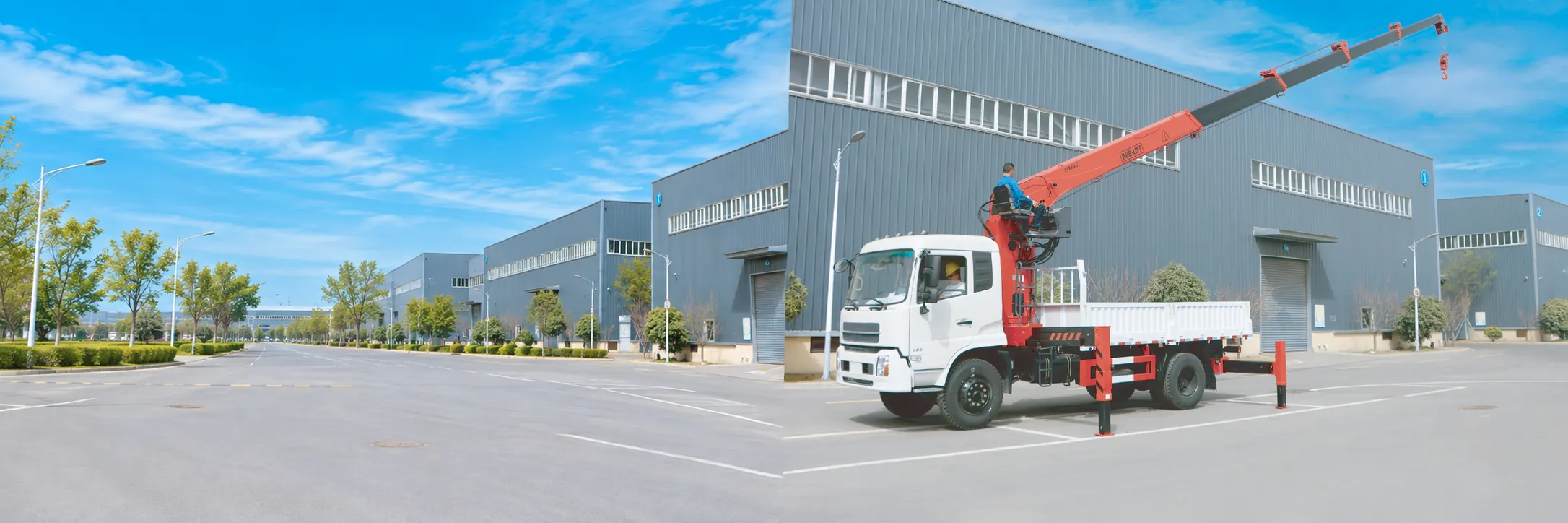
A re-branded crane photo is another maker’s picture with the original logo edited out and a new name added. To show what to look for, we took one of our own factory photos of the SQ4ZA3 knuckle boom crane and put a made-up name, “BRAND X”, over our logo. An edit like this takes a few minutes in any photo editor. The numbers 1 to 4 on the right-hand picture match the first four signs below. Signs 5 and 6 need the original file or a search, not a closer look.

1. The paint under the new logo looks flat
Real crane paint picks up light. Along a boom you see highlights, reflections and slight changes in shade. A patch painted over a logo in an editing program is often one flat colour with none of that. Look at the edges too. On our demo copy, the outline of the old decal still shows through on one side.
2. The lettering does not sit on the boom
A real decal is stuck to the steel. It runs at the same angle as the boom, takes the same light and shadow, and disappears behind anything in front of it, such as a hydraulic cylinder or a hose. Added lettering often sits at a slightly different angle, looks too sharp or too clean, and sometimes runs over parts that are physically in front of the boom. In our demo, the new name crosses the cylinder, which a real sticker on the boom never could.
3. The nameplate and labels tell a different story
It is easy to change the big logo and miss the small print. In our demo copy, the nameplate (3) is untouched and still carries our details. Zoom in on the nameplate, the load chart sticker on the oil tank and any warning labels. If the photo is sharp enough, these often still carry the real maker’s name, address or website. If the photo is too blurred to read them, ask the seller for a close-up of the nameplate.
4. The model code follows someone else’s system
Each maker has its own model codes. In our SQ4ZA3, for example, the 4 is the rated capacity in tonnes and the Z marks a knuckle (folding) boom, while an S in the same place marks a telescopic boom. If the code painted on the boom does not match the model name in the seller’s catalogue, ask what the code means. The real maker can explain every letter. A reseller often cannot.
5. The image quality drops
Every time a photo is downloaded, edited and saved again, it loses detail. Copied images are often smaller, softer or blockier than the rest of the seller’s pictures. Ask for the original file of any photo that matters to you. A factory that took the picture can send the full-size file, usually with its original camera data.
6. The same picture appeared somewhere else first
This is the strongest check. Run the photo through a reverse image search. If the same crane, in the same workshop, from the same angle, appears on another company’s website, ask the seller who took it. In TinEye you can sort matches by oldest to see where the picture was indexed first. If the oldest match is on another company’s site, ask the seller to explain why.
How do you check a supplier’s photos in ten minutes?
- Run a reverse image search. Right-click a product photo and use Google image search or Google Lens, Bing Visual Search or TinEye. Look for the same image on other sites. In TinEye, sort results by “Oldest” to see where the image appeared first.
- Zoom in on the small print. Read the nameplate, the load chart label and any stencilled codes. Compare them with the company name and model names the seller uses.
- Compare the backgrounds. A real factory’s photos share the same buildings, floors, colours and equipment. If every product sits in a different workshop, the photos may come from different sources.
- Ask for a “today” photo. Ask the seller to photograph the crane you are discussing, with a sheet of paper next to it showing your company name and today’s date. Anyone can copy an old photo. Nobody can copy one that did not exist an hour ago.
- Ask for a live video call. Ask them to walk from the factory gate to the assembly line on camera, then point the camera at the nameplate of a finished crane.
- Check the trademark. A real brand owner can show you the registration certificate for the logo on the boom. Our BOB-LIFT trademark, for example, is registered in China under No. 26579311. Anyone can check a Chinese trademark number through the CNIPA Trademark Office website (in Chinese; a browser translator helps).
None of these steps costs anything, and a genuine manufacturer will not mind any of them. If a seller refuses all of them, treat that as your answer.
How do you verify a Chinese crane factory is real?
Every company registered in China has an 18-character Unified Social Credit Code on its business licence. Ask the supplier for the licence, then look the code up on the National Enterprise Credit Information Publicity System (gsxt.gov.cn). The site is in Chinese, so search with the company’s Chinese name or the code itself, and use your browser’s translate option. Check three things:
- The registered company name matches the name on your contract, the invoice and the crane’s nameplate.
- The business scope includes manufacturing, not only trading.
- The registered or factory address matches the factory you see on the video call.
What should a real crane factory be able to show you?
A factory can show you more than product photos: the site, the people and the machines in different stages of build. Here is what we show buyers who ask us the same questions.

- The site from outside and above. Our factory sits on the S324 Provincial Road in Zhangji Town, Tongshan District, Xuzhou. You can see the gate, the halls and the truck yard on our factory tour page.
- Cranes at every stage. Boom sections, frames, hydraulic assembly, truck mounting and the test bay, all in the same halls.
- Customers on site. Buyers who visit see the same halls as in our photos. A buyer from Nigeria who met us at the Canton Fair came to the factory shortly after the fair, watched a live crane demonstration and paid a deposit the same day. You can read his three-hour factory visit.
- Paperwork in our own name. Certificates and trademark registrations under Xuzhou BOB-LIFT Construction Machinery Co., Ltd. are shown on our About page.

Frequently asked questions
Is it bad to buy a crane from a trading company?
No. A good trader can help with language, shipping and paperwork. What matters is honesty. A trader should tell you which factory builds the crane and let you check it. Be careful with a seller who shows another company’s machines as their own.
How do I verify a crane manufacturer in China?
Look up the Unified Social Credit Code from its business licence on gsxt.gov.cn and check that the name, business scope and address match the contract and the factory. Then ask for a live video call that ends at the nameplate of a finished crane.
Is a crane with another brand’s logo always a copy?
No. Some factories, including ours, build cranes for other brands with permission. Ask the seller who builds the crane and check it on a video call. A genuine partner will tell you; a seller using someone else’s photos usually will not.
Can crane photos be generated by AI?
Yes, and they are getting harder to spot. Look for hoses that go nowhere, bolts that melt into the steel, text that is not real letters and parts that do not connect. The same “today” photo and live video checks catch AI images as well as copied ones.
What should I ask to see on a video call?
Ask to see the factory gate with the company name, the assembly line, a finished crane’s nameplate and the test area. If you have a quotation, ask to see the same model you were quoted. The call takes about fifteen minutes.
Check before you pay
Photos are a good start, but they are not proof. Run a reverse image search, read the nameplate, and ask for a photo taken today or a live video call before you send a deposit. If you are comparing suppliers for a knuckle boom truck mounted crane or any other crane, contact us to book a live video tour of our factory. We will show you the crane you are asking about, nameplate included.