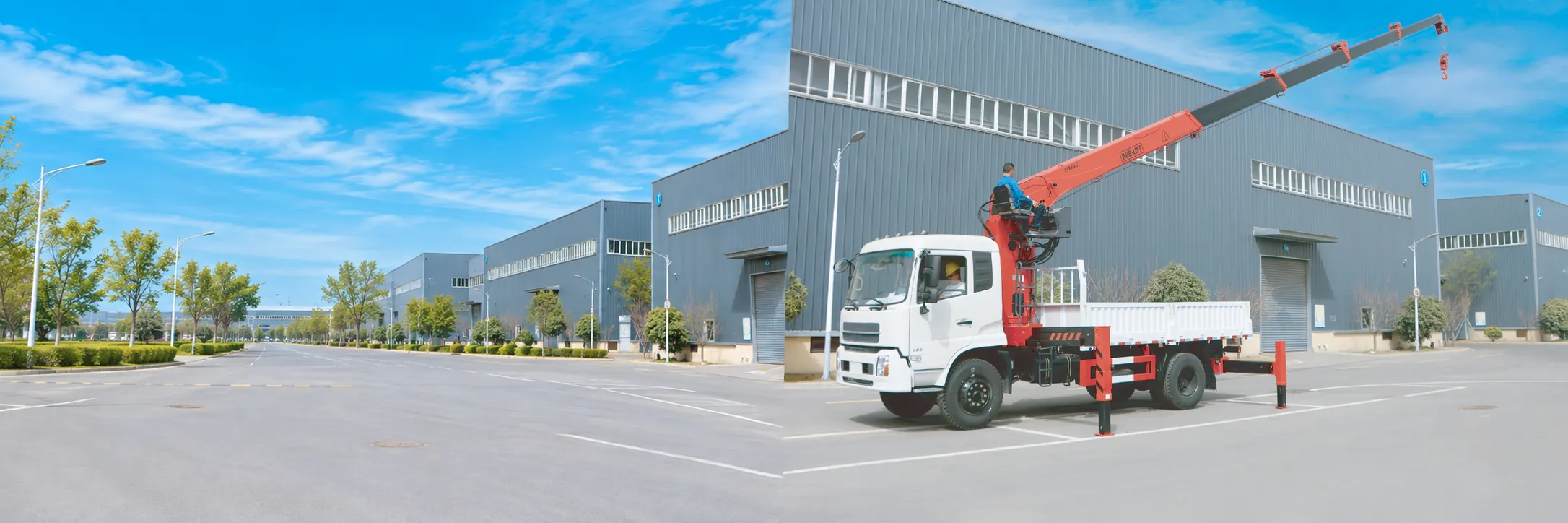

The crane device that limits the angle of the boom at its highest position is the boom stop. US federal rules define it in exactly those words: “The boom stop is a device used to limit the angle of the boom at the highest position” [1]. In a quiz that offers block, jib and boom stop, the answer is boom stop. A block carries the hook, a jib extends the boom, and only the boom stop holds the boom back at the top of its range. BOB-LIFT has built truck mounted cranes in Xuzhou since 2003.
Key takeaways
- A boom stop restricts the boom “from moving above a certain maximum angle and toppling over backward”, in the words of the OSHA construction crane definitions [2].
- It is a backstop for emergencies. California’s crane rule says it “shall not be used purposely as a substitute for normal procedures in stopping a boom being raised” [3].
- The boom hoist limiting device is a different part: it cuts boom hoist power at a set angle, before the boom reaches the stop.
- OSHA requires boom stops “except for derricks and hydraulic booms” [4]. On a hydraulic truck mounted crane, the luffing cylinder holds the boom in both directions.
- On the BOB-LIFT SQ10SA4 telescopic crane, the load chart stops at 75°. Above the last angle on the chart the crane has no rated capacity.
What is a boom stop on a crane?
A boom stop is a mechanical stop that keeps a crane boom from being raised past its maximum angle. The general industry rule for crawler, locomotive and truck cranes, 29 CFR 1910.180(a)(16), gives the short definition quoted above. The construction crane rule gives a longer one. Under it, a boom stop “includes boom stops, (belly straps with struts/standoff), telescoping boom stops, attachment boom stops, and backstops”. These devices “restrict the boom from moving above a certain maximum angle and toppling over backward” [2].
A jib stop is the jib’s version of the same part. The definitions section calls it “the same type of device as a boom stop but is for a fixed or luffing jib”, and also uses the name jib backstop. If a crane carries a jib, the jib needs its own stop as well as the boom. Our guide to what a fly jib is explains the jib itself.
Why the answer is boom stop, not block or jib
The question “What crane device limits the angle of the boom at its highest position?” appears in crane operator practice tests with three options. Each option names a real crane part, which is why it catches people out.
| Option | What it is | Does it limit the boom angle? |
|---|---|---|
| Block | The hook block or load block: the sheaves and hook that hang from the hoist rope | No. When the block is pulled into the boom head, the hazard is two-blocking, which an anti-two-block device prevents |
| Jib | An extension fitted to the boom head to add reach | No. A jib has its own jib stop |
| Boom stop | A stop that holds the boom at its highest permitted angle | Yes. This is the device the 1910.180 definition describes |
How a boom stop works
Boom stops matter most on cranes whose boom hangs from ropes, such as lattice boom crawler and truck cranes. Ropes can hold the boom up, but they cannot push it forward. If the boom is raised too far, or swings back when a heavy load is suddenly released, nothing in the rope system resists the boom moving past vertical and falling backward onto the crane.
California’s General Industry Safety Orders, section 4922 “Crane Boomstops”, set out what the device must do. Boomstops are required on cranes “of such design that the boom could fall over backward”. The rule applies when the main boom is rope supported and the crane does hook, clamshell, magnet, grapple or concrete bucket work [3]. It then states the purpose. “The boomstop shall provide emergency protection against destructive damage and related hazard by opposing any unexpected upward and rearward boom movement beyond the working range.”
For new cranes over 10 tons purchased after January 1, 1971, section 4922(b) adds design requirements. The stop must prevent the lower part of the boom from moving “beyond 90 degrees, or some lesser angle” relative to the machinery deck. It must also “provide energy absorbing resistance” over the last 5 degrees of that movement. So the stop has to slow the boom over the last few degrees rather than stop it with a shock.

Boom stop vs boom hoist limiting device
The two devices work in sequence. The boom hoist limiting device acts first and stops the boom from being driven up. The boom stop is the physical barrier behind it. A boom hoist limiting device is a control that “disengages boom hoist power when the boom reaches a predetermined operating angle”, in OSHA’s words. The same definition adds that it “also sets brakes or closes valves to prevent the boom from lowering after power is disengaged” [2].
The names overlap, which explains much of the confusion. The definition of a boom hoist limiting device lists “boom hoist kick-outs, automatic boom stop device, or derricking limiter” among its forms. So an “automatic boom stop device” is legally a limiting device, not the boom stop itself. The rules also treat the two very differently when something breaks.
| Point | Boom stop | Boom hoist limiting device |
|---|---|---|
| What it does | Physically resists the boom moving past its maximum angle and toppling backward | Cuts boom hoist power at a preset angle and holds the boom there |
| US rule | Safety device, 29 CFR 1926.1415(a)(2) | Category I operational aid, 29 CFR 1926.1416(d)(1), for equipment made after December 16, 1969 |
| When it acts | Only if the boom keeps moving beyond the working range | Every time the boom is raised to the set angle |
| If it is not working | Equipment out of service; “Alternative measures are not permitted to be used” | Repair within 7 calendar days, using at least one temporary measure meanwhile |
| Hydraulic booms | Not required | Required; the definition includes a “boom hoist hydraulic relief” |
Section 1926.1416(d)(1) lists the temporary measures for a faulty boom hoist limiting device. The first is a boom angle indicator. The others are to “clearly mark the boom hoist cable” so that the operator, or a spotter who signals the operator, has time to stop the hoist “to keep the boom within the minimum allowable radius”. No such workaround exists for a boom stop. Under 1926.1415(b), operations must not begin unless the listed safety devices “are in proper working order”, and the equipment must be taken out of service until they are.
Other devices watch other limits. The load moment indicator compares load against radius, and the anti-two-block device watches the gap under the boom head. Our guide to crane safety devices lists everything OSHA 1926.1415 and 1926.1416 require and what to check before a shift.
Does a hydraulic truck mounted crane need a boom stop?
Not under the US construction rule. Section 1926.1415(a)(2) requires “Boom stops, except for derricks and hydraulic booms” [4]. A hydraulic telescopic or knuckle boom is raised and lowered by a luffing cylinder rather than by ropes. The cylinder pushes the boom up and also holds it from going further, so the boom cannot fall backward the way a rope-hung boom can. The highest angle is set by the design of the cylinder and its mountings. Our article on the maximum angle for a crane boom explains how angle, boom length and radius relate.
Knuckle boom cranes are covered by the same Subpart CC rules. Section 1926.1400 names “Articulating cranes (such as knuckle-boom cranes)” among the equipment covered, with exclusions for some material deliveries [5]. Their two booms move on separate cylinders, so there is no single boom angle to stop. Section 1926.1416(a)(1) states that the boom angle indicator requirement in (e)(1) does not apply to articulating cranes. A knuckle boom chart is read by radius. The SQ10ZA4 chart, for example, draws the outer boom from 0° up to 84° but lists its rated loads against radii from 2,000 mm to 10,495 mm.
None of this means a hydraulic crane can be raised without limit. A hydraulic crane still has a highest angle on its load chart. It still needs the devices that do apply, such as the anti-two-block device on telescopic booms and the overload protection described in our LMI guide. Every BOB-LIFT crane is listed with a load moment limiter. Outside the US, follow the rules where the crane works and the crane manufacturer’s manual.
Example scenario: working at the top of the SQ10SA4 angle range
Example scenario (an illustration, not a customer record). A contractor in Cebu uses a BOB-LIFT SQ10SA4 telescopic truck mounted crane to set an ASSUMED 3,200 kg generator, including slings and shackles, on a plinth beside a building. The truck can only park where the plinth centre is 4.0 m from the crane’s centre of rotation, so the hook has to come in close and the boom has to stand steep.
The SQ10SA4 drawing lists a 10,000 kg maximum lifting capacity, a 25 t·m maximum lifting moment, 360° rotation and a crane weight of 3,800 kg. Its boom extends from 5.6 m to 15.87 m, and its rated load table goes from 0° to 75°. These are the steepest rows of that table:
| Boom angle | Boom 9.02 m | Boom 12.44 m | Boom 15.87 m |
|---|---|---|---|
| 60° | 4.4 m / 4,300 kg | 6.1 m / 3,000 kg | 7.8 m / 2,170 kg |
| 70° | 3.0 m / 6,000 kg | 4.1 m / 4,000 kg | 5.3 m / 3,100 kg |
| 75° | 2.3 m / 7,000 kg | 3.2 m / 5,100 kg | 4.2 m / 3,400 kg |
With the boom fully extended to 15.87 m, the last row of the chart is 75°, which gives a 4.2 m radius and a 3,400 kg rating. That is 0.2 m short of the plinth. The temptation is to raise the boom a little more to pull the load in, but the chart lists nothing above 75°, so the crane has no rated capacity there, whatever physically stops the boom. One row lower, at 70°, the radius grows to 5.3 m and the rating falls to 3,100 kg, which is 100 kg less than the load.
The answer is a shorter boom. Retracted to 12.44 m, the boom reaches 4.1 m at 70° and 3.2 m at 75°, so the 4.0 m plinth sits between two rows. When the radius falls between two chart values, use the rating at the larger radius: 4,000 kg at 4.1 m. The 3,200 kg load uses 80 percent of it. The lift plan still has to confirm that the shorter boom clears the building. The lesson holds on any crane: near the top of the angle range, shorten the boom to bring the load closer rather than pushing the angle past the last row of the chart.

Our guide on how to read a crane load chart explains the radius and boom length columns, and the full specification of this model is on the SQ10SA4 telescopic boom truck mounted crane page.
How to check a boom stop
Treat the boom stop as part of the structure that carries load in an emergency. California’s rule says that “No boomstop shall remain in use unless it is in good operating condition and maintained in accordance with the certified agent’s guidelines” [3]. OSHA’s shift inspection list in 1926.1412 includes “Safety devices and operational aids for proper operation”, and the same section requires inspection by a qualified person after any repair or adjustment to a safety device.
- Look for bent struts, cracked welds and damaged mounting points, and check that pins and retainers are in place.
- On telescoping stops, check that the cushion or spring moves freely and returns, as the crane manufacturer’s manual describes.
- Test the boom hoist limiting device at the start of the shift, so that the boom stop is never the thing that stops the boom in normal work.
- After any contact with the stop, have the crane inspected before it works again, and record the repair.
On a hydraulic crane, the pre-start check covers the devices it does have instead. Our truck mounted crane inspection checklist lists the daily and periodic points.
Frequently asked questions
What crane device limits the angle of the boom at its highest position?
The boom stop. 29 CFR 1910.180(a)(16) defines it as “a device used to limit the angle of the boom at the highest position”. In a test that offers block, jib and boom stop, choose boom stop.
Is a boom stop the same as a boom hoist limiting device?
No. The boom hoist limiting device cuts boom hoist power at a preset angle. The boom stop is the physical stop behind it that resists the boom toppling backward if it keeps moving. OSHA counts an “automatic boom stop device” as a form of boom hoist limiting device.
Do hydraulic cranes have boom stops?
OSHA 1926.1415(a)(2) does not require them on hydraulic booms. On a hydraulic boom, the luffing cylinder holds the boom in both directions. The highest angle is still limited, and it appears as the last angle on the load chart.
What is a jib stop?
A jib stop, also called a jib backstop, is “the same type of device as a boom stop but is for a fixed or luffing jib”. OSHA 1926.1415(a)(3) requires one whenever a jib is attached, except on derricks.
What is the maximum boom angle on a truck mounted crane?
It depends on the model, and the load chart shows it. The BOB-LIFT SQ10SA4 telescopic chart ends at 75°, and the SQ10ZA4 knuckle boom chart draws the outer boom up to 84°. Never lift at an angle the chart does not list.
How we compiled this guide
We quoted the US definitions and requirements from the official eCFR text of 29 CFR 1910.180, 1926.1400, 1926.1401, 1926.1412, 1926.1415 and 1926.1416. California’s boomstop rule comes from Title 8, section 4922, on the Department of Industrial Relations website. We read all of them in November 2026. The crane figures come from the BOB-LIFT SQ10SA4 dimension drawing and the SQ10ZA4 load chart, and the example uses a clearly marked assumed load and site. Achord Chan, Product Operations Director, carried out the editorial review. This guide does not replace the crane’s operator’s manual or the regulations where you work.
Ask for the load chart before you choose a crane
Tell us the heaviest load, the closest and farthest radius, and any height you have to clear. We will recommend a telescopic boom truck mounted crane or a knuckle boom model and send its dimension drawing and full load chart, including the angle range. If you buy the truck in China, we can fit the crane at our factory. If you buy it locally, we ship the crane, a local body builder fits it and we support the work remotely. Contact us for a quotation; we reply within 12 hours, and every crane carries a 12-month warranty on the whole machine.