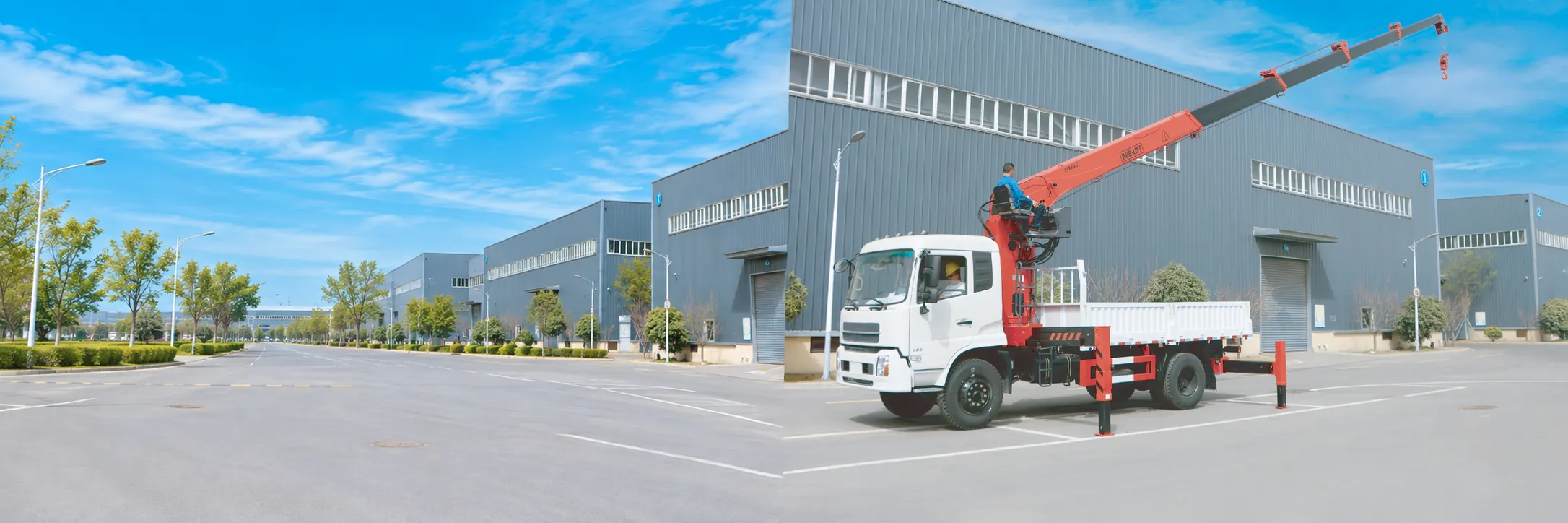

A lifting magnet is a below-the-hook device that holds ferrous (magnetic) steel by magnetic force, so plate, bar, pipe or scrap can be lifted without slings around the load. There are three families: permanent magnets, electro-permanent magnets and electromagnets, and they behave differently when the power fails. The rated load marked on any lifting magnet is a best case: it assumes clean, flat, full contact with steel of a stated thickness, and real loads usually take less.
BOB-LIFT has built truck mounted cranes in Xuzhou since 2003. This guide explains how each type of magnet holds and releases a load, and why the label overstates what it can hold on a real plate. It covers safe use and inspection, and what changes when a magnet hangs from a knuckle boom crane on a truck. It ends with a worked check of two magnets under a real BOB-LIFT load chart. We build the cranes only; magnets, lifting beams and their controls come from specialist lifting equipment suppliers.
Key takeaways
- HSE states that, except for permanent and electro-permanent types, “any interruption to the electrical supply could result in a release of the load” [1].
- A magnet’s rated load assumes ideal contact. Paint, rust, mill scale, thin plate, partial contact, heat and some stainless steels all reduce it, so read the manufacturer’s tables for the actual load.
- Long thin plate droops and can peel off a single magnet, so it is lifted with several magnets on a lifting beam. The share carried by each magnet must stay within its own rating.
- The magnet, the beam and the rigging are part of the load on the crane, and on a mobile crane the crane manufacturer may advise against magnets or require a reduced rating.
- In our example, one 6 m plate on two magnets passes the BOB-LIFT SQ10ZA5 load chart at every radius. A second plate stuck underneath would overload the crane by 254 kg at full reach, while each magnet still stays under its label.
What is a lifting magnet?
HSE describes magnetic lifting devices as a single magnet or a group of magnets hung from chains or wires, or attached to lifting equipment in another way. They are used for lifting steels and most ferrous materials “without the need for slingers” [1]. Flat pole plate magnets handle sheet metal and bulk goods such as scrap iron, shaped pole plates lift pipe, round bar and sections, and magnets with adjustable pole fingers take irregular shapes. HSE adds that magnetic lifting devices “should not be treated as ‘general purpose’ pieces of lifting gear”, because each is designed for particular loads and environments.
In standards terms, a lifting magnet is a below-the-hook lifting device. ASME B30.20 covers “the marking, construction, installation, inspection, testing, maintenance, and operation of below-the-hook lifting devices” [2], and our guide to below-the-hook lifting devices explains that family, with a short plate example on a smaller crane. US construction crane rules treat a magnet as an attachment: the standard applies to cranes used with attachments, and 29 CFR 1926.1400(b) lists “Hooks, magnets, grapples” among them. The terms “crane magnet”, “magnetic crane” and “crane with electromagnet” describe the same arrangement: a lifting magnet hung from a crane.
The mechanical alternative for plate is a plate clamp, which grips the edge by friction, so it does not depend on the steel being magnetic. A magnet holds the face of the plate and needs no access to the edge, but it only works on magnetic steel. Our guide to lifting clamps covers vertical and horizontal plate clamps.
Permanent, electro-permanent and electromagnets: the three types
All three types hold steel by magnetic force. The difference is where the holding force comes from and what happens to the load if the power is cut.
| Type | How it holds the load | How it releases | If the power fails |
|---|---|---|---|
| Permanent lifting magnet (permanent magnetic lifter) | Permanent magnets, switched on and off with a hand lever | The operator moves the lever to the release position | No power is used, so a power failure has no effect; a caution label warns against operating with the lever not fully in the lift position |
| Electro-permanent magnet | Permanent magnets, switched by a short electrical pulse | A second pulse switches the field off | The magnet keeps holding; power is needed to switch it, not to hold |
| Electromagnet (lifting electromagnet) | A coil that is energised the whole time the load is held | The current is switched off | The load can drop unless a stand-by battery or another backup takes over |
An electro-permanent magnet is switched on or off “by a pulse of electric current”, and it requires “no power source to maintain the magnetic field”. That is why this design is used for industrial lifting magnets [3]. HSE suggests that users consider “permanent magnets with electromagnetic release so that in the event of a power failure, battery backup will not be needed” [1]. Electromagnets are used for picking up heavy iron and steel objects such as scrap [6], and they are the type that depends completely on a steady supply.
For magnets that are not built to the current European standard, BS EN 13155:2003+A2:2009, HSE lists the safety measures to consider [1]:
- Battery-fed magnets with a SWL over 20 kg: an automatic warning, optical or acoustic, at least 10 minutes before the battery reaches the level at which the load would be released, and no switching on again until the battery is recharged.
- Magnets on an external supply with a SWL over 20 kg: a warning if the supply fails, and a stand-by battery that can hold the SWL for “at least 10 minutes”.
- Magnets used close to people: duplicated power cables, connections and controller, or a secondary positive holding device.
- Controls: “Releasing the load should require two control actions”, so one accidental touch cannot drop it.
- Indicators: a device that shows when the magnet is magnetised or working at reduced power.
The supply does not have to fail completely. After a dropped plate offshore, the US Bureau of Safety and Environmental Enforcement (BSEE) warned that “even brief power spikes can disable electromagnets, leading to dropped loads”. It recommended monitoring power stability and keeping backup systems in place [4].
Why the rated capacity on a lifting magnet is a best case
A crane hook or a shackle has one rated load. A lifting magnet’s real capacity changes with each load, so its marked figure is a starting point. Washington State’s construction crane rules require close proximity lifting magnets to be built to ASME B30.20-2021. They say the rated load marking “must refer to the instruction manual for information about decreases in rating”, covering six factors [5]. HSE explains why each one matters [1]:
| Factor in the manual | What reduces the holding force |
|---|---|
| Surface condition | Paint, rust, oxide scale, oil, ice, snow and other non-magnetic material on either surface increase the air gap between magnet and load. |
| Thickness | HSE notes that SWLs are “normally quoted for a specific thickness of material”; thin material cannot carry the full field, so it holds less. |
| Percentage of contact | Corrugated, embossed or perforated sheet, round bar and uneven surfaces touch only part of the magnet face, and the rating must follow the share that actually touches. |
| Temperature | Ferrous materials lose their magnetic properties as they heat up and “cease to be magnetic at around 700 C”; hot work needs a magnet designed for it. |
| Metallurgical composition | “Some stainless steels are not magnetic and other types are only partially magnetic”, and porous loads or loads with internal voids hold less well. |
| Deflection | A flexible load such as long bar, flat or thin sheet droops at the ends and can peel off the magnet under its own weight. |

HSE says “The effectiveness of a magnet falls rapidly as the distance between its face and the load i.e. the air-gap, is increased.” Iron offers far less “resistance” (reluctance) to a magnetic field than air, so a field that has to cross even a thin layer of air or paint loses much of its strength [6]. Wear on the magnet face has the same effect. In the BSEE case, a 3/8-inch steel plate detached from a magnetic lifting device and fell about 47 inches onto two workers’ feet. The manufacturer’s tests found that wear damage “could create air gaps” [4].
HSE also asks for tables of the maximum loads to be displayed where the magnet is used. They cover each type of material, such as plate, bar, tube and casting, the range of thicknesses and different air gaps. If the magnet you have been offered comes with a single headline figure and no such tables, ask the supplier for them before the first lift.
Long plates, several magnets and lifting from a stack
The shape of the load decides the magnet arrangement almost as much as its weight. HSE gives the example that “a billet may only require a single two-pole magnet, whereas a thin plate section of equal weight may require a multiple arrangement of magnets” [1]. A long thin plate held at its centre droops at both ends, and the bending pulls the edge of the plate away from the magnet face, which is how a plate starts to peel off. Several magnets spread along the plate reduce the overhang, and proper positioning should keep the sag of the overhanging ends small.
Two or more magnets are usually hung from a lifting beam, so the beam carries them at a fixed spacing under one hook. HSE says “Any lifting beam used must be fit for purpose”. Our guide to the spreader bar and lifting beam explains how a lifting beam, which works in bending, differs from a spreader bar and how to inspect one.
With more than one magnet, find the centre of gravity of the load first. HSE says the centre of gravity must be ascertained “so that the load taken by each magnet can be established”. It adds: “It is important that the SWL of each individual magnet is not exceeded.” A plate picked up off-centre puts more weight on one magnet than the other, even when the total is well within the pair’s combined rating.
Lifting from a stack brings its own risk. HSE warns that the field can magnetise “more material than required”, and that the items furthest from the magnet are the ones most easily displaced. Magnets with a reduced-power or similar facility can shed the extra plates before full power is restored to secure the top one. HSE’s advice is to use magnets only for single items where possible, and to “Fully assess the risk” of pieces peeling off when they are held only through other pieces closer to the magnet.
A bundle should not be lifted by magnet unless its banding is rated for lifting and marked with a SWL, because ordinary transport straps can break. When a magnet lifts many varying pieces at once, as with scrap, the field may barely reach the edges of the pile. HSE notes that part of the load may fall off “even though the nominal SWL has not been exceeded”.
Using a lifting magnet on a knuckle boom truck mounted crane
On a knuckle boom crane, a magnet can hang from the hook on a sling or chains. A boom-tip attachment that turns or works hydraulically needs a rotator and extra hydraulic functions on the crane, as our guide to knuckle boom crane attachments explains for grapples. A magnet on the hook needs a sound hook and latch; our crane hook guide covers both.
Five points from HSE’s guidance apply directly to a truck mounted crane [1]:
- The magnet counts as load: “the weight of the magnet and its accessories should be taken into account” when assessing the crane’s capacity. That includes the lifting beam, chains and the hook.
- Power on the truck: “On mobile lifting equipment it is important that the generator or alternator is of sufficient capacity”, and cables and connections between the power source and the magnet must be correctly sized. A permanent magnet needs no supply, and an electro-permanent magnet needs power only to switch on and off; the magnet supplier states the supply each type requires.
- Movement: mobile cranes have to cope with the magnet’s weight and with “inertia effects during slewing and travel”.
- Sudden release: HSE asks users to consider the effect on the crane if the load were suddenly released before it is set down.
- Ask the crane maker: HSE says guidance should be sought from the mobile crane manufacturer, and “The manufacturer may advise against using a magnetic attachment or require de-rating the normal SWL when using magnets.”
For a BOB-LIFT crane, that last step means telling us what you plan to lift with the magnet: the type, its weight and how it is powered, the heaviest load and the radius. We confirm whether the crane’s hook, rotator and extra hydraulic functions and load chart suit the attachment, and the attachment specification is confirmed with the quotation. We do not make or certify magnets, so the magnet’s own rating and manual come from its supplier.
Scrap yards are a different duty. On a junkyard magnet crane, HSE says all persons should be excluded from the scrap handling area while loose scrap is lifted, with the operator protected from displaced loads. A grapple or an orange peel grab is the mechanical alternative: it holds material in its jaws and does not depend on the magnetic properties of the pieces.
Rules and markings for lifting magnets
In the United States, the OSHA standard for overhead and gantry cranes defines a magnet as “an electromagnetic device carried on a crane hook to pick up loads magnetically”. It also says: “All cranes using a lifting magnet shall have a magnet circuit switch of the enclosed type with provision for locking in the open position” (29 CFR 1910.179). Washington State requires both close proximity lifting magnets and remotely operated lifting magnets to be built to ASME B30.20-2021 [5] [7].
Under those rules a close proximity lifting magnet must show the maker’s name and address, the model and unit, its own weight and its rated load. Where they apply, it must also show the duty cycle, the cold current at 20 °C and the supply or battery voltage [5]. A remotely operated magnet must show its duty cycle, cold current and voltage [7]. The SLAC National Accelerator Laboratory’s requirements add a CAUTION label. It warns against operating “when the battery capacity is inadequate” and, on a manually controlled permanent magnet, against operating “with the control handle not fully in the LIFT position” [8].
In Great Britain, HSE explains how LOLER treats magnets [1]. A magnet that is an integral part of machinery is lifting equipment. One that can be fitted to and taken off lifting equipment is an accessory for lifting. That decides the thorough examination interval: LOLER regulation 9 sets at least every 6 months for accessories and at least every 12 months for other lifting equipment, unless a written examination scheme sets the interval. Our guide to LOLER for lorry loaders covers the crane side of those examinations.
How do you use a lifting magnet safely?
The steps below combine HSE’s safe operating practices [1] with the operator duties in Washington’s rule [5]. Use them together with the magnet manufacturer’s instructions, which always come first.
- Check the load and the tables: confirm the steel is magnetic, measure its thickness and compare it with the manufacturer’s capacity table for that material, thickness and surface. Never handle containers of gases or liquids with a magnet.
- Check the magnet: test all controls each shift and check meters and indicators before every lift. Inspect the magnet face and the load surface for foreign material and smoothness.
- Clean the contact: make sure the magnet face and the contact area on the load are clean, so the air gap is as small as possible.
- Lower, then energise: bring the magnet over the load in a way that minimises swinging. HSE suggests lowering the de-energised magnet gently onto the load and letting the field settle for a few seconds after switching on, so the load does not “jump up” onto the magnet.
- Test lift: “Lift the load a few inches to make sure that the lifting magnet has been correctly applied” [5], and watch for extra plates hanging on underneath.
- Carry it low: transport the load at the lowest practical height, where practicable no higher than 1.5 m above the ground, and keep the load and the magnet clear of any obstruction. A crane tag line helps control swing; US crane rules name stabilising “a bucket or magnet” as one use of a tagline.
- Keep people away: check that everyone near the lift is warned before lifting, keep everyone except the operator out of the immediate area, and never transport a loaded magnet where anyone could be hit by a falling piece.
- Land it, then release: never leave a load hanging in the air, never use the magnet for side pulls or sliding the load unless a qualified person authorises it, and set down any load before leaving the magnet.
Riding on loads or on the lifting magnet is prohibited under Washington’s rule [5]. For a repeat job such as unloading plate at a steel stockholder, put the magnet type, its capacity table, the exclusion zone and the emergency action for a power failure into the crane lift plan.
How do you inspect a lifting magnet?
Washington’s rule requires the operator to inspect the lifting magnet “before and during every lift for any indication of damage”. The check covers the magnet face, the load surface, the control handle of a manual permanent magnet and any indicators and meters [5]. Beyond that, the rule sets two levels of inspection by service class:
| Inspection | Normal service | Heavy service | Severe service | What is checked |
|---|---|---|---|---|
| Frequent (operator or another competent person) | Monthly | Weekly to monthly | Daily to weekly | Structure and suspension for deformation, cracks and wear; magnet face; bail or sling suspension; control handle; indicators and meters; visible electrical conductors; battery electrolyte and posts; cracked housings, welds and loose bolts; legible labels |
| Periodic (qualified person) | Yearly | Quarterly | Monthly | Everything in the frequent inspection, plus all electrical components and alarms, and the coil tested for “Ohmic and ground readings compared to manufacturer’s standards” |
HSE’s inspection list adds more items [1]. Check the power cables and their supports, the suspension points and retaining bolts, and the magnet face. It also covers insulation and coil resistance, plugs and sockets, backup batteries and their alarm, and control boxes or pendants. It also describes a simple adhesion check: insert a “test piece” of non-metallic material between the magnet and the load, and it should still be possible to pick up the load. Washington’s rule also requires a breakaway force test according to the manufacturer’s directions or B30.20 [5].
In the BSEE case, the magnet “was ineffective due to wear and tear”, and BSEE called for a robust inspection program in which lifting devices are “regularly evaluated for wear and tear” [4].
Example: unloading 6 m steel plate with two magnets under a BOB-LIFT SQ10ZA5
Example scenario (an illustration, not a customer record). A fabricator wants to unload flat steel plate from a trailer with a BOB-LIFT SQ10ZA5 knuckle boom crane, using two lifting magnets on a lifting beam. Values marked ASSUMED are chosen for the illustration; the crane figures come from the SQ10ZA5 drawings.
- Plate: 6,000 × 1,500 × 10 mm, so 0.09 m³. At an ASSUMED density of 7,850 kg/m³, inside the 7,750 to 8,050 kg/m³ range Wikipedia gives for steel [9], it weighs 0.09 × 7,850 = 706.5 kg, rounded to 707 kg.
- Why two magnets: a 6 m plate only 10 mm thick is flexible. On one central magnet each end would overhang by about 3 m and could droop and peel off, so two magnets are spaced along the plate on a lifting beam.
- Magnets and rigging (ASSUMED): two magnets each labelled 1,000 kg and weighing 75 kg, a lifting beam of 120 kg and a chain sling of 20 kg. The load chart does not state whether the hook weight is already deducted, so a 30 kg hook is ASSUMED and counted.
- Gross load on the crane: 707 + 150 + 120 + 20 + 30 = 1,027 kg.
- Load on each magnet: with the magnets placed evenly about the plate’s centre of gravity, each carries about 354 kg of plate, well under its 1,000 kg label. That label still has to be checked against the manufacturer’s table for 10 mm plate and the real surface.

Then check the crane. OSHA’s crane rules count “the load-attaching equipment” as part of the load (29 CFR 1926.1401), so the magnets, beam, chains and hook all count. The SQ10ZA5 drawing lists a 10,000 kg maximum lifting capacity, a 21 t·m lifting moment, 360° slewing, a working radius of 4,457 to 12,630 mm and a crane weight of 3,550 kg. Its load chart gives the rated loads below with the boom horizontal.
| Radius | Rated load | One plate, 1,027 kg | Two plates stuck together, 1,734 kg |
|---|---|---|---|
| 6.49 m | 3,080 kg | Passes, 2,053 kg spare | Passes, 1,346 kg spare |
| 8.51 m | 2,280 kg | Passes, 1,253 kg spare | Passes, 546 kg spare |
| 10.56 m | 1,800 kg | Passes, 773 kg spare | Passes, only 66 kg spare |
| 12.63 m | 1,480 kg | Passes, 453 kg spare | Fails by 254 kg |
One plate is an easy lift for this crane: even at full reach it leaves 453 kg spare. The trap is the plate underneath. When magnets are lowered onto a stack, the field can hold a second plate against the first, and the operator may not see it until the load is in the air. Two plates plus rigging weigh 1,734 kg. Each magnet then carries about 707 kg of plate, still under its 1,000 kg label, so nothing on the magnet side looks wrong. The crane side does change: 66 kg spare at 10.56 m and 254 kg over the chart at 12.63 m.
The magnets are not as safe as the labels suggest either. The 1,000 kg figure is quoted for a specific thickness and clean, full contact, as HSE and Washington’s rule describe. A 10 mm plate with mill scale, paint or rust has an air gap, and the lower plate is held only through the upper one, which is exactly the case HSE asks users to assess. So the test lift of a few inches is the moment to check for a second plate and to shed it, with the magnet’s reduced-power facility if it has one, before the boom goes out.
Our guides on how to read a crane load chart, on safe working load and on the lifting moment of a crane explain the crane side of this check. Every BOB-LIFT crane is listed with a load moment limiter. A limiter responds to the crane’s load and radius, but it cannot know the magnet’s rating, the air gap or how securely a second plate is held, as our load moment indicator guide describes. The full specification of this model is on the SQ10ZA5 knuckle boom truck mounted crane page.
Frequently asked questions
How much can a lifting magnet lift?
Only what its manufacturer’s tables allow for the actual load. The marked rated load assumes ideal conditions, and the real capacity falls with surface condition, thickness, partial contact, temperature, steel grade and deflection. Check the table for your material and thickness before each new job.
What happens if the power fails on a lifting magnet?
Permanent and electro-permanent magnets keep holding, because they do not need power to hold. An electromagnet can drop the load unless a stand-by battery takes over; HSE describes a battery that can hold the SWL for at least 10 minutes, with a warning when the supply fails.
Can a lifting magnet lift stainless steel?
Not always. HSE notes that some stainless steels are not magnetic and others are only partially magnetic, and that non-magnetic pieces in a mixed load are likely to fall away. Check the grade with the magnet supplier, and use a lifting method that does not rely on magnetism for any steel the magnet cannot hold.
Can I use a lifting magnet on a truck mounted crane?
It can be done, but ask the crane manufacturer first. The magnet’s weight counts against the load chart, an electromagnet needs a generator or alternator of sufficient capacity, and HSE notes that the crane manufacturer may advise against a magnet or require a reduced rating.
Does BOB-LIFT supply lifting magnets with its cranes?
No. We build truck mounted and marine cranes, and magnets come from specialist lifting equipment suppliers. Tell us the magnet’s type and weight and the loads and radii you need, and we will check whether the crane’s hook, extra hydraulic functions and load chart suit it.
How we compiled this guide
The magnet guidance comes from the HSE page “Magnetic lifting devices”, Washington State rules WAC 296-155-56210 and 296-155-56215, the SLAC requirements for below-the-hook lifting devices (March 2025) and BSEE Safety Alert 500 (June 2025), with the scope of ASME B30.20 from the ASME website. Wikipedia’s “Electropermanent magnet”, “Electromagnet” and “Steel” articles gave the background physics and the density range. We quoted US rules from the official eCFR text of 29 CFR 1910.179, 1926.1400 and 1926.1401, and LOLER regulation 9 from legislation.gov.uk, all read in November 2026. The crane figures come from the BOB-LIFT SQ10ZA5 dimension drawing and load chart, and the example uses clearly marked assumed weights and magnet ratings. Achord Chan, Product Operations Director, carried out the editorial review. This guide does not replace the magnet manufacturer’s instructions, the crane’s operator’s manual or the regulations where you work.
Need a crane for handling steel with a magnet?
Tell us the heaviest plate or bar, the magnet type and weight, the weight of any lifting beam and chains, and the radius at which the load must land. We will recommend a knuckle boom truck mounted crane and send its dimension drawing and load chart. If you buy the truck in China, we can fit the crane at our factory; if you buy it locally, we ship the crane, a local body builder fits it and we support the work remotely. Contact us for a quotation; we reply within 12 hours, and every crane carries a 12-month warranty on the whole machine.