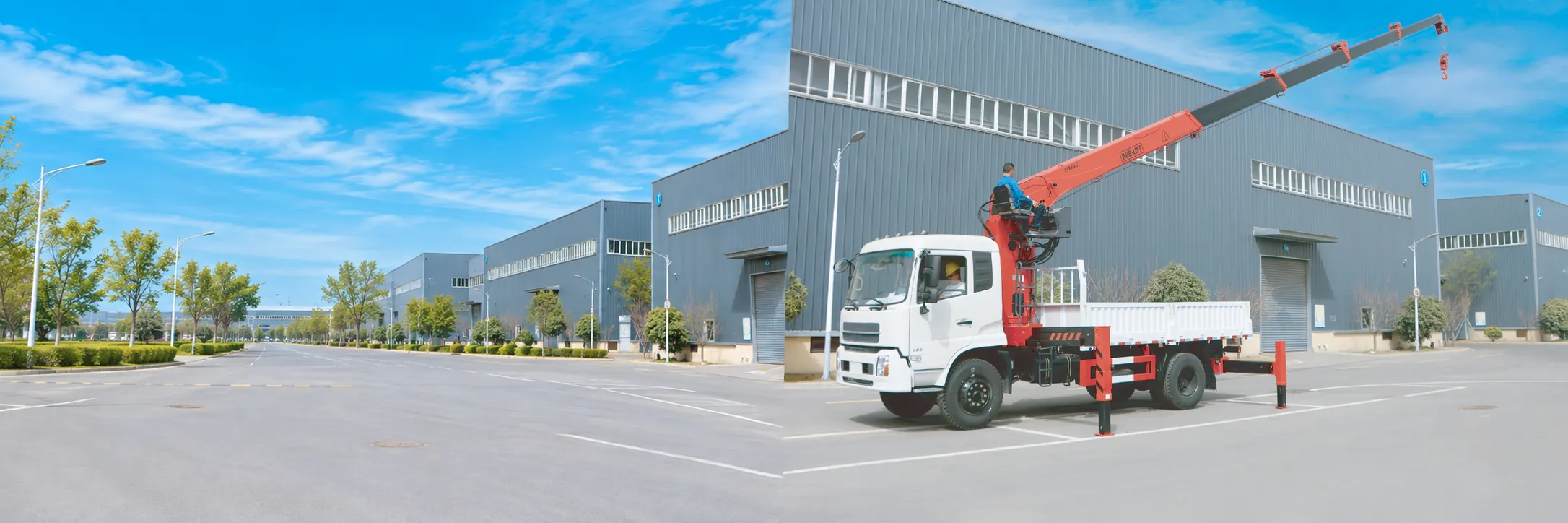

Crane pallet forks are a below-the-hook attachment with two tines that slide under a pallet. They let a crane lift palletised loads such as concrete blocks, bricks, bagged cement and boards without slinging each pack. They hang from the crane hook or from a rotator at the boom tip, and they are also sold as crane forks, a crane pallet lifter or brick forks. Builders use them to set pallets on roofs, scaffolds, upper floors and over walls. Two checks decide every lift: the rated load marked on the forks, and the crane’s load chart at the working radius with the weight of the forks, the net and the pallet included.
BOB-LIFT has built truck mounted cranes in Xuzhou since 2003. We manufacture the crane, not the forks: forks and nets come from a specialist supplier, and we confirm with you whether the crane’s hook, hydraulic functions and load chart are compatible with them. This guide explains the types of crane forks, what limits their capacity, how to keep a pallet secure on the tines, a step-by-step lifting sequence and the inspections the regulations require. It ends with a pallet of blocks checked against the load chart of a real BOB-LIFT SQ6.3ZA4 knuckle boom crane.
Key takeaways
- HSE’s LOLER code of practice lists crane forks among lifting accessories, next to slings, shackles, grabs and lifting beams [1].
- The forks carry a marked rated load, and the crane carries a rated load for each radius. The lower of the two governs, and the forks, net and pallet count as part of the crane’s load.
- A pallet on open tines can shed part of its load, so UK guidance identifies safety nets for palletised loads and metal strapping or plastic sheeting on pallets of bricks.
- Keep people out of the fall zone; US rules allow only listed exceptions, such as workers hooking, guiding or receiving the load. In Great Britain, crane forks need a thorough examination at least every 6 months.
- In our example, a 1,440 kg gross lift on an SQ6.3ZA4 has 580 kg spare at 6.3 m and only 60 kg at 8.3 m. At 10.2 m it is 250 kg over, so the same pallet must be divided into two lifts for the longest delivery radius.
What are crane pallet forks?
Crane forks consist of a hanger with an eye or link at the top, a vertical frame and two horizontal tines at the bottom. The crane picks up the hanger, the tines go under the pallet, and the load rides on the tines instead of in slings. Because the forks hang between the hook and the load, they are a below-the-hook lifting device. In the United States the reference standard for such devices is ASME B30.20, which covers “the marking, construction, installation, inspection, testing, maintenance, and operation of below-the-hook lifting devices” [2]. Our guide to below-the-hook lifting devices explains that standard and its design partner, ASME BTH-1.
In Great Britain the same item is a lifting accessory. Paragraph 29 of HSE’s L113 code of practice says lifting accessories “would include such items as slings, removable eyebolts, chains, ropes, shackles, grabs, magnets, vacuum lifters, crane forks, lifting beams and spreaders” [1]. That classification determines the marking and examination requirements described below. Our overview of knuckle boom crane attachments places forks next to grabs, augers and the winch.
Searches for “fork crane” or “crane forklift” often mean something else: a jib that mounts on a forklift truck’s carriage so the forklift can lift like a small crane. That product is covered in our forklift jib crane guide.
Types of crane forks
Crane forks differ in three ways: whether the tine spacing can change, how the hanger keeps the tines level, and how the forks connect to the crane.
| Type | How it works | Suits | Check before you buy |
|---|---|---|---|
| Fixed-tine forks | Tines fixed at one spacing on the frame | One pallet size, light and simple | Tine spacing and length against your pallets |
| Adjustable crane forks | Tines slide along a bar and lock at the spacing you set | Mixed pallet sizes and bundles | Locking method and the spacing range |
| Fixed-hanger forks | The hanger does not adjust, so the tines tilt if the load is not under the lifting eye | Even, repeatable loads | How far the tines may tilt under the manufacturer’s limits |
| Self-levelling forks | The hanger adjusts so the tines stay level as the load goes on and comes off; also sold as self-balancing forks | Loads that change during the lift, such as unloading at height | The maker’s instructions for the levelling range |
| Brick or block forks with a cage | Forks with a fitted cage or mesh guard around the pack | Loose or part-used packs of bricks and blocks | Guard condition and the rated load with the guard fitted |
| Rotator-mounted forks | Forks hung on a hydraulic rotator at a knuckle boom tip, turned from the controls | Lining a pallet up with a narrow opening | A spare hydraulic function and hoses to the tip |

Drywall crane forks are long-tine forks for board bundles; our guide to the drywall delivery crane covers board weights and how the fork connection is agreed with the crane supplier. Pallet forks for an overhead crane work the same way under a fixed hoist hook in a workshop. Whatever the type, the forks must hang from a hook with a working latch, as our crane hook guide explains.
How much can crane forks lift?
The first check is the marking. LOLER regulation 7 requires that accessories for lifting “are clearly marked to indicate their safe working loads”, and marked so that “it is possible to identify the characteristics necessary for their safe use” [3]. In US construction, 29 CFR 1926.251(a)(2) asks that rigging equipment has “permanently affixed and legible identification markings” showing the recommended safe working load, and is not used beyond it or without the marking [4]. Forks with no legible rating plate stay on the ground.
The fork rating also depends on where the load sits on the tines. The load centre is the horizontal distance from the fork frame to the centre of gravity of the load. A fork rating applies only at the load centre the manufacturer specifies, usually with the pallet positioned back against the frame. The further out the load’s centre of gravity sits, the larger the turning moment on the tines and the hanger. OSHA’s stability appendix for forklift trucks demonstrates the arithmetic on a fork-carried load. A truck rated at 3,000 pounds with a 24-inch load center has a maximum load moment of 72,000 inch-pounds, so a load with a 30-inch load center may weigh no more than 2,400 pounds [5]. A forklift rating describes the truck, not crane forks, but the leverage principle is identical. Keep the tines fully under the pallet, position the pallet back against the frame and use the fork manufacturer’s figure for any other position.
The second check concerns the crane itself. OSHA defines the load as the object hoisted together with “the load-attaching equipment, such as, the load block, ropes, slings, shackles, and any other ancillary attachment” [6]. L113 adds that the weight of lifting accessories should be considered part of the load and that equipment designed to contain the load, including pallets, “should be considered as part of the load” [1]. So the crane sees the blocks, the pallet, the forks, the net and the hook fitting. Our article on safe working load explains why the system rating is set by its lowest-rated part, and the guide on how to read a crane load chart shows where the radius figures come from.
How do you stop the load falling off the forks?
A pallet on open tines is held by gravity and friction alone. If the forks tilt, the pallet fractures or the load shifts, blocks can fall from height. Regulators in the United Kingdom, Australia and the United States point to the same controls.
- Nets or cages: HSE lists ways to stop loads falling, “including the use of multiple ropes or chains, hydraulic check valves and nets for palletised loads” [7]. The L113 guidance on regulation 6 also names “safety nets for palletised loads” [1]. A net goes over and under the pack and closes around the tines; a cage does the same job as a rigid guard.
- Intact packs: where a load could break up over people, L113 paragraph 251 gives the example of “lifting pallets of bricks which should be secured by metal strapping or plastic sheeting” [1]. Paragraph 122 adds that where banded or wrapped loads ride “on the forks of a forklift truck or in a net attached to crane hook”, the banding must withstand the stresses of hoisting and moving the load.
- Sound pallets: timber pallets are part of the load and “must be of adequate strength for the particular load and lifting operation”, and should be checked for damage [1].
- Secured for the whole route: Safe Work Australia’s general guide says “Crane-lifted loads should be slung and secured so the load or part of it cannot fall” [8]. Under 29 CFR 1926.1425(c)(1), where workers must be in the fall zone to hook or guide a load, “The materials being hoisted must be rigged to prevent unintentional displacement” [9].
The second control is separation from the load. The fall zone is the area, “including but not limited to the area directly beneath the load”, in which suspended materials could foreseeably fall in an accident, as OSHA defines it [6]. Under 1926.1425, while the operator is not moving a suspended load, only listed exceptions may be inside it, such as workers hooking, unhooking or guiding the load, and only employees needed to receive a load may be there while it is landed [9]. HSE adds that the equipment “should also be positioned to minimise the need to lift over people” [7]. Choose the truck position so that the route from deck to landing passes over no walkway, roadway or occupied scaffold.
How to lift a pallet with crane forks, step by step
- Know the weight. Take the pack weight from the delivery documentation or product data, then add the pallet, forks, net and hook fitting. Compare the total with the crane chart at the furthest landing radius.
- Inspect the forks. Before the shift, examine the rating plate, the tines, the hanger and the safety net. 29 CFR 1926.251(a)(1) requires rigging equipment to be inspected “prior to use on each shift”, and defective equipment is removed from service [4].
- Set the tines. Adjust the spacing to the pallet’s entry points and push the tines fully under, with the pallet against the frame.
- Secure the pack. Close the net or cage, and confirm the strapping or wrapping is intact.
- Lift a few centimetres and stop. Check that the tines sit level, the pack is stable and the crane’s limiter shows no warning.
- Control the swing. Use a tag line on the pallet, not on the forks’ hanger; our guide to the crane tag line covers where to attach it and where to stand.
- Land on a rated surface. A roof, scaffold loading bay or concrete slab must be capable of supporting the pallet; that verification belongs in the crane lift plan. Set the pallet down fully before the tines come out.
- Withdraw the forks. Slew or boom out slowly so the tines do not drag the pallet towards the edge.
The same order works for a concrete bucket and other below-the-hook tools; our guide to the concrete bucket for a crane shows the bucket version, and the guide to lifting clamps the version for steel plate. Roof trusses are long, flexible loads that do not sit on a pallet; the guide to lifting trusses with a crane covers them.
Crane forks on a knuckle boom crane: hook, rotator or self-levelling
On a knuckle boom truck mounted crane, forks hang either from the boom-tip hook or from a hydraulic rotator. A hook-hung fork is the simplest set-up, but the pallet can turn on the hook, so a tag line does the aligning. A rotator turns the forks from the controls, which helps when a pallet has to pass through a window or between scaffold standards. It needs a spare hydraulic function and hoses to the boom tip, and its own weight joins the forks on the load chart. Our drywall delivery crane guide lists the three connection questions to settle before ordering forks.
Self-levelling forks are worth considering when the load changes at height, for example when a crew takes blocks off the pallet while it hangs, because the tines stay level as the weight changes. Radio remote control lets the operator stand where the landing and the tines are both in view; our guide to truck crane remote control compares the options. For any BOB-LIFT crane, tell us the forks you plan to use and we confirm whether the tip connection, the hydraulics and the load chart suit them. The fork specification is then confirmed with the quotation.
How should crane forks be inspected and examined?
Before use, reject or quarantine the forks if you identify any of these defects:
- A missing or unreadable rating plate.
- Cracks in the tines, at the heel where tine meets frame, or in the welds of the hanger.
- Bent or twisted tines, or tines no longer at the same height.
- Wear, elongation or a crack at the lifting eye or top link.
- A tine lock or adjustment that does not hold.
- A torn net, a damaged cage or missing net fixings.
In Great Britain, LOLER regulation 9 requires an accessory for lifting to be thoroughly examined “at least every 6 months”, or in accordance with an examination scheme, and after exceptional circumstances [10]. The crane itself is on a 12-month cycle unless a scheme says otherwise. Our LOLER guide for lorry loaders covers reports, records and a sample examination calendar for a crane, forks and slings.
Example: a pallet of concrete blocks on a BOB-LIFT SQ6.3ZA4
Example scenario (an illustration, not a customer record): a builders’ merchant delivers concrete blocks to an upper floor with a BOB-LIFT SQ6.3ZA4 knuckle boom truck mounted crane. The crane operates with crane forks and a safety net. The crane figures come from the SQ6.3ZA4 dimension drawing and load chart; every other weight is ASSUMED. The SQ6.3ZA4 product page notes that this crane suits medium trucks “delivering blocks, bagged cement, pallets and precast items”.
- Crane: the SQ6.3ZA4 drawing lists 6,300 kg maximum lifting capacity, a 13.2 t·m lifting moment, a 2,180 kg crane weight, a working radius of 4,400 to 10,200 mm and an outrigger span of 2,290 to 5,606 mm.
- Pallet: 60 blocks at 20 kg each, 1,200 kg, on a 25 kg timber pallet: 1,225 kg on the tines (ASSUMED).
- Below the hook: forks 180 kg, safety net 10 kg and hook fitting 25 kg: 215 kg (ASSUMED). The forks are marked with a rated load of 2,000 kg (ASSUMED), so the pallet is within the fork rating.
- Gross load on the crane: 1,225 + 215 = 1,440 kg.

| Radius | Rated load (load chart) | Gross load 1,440 kg | Share of rating |
|---|---|---|---|
| 2.1 m | 6,300 kg | Passes, 4,860 kg spare | 23 percent |
| 4.4 m | 3,010 kg | Passes, 1,570 kg spare | 48 percent |
| 6.3 m | 2,020 kg | Passes, 580 kg spare | 71 percent |
| 8.3 m | 1,500 kg | Passes, 60 kg spare | 96 percent |
| 10.2 m | 1,190 kg | Fails, 250 kg over | 121 percent |

Out to 6.3 m the lift has a comfortable margin. At 8.3 m it passes with 60 kg in reserve, which leaves no allowance for a wet pallet, a heavier batch of blocks or a landing position slightly further out than planned. At 10.2 m, the crane’s longest chart radius, it fails by 250 kg. The chart gives values at five radii only; between two of them, we read the value at the next radius out rather than interpolate.
The forks, net and hook fitting weigh 215 kg, which is 15 percent of the gross load and 18 percent of the rated load at 10.2 m. For the far drop, the most the forks can carry is 1,190 − 215 = 975 kg; less the 25 kg pallet, that is 950 kg of blocks, or 47 blocks. Splitting the 60 blocks into two lifts of 30 puts 840 kg on the crane, 71 percent of its rating at 10.2 m. Lighter forks would also increase the payload, which is why the fork weight belongs in the purchasing decision.
Every BOB-LIFT crane is listed with a load moment limiter, as our article on the lifting moment of a crane explains, but the limiter is a final safeguard, not a method for establishing the weight. The full drawing and load chart are on the SQ6.3ZA4 product page.
Frequently asked questions
What are crane forks used for?
Crane forks let a crane lift palletised materials, such as concrete blocks, bricks, bagged cement, roof tiles and board bundles, onto roofs, scaffolds and upper floors or over boundary walls. The tines slide under the pallet, so the package does not need individual slings.
Does the weight of the forks count against the crane’s capacity?
Yes. The forks, the net or cage, the pallet and the hook fitting are all part of the load the crane lifts, so subtract them from the rated load at your working radius before you load the pallet.
What are self-levelling crane forks?
Self-levelling crane forks are forks whose hanger adjusts so the tines stay level as the load goes on or comes off, which helps when a pallet is unloaded at height. They are also sold as self-balancing crane forks; the levelling range is in the manufacturer’s instructions.
How often must crane forks be examined in the UK?
Crane forks are lifting accessories, so LOLER requires a thorough examination at least every 6 months, or as an examination scheme sets out, plus a check before each use.
Can I use crane forks with a BOB-LIFT crane?
Forks come from a specialist fork supplier, not from BOB-LIFT. Tell us the forks you plan to use and the loads you lift, and we confirm whether the hook, any rotator and the crane’s load chart suit them; the fork specification is confirmed with the quotation.
How we compiled this guide
The UK points come from HSE’s L113 code of practice for LOLER, HSE’s page on planning and organising lifting operations and LOLER regulations 7 and 9 on legislation.gov.uk. The US points are quoted from the official eCFR text of 29 CFR 1926.251, 1926.1401 and 1926.1425 and from OSHA’s stability appendix to 1910.178. The Australian point comes from Safe Work Australia’s general guide for cranes, and the ASME B30.20 scope from the ASME website. All were read in November 2026. The crane figures come from the BOB-LIFT SQ6.3ZA4 dimension drawing, load chart and product page; the pallet, block, fork, net and hook weights in the example are assumed and marked as such. Achord Chan, Product Operations Director, carried out the editorial review. This guide does not replace the fork manufacturer’s instructions, the crane’s operator’s manual or the rules where you work.
Delivering pallets with a crane?
Tell us your heaviest pallet, the forks you plan to use and the furthest landing point from the truck. We will check the lift against the load chart of a suitable knuckle boom truck mounted crane and send its dimension drawing and load chart. If you buy the truck in China, we can fit the crane at our factory; if you buy it locally, we ship the crane, a local body builder fits it and we support the work remotely. Contact us for a quotation; every crane carries a 12-month warranty on the whole machine.