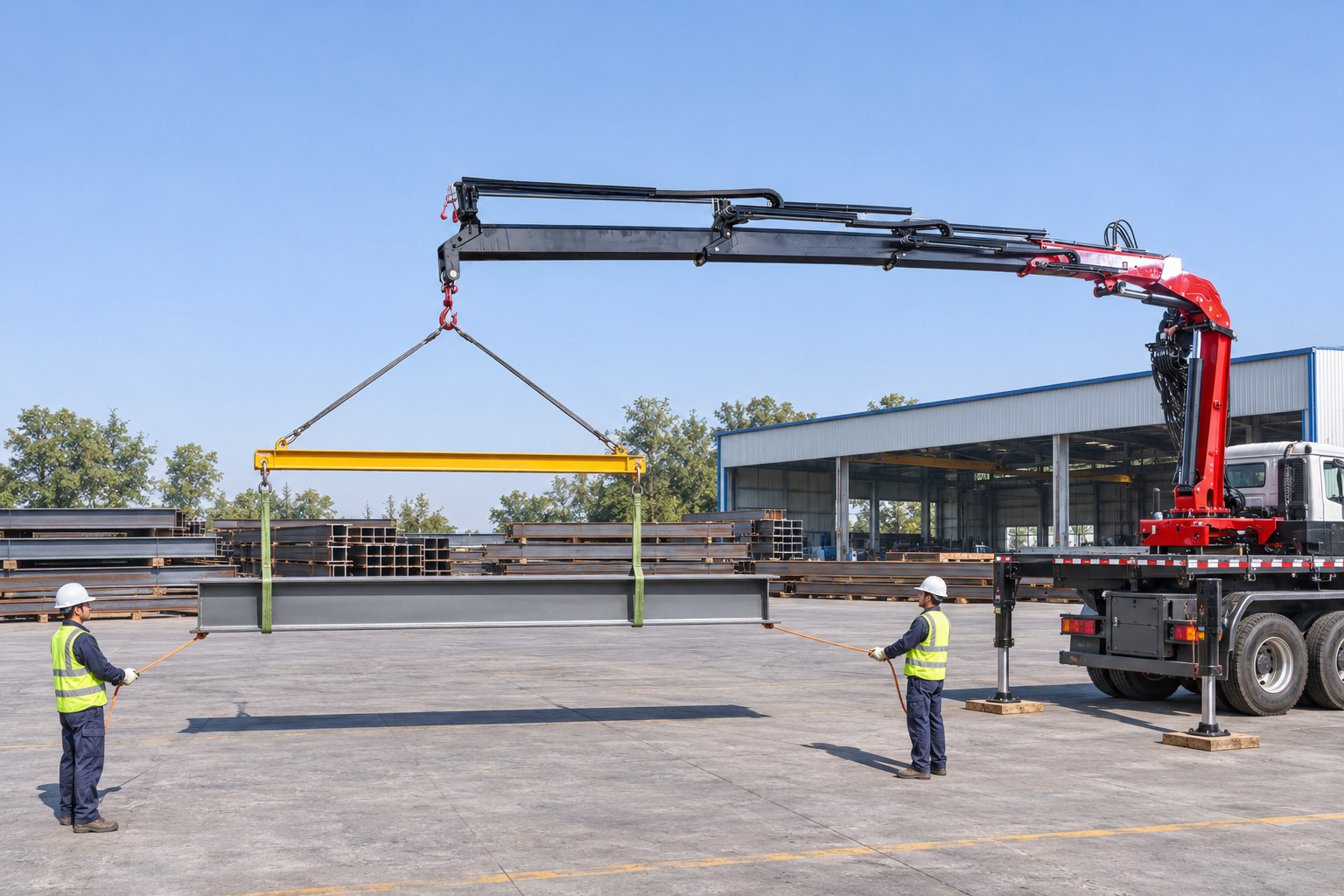

A concrete bucket for a crane is a steel container that hangs from the crane hook and is filled with fresh concrete at the truck. The crane then swings it over the pour, where a gate in its base or side lets the concrete out. To choose one, work out the full weight first: the concrete in the bucket, plus the empty bucket, plus the rigging. Then compare that total with the crane’s rated load at the radius of the furthest point you have to pour.
BOB-LIFT has built truck mounted cranes in Xuzhou since 2003, and we supply the crane only, so the bucket, slings and truck come from other suppliers. This guide explains the common bucket types and sizes, how to calculate the weight of a full bucket in kilograms and pounds, and how to read that weight against three of our knuckle boom load charts. It also quotes the US rules that apply to concrete buckets.
Key takeaways
- Full bucket weight = bucket volume × concrete density + empty bucket weight + rigging. At about 2,400 kg/m³, the concrete in a 1 yd³ bucket alone weighs about 1,835 kg (4,045 lb).
- Take the empty weight and rated capacity from the bucket’s own plate or data sheet; never guess them.
- Read the crane’s rated load at the radius of the far edge of the pour, and use the next chart point out if the radius falls between two points.
- In our example at 12 m, a 0.5 yd³ bucket with the assumed bucket and rigging weights is 27 kg too heavy for an 8 t knuckle boom crane. A 12 t crane carries it with 213 kg to spare.
- US rules say nobody may ride a concrete bucket or work under one while it is being raised or lowered, and buckets with hydraulic or pneumatic gates need positive safety latches or similar safety devices.
What is a concrete bucket for a crane?
It is a hook-hung container for placing concrete where a chute or pump cannot reach, such as columns, walls, footings, small slabs and upper floors. The bucket hangs from a lifting bail or eye, is filled from the ready-mix truck, and is emptied through a discharge gate. Site crews also call it a crane bucket, a crane cement bucket, a concrete skip or a concrete hopper, and the US crane rules use “concrete hopper or concrete bucket” side by side.
- A lay-down bucket is filled while lying on its side on the ground, so the truck chute can reach it at a low height, and the crane then lifts it upright. It suits sites where the truck chute cannot reach the top of an upright bucket.
- An upright bucket is filled from above while standing vertically, so the chute must reach over its rim. It suits sites where the truck chute, a conveyor or a second bucket can reach over the rim comfortably.
- Gate types: a lever-operated gate at the bottom is the common manual design, while some buckets have a hydraulic or pneumatic gate operated from a control. Some buckets also have a side outlet or a flexible discharge sleeve for placing concrete into narrow wall and column forms.
A skid-steer concrete bucket, which carries and tips concrete on a loader’s arms, is a different tool and is not lifted by a crane hook. A clamshell bucket for a crane is a grab for loose material such as sand or gravel rather than a container for concrete, and our guide to knuckle boom crane attachments covers grabs and clamshells. A concrete bucket is one of many below-the-hook items that hang between the hook and the load, as our guide to below-the-hook lifting devices explains.
What sizes do crane concrete buckets come in?
In the US, crane concrete buckets are sold by nominal volume in cubic yards, commonly from a quarter of a yard up to two yards and more, while metric markets size them in cubic metres or litres. To convert, NIST’s Guide to the SI, Appendix B.9 gives 1 cubic yard = 0.7645549 m³ [1]. A 1 yard concrete bucket therefore holds about 0.76 m³ (765 litres), and a 2 yard concrete bucket about 1.53 m³.
The nominal volume is the level-full capacity of the bucket, so a heaped load weighs more than the table below shows. Check the volume marked on the bucket rather than the size it was sold as, because two buckets sold as “half-yard” can differ.
How much does a full concrete bucket weigh?
Concrete weight = volume in m³ × density in kg/m³. The density of concrete “varies, but is around 2,400 kilograms per cubic metre (150 lb/cu ft)”, according to Wikipedia’s article on the properties of concrete [2]. With 1 lb = 0.4535924 kg from the same NIST table, the concrete alone in each common bucket size weighs as follows.
| Bucket size | Volume (m³) | Concrete only (kg) | Concrete only (lb) |
|---|---|---|---|
| 1/4 yd³ | 0.191 | 459 | 1,011 |
| 1/2 yd³ | 0.382 | 917 | 2,023 |
| 3/4 yd³ | 0.573 | 1,376 | 3,034 |
| 1 yd³ | 0.765 | 1,835 | 4,045 |
| 1 1/2 yd³ | 1.147 | 2,752 | 6,068 |
| 2 yd³ | 1.529 | 3,670 | 8,091 |
The full bucket weight is what the crane actually lifts: the concrete, the empty bucket and everything between the bucket and the hook. Empty weights vary widely with size, gate type and construction, so read the empty weight and the rated capacity from the bucket’s plate or the supplier’s data sheet. Your mix also matters, because heavyweight aggregates, steel fibres or a wetter or drier mix change the density, and the ready-mix supplier can tell you the unit weight of the mix you ordered.
US crane regulations accept this kind of calculation from measured dimensions and a published density. Under 29 CFR 1926.1417(o)(3), the operator must verify that the load is within the crane’s rated capacity. One accepted method, in paragraph (i), is a load weight determined “from a source recognized by the industry (such as the load’s manufacturer), or by a calculation method recognized by the industry”. When the operator requests it, that information must be provided before the lift [3].
How do you match a bucket to a crane’s load chart?
Begin with the geometry, because the working radius decides everything else. The working radius is the horizontal distance from the crane’s slewing centre to the furthest point where the bucket must hang over the pour. Then read the rated load at that radius from the load chart, and if the radius falls between two chart points, use the point further out. The full bucket weight, including every component below the hook, must not exceed that figure. Our guide on how to read a crane load chart walks through the reading step by step, and our article on safe working load explains why the hook, slings and bucket all count against the rating.

The chart illustrates why the bucket size and the working radius have to be chosen together rather than separately. Near 12 m, an 8 t knuckle boom crane runs out of capacity before a 3/4 yd³ bucket of concrete alone, and a 12 t crane stops between 3/4 and 1 yd³. A 20 t crane covers 1 yd³ comfortably, but not a 1 1/2 yd³ bucket. Positioning the truck closer to the pour moves every crane to a higher point on its load chart, which effectively raises each of those horizontal lines.
Which BOB-LIFT cranes suit concrete bucket work?
Bucket work needs useful capacity at long radius rather than a high headline tonnage. We therefore compare an 8 t, a 12 t and a 20 t knuckle boom truck mounted crane at the radii a pour typically needs. All figures come directly from each crane’s dimension drawing and load chart, without interpolation between the published radii.
| Figure from the drawing | SQ8ZA6 | SQ12ZA6 | SQZ430 |
|---|---|---|---|
| Maximum lifting capacity / moment | 8,000 kg / 16 t·m | 12,000 kg / 27 t·m | 20,000 kg / 42.3 t·m |
| Rated load, radius near 8 m | 1,820 kg at 8,510 mm | 2,500 kg at 8,190 mm | 4,550 kg at 7.8 m |
| Rated load, radius near 10 m | 1,420 kg at 10,560 mm | 1,850 kg at 10,100 mm | 3,430 kg at 9.9 m |
| Rated load, radius near 12 m | 1,160 kg at 12,630 mm | 1,400 kg at 12,200 mm | 2,730 kg at 12.0 m |
| Maximum radius, rated load | 14,680 mm, 850 kg | 14,500 mm, 1,000 kg | 16.6 m, 1,910 kg |
| Outrigger span | 2,310–5,610 mm | 2,316–5,706 mm | 2,300–6,600 mm |
| Crane self weight | 3,450 kg | 4,800 kg | 5,500 kg |
The SQZ430 chart requires one additional explanation, because it lists up to four rated loads at each radius, for example 2,730, 2,930 and 3,140 kg at 12.0 m. The figure depends on how the boom is configured to reach that radius. Plan bucket lifts on the lowest figure unless the operator’s manual confirms the configuration you will actually use.

The full drawing and load chart for each crane are on its product page: the SQ8ZA6, the SQ12ZA6 and the SQZ430. Every BOB-LIFT crane is listed with a load moment limiter, as our article on the lifting moment of a crane explains, and our load moment indicator guide describes what such a device can and cannot detect. It is a backstop, however, not a substitute for calculating the bucket weight before the pour.

Example: a slab pour 12 m from the crane
Example scenario (an illustration, not a customer record): a contractor pours a small slab with a 1/2 yd³ upright bucket. The far edge of the slab is 12 m from the crane’s slewing centre. The bucket and rigging weights below are ASSUMED for the example, not data for any real bucket.
- Concrete: 0.5 yd³ × 0.7645549 × 2,400 kg/m³ = 917 kg.
- Empty bucket: an ASSUMED 250 kg, which on a real job would come from the bucket’s plate.
- Rigging: an ASSUMED 20 kg for a shackle and a short sling between the bail and the hook.
- Full bucket weight: 917 + 250 + 20 = 1,187 kg.
The SQ8ZA6 does not pass, because its next chart point beyond 12 m is 1,160 kg at 12,630 mm, which is 27 kg short, even though the concrete alone would fit. The SQ12ZA6 passes, reading 1,400 kg at 12,200 mm and leaving 213 kg in hand. The SQZ430 reads 2,730 kg at 12.0 m on its lowest row, which leaves room for a 1 yd³ bucket too. That load would be 1,835 kg of concrete plus an ASSUMED 400 kg bucket and 20 kg of rigging, or 2,255 kg in total.
Two practical changes would allow the 8 t crane to complete the job without exceeding its rating. Parking 1.5 m closer brings the far edge to 10.5 m, inside the SQ8ZA6’s chart point of 1,420 kg at 10,560 mm. Alternatively, keep the truck where it is and only part-fill the bucket for the far bays. Either decision belongs in the lift plan before the truck arrives, not on the slab while the concrete is setting.
How does discharging concrete affect the crane?
Opening the gate removes most of the load from the hook within seconds, and a hydraulic boom that was carrying a full bucket reacts to that sudden change. A swinging bucket also pulls sideways on the boom tip, and the US crane standard states that “The equipment must not be used to drag or pull loads sideways” under 1926.1417(q) [3]. Run the crane smoothly, bring the bucket to a stop low over the pour before the gate is opened, and open the gate gradually rather than snapping it open with the boom at full extension. Follow the crane’s operator’s manual for the crane and the bucket supplier’s operating instructions for the bucket.
The design of the bucket matters for a similar reason, because residual material changes the weight from one lift to the next. Concrete that sticks inside the bucket adds weight to the next lift and can fall off later. The US rules also require that “Concrete buckets shall be designed to prevent concrete from hanging up on top and the sides” [4]. Cleaning and maintaining the bucket is the bucket owner’s job, as is washing it out after each pour.
What do the OSHA rules say about concrete buckets?
In the US, subpart Q of 29 CFR part 1926 covers concrete and masonry construction and contains three short rules on buckets. Subpart CC, the crane standard, adds a fall zone rule that names concrete buckets directly. The text below is quoted from the official 2023 edition of the Code of Federal Regulations.
| Rule | What it says |
|---|---|
| 1926.701(d) Riding concrete buckets | “No employee shall be permitted to ride concrete buckets.” [5] |
| 1926.701(e)(1) Working under loads | “No employee shall be permitted to work under concrete buckets while buckets are being elevated or lowered into position.” [5] |
| 1926.701(e)(2) | “To the extent practical, elevated concrete buckets shall be routed so that no employee, or the fewest number of employees, are exposed to the hazards associated with falling concrete buckets.” [5] |
| 1926.702(f)(1) Concrete buckets | “Concrete buckets equipped with hydraulic or pneumatic gates shall have positive safety latches or similar safety devices installed to prevent premature or accidental dumping.” [4] |
| 1926.702(f)(2) | “Concrete buckets shall be designed to prevent concrete from hanging up on top and the sides.” [4] |
| 1926.1425(b)(3) Keeping clear of the load | While the operator is not moving a suspended load, nobody may be in the fall zone except listed employees, including those “Operating a concrete hopper or concrete bucket.” [6] |
Read 1926.1425(b)(3) and 1926.701(e)(1) together, because each one qualifies the other. The worker who opens the gate may stand in the fall zone while the bucket hangs still over the pour, but nobody may work under the bucket while it is being raised or lowered into position. Paragraph (a) of 1926.1425 also says that “hoisting routes that minimize the exposure of employees to hoisted loads must be used” where available. Plan the swing path from the truck to the slab around the crew rather than over it. Outside the US, apply your own national rules, which may be worded differently.
How do you set up the crane for a bucket pour?
A pour cannot be stopped halfway to move the crane, so the set-up has to be right before the first truck arrives. The following crane-side preparations are each covered in more detail in a separate, linked guide on this website.
- Outriggers and ground: new sites often have soft fill and trenches next to the forms, and a full bucket at long radius puts high loads on the outrigger feet. Check the ground with our guide to outriggers and ground bearing pressure, and use pads or crane mats where the ground needs them.
- Lift plan: write down the truck position, the furthest radius, the full bucket weight and the swing path, using our crane lift plan template.
- Signals: the operator often cannot see the slab, so agree hand or radio signals with the person at the gate, using our guide to crane hand signals.
- Power lines: street lines often run beside small building sites, so follow our crane power line safety guide before choosing the truck position.
- Wind: a bucket swinging on the hook is hard to stop precisely, so set a stop limit before the job, as described in our page on crane wind speed limits.
A radio remote control helps a great deal with bucket work, because the operator can stand where both the bucket and the forms are visible and place each load precisely. Our guide to truck crane remote control compares the options. A knuckle boom places the bucket with the boom tip close above the pour, which limits swing. By contrast, a telescopic truck mounted crane lifts on its winch rope and gives more hook height but a longer, more pendulous line. Our knuckle boom vs telescopic boom comparison looks at five real pairs side by side.
How is the crane fitted to your truck?
We supply the crane, and the truck is supplied separately by a dealer of your choice. If you buy the truck in China, we can fit the crane at our factory. If you buy the truck locally, we ship the crane only, a local body builder fits it, and we support the fitting remotely. The crane’s self weight, from 3,450 kg for the SQ8ZA6 to 5,500 kg for the SQZ430, comes out of the truck’s payload, and our truck mounted crane installation guide covers the subframe and mounting work.
Frequently asked questions
How much does a 1 yard concrete bucket weigh when full?
The concrete alone weighs about 1,835 kg (4,045 lb), based on 0.7646 m³ at around 2,400 kg/m³. Add the empty bucket weight from the bucket’s plate and the weight of the rigging to get the full load the crane must lift.
What size crane do I need for a concrete bucket?
Choose a crane whose rated load at the furthest pour radius is at least the full bucket weight. In our example at 12 m, a 1/2 yd³ bucket was just too heavy for an 8 t knuckle boom crane but fitted a 12 t crane, while a 1 yd³ bucket needed the 20 t SQZ430.
Can a knuckle boom crane lift a concrete bucket?
Yes, provided the full bucket weight is within the rated load at the working radius and the bucket hangs from the hook on suitable rigging. The knuckle boom’s short line from the boom tip to the bucket helps place concrete accurately.
Is a concrete hopper the same as a concrete bucket?
On site the two names are often used for the same hook-hung container, and the US crane standard lists “a concrete hopper or concrete bucket” together. Whatever it is called, check its rated capacity and empty weight on the plate.
Can a worker stand under a concrete bucket?
Not while it is being raised, lowered or otherwise moved into position. Under US rules, nobody may work under a concrete bucket while it is being raised or lowered into position, and nobody may ride one. The worker operating the gate may be in the fall zone while the bucket hangs still over the pour.
How we compiled this guide
The bucket rules come from the official 2023 edition of 29 CFR part 1926 on govinfo.gov, specifically sections 1926.701, 1926.702, 1926.1417 and 1926.1425. The unit conversions come from NIST Special Publication 811, and the concrete density from Wikipedia’s article on the properties of concrete, all read in November 2026. The crane figures come from the current BOB-LIFT dimension drawings and load charts for the SQ8ZA6, SQ12ZA6 and SQZ430, and the video is a factory film of the SQZ430. The example uses clearly marked assumed bucket and rigging weights, and Achord Chan, Product Operations Director, reviewed the guide before publication. It does not replace the bucket supplier’s instructions, the crane’s operator’s manual or the rules where you work.
Need a crane for concrete bucket work?
Tell us your bucket size and its empty weight, the furthest radius you pour at, and the truck you will mount the crane on. We will recommend a knuckle boom truck mounted crane and send its dimension drawing and load chart, so you can check the full bucket against the rated load yourself. Contact us for a quotation and a load chart check; every crane carries a 12-month warranty on the whole machine.