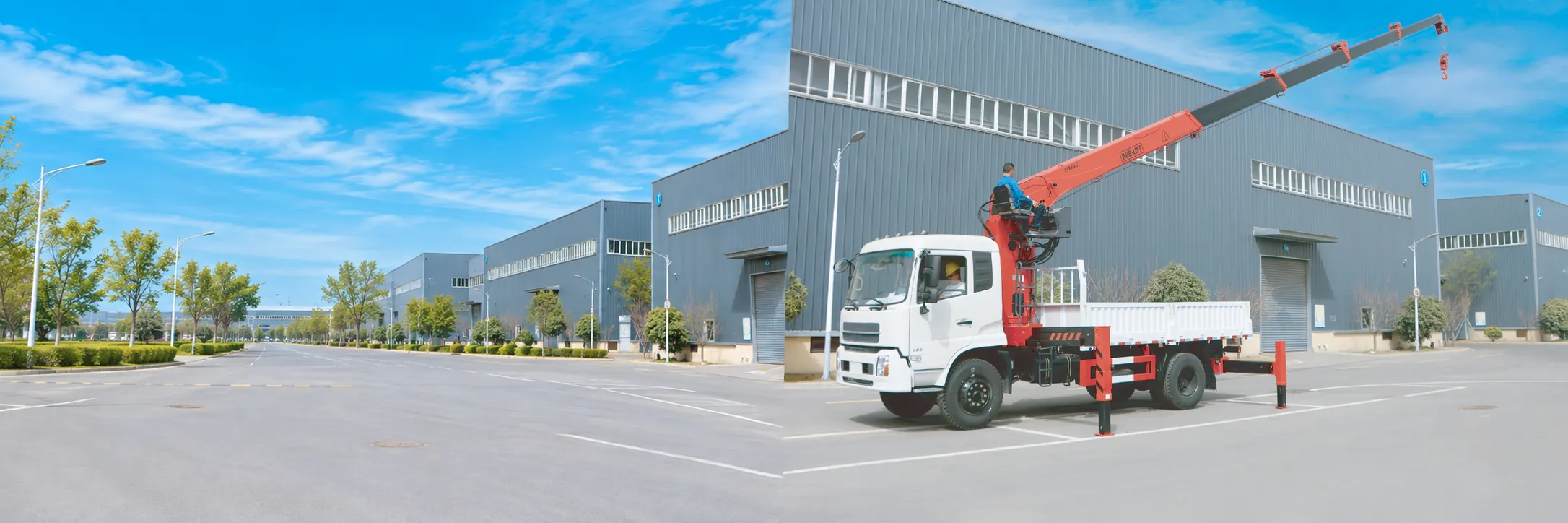

The crane boom angle is the angle between the boom and the horizontal, so a flat boom sits at 0° and a steeper boom has a higher angle. There is no single maximum that applies to every crane: the maximum boom angle is the highest angle that the manufacturer’s load chart lists for that particular model. On our telescopic truck cranes the load charts run from 0° up to a maximum of 75°, while some of our knuckle boom charts are drawn up to 84°. Above the last angle printed on the chart, the crane simply has no rated capacity.
BOB-LIFT has manufactured truck mounted cranes in Xuzhou since 2003, and every model comes with a dimension drawing and a load chart. This guide uses those drawings to explain what boom angle means, how it connects boom length with working radius, why capacity increases as the boom goes up, why there is still an upper limit, and which safety devices limit or display the angle under the OSHA crane regulations.
You can browse every model in our truck mounted crane range, from 1.6 to 50 t knuckle boom cranes to 2 to 20 t telescopic boom cranes.
Key takeaways
- Boom angle is measured from the horizontal: 0° is a flat boom, and a steeper boom has a higher angle.
- The maximum boom angle is set by the load chart. Our SQ5SA4, SQ10SA4 and SQ20SA5 telescopic charts all stop at 75°.
- Working radius is approximately boom length multiplied by the cosine of the angle. On our SQ20SA5, this simple formula lands within half a metre of the real chart.
- Raising the boom shortens the radius, so the rated load increases: the SQ20SA5 lifts 1,500 kg with its longest boom flat and 4,000 kg at 75°.
- The only safe angle for a lift is one that the load chart lists for that boom length and load. An empty cell means no rating.
- OSHA calls the device that limits the boom at its highest position a boom stop, although hydraulic booms are exempt from boom stops under 29 CFR 1926.1415.
What is a crane boom angle?
The boom angle of a crane is the angle between the boom’s centreline and a level line. OSHA’s general crane regulation, 29 CFR 1910.180(a)(14), defines it as “the angle between the longitudinal centerline of the boom and the horizontal”, where the centreline runs from the boom foot pin to the boom point sheave pin.
Consequently, a boom lying flat is at 0°, and a boom pointing straight up would be at 90°, a position that no truck crane actually works in. The operator reads the angle from a boom angle indicator, which the construction crane regulation defines as “a device which measures the angle of the boom relative to horizontal” (29 CFR 1926.1401).
Boom angle matters because it is one of three connected inputs to every lift on a telescopic crane, together with boom length and working radius. If you change one of them, at least one of the other two changes as well, and the rated load changes with it.
What is the maximum angle for a crane boom?
The maximum angle for a crane boom is the highest angle printed on that crane’s load chart. It is a design limit rather than a universal rule, so two different cranes can have different maximums. The previous version of this page quoted wide ranges for entire crane categories without any source, so we have replaced them with the figures from our own technical drawings.
| Model (type) | Angles on the drawing | Note from the chart | Load at the top angle, longest boom |
|---|---|---|---|
| SQ5SA4 (telescopic, 5,000 kg) | 0° to 75° | The shortest boom is rated only up to 50° and the second boom up to 60° | 2,000 kg (12 m boom, 75°) |
| SQ10SA4 (telescopic, 10,000 kg) | 0° to 75° | The shortest boom is rated only up to 60° | 3,400 kg (longest boom, 75°) |
| SQ20SA5 (telescopic, 20,000 kg) | 0° to 75° | The shortest boom is rated up to 70°, where it lifts 20,000 kg at 2 m | 4,000 kg (longest boom, 75°) |
| SQ5ZA4 (knuckle boom, 5,000 kg) | 0° to 75° | Loads are listed by radius, from 5,000 kg near the column to 700 kg at full reach | Read by radius, not by angle |
| SQ10ZA4 (knuckle boom, 10,000 kg) | 0° to 84° | Loads are listed by radius, from 10,000 kg at 2 m to 1,880 kg at full reach | Read by radius, not by angle |
Two important details stand out from this comparison. First, the lowest angle on every one of these charts is 0°, a horizontal boom, which gives the longest working radius. Second, the shortest boom is often not rated at the highest angles at all: on the SQ5SA4, for example, the shortest boom stops at 50°. An empty cell is therefore not an invitation to estimate; it means the crane has no rated load in that position.
Lattice boom crawler cranes follow the same principle, although their angle range depends on the specific boom and jib configuration, so it can only come from that crane’s own chart. For that reason, we do not quote a general range for them here.
How boom angle, boom length and working radius relate
The working radius is the horizontal distance from the centre of rotation to the hook. For a straight telescopic boom, simple trigonometry provides a reasonable estimate:
Working radius ≈ boom length × cos(boom angle) + small offsets
The offsets exist because the boom foot pin is not located exactly on the slewing centre, and because the hook hangs from the sheave rather than from the very tip of the steel structure. That is why the result is only an approximation. You can also reverse the formula to estimate the angle: boom angle ≈ arccos(radius ÷ boom length), which is the calculation behind every online “boom angle calculator”.
Worked example with a real drawing. The SQ20SA5 twenty ton telescopic crane has a boom of twenty-two and a half metres at full extension. The following table compares the formula with the radius printed on its technical drawing.
| Boom angle | Boom length × cos(angle) | Radius on the SQ20SA5 chart | Rated load on the chart |
|---|---|---|---|
| 0° | 22.5 m | 22.0 m | 1,500 kg |
| 30° | 19.5 m | 19.1 m | 2,430 kg |
| 60° | 11.3 m | 11.1 m | 3,600 kg |
| 75° | 5.8 m | 5.70 m | 4,000 kg |
The formula lands within half a metre of the chart at every angle, and it also works in the opposite direction. Suppose you need to place a load six metres from the slewing centre with the third boom length of an SQ10SA4, which is roughly twelve and a half metres. Dividing six by the exact length on the drawing and taking the arccos gives approximately 61°. The SQ10SA4 chart lists a radius of about six metres at 60° for that boom, with a rated load of 3,000 kg, so you would plan the lift using that row.
Quick geometry table: boom length and angle to radius
This table is pure geometry, boom length multiplied by the cosine of the angle, without any offsets. Use it to visualise how quickly the radius shrinks as the boom rises. It is not a load chart, and it says nothing about what any particular crane can lift.
| Boom length | 0° | 30° | 45° | 60° | 75° |
|---|---|---|---|---|---|
| 10 m | 10 m | 8.7 m | 7.1 m | 5 m | 2.6 m |
| 15 m | 15 m | 13 m | 10.6 m | 7.5 m | 3.9 m |
| 20 m | 20 m | 17.3 m | 14.1 m | 10 m | 5.2 m |
Notice that the first 30° of elevation costs relatively little radius, whereas the final 15° removes a considerable amount. Boom length works in the opposite way: a longer boom provides more radius at every angle, but it is also heavier, which is why a long boom lifts less. Our article on what a telescopic boom crane is explains how the boom sections and hydraulic cylinders determine that length.
For what the boom sections and cylinders do, and how boom length relates to lifting height, see our crane boom guide.
Why capacity rises as the boom goes up
A crane tips over when the turning effect of the load, which is the load multiplied by the radius, exceeds the stability of the crane and the truck. Raising the boom moves the hook closer to the slewing centre, so the radius decreases and the same crane can hold a heavier load. Our guide to the lifting moment of a crane explains that relationship in more detail.
The manufacturer’s charts demonstrate this relationship clearly. With its longest boom, the SQ20SA5 is rated at 1,500 kg when horizontal and 4,000 kg at 75°. Similarly, with its longest boom the SQ10SA4 increases from 1,050 kg at 0° to 3,400 kg at 75°. The chart below plots the complete SQ10SA4 table.

To interpret a chart like this step by step, see our guide on how to read a crane load chart.
Why is there still a maximum boom angle?
If a higher angle allows a heavier load, it is reasonable to ask why the boom is not simply raised to 90°. There are four practical engineering reasons.
- The benefit disappears. Near the top of the range, each additional degree saves very little radius. On the SQ5SA4 with its third boom length, the rated load is 2,200 kg at both 70° and 75°, because other limits, such as the strength of the boom and the hoist, take over.
- The boom could fall backwards. OSHA describes boom stops as devices that restrict the boom “from moving above a certain maximum angle and toppling over backward” in its crane definitions. A load swinging close to a steep boom can push it back.
- The boom is designed for a set range. On a hydraulic crane, the luffing cylinder holds the boom up, and the crane is designed and charted only up to the top angle that the drawing shows.
- Short booms run out of space. A short boom at a steep angle places the hook very close to the column, which is why the shortest boom of the SQ10SA4 has no rating at 70° or 75°.
What is the safe angle for crane lifting?
The safe angle for crane lifting is any angle that the manufacturer’s load chart lists for your boom length, with a rated load equal to or greater than the combined weight of your load and rigging. Nothing outside the chart is safe, however reasonable it might look on site, and there is no universal “best” angle that suits every crane.
In practice, the operator or lift planner should verify the following points before every lift:
- Find the row for your boom length and angle, or for the radius you need.
- If your radius falls between two rows, use the row with the longer radius and the lower load.
- Treat empty cells and dashes as positions that are not permitted.
- Add the weight of the hook, slings and any attachment to the weight of the load.
- Set up the outriggers exactly as the manual requires, because the chart assumes them. Our guide to crane outriggers and ground bearing pressure explains the procedure.
Devices that limit or show the boom angle
In the United States, the construction crane regulation in 29 CFR Subpart CC specifies which devices a crane must carry. Its scope includes articulating (knuckle boom) cranes and commercial truck-mounted cranes, among many other types (29 CFR 1926.1400). The devices that relate to boom angle are the following.
- Boom stop. This is the device that limits the boom at its highest position. According to 29 CFR 1910.180(a)(16), “the boom stop is a device used to limit the angle of the boom at the highest position.” 29 CFR 1926.1415(a)(2) requires boom stops “except for derricks and hydraulic booms”.
- Jib stop. Section 1926.1415(a)(3) requires jib stops whenever a jib is attached, and the definitions section describes a jib stop as “the same type of device as a boom stop but is for a fixed or luffing jib”.
- Boom hoist limiting device. Under 29 CFR 1926.1416(d)(1), equipment manufactured after December 16, 1969 needs one. It “disengages boom hoist power when the boom reaches a predetermined operating angle”, in the words of the definitions section. It is a Category I operational aid, so a defect must be repaired within seven calendar days.
- Boom angle or radius indicator. Section 1926.1416(e)(1) requires an indicator “readable from the operator’s station”. It is a Category II operational aid with thirty calendar days for repair, and until then the angle or radius must be determined with a measuring device.
- Load moment limiter. According to the OSHA definitions, this system senses “load multiplied by radius” and, when rated capacity is reached, shuts off the functions that would increase the loading. Under 1926.1416(e)(4), most equipment manufactured after March 29, 2003 with a rated capacity above 6,000 pounds needs a load weighing device, a load moment indicator or a load moment limiter.
Under 1926.1415(b), operations must not begin unless all the required safety devices are in proper working order. Many crane examination questions quote older wording. For example, the previous construction rule, 29 CFR 1926.550(b)(1) in the 2010 edition, stated that on crawler, locomotive and truck cranes “all jibs shall have positive stops to prevent their movement of more than 5° above the straight line of the jib and boom”, and added that cable type belly slings do not constitute compliance.
The voluntary ASME standards are also divided by crane type: ASME B30.5 covers mobile and locomotive cranes and excludes knuckle boom cranes from its scope, whereas ASME B30.22 covers articulating boom cranes.
Boom angle on a knuckle boom crane
A knuckle boom crane has two main booms connected by a pin, the inner boom and the outer boom, plus hydraulic extensions on the outer boom. As a result, there is no single “boom angle” that determines the radius: the same radius can be reached with the inner boom steep and the outer boom flat, or the other way round.
That is why knuckle boom load charts list the load by radius rather than by angle. The SQ10ZA4 chart draws the outer boom rotating around the knuckle from 0° up to 84°, but the rated loads are listed against radii from two metres to full reach. The SQ5ZA4 chart is drawn from 0° to 75°. The American regulation reflects this difference as well: 1926.1416(a)(1) states that the boom angle indicator requirement in (e)(1) does not apply to articulating cranes, and (e)(4)(ii) requires an overload prevention device or load moment system on articulating cranes manufactured after November 8, 2011.

For a knuckle boom crane, locate your radius on the chart and read the rated load from there. Our comparison of knuckle boom vs telescopic boom truck cranes covers the other differences between the two designs.
Boom deflection: why the formula is only a guide
A long telescopic boom is not perfectly rigid, and under load it bends slightly, which is known as boom deflection, so the hook can sit a little further out than the unloaded geometry suggests. In addition, the load swings outwards when the crane slews quickly. Combined with the offsets at the foot pin and the boom head, these effects mean the formula can only ever provide an estimate. Therefore, plan with the formula, but lift with the load chart and the crane’s own indicators.
Regular inspections are equally important, so add the angle indicator, the limiting devices and the luffing cylinder to the routine in our truck mounted crane inspection checklist.
Frequently asked questions
What is the maximum angle for a crane boom?
It is the highest angle on that crane’s load chart. Our SQ5SA4, SQ10SA4 and SQ20SA5 telescopic truck cranes are charted from 0° to 75°, the SQ5ZA4 knuckle boom chart is drawn to 75° and the SQ10ZA4 chart to 84°, while other cranes have their own limits.
What is the safe angle for crane lifting?
Any angle that the manufacturer’s load chart lists for your boom length, where the rated load is at least the weight of the load plus the rigging. Empty cells mean there is no rating, and angles beyond the chart are never safe.
What crane device limits the angle of the boom at its highest position?
It is called the boom stop: 29 CFR 1910.180(a)(16) defines it as “a device used to limit the angle of the boom at the highest position”, and 29 CFR 1926.1415(a)(2) requires boom stops on construction cranes, except derricks and hydraulic booms.
Must crawler, locomotive and truck crane jibs have positive stops?
Yes, under the historical construction regulation. The previous rule, 29 CFR 1926.550(b)(1), required positive stops to prevent jibs from moving more than 5° above the straight line of the jib and boom. Today, 29 CFR 1926.1415(a)(3) requires jib stops whenever a jib is attached.
How do you calculate a crane boom angle?
Use the formula boom angle ≈ arccos(working radius ÷ boom length). For a boom of about twelve and a half metres and a radius of six metres, that gives approximately 61°. Because it is only an estimate, always check the result against the crane’s load chart and angle indicator.
Does a higher boom angle always mean more capacity?
Usually it does, up to the top of the chart, because the working radius becomes progressively shorter. However, the benefit becomes small near the top: the SQ5SA4 with its third boom length is rated at 2,200 kg at both 70° and 75°, and above the last listed angle there is no rating at all.
Does crane boom length change the maximum angle?
It can, because on our charts the shortest boom is often not rated at the highest angles: the shortest SQ10SA4 boom stops at 60°, while its longer booms continue to 75°. Always check the row for your exact boom length.
How we compiled this guide
The boom angles, radii and loads come from the BOB-LIFT technical drawings and load charts of the SQ5SA4, SQ10SA4, SQ20SA5, SQ5ZA4 and SQ10ZA4, and we compiled the formula comparisons from those same charts. The regulations are quoted from the official texts on eCFR and GovInfo linked above, as they stood in November 2026, and the ASME scope notes come from the ASME product pages. The photograph shows a real crane in our Xuzhou factory. The guide was reviewed by Achord Chan, Product Operations Director, in November 2026, and it does not replace your crane’s load chart, operating manual or the regulations where you work.
Get the load chart for your crane
Tell us the load, the radius and the lifting height you need, and we will recommend a model and send its dimension drawing and load chart, with every rated angle shown. Every crane carries a 12-month warranty on the whole machine, common spare parts are dispatched within 48 hours, and our service team replies within 12 hours. Browse our telescopic boom truck cranes and knuckle boom truck cranes, or contact us to start.