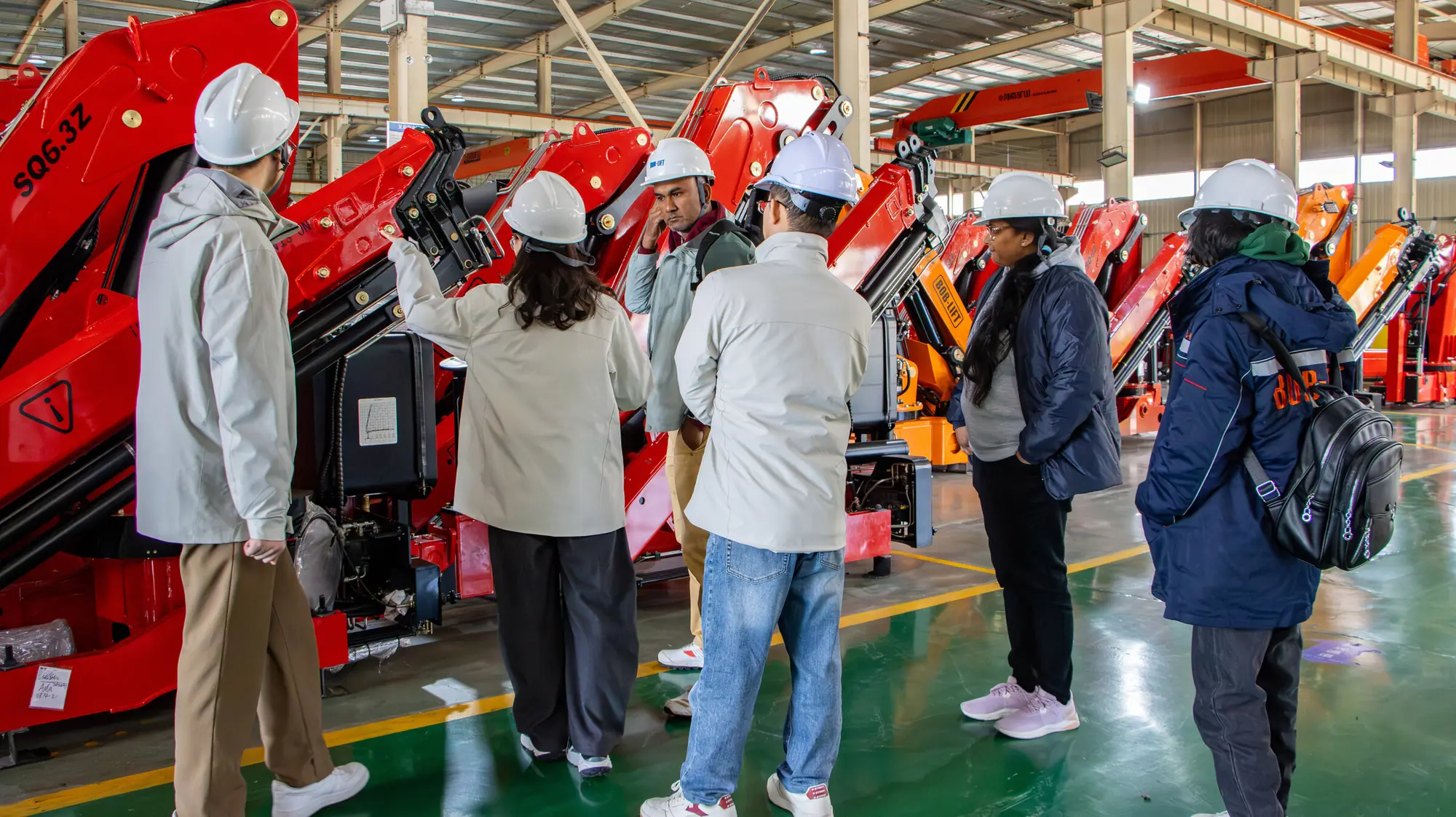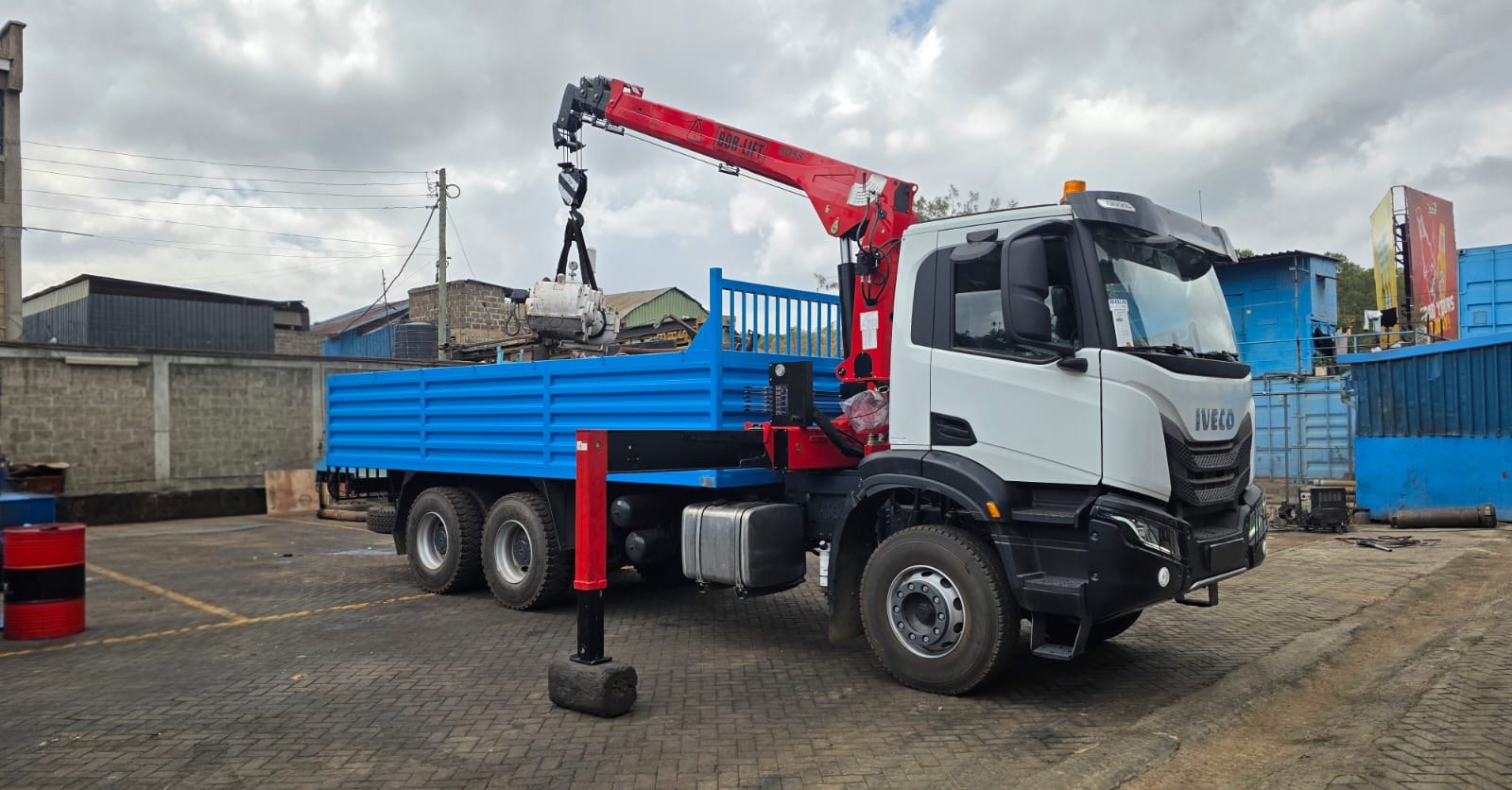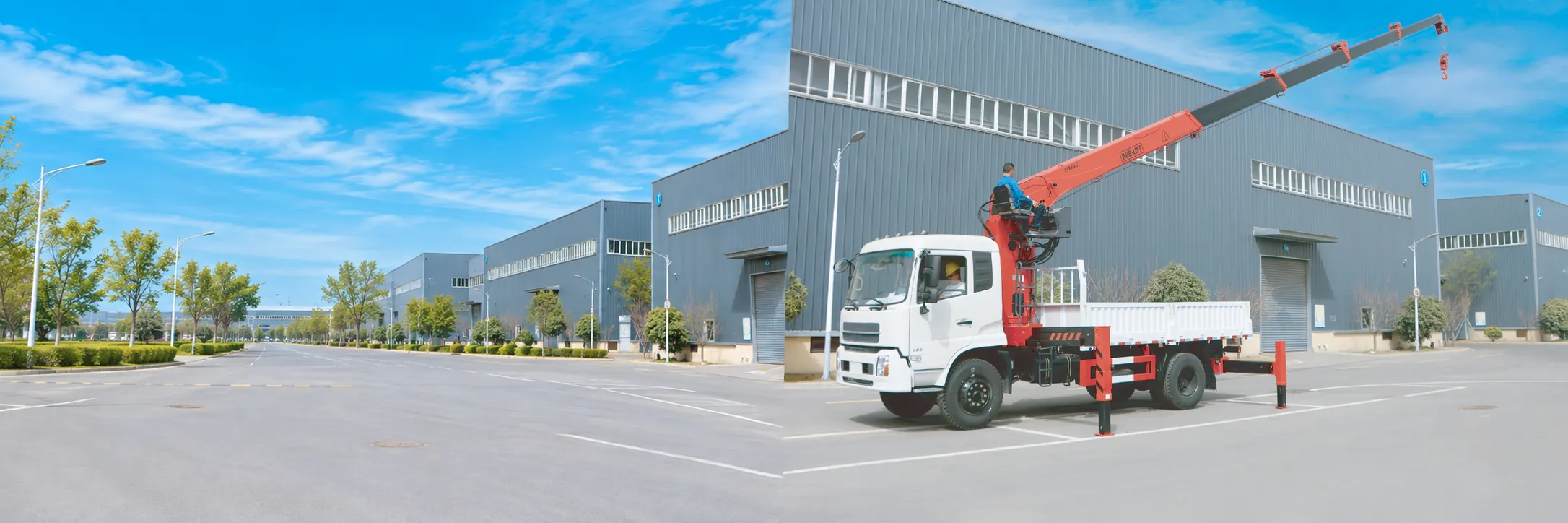

Truck mounted crane vs mobile crane is a comparison that comes down to one practical question: does the vehicle also carry goods? A truck mounted crane is a hydraulic loader crane installed on an ordinary goods truck, usually directly behind the cab, so that a single vehicle can transport a load and also lift it on and off. A mobile crane is a self-propelled lifting machine on its own dedicated carrier, which exists only to move the crane and carries nothing except the crane and its equipment.
BOB-LIFT has manufactured truck mounted cranes since 2003, and our current range covers knuckle boom and telescopic boom cranes for truck chassis from 800 kg to 50 t. We do not manufacture mobile cranes, so this guide does not quote mobile crane specifications. Instead, it explains what each machine is, how the two differ in operation and regulation, and how to decide which one suits your lifting work.
Key takeaways
- A truck mounted crane works from a goods truck that still carries cargo, while a mobile crane travels on a carrier designed only for the crane.
- “Truck crane” is an ambiguous name: in many markets it describes a mobile crane, not a crane on a lorry, so confirm what a seller actually means.
- Truck mounted cranes suit delivery and light to medium lifting next to the vehicle, whereas mobile cranes suit heavy, high or long-reach lifts.
- In US construction, OSHA’s crane standard covers both machine types, but it excludes knuckle boom truck cranes during certain material delivery operations.
- A tower crane remains in one position for the duration of a project, whereas a mobile crane arrives, completes the lift and leaves.
What is a truck mounted crane?
A truck mounted crane is a hydraulic crane bolted to the chassis of a goods truck, typically between the cab and the cargo body, with its own outriggers to stabilise the vehicle during lifting. The truck remains a conventional commercial vehicle: it travels to the delivery point with materials on the load bed, and the crane then unloads them without any additional equipment.
Buyers use several names for the same machine, including loader crane, lorry loader, lorry crane, crane truck, boom truck and crane lorry. Our crane lorry guide explains the British terminology in more detail. There are two principal boom designs:
- A knuckle boom crane is a crane whose boom folds at one or more hinged joints, similar to an arm bending at the elbow. It folds into a compact package behind the cab, which leaves more usable space on the load bed. OSHA calls this type an articulating crane, defined as “a crane whose boom consists of a series of folding, pin connected structural members”.
- A telescopic boom crane is a crane whose straight boom extends through sliding sections. The design is mechanically simple, it often provides good lifting height, and a hook with a winch is the standard configuration.
Our article on knuckle boom vs telescopic boom truck cranes compares the two designs in depth. You can also review both types on our knuckle boom truck mounted cranes and telescopic boom truck mounted cranes pages.
What is a mobile crane?
A mobile crane is a crane that drives itself between operating locations. The US construction crane standard, 29 CFR 1926.1401, defines it as “a lifting device incorporating a cable suspended latticed boom or hydraulic telescopic boom designed to be moved between operating locations by transport over the road”.
On a mobile crane, the carrier is an integral part of the machine. It supports a rotating upper structure with the boom, the counterweight and usually a separate operator cab, together with outriggers for stability. The most common categories are these:
- Truck crane. A crane on a road-going carrier that resembles a heavy truck and travels on public roads.
- All-terrain crane. A multi-axle carrier with all-wheel steering, designed to travel on public roads and also to manoeuvre on uneven site ground.
- Rough-terrain crane. A compact carrier with large tyres, intended for construction sites and soft ground, and often transported between sites on a trailer.
Great Britain’s vehicle taxation law draws a useful distinction. Schedule 1 of the Vehicle Excise and Registration Act 1994 describes a mobile crane as a vehicle “designed and constructed as a mobile crane” which, when travelling, “does not carry any load except such as is necessary for its propulsion or equipment”. In other words, a mobile crane transports only itself, while a truck mounted crane transports cargo.
Why does the name “truck crane” cause confusion?
The same terminology describes different machines in different regions. In many markets a “truck crane” is a mobile crane on a truck-type carrier, whereas in others, and in many online listings, it means a loader crane on a goods truck. Search terms such as “truck mounted mobile crane” and “mobile crane truck” are used for both machines.
Even the regulations combine the categories. OSHA’s scope section, 29 CFR 1926.1400, lists “articulating cranes (such as knuckle-boom cranes)” separately, but it includes “commercial truck-mounted, and boom truck cranes” among the varieties of mobile crane. Under that standard, therefore, a telescopic boom truck counts as a mobile crane, while a knuckle boom crane on a truck is classified as an articulating crane.
The practical solution is to ask two specific questions. First, does the vehicle have a cargo body that transports goods? Second, what are the crane’s rated capacity, boom type and maximum reach? The answers identify the equipment you are actually buying, regardless of the name in the advertisement.
Truck mounted crane vs mobile crane: key differences
The following table compares the two machine types on the points that buyers most frequently ask about.
| Point | Truck mounted crane | Mobile crane |
|---|---|---|
| Main purpose | Transport goods and load or unload them | Lifting only; the carrier moves the crane |
| Carries cargo? | Yes, on the truck’s own load bed | No, only its own equipment |
| Base vehicle | A standard commercial truck chassis | A purpose-built crane carrier |
| Boom type | Knuckle or telescopic | Mostly telescopic; some lattice booms |
| Capacity | Light to medium; BOB-LIFT range 800 kg to 50 t | From compact city cranes to very large all-terrain cranes |
| Set-up | Deploy outriggers, unfold the boom | Deploy outriggers; large cranes may need counterweight installed on site |
| US crane standard | 29 CFR 1926 subpart CC, with a delivery exclusion for knuckle boom cranes | 29 CFR 1926 subpart CC |
| Typical applications | Building materials, pallets, machinery, utility work, own-fleet delivery | Steel erection, precast panels, plant installation, heavy or high lifts |
The decisive factor is the truck itself. With a truck mounted crane you operate one vehicle that both transports and handles the goods, whereas with a mobile crane you hire or purchase a dedicated lifting machine and the materials arrive on separate transport.
What can a truck mounted crane lift?
Truck mounted cranes range from small units for pickups and light trucks to large knuckle boom cranes for heavy multi-axle chassis. The following five BOB-LIFT models illustrate that spread, and every figure comes from the model’s published dimension drawing or load chart.
| Model | Boom | Max capacity | Max lifting moment | Max horizontal reach | Outrigger span | Crane weight |
|---|---|---|---|---|---|---|
| SQ2ZA4 | Knuckle | 2,000 kg | 4.2 t·m | 7.54 m | 1.84–3.50 m | 750 kg |
| SQ5SA4 | Telescopic | 5,000 kg | 12.5 t·m | 11.79 m | 2.29–5.59 m | 2,400 kg |
| SQ10SA4 | Telescopic | 10,000 kg | 25 t·m | 15.5 m | 2.29–5.99 m | 3,800 kg |
| SQZ430 | Knuckle | 20,000 kg | 42.3 t·m | 16.6 m | 2.30–6.60 m | 5,500 kg |
| SQZ1000 | Knuckle | 50,000 kg | 90 t·m | 20.3 m (load chart) | 2.25–8.60 m | 10,000 kg |
Maximum capacity is only available close to the crane column, and the permitted load decreases considerably as the radius increases. The SQ5SA4 load chart shows 600 kg at 11.8 m with the boom horizontal, the SQ10SA4 chart shows 1,050 kg at 15.5 m, and the SQZ1000 lifts 25,500 kg at 3 m but 3,230 kg at 20.3 m. For that reason, always select a crane by the load at the working radius you actually need. Our guide on how to read a crane load chart explains the method, and our boom truck sizes guide matches crane capacity to truck size.

When should you choose a truck mounted crane?
A truck mounted crane is usually the better investment when the same vehicle transports the materials and handles them at the destination. It typically suits these applications:
- Delivery operations. Builders’ merchants, block and pipe suppliers, and machinery distributors can unload at every stop without waiting for a forklift or a separate crane.
- Frequent short lifts. Because preparation is quick, one driver can complete several deliveries during a single shift.
- Your own fleet. Utilities, municipalities and contractors keep the crane permanently available on their own vehicle.
- Restricted access. A knuckle boom folds compactly and can reach over a wall or into a yard from the street.
- Additional functions. On our knuckle boom cranes, a winch, auger, basket or grapple is available on request, so one truck can perform more than one task.
Once the crane has set the load down at the kerb or in the yard, the material often still has to travel across the site to where it is used. For that last stretch, where a truck cannot drive, our sister company BOB-LIFT Loader builds mini dumpers for carrying blocks, soil and rubble and mini skid steer loaders for moving pallets and loose material on tight sites.
Before ordering, match the crane to the truck carefully, because the chassis must carry the crane, the subframe and your payload within its permitted axle loads. Our truck mounted crane installation guide explains the subframe, the axle load distribution and the power take-off.
When is a mobile crane the better choice?
A mobile crane is generally the better choice when the lift itself is the entire operation. Consider one in the following situations:
- Heavy loads at long radius. When the load exceeds what a truck mounted crane can handle at the required working radius.
- High lifts. Rooftop equipment, structural steel and tall structures frequently require more lifting height than a loader crane provides.
- Planned individual lifts. A precast bridge beam or a large tank is usually lifted once, according to a detailed lift plan, and a hired crane with a qualified operator suits that situation.
- Separately delivered materials. If the load arrives on a trailer or is already on site, you do not need a crane that transports cargo.
Example scenario (an illustration, not a customer record): a builders’ merchant delivers bricks, blocks and timber to residential customers every day. A truck with a medium-sized knuckle boom crane carries the materials and places each pallet over a front wall at every address. When the same merchant occasionally needs to position a large steel beam on a two-storey extension, hiring a mobile crane with an operator for that single lift is more economical than purchasing a much larger crane.
Whichever machine you use, the basic preparation is identical: stable ground, fully extended outriggers and suitable support pads come first. Our guide to crane outriggers and ground bearing pressure explains how to assess the ground before lifting.
Do the rules treat them differently?
In some respects they do, although requirements depend on the country and the type of work, so treat the following as a starting point rather than legal advice.
- United States, construction scope. 29 CFR 1926.1400 covers both knuckle boom cranes and mobile cranes used in construction. However, paragraph (c)(17) excludes “articulating/knuckle-boom truck cranes that deliver material to a construction site when used to transfer materials from the truck crane to the ground”. The exclusion does not apply when the crane holds material in position during construction activity or handles prefabricated components such as roof trusses or wall panels.
- United States, operator qualification. Under 29 CFR 1926.1427, operators of covered equipment must be “trained, certified/licensed, and evaluated”. Equipment with a maximum rated capacity of 2,000 pounds or less is exempt from that section, although separate training requirements still apply.
- Great Britain, vehicle taxation. The Vehicle Excise and Registration Act 1994 places a mobile crane that carries no load in its own category. A truck mounted crane that transports goods does not meet that definition.
- Great Britain, safe operation. HSE safety notice EPD04-2023 on lorry loaders warns about crushing risks from powered tilting stabilisers and states that users should ensure “operators are competent” and trained on the stabiliser type fitted.
Weight, height and speed limits on public roads are set by each country, so always check the regulations where you drive and operate.
Tower crane vs mobile crane: what is the difference?
A tower crane is a stationary crane that remains in one position for the duration of a project. OSHA’s 29 CFR 1926.1401 describes it as a lifting structure that “utilizes a vertical mast or tower to support a working boom (jib) in an elevated position”. It is erected at the start of construction and dismantled at the end, and the same standard notes that it may be “climbed in stages” as the building rises.
A mobile crane, by contrast, arrives, sets up, completes the lift and departs, often on the same day. A tower crane therefore suits long projects with continuous lifting across a large or tall site, while a mobile crane suits short assignments and individual lifts. A truck mounted crane addresses a third requirement: delivering the materials and placing them on arrival.
Frequently asked questions
Is a crane a vehicle?
It depends on the type of crane. A mobile crane is a vehicle: OSHA defines it as a lifting device “designed to be moved between operating locations by transport over the road”, and British tax law treats it as a vehicle. A truck mounted crane is equipment installed on a vehicle, the goods truck. A tower crane or an overhead crane is a fixed installation, not a vehicle.
Is a boom truck a mobile crane?
Under the US construction standard, yes: 29 CFR 1926.1400 lists “boom truck cranes” as a variety of mobile crane. In everyday language, however, a boom truck usually means a telescopic crane on a goods truck, which is a truck mounted crane that still transports cargo.
What is the difference between a lorry crane and a mobile crane?
A lorry crane is the British term for a truck mounted crane, meaning a crane on a goods lorry that transports and unloads cargo. A mobile crane is a self-propelled crane on its own carrier that transports only the crane and its equipment.
Can a truck mounted crane replace a mobile crane?
For many delivery and site lifts it can, provided the load at the required radius is within the crane’s load chart. For heavy or very high lifts, a mobile crane remains the appropriate equipment, so check the load at your working radius before deciding.
Which lifts more, a truck mounted crane or a mobile crane?
Large mobile cranes lift considerably more. Truck mounted cranes are lighter machines: the BOB-LIFT range reaches 50 t with the SQZ1000, and like every crane its permitted load decreases as the working radius increases.
Does BOB-LIFT supply the truck?
No. We manufacture and export new cranes only. If you buy a Chinese truck, your truck supplier can deliver it to our factory and we mount the crane before it ships. If you buy the truck in your own country, we ship the crane on its own: your local body builder mounts it, with installation guidance and remote technical support from our engineers. Our truck mounting and export page explains the process.
How we compiled this guide
The BOB-LIFT figures come from the dimension drawings of the SQ2ZA4, SQ4ZA3, SQ5SA4, SQ10SA4, SQZ430 and SQZ1000 and from the SQZ1000 load chart, and the product range comes from our live product pages. The definitions and regulations are quoted from the official texts linked in the guide, namely the US eCFR, UK legislation and HSE guidance, as they stood in November 2026. Because we do not manufacture mobile cranes, we describe them in general terms only. The guide was reviewed by Achord Chan, Product Operations Director, in November 2026. It replaces an earlier version of this article and corrects that version’s incorrect statement about speed limits.
Find the right truck mounted crane
Tell us what you transport, your heaviest load, the reach you need and the truck you operate, and we will recommend a model with its drawing and load chart. Every crane is mounted on our test bay and run through lifting, slewing and outrigger functions under load before packing. Each crane carries a 12-month warranty on the whole machine, common spare parts are dispatched within 48 hours, and our service team replies within 12 hours. Read our guide to buying a truck mounted crane from China, browse the complete truck mounted crane range, or contact us to start.