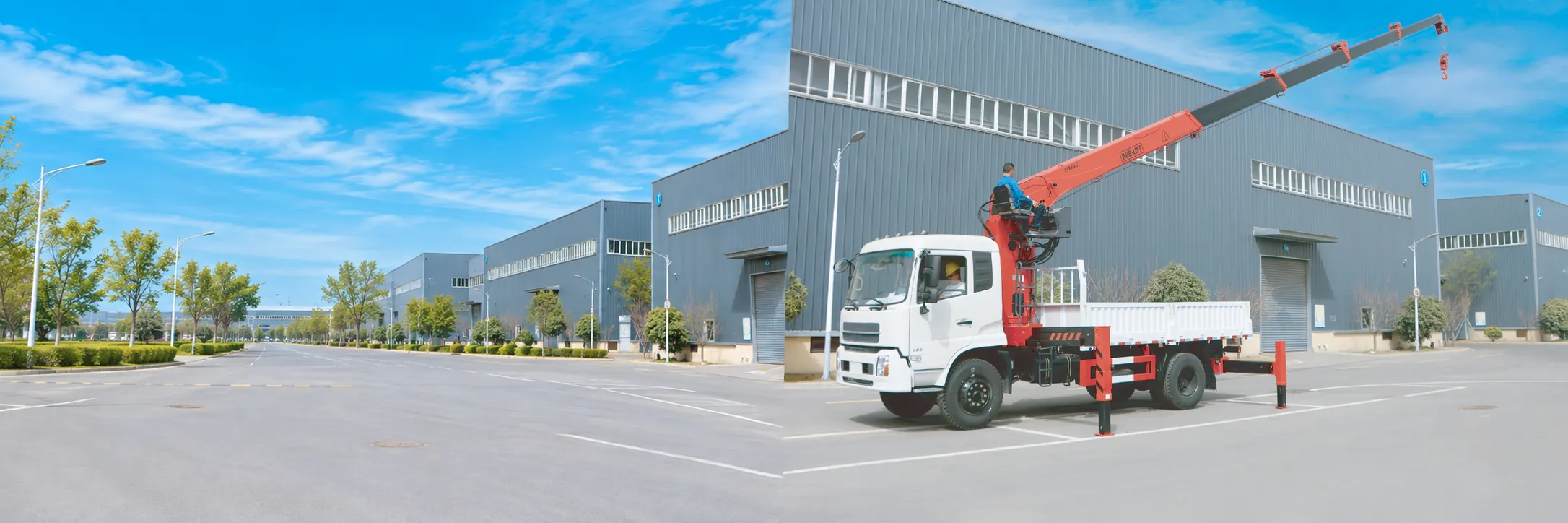

A pickup truck crane is a compact hydraulic crane bolted into the bed of a pickup, so that the driver can load and unload heavy items without a forklift or a second machine. A hydraulic pump delivers pressurised oil to cylinders that raise, fold and extend the boom, while a slewing column rotates it over the side or the tailgate. The pump is driven either by the engine through a power take-off or by an electric motor powered by the vehicle’s battery.
We have manufactured truck mounted cranes in Xuzhou since 2003, including 800 kg pickup cranes and 1 t and 2 t electric cranes. This guide explains how a pickup truck crane works, component by component, using the figures from our own technical drawings: where the hydraulic power comes from, how each boom movement is generated, how the bed and the outriggers support the load, and which factors actually determine how much it can lift.
Key takeaways
- Every powered movement of a hydraulic pickup truck crane comes from pressurised oil: pressure determines the force, and flow determines the speed.
- Our 800 kg SQ08ZA3+1 requires 8 L/min at 18 MPa, with approximately 3.5 kW of recommended power, from a PTO-driven pump or a separate power unit.
- The 800 kg rating applies only close to the column; at its maximum 4.15 m reach, the same crane is rated for 220 kg.
- The crane’s own weight, its hydraulic oil and the cargo all count against the pickup’s payload, so check the vehicle’s GVWR label before choosing a crane.
- In US construction work, cranes rated at 2,000 lb or less fall under a short OSHA rule, 29 CFR 1926.1441, which still requires operator training, an accessible load chart and power line clearance.
How does a pickup truck crane work?
A pickup truck crane works by converting engine or battery power into hydraulic pressure, and then converting that pressure into controlled movement of the boom. The sequence is essentially identical on every hydraulic model:
- Power source. The engine drives a pump through a power take-off (PTO), or an electric motor operating on the vehicle’s electrical system drives the pump directly.
- Pump and reservoir. The pump draws hydraulic oil from a small reservoir and delivers it into the circuit at a defined flow rate.
- Directional control valve. When the operator moves a lever or presses a remote button, the valve directs oil to one side of a cylinder or motor and returns oil from the other side to the reservoir.
- Cylinders and slewing motor. The oil extends a piston to raise or telescope the boom, or rotates the slewing drive to turn the column.
- Boom and hook. The boom moves the hook upward, outward or around, and the suspended load follows.
Two values describe any hydraulic crane. Pressure, measured in megapascals (MPa), determines how much force a cylinder can produce, because force equals pressure multiplied by piston area. Flow, measured in litres per minute, determines how quickly the piston moves. A pressure relief valve limits the maximum pressure, which is why a properly designed crane stalls instead of failing when the operator demands too much. Our guide to the hydraulic crane for a truck describes the same circuit on larger cranes.
The parts of a pickup truck bed crane
Whatever the manufacturer or capacity, a pickup truck bed crane consists of the same principal components:
- Base frame: the steel structure bolted to the bed and the chassis, which supports the column and, on some models, the outrigger legs.
- Slewing column: the vertical post that rotates on the base and carries the boom.
- Boom sections: a main boom, a folding (knuckle) boom and telescopic extensions, each operated by its own cylinder.
- Hydraulic cylinders: the lifting cylinder, the folding cylinder and the extension cylinders.
- Control valve bank: one lever for each movement, or solenoid valves operated by a remote control.
- Power unit: the pump, oil reservoir and filter, together with the electric motor or the PTO drive.
- Hook or winch: a swivel hook at the boom tip, or a winch rope with a hook block.
- Outriggers: extendable legs that transfer the load to the ground instead of the vehicle’s suspension.

Where the hydraulic power comes from
A hydraulic pickup truck crane requires a continuous supply of oil at the correct flow and pressure, and there are two common ways of providing it.
PTO-driven pump. A power take-off on the gearbox drives a hydraulic pump while the engine is running. This arrangement delivers sustained power for long working days; however, many pickups have no PTO provision, so confirm availability with your dealer or body builder before ordering.
Electric-hydraulic power unit. An electric motor, a pump and an oil reservoir are combined in a single unit installed in the bed. It operates from the vehicle’s battery, requires no PTO and functions with the engine switched off, which is exactly how an electric pickup crane works. The limitation is electrical current: a powerful motor on a 12 V supply draws a very high current, so this design is suited to intermittent loading rather than continuous operation.
Our technical drawings specify the supply that each pickup crane requires. The 800 kg SQ08ZA3+1 with outriggers requires 8 L/min at 18 MPa, with 3.5 kW of recommended power and a 20 L oil tank. The SQ08ZA3, which has no manual extension, has the same supply: 8 L/min at 18 MPa, with 3.5 kW and a 20 L tank.
These figures are consistent with each other. Hydraulic power equals pressure multiplied by flow, so 18 MPa at 8 L/min corresponds to approximately 2.4 kW of hydraulic power. The recommended 3.5 kW therefore includes a margin for losses in the pump and the drive. That calculation is our own arithmetic based on the drawing values, so ask us to confirm the drive arrangement for your particular vehicle.
Our electric models carry their complete power unit with them. For example, the 1 t SQ1Z-E has a 1,200 W motor operating on 12 V DC with a typical 12 V 60 Ah battery, whereas the 2 t SQ2Z-E has a 2,200 W motor with a typical 136 Ah battery. Our electric truck crane guide explains cabling, fuses and duty cycle. If your vehicle operates on 24 V, mention it in your enquiry and we will confirm the supply arrangement with your quotation.
How the boom lifts, folds, extends and slews
Each movement has its own actuator, so an experienced operator can combine several movements to position a load precisely.
- Lifting (luffing). The main cylinder raises or lowers the main boom. On the SQ08ZA3+1 the boom rises to a maximum angle of 75°, which, according to our load chart, places the hook approximately 5.7 m above the crane base.
- Folding. On a knuckle boom, a second cylinder articulates the outer boom at the joint, which allows the crane to fold into a compact transport position.
- Extension. Cylinders inside the outer boom extend the telescopic sections. The “+1” in SQ08ZA3+1 indicates one additional manual extension, which the operator pulls out and secures with a pin.
- Slewing. A hydraulic drive rotates the column. The SQ08 cranes slew through 330°, covering both sides and the tailgate, whereas our electric models rotate a full 360° on a toothed slewing ring.
The guide to truck crane slewing explains slewing rings and rack-and-pinion drives in greater detail. Our SQ08ZA3+1 load chart extends from 1,337 mm with the boom fully retracted to 4,151 mm with every section extended.
Pickup truck crane with a winch
A crane without a winch can change the hook height only by moving the boom. A pickup truck crane with a winch, by contrast, reels a wire rope in and out, so the hook can descend to the ground or into a pit while the boom remains stationary. The crane in our photographs and in the video below has a winch mounted at the top of the column. However, wire rope introduces additional inspection work, and OSHA requires small cranes manufactured after November 2011 to have an anti two-block device, or a design that suffers no damage if the hook block contacts the boom tip. Our article on knuckle boom crane attachments discusses when a winch is worthwhile.
How the bed and the outriggers carry the load
When a crane lifts, the combined weight of the load and the boom creates an overturning moment at the column. The base frame transfers that moment into the vehicle, and because a thin pickup bed floor cannot resist it alone, the base must be mounted on a structure connected to the chassis.
The drawings show how compact this arrangement is: both the SQ08ZA3+1 and the SQ08ZA3 fold to 1,614 mm high. On the electric SQ1Z-E, the base is secured with eight M12 bolts on a 390 mm square. Whatever the model, have the mounting checked by a qualified body builder or engineer before the first lift.
Outriggers relieve the vehicle’s springs and tyres. On the SQ08ZA3+1, two legs adjust from 1,464 mm to 3,020 mm in span and from 640 mm to 1,020 mm in height. Deploy them on firm ground before slewing a load outward, and use support pads on soft surfaces. The SQ08ZA3 has outriggers as well; set them before every lift rather than letting the suspension take the load. In the United States, the ground conditions rule, 29 CFR 1926.1402, requires ground that is “firm, drained, and graded” sufficiently to meet the manufacturer’s support and levelling specifications. Our guide to crane outriggers and ground bearing pressure explains how to select suitable pads.
What limits a pickup crane’s capacity
Three factors limit what a pickup crane can lift: its lifting moment, the working radius and the payload of the pickup. Consequently, the headline rating is valid only close to the column.
Moment and radius. The lifting moment is the load multiplied by its horizontal distance from the slewing centre. The SQ08ZA3+1 has a maximum lifting moment of 1.3 t·m, and its load chart shows how the permitted load decreases as the hook moves outward:
| Working radius | Rated load (SQ08ZA3+1) | Rated load (SQ08ZA3) |
|---|---|---|
| About 1.1 to 1.3 m | 800 kg at 1.34 m | 800 kg at 1.34 m |
| About 2 to 2.3 m | 450 kg at 2.25 m | 450 kg at 2.25 m |
| About 2.7 to 3.2 m | 300 kg at 3.23 m | 300 kg at 3.23 m |
| Full reach | 220 kg at 4.15 m | 300 kg at 3.23 m |
Our guide on how to read a crane load chart demonstrates the method in detail. Remember that the hook, the slings and any winch hook block also form part of the load.
The pickup’s payload. A crane capable of lifting a load is of little use if the vehicle cannot legally carry it. In the United States, the certification label on the door pillar must state the Gross Vehicle Weight Rating (GVWR), which under 49 CFR 567.4 covers the unloaded vehicle weight, the rated cargo load and the occupants. The same label also gives a Gross Axle Weight Rating (GAWR) for each axle, which matters because the crane sits above the rear axle. Subtract the crane, its oil, any mounting frame and the occupants from the payload before calculating how much cargo remains.
Example scenario (an illustration, not a customer record): a pickup’s registration documents indicate a payload of 1,000 kg. With the 380 kg SQ08ZA3+1 and approximately 20 kg of oil and fittings installed, approximately 600 kg remains for the driver and the cargo. A 450 kg pump plus the driver still fits, and the crane is rated for 450 kg at 2.25 m, so the lift is acceptable if the pump is picked within 2.25 m of the column; otherwise, reposition the vehicle closer to the load.
BOB-LIFT pickup and electric crane models compared
Our pickup cranes are available in two 800 kg versions, and our two electric cranes are also suitable for pickups and light trucks. The table compares them on the specifications that determine how each one operates.
| Model | Rated load near column | Load at full reach | Self weight | Slewing | Power supply | Outriggers |
|---|---|---|---|---|---|---|
| SQ08ZA3 | 800 kg at 1.34 m | 300 kg at 3.23 m | 365 kg | 330° | 8 L/min, 18 MPa, 3.5 kW | Yes, 1,464 to 3,020 mm span |
| SQ08ZA3+1 | 800 kg at 1.34 m | 220 kg at 4.15 m | 380 kg | 330° | 8 L/min, 18 MPa, 3.5 kW | Yes, 1,464 to 3,020 mm span |
| SQ1Z-E | 1,000 kg at 1.2 m | 200 kg at 2.8 m | 235 kg | 360° | 1,200 W, 12 V DC | Optional base cart |
| SQ2Z-E | 2,000 kg at 1.2 m | 500 kg at 3.1 m | 290 kg | 360° | 2,200 W, 12 V DC | Optional base cart |
When choosing between them, begin with the load at the radius you need, and then consider the vehicle. Our small truck crane guide compares cranes from 800 kg to 5 t against their actual load charts, and the electric guide covers battery-powered models.
Safe operation basics
A small crane is still a crane in law. In US construction work, OSHA applies a shorter rule to equipment with a maximum rated capacity of 2,000 lb or less, 29 CFR 1926.1441. An 800 kg crane, approximately 1,760 lb, falls within its scope, whereas our 1 t and 2 t electric cranes exceed that threshold, so the complete rule set applies to them. Even the shorter rule requires the employer to:
- keep the load chart available to the operator at the control station;
- train each operator on the specific type of equipment before use;
- follow the manufacturer’s operating procedures and inspect the crane in accordance with them;
- never use the equipment to hoist personnel;
- maintain clearance from power lines: under 29 CFR 1926.1408, additional precautions apply if any part of the crane or load could come within 20 feet of a line.
In Great Britain, regulation 8 of LOLER 1998 requires every lifting operation to be “properly planned by a competent person”, appropriately supervised and carried out in a safe manner. The HSE guidance on thorough examination of lifting equipment sets the default interval at 12 months for a crane of this kind and 6 months for lifting accessories such as slings.
In daily operation, park on firm, level ground, deploy the outriggers, keep people away from the area beneath the boom and wear a hard hat. Lift smoothly, never drag a load sideways, and stow and secure the boom and hook before driving. Our truck mounted crane inspection checklist, the crane safety tips and the guide to crane hand signals describe the routine. For training requirements by country, see crane operator licences. In addition, a truck crane remote control allows a single operator to stand where the load is most visible.
Frequently asked questions
How does a pickup truck crane get its power?
From a hydraulic pump, which is driven either by the engine through a power take-off or by an electric motor operating on the vehicle’s 12 V battery. Our 800 kg pickup cranes require 8 L/min of oil flow at 18 MPa.
How much can a pickup truck crane lift?
Our pickup cranes are rated at 800 kg close to the column. At maximum reach, the SQ08ZA3+1 is rated for 220 kg at 4.15 m and the SQ08ZA3 for 300 kg at 3.23 m. The pickup’s payload may impose a lower limit, so check it first.
Does a pickup truck crane need outriggers?
Not always. Outriggers transfer the load to the ground and stabilise the vehicle, so use them for loads near the rating, long reach or soft ground. Some pickup cranes on the market have none, but both of ours, the SQ08ZA3 and the SQ08ZA3+1, have outriggers, and we recommend setting them for every lift.
What is the difference between a hydraulic and an electric pickup crane?
Both move the boom with hydraulic cylinders. A conventional hydraulic crane usually receives oil from a PTO-driven pump, whereas an electric pickup crane carries its own motor, pump and reservoir, operates from the battery and is suited to intermittent lifting.
Can I add a winch to a pickup truck crane?
Often, yes. A winch allows the hook to descend below the bed without moving the boom, although it adds a wire rope to inspect and, on newer small cranes, an anti two-block device. Describe your loads and we will confirm whether a winch suits your model.
How we compiled this guide
We compiled the SQ08ZA3+1 and SQ08ZA3 figures from their BOB-LIFT dimension drawings and load charts, and the SQ1Z-E and SQ2Z-E figures from the technical data on our product pages, which are taken from the same drawings. The hydraulic power figures are our own arithmetic based on those values. The photograph and the video show an SQ08ZA3+1 pickup crane at our Xuzhou factory. The regulations are quoted from the official eCFR text of 29 CFR 1926.1402, 1926.1408 and 1926.1441 and 49 CFR 567.4, from legislation.gov.uk and from the HSE website, as consulted in November 2026. Achord Chan, Product Operations Director, reviewed the guide. It replaces our 2024 article of the same name and does not replace your crane manual or the regulations where you work.
Get the right crane for your pickup
Tell us your pickup’s make and model, its payload, your heaviest load and the distance from the crane at which you need to place it. We will recommend a crane, send its drawing and load chart, and confirm how your vehicle will power it. We supply the crane only, and we can guide your installer remotely. Every crane carries a 12-month warranty on the whole machine, common spare parts leave the factory within 48 hours, and our service team responds within 12 hours. Contact us for a quotation, or browse our pickup cranes.