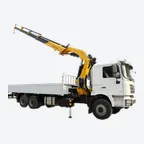

Knuckle boom crane operation is the fixed order of work an operator follows to run a folding-boom crane safely. In short: check the crane and site, park and engage the power take-off, set the outriggers and unfold the boom, then lift and place the load within the load chart before folding, stowing and shutting down. On a truck mounted knuckle boom crane every one of those movements is hydraulic, and each one has its own control lever.
We have built truck mounted knuckle boom cranes in Xuzhou since 2003, and this guide walks through that sequence step by step. It explains what each control lever does, how to feather the valves for smooth movement, where the operator should stand and how to fold the crane away at the end of the job. Treat it as a companion to the operator’s manual supplied with your crane, not a replacement: the exact unfolding order, lever layout and stowing position differ from model to model, and the manual always wins.
Key takeaways
- Operating a knuckle boom crane follows ten steps in three phases: set up, lift and pack up, and skipping a step, especially the outriggers, is how most problems start.
- Every movement has its own lever (slewing, inner boom, outer boom, extensions, winch and outriggers), so read the decals on your crane, because the order differs by model.
- Move the levers gently and progressively, because feathering the valves keeps the load steady; combined movements come only with practice.
- Check every lift against the load chart at the real radius, not the headline capacity, since a 5,000 kg SQ5ZA4 is rated for only 700 kg at full reach.
- Stand where you can see the load and stay outside the crush zones, and if you cannot see the landing point, use a signal person or a radio remote.
How do you operate a knuckle boom crane, step by step?
You operate a knuckle boom crane in ten steps, and the order matters more than speed. A knuckle boom crane is a crane whose boom “articulates at a ‘knuckle’, letting it fold back like a finger”, as Wikipedia’s knuckle boom crane article puts it, and most are worked by hydraulic cylinders. Because the boom folds, it must be unfolded and folded in a set order, so the steps below always follow the same pattern.
- Check the crane and the site: Do the shift inspection, confirm the lift plan and make sure you are qualified for this crane.
- Park on firm, level ground: Set the handbrake, stay well clear of power lines and keep people out of the work area.
- Engage the PTO: Follow the truck manual, and let cold oil warm up before you load the crane.
- Set the outriggers: Extend the beams, lower the legs onto pads and level the crane.
- Unfold the boom: Lift the boom off its rest and unfold it in the order your crane manual gives.
- Rig the load and test it: Lift it a few centimetres, pause and check the crane, the rigging and the ground.
- Lift, slew and place: Move smoothly, stay within the load chart at the real radius and keep the load under control.
- Fold the boom and stow it: Secure the hook and fold the boom back onto its transport rest.
- Raise and retract the outriggers: Watch every leg as it moves, and stow tilting legs vertically before the beam comes in.
- Switch off and secure: Disengage the PTO, return the levers to neutral and report any defect.

The sections below explain each phase, and where another of our guides covers a topic in depth, such as outriggers, load charts or hand signals, we give a short summary and link to it.
What should you check before operating the crane?
Check three things before the first lift of the day: the crane, the operator and the plan. In the United States, the construction crane rule 29 CFR 1926.1412 requires a competent person to begin a visual inspection “prior to each shift the equipment will be used”. On a knuckle boom crane, the shift check should cover at least these points from that list:
- Controls: control mechanisms “for maladjustments interfering with proper operation”, such as a sticking lever or one that does not return to neutral.
- Hydraulics: hoses “for deterioration or leakage, particularly those which flex in normal operation”, and the oil level.
- Hook and rope: the hook and latch for cracks, wear or damage, and the wire rope if the crane has a winch.
- Ground and level: settling under the outriggers, standing water, and the crane level “within the tolerances specified by the equipment manufacturer”.
- Safety devices: safety devices and operational aids “for proper operation”, including the load moment limiter and the emergency stop.
Our truck mounted crane inspection checklist turns these items into a printable daily list, with the monthly and annual checks as well.
The operator must also be qualified. Under 29 CFR 1926.1427, operators of covered cranes must be “trained, certified/licensed, and evaluated”, although cranes rated at 2,000 pounds or less are exempt from that section. Other countries use different schemes, so read our guide to the crane operator license for the US, UK and Australian rules.
Finally, the lift needs a plan, and in Great Britain regulation 8 of LOLER 1998 requires every lifting operation to be “properly planned by a competent person”, “appropriately supervised” and “carried out in a safe manner”. For a routine delivery, a short generic plan is often enough, and our crane lift plan guide shows when you need a written one and what goes into it.
How do you park the truck and engage the PTO?
Park as close to the load and the landing point as you safely can, on ground that will carry the outriggers. The US rule on ground conditions says the crane must not be used unless the ground is “firm, drained, and graded” well enough to meet the manufacturer’s requirements for support and level. Before you stop, look up: overhead power lines are the hazard most often missed when a driver picks a spot. Our crane power line safety guide explains the clearance distances and the work zone.
With the truck parked, apply the handbrake and engage the power take-off. The power take-off (PTO) is a gear unit on the truck’s gearbox that drives the crane’s hydraulic pump while the truck stands still. Engage it exactly as the truck manufacturer’s instructions say, and on a cold morning run the crane slowly without a load for a few minutes so the oil can warm up. Our guide to the hydraulic crane for a truck covers the PTO, the pump and the oil flow each crane needs.
Before you touch the crane controls, check that every lever is in neutral and that nobody is near the crane. Under 29 CFR 1926.1417, the operator must verify “that all controls are in the proper starting position and that all personnel are in the clear” before starting the engine.
How do you set up the outriggers?
Set the outriggers before the boom leaves its rest, because the load chart applies only with the outriggers set as the manual requires. Extend each outrigger beam, lower the leg onto a pad and raise the leg until the crane is level and the tyres no longer carry the weight. Use the full span wherever the site allows, since a shorter span gives the crane less resistance to tipping.
The span is set by the crane’s design: on our 5-ton SQ5ZA4, the drawing gives an outrigger span of 2,272 to 5,122 mm, with the legs adjustable from 801 to 1,500 mm in height. On the 10-ton SQ10ZA4, the span runs from 2,310 to 5,610 mm and the legs from 740 to 1,390 mm. Ground bearing pressure, pad size and set-up mistakes are covered in our guide to crane outriggers and ground bearing pressure.
Watch every outrigger as it moves, because legs and beams can crush. The UK Health and Safety Executive’s safety notice on lorry loaders with powered tilting stabilisers reports that HSE is aware of three fatal incidents in Great Britain since 2019 [1]. In each one, an operator was crushed against the vehicle body by a retracting stabiliser leg. The notice says it is essential that operators “fully observe all movements of the stabilisers”, and that nobody may stand, lean or reach into the danger zones.
What does each control lever do?
Each lever opens one section of the crane’s control valve, the bank of hydraulic spools that sends oil to one cylinder or motor at a time; pushing a lever further opens the spool further, so the movement runs faster. A typical truck mounted knuckle boom crane has six basic movements, and cranes with a grab or a rotator add more.

| Lever | What it moves | What to watch |
|---|---|---|
| Slewing | Turns the whole crane on its base, left or right | Start and stop gently so the load does not swing; check the swing area is clear |
| Inner (main) boom | Raises and lowers the first boom on the column | The boom tip moves fast at long reach, even on small lever movements |
| Outer boom | Folds and unfolds the second boom at the knuckle | The hook can drop or rise quickly as the outer boom swings past horizontal |
| Extensions | Telescope the hydraulic sections out of the outer boom and back in | Capacity falls as reach grows, so check the load chart before extending |
| Winch (if fitted) | Raises and lowers the hook on wire rope | Keep at least two wraps of rope on the drum |
| Outriggers | Extend the beams and lower or raise the legs | Watch the leg on the side you are working; never lift with them unset |
Summary compiled by BOB-LIFT from our crane manuals and 29 CFR 1926.1417, November 2026.
Where you work the levers from is your choice of control position. Most cranes have a lever bank on both sides of the base, so the operator can work from the side with the better view. Larger knuckle boom cranes can have a high seat on the column, and any size can have a wireless remote. Our guide to the remote control for a truck mounted crane compares the three in detail.
Whatever the position, read the decals before you move anything, because each lever is labelled with its function and its direction. The order of the levers is not the same on every crane, so if you change crane, practise every function slowly without a load first.
How do you unfold the boom?
Unfold the boom in the order the operator’s manual gives, because the stowed position is different on every model. On many knuckle boom cranes, the first move is to raise the inner boom a little so the boom lifts clear of its rest. The outer boom then unfolds at the knuckle, and only after that do the extensions telescope out. Doing it in the wrong order can drive the boom into the cab, the load bed or the load.
Watch the boom tip and the hook while you unfold, not the levers. Under 29 CFR 1926.1417, the boom “must not contact any obstruction”, and the boom of a folded crane often passes close to the cab roof. Keep the hook clear of people and of the load until the boom is in its working position; for the parts of the boom and how it folds, see what a knuckle boom crane is.
How do you lift, slew and place the load?
Lift with slow, progressive lever movements, check the load at the real radius and keep it under control from pick-up to landing. Experienced operators call this feathering: easing a lever open and closed instead of snapping it, so the oil flow, and with it the movement, builds up and dies away smoothly. Snatching a lever makes the boom bounce and the load swing, and that dynamic load adds to the static weight.
Begin every lift by raising the load a few centimetres and stopping; in that pause, check that the load hangs level, that the rigging is seated and that the outriggers and ground have not moved. US rule 1926.1417 also requires the operator to verify the load weight, for example from the load’s manufacturer or by a recognised calculation. Without such a figure, the operator must use a load weighing device or a capacity indicator to check whether the load exceeds 75 percent of the rated capacity at the longest radius of the lift.
Then check the load chart at the radius where the load will actually be, which is usually the landing point. The working radius is the horizontal distance from the centre of the crane’s column to the hook, and on a knuckle boom crane capacity falls quickly as that distance grows. For example, the SQ5ZA4 load chart gives these ratings:
| Working radius | Rated load, SQ5ZA4 | Rated load, SQ10ZA4 |
|---|---|---|
| About 2 m (2,100 mm / 2,000 mm) | 5,000 kg | 10,000 kg |
| About 4.5 m (4,450 mm / 4,440 mm) | 2,350 kg | 4,700 kg |
| About 6.3 m (6,200 mm / 6,425 mm) | 1,600 kg | 3,150 kg |
| About 8.2 m (8,050 mm / 8,445 mm) | 1,100 kg | 2,350 kg |
| Full reach (9,900 mm / 10,495 mm) | 700 kg | 1,880 kg |
Source: BOB-LIFT SQ5ZA4 and SQ10ZA4 load charts. The two charts use slightly different radius points, given in brackets in the order SQ5ZA4 / SQ10ZA4.
Our guide on how to read a crane load chart works through more examples. The article on the lifting moment of a crane explains why capacity falls with reach and what a load moment limiter does. Every BOB-LIFT crane is listed with a load moment limiter, but it is a back-up, not a plan. The US rule says that safety devices and operational aids “must not be used as a substitute for the exercise of professional judgment by the operator”.
Once the load is clear, move it with these habits:
- Slew slowly: The rule says the rotational speed must be such that “the load does not swing out beyond the radius at which it can be controlled”. Our guide to truck mounted crane slewing covers the slewing drive and the swing zone.
- Learn one movement at a time: Combined movements, such as slewing while unfolding the outer boom, save time but take practice. Combine them only when each single movement is smooth.
- Never drag the load: The crane “must not be used to drag or pull loads sideways”, so position the boom tip directly above the load before lifting.
- Use a tag line: A tag or restraint line is required where rotation of the load would be hazardous, and it keeps hands off the load.
- Mind the winch: If the crane has a winch, keep at least two full wraps of rope on the drum. Our crane winch guide explains the winch option.
- Land the load gently: Lower the last few centimetres slowly, let the load settle and keep the slings tight until it is stable.
Example scenario (an illustration, not a customer record): a builders’ merchant uses an SQ5ZA4 to set a 1,200 kg pallet of blocks over a garden wall about 6 m from the crane column. The load chart gives 1,600 kg at 6,200 mm, which covers the pallet, the hook and a light set of slings. If the only landing spot is 8 m away, the chart gives just 1,100 kg at 8,050 mm. The driver would then need to move the truck closer or split the load, because the full pallet is over the rating at that radius.
Where should a knuckle boom operator stand?
A knuckle boom operator should stand where they can see the load, the boom and the landing point, but outside every crush and fall zone. The HSE notice puts it simply: the operator “should stand in a position suitable to observe the operation but outside of the danger zone”. With levers on both sides of the base, pick the side that gives the better view, never the side where an outrigger leg or a swinging load can reach you.
When the operator cannot see where the load is going, someone has to. Under 29 CFR 1926.1419, a signal person must be provided when the point of operation “is not in full view of the operator”. Our guide to crane hand signals shows the standard signals, and a radio remote often lets the operator walk to a better viewpoint instead.
Keep everyone else clear of two areas. The fall zone is the area, including directly beneath the load, where a load “could fall in the event of an accident”. The US rule keeps workers out of it, apart from those hooking, unhooking or guiding the load and a few other listed tasks. The swing area is where the slewing crane can strike or pinch a person, and the US rule calls for control lines, warning lines or similar barriers to mark it. Three more rules matter on every lift:
- Do not leave the controls while the load is suspended, except under the narrow conditions in 29 CFR 1926.1417.
- Obey a stop or emergency stop signal “irrespective of who gives it”.
- Do not use a phone or anything else that diverts your attention, except for signal communications.
How do you fold and stow the crane?
Fold the crane in roughly the reverse order of unfolding, again following the manual for your model. Retract the extensions first, then fold the outer boom at the knuckle, slew the crane to its transport position and lower the boom onto its rest. Secure the hook so it cannot swing during the drive, and check that no hose is trapped between the booms.
Only when the boom is fully stowed should the outriggers come up; raise each leg, then retract each beam, watching every movement as you go. On cranes with tilting legs, the HSE notice says the legs “should be pinned or locked in the vertical position” before the beam is deployed or retracted, and it also says not to tilt and retract at the same time.
Before you drive away, check the overall height of the truck with the crane stowed. The SQ5ZA4 drawing gives a folded crane height of 2,357 mm and a width of 943 mm, but the height on the road also depends on the truck’s chassis and subframe. Bridges, gateways and overhead cables are as much a risk to a folded crane as to a working one.
How do you shut the crane down?
Shut down by disengaging the PTO as the truck manual says, returning every lever to neutral and switching off the radio remote if you use one. Keep the transmitter with you so nobody else can start the crane, then walk round the crane once more and look for leaks, loose pins or damage the job may have caused.
Report what you find: the US rule requires the operator to inform the employer’s designated person “in writing” when adjustments or repairs are needed, and to pass the information to the next operator. If the crane or one function is taken out of service, a tag must say so, and nobody may start it until the tag has been removed by an authorised person.
Which truck mounted cranes are easiest for one operator to use?
The easiest truck mounted cranes for a single operator are those that let one person see the load and control it at the same time. In practice, that means three features:
- A radio remote control: The operator can walk to the landing point and place the load alone, as long as they stay out of its path. A proportional remote also allows smooth, combined movements.
- A crane sized for the work: A compact knuckle boom crane that does not have to run near its limits is easier to control. Our guide to the small knuckle boom crane covers the lighter models.
- Outriggers you can watch: The HSE notice recommends using remote controls for the stabilisers where available, so the operator can stand back and see the leg move.
A single operator still needs a signal person whenever the load or the landing point is out of sight; remote operation changes where the operator stands, not the rules.
What are the most common knuckle boom operating mistakes?
- Lifting on part-set outriggers: The load chart assumes the outriggers are set as the manual says, and a short or unsupported leg removes that margin.
- Reading the wrong line of the chart: The headline capacity applies only close to the column, so check the rating at the landing radius.
- Snatching the levers: Fast, jerky lever movements make the load swing and stress the boom.
- Unfolding in the wrong order: The boom can strike the cab or the load bed, so follow the manual’s sequence every time.
- Standing in the wrong place: Standing beside a moving outrigger leg or under a swinging boom puts the operator in the crush zone.
- Driving with the crane not fully stowed: A boom off its rest or a hook left loose can strike a bridge or another vehicle.
Frequently asked questions
How do you operate a crane step by step?
For a truck mounted knuckle boom crane: inspect the crane, park on firm level ground, engage the PTO, set the outriggers, unfold the boom, test the load, then lift, slew and place it within the load chart. Afterwards, fold the boom, stow the outriggers and switch off. Always follow the manual supplied with your crane.
Do you need a licence to operate a knuckle boom crane?
It depends on the country and the crane size. In the United States, 29 CFR 1926.1427 requires operators of covered cranes to be trained, certified or licensed and evaluated, with an exemption for cranes rated at 2,000 pounds or less. In Great Britain, the law asks for a competent operator rather than a licence.
Can one person operate a knuckle boom crane?
Yes, when the operator can see the load, the boom and the landing point, which a radio remote often makes possible; when the load or the landing point is out of view, a signal person is needed.
What does feathering the controls mean?
Feathering means opening and closing a hydraulic lever gradually instead of snapping it; the valve spool opens a little at a time, so the movement starts and stops smoothly and the load does not swing or bounce.
Can you lift with the outriggers only partly extended?
Only if the crane manual and load chart allow it for that outrigger position. The standard load chart applies with the outriggers set as the manual specifies, usually at full span. If the site will not allow that, ask the crane manufacturer what the crane may lift before you start.
How we compiled this guide
We based the operating sequence on our own crane manuals and on what our service team sees in the field. The rules come from the official eCFR text of 29 CFR 1926.1401, 1926.1402, 1926.1412, 1926.1417, 1926.1419, 1926.1424, 1926.1425 and 1926.1427, from LOLER 1998 regulation 8 on legislation.gov.uk, and from HSE safety notice EPD04-2023, as they stood in November 2026. The knuckle boom definition is from Wikipedia. The outrigger spans, heights and load ratings come from the current BOB-LIFT technical drawings of the SQ5ZA4 and SQ10ZA4, and both diagrams are our own simplified illustrations. Achord Chan, Product Operations Director, reviewed the guide before publication. It does not replace your crane’s operator’s manual, operator training or the rules where you work.
Need a knuckle boom crane that is easy to operate?
Tell us what you lift, how far from the truck you place it and who will run the crane. We will suggest a knuckle boom crane and a control set-up, whether levers, a high seat or a radio remote, and send the drawing and load chart. Every crane comes with an operator’s manual in English, carries a 12-month warranty on the whole machine, and our service team answers within 12 hours. Browse our knuckle boom truck mounted cranes or contact us for a quotation.