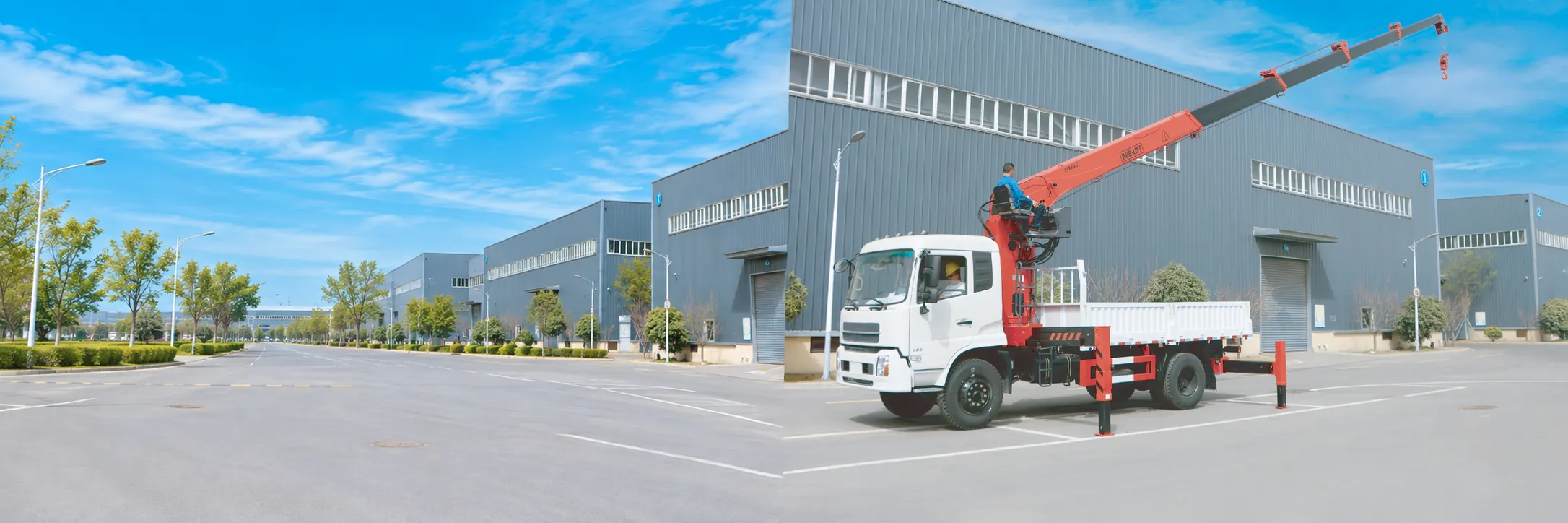

Marine crane size is the load a crane can safely hold at the working radius your operation requires, not simply the tonnage printed in its model name. A 10 t marine crane lifts 10 t only immediately beside its column; at maximum extension the same crane may hold approximately one tenth of that rating. Our current marine range extends from a 0.8 t knuckle boom crane for small boats to a 25 t knuckle boom crane for cargo vessels and work barges, with telescopic models from 2 t to 20 t.
We have manufactured cranes in Xuzhou since 2003. This guide collects every current BOB-LIFT marine crane in a single comparison table and chart, compiled directly from the technical drawings. It then explains how to interpret crane size the way a load chart does, which size category suits which type of vessel, and what the vessel itself must be capable of supporting. Each model links to its product page, where the dimension drawing and load chart are available to download.
Key takeaways
- Size a marine crane by the load at your working radius. The rated load in the model name applies only at the shortest radius, about 1.3 to 2.5 m on our cranes.
- Our 26 current marine crane models run from 0.8 t to 25 t rated load, with a maximum working radius from 4.151 m to 22.3 m.
- Knuckle boom models stow low and compact; telescopic models reach further for the same rating. Every telescopic marine crane we build has a winch as standard.
- Crane weight ranges from 220 kg to 6,950 kg, and pump power from 3.5 kW to 55 kW, so the vessel must carry the crane as well as the load.
- Waves and vessel motion add dynamic load. Our marine cranes are for moored or sheltered-water work, have no class-society certification and are not offshore cranes.
Marine crane sizes at a glance
The table lists our current marine cranes in ascending order of rated load. Rated load is the maximum permitted load at the minimum working radius. Load at full reach is the final point on the load chart: the weight the crane can still support with every boom section extended. Selecting a model opens its product page, which also lists the alternative configurations available in that capacity, such as versions with or without a hydraulic winch.
| Model | Boom | Rated load | At full reach | Crane weight | Pump power, oil flow |
|---|---|---|---|---|---|
| SQ08ZA3TJ+1 | Knuckle | 800 kg at 1.337 m | 220 kg at 4.151 m | 220 kg | 3.5 kW, 8 L/min |
| SQ1ZA3TJ+1 | Knuckle | 1,600 kg at 1.39 m | 300 kg at 4.23 m | 380 kg | 7.5 kW, 15 L/min |
| SQ2ZA2TJ | Knuckle | 2,000 kg at 2 m | 750 kg at 5.1 m | 590 kg | 9 kW, 20 L/min |
| SQ2SA3T | Telescopic | 2,000 kg at 2 m | 250 kg at 8.2 m | 830 kg | 8 kW, 25 L/min |
| SQ3.2ZA3TJ | Knuckle | 3,200 kg at 2.1 m | 680 kg at 7.7 m | 1,236 kg | 15 kW, 25 L/min |
| SQ3.2SA4T | Telescopic | 3,200 kg at 2.2 m | 200 kg at 10.5 m | 1,250 kg | 14 kW, 25 L/min |
| SQ4ZA3TJ | Knuckle | 4,000 kg at 2.1 m | 850 kg at 7.7 m | 1,256 kg | 15 kW, 25 L/min |
| SQ4SA3T | Telescopic | 4,000 kg at 2.5 m | 950 kg at 8 m | 1,500 kg | 16 kW, 25 L/min |
| BLZ90K4TJ | Knuckle | 4,600 kg at 1.9 m | 815 kg at 9.75 m | 1,420 kg | 15 kW, 25 L/min |
| BLZ90K5TJ | Knuckle | 4,600 kg at 1.9 m | 590 kg at 11.7 m | 1,520 kg | 15 kW, 25 L/min |
| SQ5ZA3TJ | Knuckle | 5,000 kg at 2.1 m | 1,100 kg at 8.05 m | 2,120 kg | 22 kW, 35 L/min |
| SQ5SA4T | Telescopic | 5,000 kg at 2.5 m | 600 kg at 11.79 m | 2,100 kg | 18 kW, 32 L/min |
| SQ6.3ZA4TJ | Knuckle | 6,300 kg at 2.1 m | 1,190 kg at 10.2 m | 1,740 kg | 22 kW, 40 L/min |
| SQ6.3ZA5T | Knuckle | 6,300 kg at 2.1 m | 950 kg at 12.2 m | 1,730 kg | 22 kW, 40 L/min |
| SQ6.3SA4T | Telescopic | 6,300 kg at 2.5 m | 600 kg at 12.6 m | 2,200 kg | 22 kW, 40 L/min |
| SQ8ZA6TJ | Knuckle | 8,000 kg at 2 m | 850 kg at 14.68 m | 2,730 kg | 25 kW, 40 L/min |
| SQ8SA5T | Telescopic | 8,000 kg at 2.5 m | 400 kg at 18.5 m | 3,250 kg | 30 kW, 55 L/min |
| SQ10ZA6TJ | Knuckle | 10,000 kg at 2 m | 1,150 kg at 14.68 m | 2,920 kg | 30 kW, 40 L/min |
| SQ10SA4T | Telescopic | 10,000 kg at 2.5 m | 1,050 kg at 15.5 m | 3,250 kg | 37 kW, 63 L/min |
| SQ12ZA6T | Knuckle | 12,000 kg at 2.25 m | 1,000 kg at 14.5 m | 4,350 kg | 30 kW, 55 L/min |
| SQ12SA4T | Telescopic | 12,000 kg at 2.5 m | 1,200 kg at 16.19 m | 4,050 kg | 45 kW, 75 L/min |
| SQZ330T | Knuckle | 16,000 kg at 2 m | 1,450 kg at 15.9 m | 4,500 kg | 45 kW, 63 L/min |
| SQ16SA5T | Telescopic | 16,000 kg at 2.5 m | 1,050 kg at 22.3 m | 5,800 kg | 55 kW, 80 L/min |
| SQZ430T | Knuckle | 20,000 kg at 2 m | 1,910 kg at 16.6 m | 4,900 kg | 45 kW, 63 L/min |
| SQ20SA5T | Telescopic | 20,000 kg at 2.5 m | 1,500 kg at 22 m | 6,950 kg | 55 kW, 80 + 63 L/min |
| SQZ500T | Knuckle | 25,000 kg at 2 m | 2,000 kg at 18 m | 6,474 kg | 55 kW, 80 L/min |
All figures originate from each model’s technical drawing. In our model designations, J indicates a crane equipped with a winch and T identifies the marine version. The 4 t knuckle boom crane is additionally available without a winch as the SQ4ZA3T, which weighs 1,210 kg. If competing loads, reach requirements or vessel types leave you between two capacities, our marine crane buying guide explains the complete selection process.

Two patterns are immediately visible. Maximum reach increases considerably with capacity, yet the load at full reach remains between 200 kg and 2,000 kg across the entire range. At an identical rating, a telescopic crane typically reaches further, whereas a knuckle boom crane usually supports more weight at its own maximum extension.
Rated load is not the size: read the chart at your working radius
Lifting moment is the load multiplied by its horizontal distance from the slewing centre, and it is the quantity that ultimately limits a crane’s structural capacity. As the working radius increases, the permissible load decreases proportionally. Our lifting moment guide explains the calculation in detail, although in practice the load chart already provides the permitted load at each radius.
Consider the two 10 t models. The SQ10ZA6TJ knuckle boom crane holds 10,000 kg at 2 m, 3,080 kg at 6.49 m and 1,150 kg at 14.68 m. The SQ10SA4T telescopic crane holds 10,000 kg at 2.5 m, 2,200 kg at 9 m and 1,050 kg at 15.5 m. Both are sold as 10 t cranes, yet at 8.5 to 9 m from the column each holds only about 2.2 to 2.3 t.
Selection therefore begins with two measurements: the heaviest load, including slings and any lifting frame, and the furthest horizontal distance from the crane column at which that load must be collected or delivered. Then consult each chart at the first listed radius equal to or beyond your working radius. Our guide to reading a crane load chart demonstrates the procedure with worked examples.
Example scenario (an illustration, not a customer record): a workboat must lift 1,500 kg of mooring gear from 8 m off the side. The 5 t SQ5ZA3TJ holds only 1,100 kg at 8.05 m, so it is too small. The 6.3 t SQ6.3ZA4TJ holds 1,500 kg at 8.3 m, exactly the load, with no margin. The 8 t SQ8ZA6TJ holds 1,820 kg at 8.51 m, which leaves room for slings and a heavier lift later. A 1.5 t requirement therefore leads to an 8 t crane, which is entirely typical for marine applications.
Marine crane size classes and the vessels they suit
The categories below reflect the applications for which our marine cranes are usually purchased. Treat them as a preliminary orientation only: deck dimensions, vessel stability and the hydraulic power available on board determine the final specification.
| Size class | Our models | Typical vessel and job | Guide |
|---|---|---|---|
| 0.8 to 2 t | SQ08ZA3TJ+1, SQ1ZA3TJ+1, SQ2ZA2TJ, SQ2SA3T | Small boats, yachts and fishing boats: stores, nets, outboard motors, tenders | Boat crane guide |
| 3.2 to 6.3 t | SQ3.2ZA3TJ to SQ6.3ZA5T, BLZ90K4TJ/K5TJ, SQ3.2SA4T to SQ6.3SA4T | Workboats, pontoons and small cargo boats: pallets, bags, pipe, mooring gear | Deck crane guide |
| 8 to 12 t | SQ8ZA6TJ, SQ10ZA6TJ, SQ12ZA6T, SQ8SA5T, SQ10SA4T, SQ12SA4T | Cargo vessels, landing craft and work barges: general cargo at longer reach | Barge crane guide |
| 16 to 25 t | SQZ330T, SQZ430T, SQZ500T, SQ16SA5T, SQ20SA5T | Larger cargo vessels, barges and quay pedestals: heavier cargo and reach over a wide deck | Pedestal crane guide |
If the operation involves lifting a dinghy or a modest load over the side of a dock or deck, a davit may be sufficient. Our davit crane guide explains where a davit ends and a slewing crane becomes necessary. For loads considerably beyond 25 t, the operation moves to specialised crane vessels and sheerlegs, which our floating crane guide covers.
Knuckle boom or telescopic: which sizes come in which type
We manufacture knuckle boom marine cranes from 0.8 t to 25 t and telescopic marine cranes from 2 t to 20 t. The boom type affects the capacity you need, because the two designs distribute their reach and structural weight differently.
- Knuckle boom cranes fold behind the column. On our drawings the 5 t SQ5ZA3TJ stows at 2,321 × 712 × 2,261 mm (length × width × height), and the 10 t SQ10ZA6TJ at 2,454 × 1,219 × 2,295 mm. They usually support more weight at full extension and suit decks where the boom must be stowed compactly during passage.
- Telescopic cranes reach further for the same rating: 22.3 m for the 16 t SQ16SA5T against 15.9 m for the 16 t SQZ330T knuckle boom. Their retracted boom remains comparatively long, so the installation requires an unobstructed section of deck or a dedicated boom rest.
- Winch: every telescopic marine crane we build has a winch as standard. On knuckle boom models the winch is optional, and J in the model name marks the version drawn with one. A winch allows the hook to descend below the crane base, for example into a cargo hold or down to the waterline.
Our knuckle boom vs telescopic marine crane comparison shows six pairs side by side, and the crane winch guide covers winch sizing.
Can the vessel carry the crane? Weight, base and stability
A larger crane is also a considerably heavier crane mounted on a taller, more substantial base. Across our range the crane alone weighs from 220 kg (SQ08ZA3TJ+1) to 6,950 kg (SQ20SA5T), excluding the pedestal, hydraulic power unit and oil. The mounting interface increases accordingly: the 2 t SQ2ZA2TJ bolts down on a 780 × 500 mm plate, while the 20 t SQZ430T needs a 1,400 mm diameter base plate.
The UK guidance for lifting equipment on ships, MGN 332, says a crane’s effect on stability, angle of heel and down-flooding must be considered, especially on workboats and other small vessels. It recommends a stability check by a suitably qualified person before installation, and warns that overloading the crane on a small vessel could in some circumstances sink it [1]. In practice, your naval architect or the vessel’s designer should verify deck strength and heel angle with the crane at maximum reach and full load over the side.
We supply the base plate and bolt data for each model from its drawing, and our pedestal crane guide lists base plates, bolt patterns and crane weights by model. We manufacture the crane only; we do not supply vessels or complete installations.
Power and hydraulics by size
Every technical drawing specifies a recommended pump power together with the required hydraulic oil flow and operating pressure. These requirements increase steeply with capacity: 3.5 kW and 8 L/min at 18 MPa for the 0.8 t SQ08ZA3TJ+1, 22 kW and 35 L/min at 28 MPa for the 5 t SQ5ZA3TJ, and 55 kW and 80 L/min at 35 MPa for the 25 t SQZ500T. The 20 t SQ20SA5T telescopic crane is drawn with two flows, 80 and 63 L/min.
Verify this requirement early. A small vessel may lack the engine capacity or installation space for the pump that a larger crane demands, which can restrict the crane size before load or reach become decisive. Tell us what power is available on board, and we will specify a compatible hydraulic power unit in the quotation.

Sea state and dynamic loads
A load chart describes a crane on a level, steady base. At sea, waves and vessel motion swing the load and add dynamic force. Writing in Cranes Today, Andy Henderson notes that when cargo is transferred from a supply vessel to an offshore installation, the dynamic effect can increase the load on the crane by up to three times the actual weight lifted [2]. Offshore cranes handle this with sea-state duties that de-rate the safe working load as wave height rises [2].
Those cranes are designed to their own standards. The draft European standard prEN 13852-1, for example, covers general-purpose offshore cranes, including lifting of persons [3]. Our marine cranes are not offshore cranes, carry no class-society certification and never lift people. They are sized for vessels that are moored or working in harbours, rivers and sheltered coastal water. MGN 332 also advises that lifting should stop before the weather makes it dangerous [1]. Our marine vs offshore crane guide explains the difference in detail.
Corrosion protection at every size
Salt spray attacks protective coatings, cylinder rods, pins, hydraulic hoses and electrical components regardless of crane capacity, which is why our marine cranes are separate T versions rather than truck mounted cranes bolted to a deck. Ask any supplier to specify the coating system and explain how the rods and electrical components are protected. After operation in spray, rinse the crane thoroughly with fresh water and grease the slewing ring and pivots on the schedule in the operating manual.
A five-step marine crane sizing checklist
- Heaviest load: the weight of the load including slings, hooks and any additional lifting frame.
- Working radius: the distance from where the column will stand to the furthest pick-up or set-down point, over the side if needed.
- Read the charts: pick the smallest model whose load chart holds that load at that radius with a margin, using the table above as a shortlist.
- Check the vessel: deck space for the base and the stowed boom, deck strength, and a stability check by a naval architect.
- Check power and winch: the pump power and oil flow available on board, and whether the hook must operate below deck level.
If you are buying from overseas, our guide to buying a marine crane from China covers drawings, factory testing and shipping.
Frequently asked questions
What size crane do I need for a 30 ft boat?
On a vessel of approximately 9 m, deck space, stability and available onboard power usually determine the crane size before the load itself becomes decisive. Our smallest models fit here: the 0.8 t SQ08ZA3TJ+1 weighs 220 kg, reaches 4.151 m and needs 3.5 kW of pump power. Have the boat’s stability verified with the crane installed, and consult our boat crane guide for the complete selection procedure.
Can I put a truck mounted crane on a boat?
We do not recommend it. A marine crane is manufactured as a separate marine version, identified by T in our model names, specifically for salt spray exposure and deck installation. A truck mounted crane is engineered for a truck chassis, and any crane installed on a vessel additionally requires a stability assessment that a truck installation never involves.
What is the largest marine crane BOB-LIFT makes?
By rated load, the SQZ500T knuckle boom crane: 25,000 kg at 2.0 m and 2,000 kg at its full 18.0 m reach, with a crane weight of 6,474 kg. By reach, the SQ16SA5T telescopic crane goes furthest, to 22.3 m, where it holds 1,050 kg.
Do marine cranes need a winch?
Only when the hook must descend below the crane base or the load must be lowered a considerable distance, for example into a cargo hold or down to the waterline. Every telescopic marine crane we build has a winch as standard. On knuckle boom models it is optional and marked J in the model name.
How do I find the right marine crane size?
Send us the heaviest load, the required working radius, and the vessel type, length and deck layout. Our engineers will compare the load charts and recommend a suitable model, supplying its technical drawing and load chart for your naval architect.
How we compiled this guide
Every BOB-LIFT figure in the table, chart and text comes from the current technical drawings of each model, the dimension and load chart sheets from our technical department, as held in our media library in November 2026. Loads at full reach are the last point on each load chart. The stability and weather guidance comes from MGN 332 on GOV.UK, the dynamic load figures from Cranes Today, and the offshore crane scope from the published abstract of prEN 13852-1. Achord Chan, Product Operations Director, reviewed the guide in November 2026. It does not replace your naval architect’s stability check, the crane manual or the rules of your flag state.
Send us your vessel and load details
Tell us your heaviest load, the working radius, and your vessel type, length and deck layout. We will recommend a marine crane size from the load charts and send its drawing so your naval architect can check the installation. Every crane carries a 12-month warranty on the whole machine, common spare parts leave the factory within 48 hours, and our service team answers within 12 hours. Contact us for a quotation.