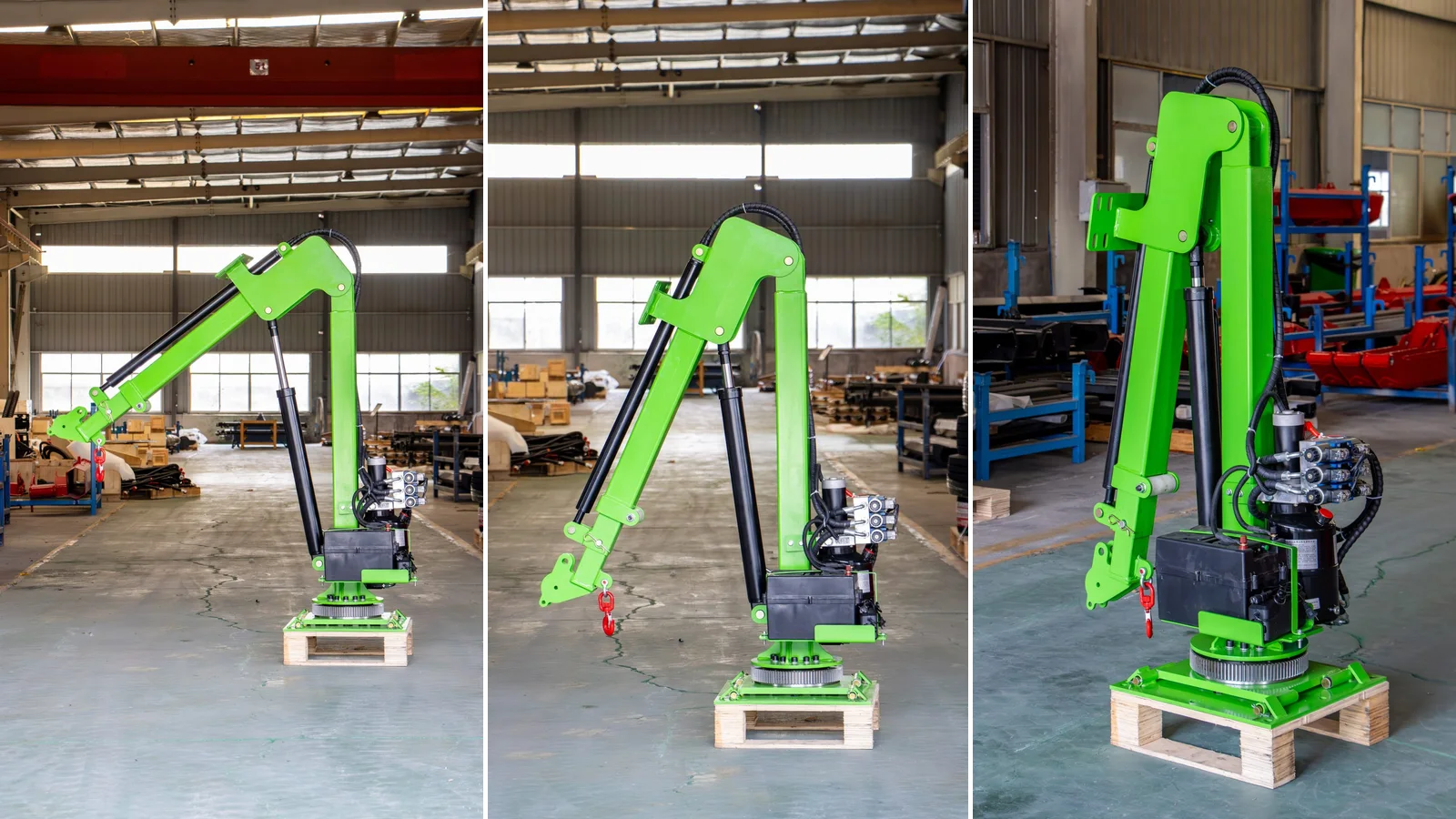

To buy a marine crane from China, start with the job on your vessel, not with a catalogue. Write down the load, the outreach over the side, how far the hook must go below deck and the sea conditions you will work in. Then send those facts to the manufacturer, and check its drawings, load chart, deck interface, test and documents before you pay the balance. Lead time, packing and freight are confirmed in the written quotation, so you can compare offers on the same terms.
BOB-LIFT has built hydraulic cranes in Xuzhou, Jiangsu, since 2003, and our current marine range runs to 27 knuckle boom and telescopic boom models from 0.8 t to 25 t. Our marine cranes have gone to the Philippines, Russia, Ecuador, the USA, the Netherlands and Bangladesh. This guide follows the steps our sales team takes with first-time marine buyers. It sets out the questions worth asking any marine crane manufacturer in China, including us.
Key takeaways
- Give the factory the duty, not just a tonnage: load at outreach, hook depth below deck, and the heel, trim and sea state you expect.
- Decide early whether the crane runs on the vessel’s hydraulics or on its own electric or diesel power unit.
- Ask for the base drawing and foundation loads before you order, so your yard can design the pedestal and the deck under it.
- Ask about corrosion protection as questions, in writing: surface preparation, paint system, pins and cylinder rods.
- If your vessel needs class approval, confirm it with the factory before ordering. BOB-LIFT marine cranes are supplied without classification society certification.
- Agree the warranty and service terms in writing. Ours are 12 months on the whole crane, common parts dispatched within 48 hours and a reply within 12 hours.
A marine crane is a hydraulic crane mounted on a vessel’s deck or on a quay to lift cargo, equipment and supplies between ship and shore. Buying one differs from buying a truck mounted crane from China. There is no chassis, but there is a moving deck, salt spray, a fixed foundation and, often, a maritime inspector who must sign it off.
Step 1: Define the duty the crane must do at sea
A crane is chosen by the load it must lift at the distance it works, so measure from the planned crane centre to the furthest landing point. On a vessel, that point is usually beyond the ship’s side: on a quay, on a boat alongside or in the water. Add the weight of the hook, slings and any lifting frame to the load, such as a spreader beam or a basket. Our 10 t knuckle boom marine crane, the SQ10ZA6TJ, shows why this matters. Its load chart gives 10,000 kg at 2.0 m, 1,800 kg at 10.56 m and 1,150 kg at its full 14.68 m reach.
Next, say how far the hook must go below the crane base. For example, a buoy or a tender may have to come up from the water. A knuckle boom can reach down over the side, but lowering a load into a hold, onto a boat at low tide or into the water usually needs a winch. Our knuckle boom models with J in the code are drawn with a winch drum. Our dimension drawings do not list winch line pull or rope length, so ask for both in writing.
Finally, tell the factory how the vessel will move while the crane works. Heel is the sideways tilt of a vessel, also called list, and trim is its tilt from bow to stern. In the USA, OSHA’s floating crane rule limits list and trim to 5 degrees each for cranes of 25 tons or less that are permanently attached to a vessel, and requires the load charts to allow for wind [2]. Our drawings do not state heel or trim limits, so give us the heel, trim and sea state you expect. Then ask which limits apply to the load chart before you order. The UK’s MGN 332 also expects lifting to stop before weather makes it dangerous [1].
Example scenario (an illustration, not a customer record): a workboat owner needs to land 1,500 kg, slings included, on a quay 10.5 m from the crane centre. The SQ10ZA6TJ chart gives 1,800 kg at 10.56 m, so it covers the lift with a margin, subject to the vessel’s stability check. Our deck crane guide explains how to measure outreach over the side.
Step 2: Settle the power supply

A marine crane has no truck engine to drive its pump, so it runs either on the vessel’s hydraulic system or on its own power unit. If the vessel has no suitable supply, we can provide an electric or a diesel hydraulic power unit. Choose early, because it changes the quotation, the deck layout and the wiring or fuel work on board.
Ask for the flow, pressure and power on the drawing, and check them against your supply. The SQ10ZA6TJ needs 40 L/min at 30 MPa, with 30 kW of recommended power and a 160 L oil tank. Across our marine range the figures run from 3.5 kW and 8 L/min on the 0.8 t crane to 55 kW and 80 L/min on the 25 t knuckle boom crane. In our Egypt workboat case, each SQ5ZA3T crane runs from a power unit housed on deck beside it.
Step 3: Get the deck interface on paper
Your yard or naval architect designs the pedestal and the deck under it, so they need the crane’s base drawing before you order. For the SQ10ZA6TJ, the drawing shows a Ø1,000 mm base plate with 28 holes of Ø26 mm on a Ø930 mm bolt circle. The crane weighs 2,920 kg and has a rated lifting moment of 21 t·m. Foundation loads are the forces and moments the crane puts into its pedestal and deck. Ask for them as well, because the rated moment leaves out the boom’s own weight and the dynamic loads at sea. Our pedestal crane guide lists the base plate and bolts for 18 models.

Stability comes before welding. The UK Maritime and Coastguard Agency recommends that a qualified person checks the vessel’s stability before a crane is installed, and that small-vessel owners take advice from the crane manufacturer [1]. On a flat-bottomed hull, heel is the bigger risk, and our barge crane guide works through it. Tell us the vessel type and deck structure; we can adapt the mounting and confirm it with you.
Step 4: Ask how the crane is protected from salt water
Every supplier says its marine crane is “anti-corrosion”, so ask what that means in practice. The T at the end of our model codes marks the marine version, which receives a multi-layer anti-rust treatment for salt air and spray. Our workshop has shot blasting and a paint booth. ISO 12944-2 classifies the environments steel structures face, and the corrosion stress of that environment governs the choice of paint system [3]. Questions worth putting to any marine crane manufacturer:
- How is the steel prepared before painting, and how many coats are applied, at what dry film thickness?
- Which environment is the paint system meant for: salt air on deck, regular spray or splash zone?
- Are the boom pins stainless steel or coated carbon steel, and how are they greased?
- What coating do the cylinder rods have, and are they protected when the crane is stowed?
- Which hoses, fittings and electrical boxes are used, and how are they sealed against spray?
Get the answers in the quotation, not only in an email. Upkeep still decides how long a crane lasts at sea: rinse it with fresh water after salt-water work, and grease the slewing bearing and pins on schedule.
Step 5: Ask for the documents before you order
Documents are what let your yard install the crane, your inspector sign it off and your crew run it. Settle the list before the order, not after the crane ships. The table shows what to ask for and why.
| Document | Why you need it | What to check |
|---|---|---|
| Dimension drawing | Deck layout, stowed height and slewing circle | The exact model code, including T for marine and J for winch |
| Load chart | Proves the load at your outreach | Radius and load pairs to full reach, and the conditions that apply at sea |
| Base drawing and foundation loads | Pedestal and deck design by your yard | Plate size, bolt circle, hole count and size, loads for the engineer |
| Hydraulic data | Matching the vessel supply or a power unit | Flow, pressure, power and tank size |
| Operator manual and spare parts list | Safe use, maintenance and ordering parts | Language: ours is in English, and other languages are available if you ask when you order |
| Factory test record or video | Shows your crane was run under load | Serial number visible and matching the nameplate |
| Certificates | Import, insurance and your own quality file | Which certificates cover the model; class approval if your vessel needs it |
Our certificates are shown on our about page. They include CE under the Machinery Directive 2006/42/EC, and an ISO 9001 certificate that covers marine crane production. Classification is separate. BOB-LIFT marine cranes are supplied without classification society certification, so if your vessel or charterer needs class approval, confirm it with us before you order.
Step 6: Inspect the factory and witness the load test
Each BOB-LIFT marine crane is mounted on a deck-style test stand in our Xuzhou factory and runs every boom and slewing motion before release. A factory acceptance test (FAT) is the buyer’s check of that run, made at the factory before shipping. Ask for a video of your own crane under load, with the serial number visible, before you pay the balance. Better still, visit the factory and watch it, or send an inspection company you trust. During the test, watch three things:
- The test weight and the radius it is lifted at, compared with the load chart.
- Smooth slewing, boom and winch motion, with no leaks at hoses or cylinders.
- The overload protection. Each of our marine cranes has a dedicated torque limiter.
A factory test does not replace the test on board. Under the UK rules, ship’s lifting equipment must be tested and thoroughly examined by a competent person after installation, before it is used. For a ship that is not a UK ship, the certificate must be in a form approved by the flag state [1]. Book that inspector before the crane arrives.
Step 7: Read the quotation and the shipping terms
Two quotations for a “10 t marine crane” can describe very different machines. A complete one names the model and its load chart, boom type and sections, winch, power supply, controls, corrosion treatment and options. Our marine options include a winch, an aerial basket, a grapple, an overhead seat and a wireless remote control. You can order a single crane.
The trade term decides where the seller’s costs and risks end. The ICC publishes the Incoterms rules, which set out the tasks, costs and risks between buyer and seller [4]. Our cranes are set on their base or a pallet, wrapped in stretch film and strapped, then loaded into a container. Most orders leave from Lianyungang, Qingdao or Shanghai. Tell us your destination port, and we confirm the route, lead time and number of cranes per container with the quotation.
Step 8: Plan installation, commissioning and after-sales
Your yard fits the crane to the pedestal, connects the hydraulics and runs it in. Our after-sales team replies within 12 hours and can guide your technicians by video call through the start-up checks. If the job needs an engineer on board, we can send one to your country as a paid service, agreed before the trip. We do not run operator training at delivery, but your engineers are welcome at our factory to learn installation, operation and maintenance.
Every BOB-LIFT crane carries a 12-month warranty on the whole crane, and common spare parts are dispatched within 48 hours. To claim, send the model, the serial number and a photo or video of the problem.
Red flags when comparing marine crane suppliers
Some sellers show photos of cranes they did not build. Unauthorised factories copy other makers’ pictures, and the crane they ship may not match the photo. A different logo is not proof of theft on its own: BOB-LIFT has also built cranes for other factories under authorised OEM agreements. Watch for signs such as these:
- No dimension drawing or load chart for the exact marine model, only a brochure page.
- A load chart that gives the rated tonnage but no loads at long reach.
- No answer on power supply, base drawing or foundation loads.
- Vague replies on corrosion protection, or a claim of class approval with no certificate number.
- A refusal to show the crane on a live video call from the workshop.
Our guide on how to tell if crane supplier photos are real shows how to spot borrowed or edited images. Customer photos are harder to fake. Our Maldives harbour case shows telescopic marine cranes on a quay and on cargo vessels.
Marine crane buying checklist
| Stage | You send or ask | A good supplier gives |
|---|---|---|
| Duty | Load, outreach over the side, hook depth, heel, trim and sea state | A model with its load chart, and the limits that apply at sea |
| Power | Vessel hydraulic data, or the power available for a unit | Flow, pressure and power, or a power unit offer |
| Deck interface | Deck plan and crane position | Base drawing, bolt pattern and foundation loads |
| Corrosion | The questions in Step 4 | Written answers in the quotation |
| Documents | Your inspector’s and importer’s list | Drawings, manual, parts list, certificates, and a clear answer on class |
| Testing | A test video or a factory visit | Your crane under load, serial number visible |
| Shipping | Destination port and trade term | Route, lead time and packing confirmed in the quotation |
| After-sales | Warranty, parts and reply time | Terms in writing |
RFQ template for a marine crane
Copy this into your first email. A manufacturer can answer it within a day or two, and a supplier who cannot is telling you something.
Vessel: type, length, beam, flag state.
Crane position: deck plan or photo, height above the waterline.
Heaviest load (with slings): ___ kg at ___ m from the crane centre.
Furthest landing point: ___ m (quay, boat alongside, water).
Hook below crane base: ___ m (winch needed?).
Expected heel / trim / sea state when lifting: ___.
Boom type preferred: knuckle / telescopic / no preference.
Power: vessel hydraulics (flow, pressure) / electric unit (voltage, Hz) / diesel unit.
Controls and options: seat, remote control, basket, grapple.
Documents needed: drawings, load chart, foundation loads, manual language, certificates.
Class approval required: yes / no (society: ___).
Destination port and trade term: ___.
Test: video with serial number / factory visit / third-party inspection.
Frequently asked questions
Can I fit a truck crane on a boat instead of a marine crane?
Ask for the marine version instead. The T in our model codes marks the marine, pedestal-mounted version, which gets a multi-layer anti-rust treatment and is tested on a deck-style stand. A road crane is built for a truck frame and outriggers, not for a pedestal on a moving deck.
Are BOB-LIFT marine cranes approved by a classification society?
No. BOB-LIFT marine cranes are supplied without classification society certification. If your vessel needs class approval for the crane, tell us before you order so we can confirm what is possible.
How long does it take to get a marine crane from China?
It depends on the model, the options and your port. We confirm the production lead time, the route and the number of cranes per container in writing with each quotation.
Who installs the crane on the vessel?
Your shipyard or a local fitter installs it from our base drawing and foundation loads, with video guidance from our after-sales team. An engineer can travel to your country as a paid service.
Which marine crane should I choose for my vessel?
Choose by the load at your outreach, your deck space and the reach you need. Our marine crane buying guide compares knuckle boom and telescopic boom models, and the marine crane range lists every model with its load chart.
How we compiled this guide
We compiled the crane figures from BOB-LIFT technical drawings, checked against the SQ10ZA6TJ dimension drawing and load chart in October 2026. Power options, test procedure, packing, ports, warranty, parts and service times come from our marine crane, quality testing, shipping and service pages and the factory’s written answers of October 2026. The rules come from four sources we read in full: [1] the UK MCA’s MGN 332 on lifting equipment on ships; [2] OSHA 29 CFR 1926.1437 on floating cranes; [3] the ISO 12944-2 page; [4] the ICC’s Incoterms page. The customer photos come from our Egypt and Maldives case studies.
Send us your vessel and your lift
Buying a marine crane from China works when the order rests on facts: your duty, your power supply, the deck interface, written answers on corrosion and documents, and a test you have seen. Send us the vessel, the crane position, the heaviest load and its outreach, and the power on board. Our team will propose a model with its drawings and load chart, and quote it. Reach us through the contact page.
Editorial note: this guide was written by Achord Chan, Product Operations Director at BOB-LIFT. Warranty, spare parts and service figures were checked against our factory’s written answers of October 2026.