Customer Case · Marine Operations
Knuckle Boom Marine Cranes for Harbour Workboats in Egypt
Customer photos from Egypt follow BOB-LIFT SQ5ZA3T knuckle boom marine cranes from shipyard outfitting to a finished harbour workboat on the water.
 Written by
Achord Chan
Product Operations Director, BOB-LIFT
Updated

- Country
- Egypt
- Crane
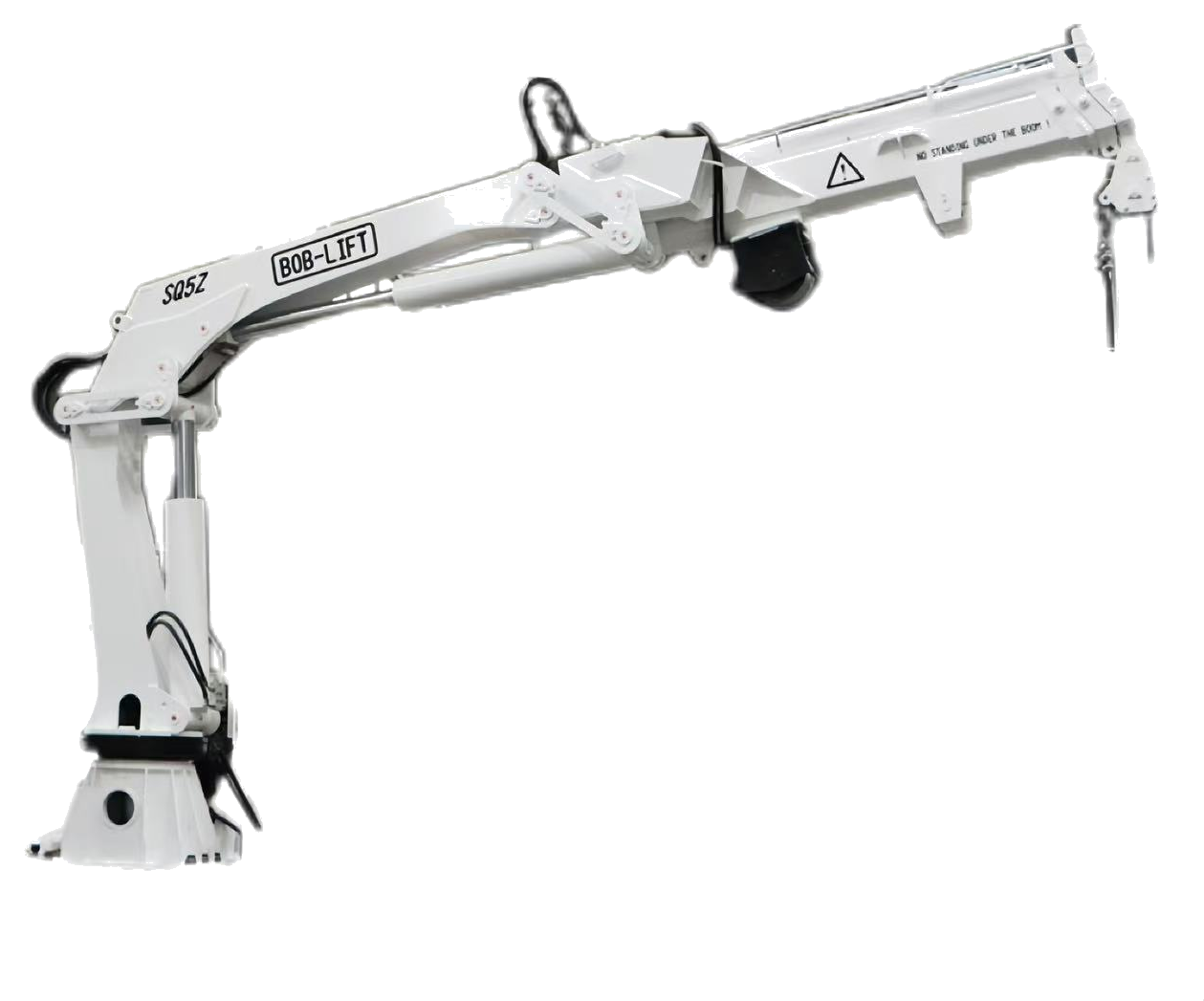
- SQ5ZA3T knuckle boom marine crane
- Max lifting capacity
- 5,000 kg
- Application
- Harbour workboat deck

Project at a glance
A customer in Egypt fitted BOB-LIFT SQ5ZA3T knuckle boom marine cranes to steel harbour workboats and sent back 14 photos of the job; nine of them are shown on this page. The set starts at the shipyard, where the bare hulls still carry primer and two yellow cranes are already standing on deck, and ends with a finished orange-red workboat, hull number SG1, running on open water under an Egyptian flag. Above the hull number, the Arabic lettering reads "Alexandria" (اسكندرية).
In order, the photos show:
- Bare hulls in primer at the yard, with the cranes already on deck.
- Each crane on a raised pedestal, with a seat control station and access ladder.
- A hydraulic power unit housed on deck beside the crane.
- The finished SG1 afloat, with the crane folded on the aft deck.
Everything below comes from those photos and the crane's spec sheet. Lift weights and operating hours were not shared, so they are not given here.

Why a knuckle boom crane suits a small workboat
A harbour workboat has little free deck. A knuckle boom folds into a compact package when it is not working, so it leaves the aft deck clear for mooring lines, fenders and cargo. When it is needed, the boom unfolds over the side or the stern and reaches further out over the side than a fixed davit.
The SQ5ZA3T is rated at 5,000 kg maximum lifting capacity and 10.5 t·m maximum lifting moment, with 360° slewing. The maximum capacity applies close to the column; the load chart reduces it as the radius grows, so the job, not the headline figure, should decide the size. At 2,060 kg self weight it adds a moderate deck load, but the vessel's designer should still check the deck structure and stability with the crane loaded at full outreach.

Outfitting at the yard
The yard photos show the cranes bolted to raised pedestals on the aft deck before the hull was painted. Each crane has a seat control station with its own access ladder, so the operator sits above the deck with a direct view of the load. The hydraulic hoses run in a bundle down the column, away from the working area.
One close-up shows an orange hydraulic power unit housed on deck next to the crane. Marine cranes like this need a hydraulic supply of the right flow and pressure; for the SQ5ZA3T that is 35 L/min at 28 MPa, from roughly 22 kW of recommended power, with a 100 L oil tank.

On the water
The last photos show the SG1 afloat and finished: orange-red hull, white wheelhouse, tyre fenders along the rail and the yellow crane folded on the aft deck. Folded, the crane sits low behind the wheelhouse, which is a main reason to choose a folding boom on a boat this size: where deck space is short, folded height matters more than maximum reach.
The full set of customer photos is on the SQ5ZA3T customer feedback page linked below.

Planning a similar marine crane
If you are fitting a crane to a workboat, tug or service vessel, send us the deck layout, the heaviest load and the reach you need, and the hydraulic power available on board. We will match a model from the knuckle boom marine crane range, such as the 4-ton SQ4ZA3T or the 6.3-ton SQ6.3ZA5T, and check the load chart against your outreach. BOB-LIFT marine cranes are supplied without classification society certification, so tell us early if your vessel needs class approval.
Products in this case
See the crane and the customer photos
Site photos


Planning a similar project?
Discuss Similar ProjectRelated Cases
View all Customer Case · Marine Operations
Telescopic Marine Cranes for Island Harbour Cargo in the Maldives
 Customer Case · Stone Processing
A 12-Ton Pedestal Crane with a Stone Lifting Clamp in a German Stone Workshop
 Customer Case · Special Chassis
Tractor Cranes with a Stabiliser Leg and Crane Basket in Belarus