

A service truck crane is a crane mounted on a mechanic’s or utility service truck. It is hydraulic or electric and usually sits at a rear corner of the service body. It lets one technician lift engines, tyres, pumps and parts in the field. Choose one by the load you lift at the reach you need, then check that the truck’s payload, frame and body can carry the crane and its working loads. A 2 t to 5 t (about 4,400 lb to 11,000 lb) telescopic crane covers most service work.
BOB-LIFT has built truck mounted cranes in Xuzhou, China, since 2003. Our range includes the small telescopic and knuckle boom cranes that buyers fit to service and utility trucks. This guide explains how a service truck crane differs from a loader crane behind the cab, how to size one in pounds and feet, what the truck needs, and which rules apply in the United States. Every crane figure comes from our own technical drawings and load charts.
Key takeaways
- A service truck crane lifts heavy parts and tools for field maintenance; a loader crane behind the cab is built to load and unload cargo. Many trucks can carry either, but the mounting is different.
- Size the crane by the load at your working radius. Our 3.2 t telescopic SQ3.2SA3 is rated 7,055 lb at 7.4 ft but lifts 1,213 lb at its full 27.2 ft reach.
- The crane’s weight comes out of the truck’s payload: 2,094 lb for our 2 t telescopic crane and 2,822 lb for the 3.2 t model, before tools and stock.
- Telescopic booms suit straight lifts out of a service body; knuckle booms fold smaller and reach over obstacles.
- In the US, OSHA 29 CFR 1926 Subpart CC lists service and mechanic trucks with a hoisting device, but excludes a mechanic’s truck used for equipment maintenance and repair.
What is a service truck crane?
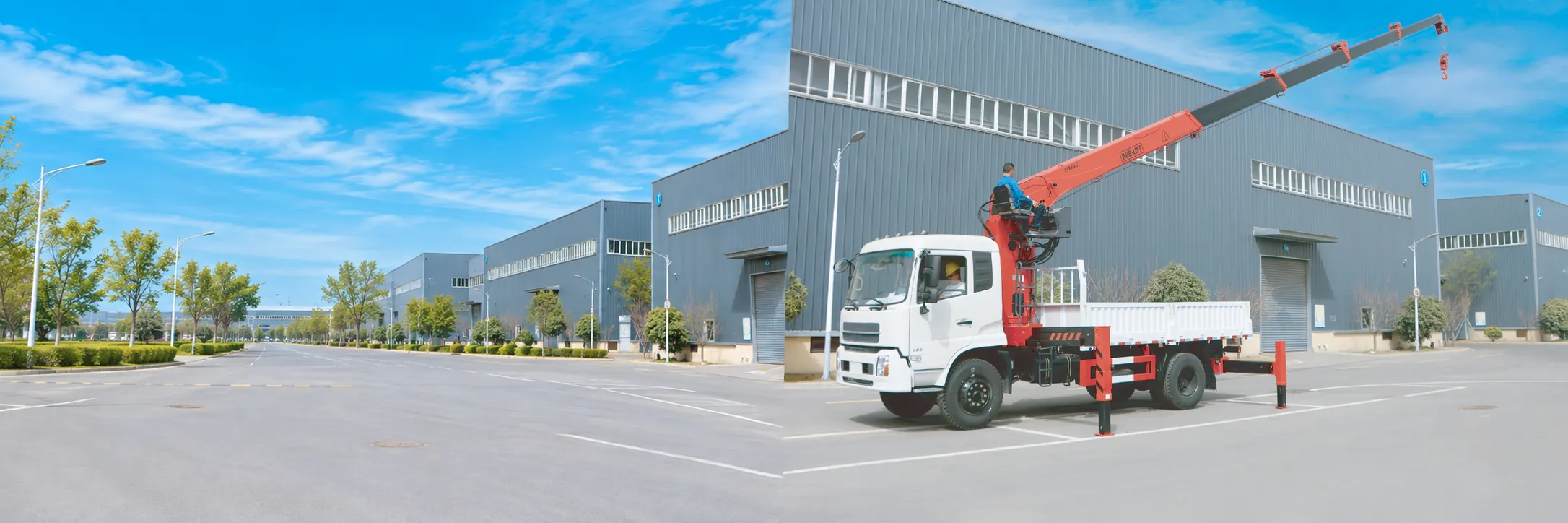
A service truck crane is the crane on a truck that carries a technician’s workshop to the job. It is also called a service crane or mechanic’s truck crane. It lifts what a person cannot: a gearbox out of an excavator, a pump onto a skid, a tyre onto a haul truck. It is usually a telescopic crane mounted at a rear corner of the service body, with a stabilizer leg on the crane side and a remote or pendant control.
A loader crane is a truck mounted crane built for a different job. It sits behind the cab or at the rear of a flatbed and loads the truck’s own cargo: blocks, pipes, pallets, machines. It has its own base and outriggers on both sides and is built for many lifts a day. The two overlap in the 2 t to 5 t class, which is why buyers searching for a service truck crane often compare both.
| Service truck crane | Loader crane (truck mounted crane) | |
|---|---|---|
| Main job | Lifting parts, tools and components for maintenance | Loading and unloading the truck’s cargo |
| Usual position | Rear corner of a service body | Behind the cab, or at the rear of a flatbed |
| Stabilizers | Often one leg on the crane side | Outriggers on both sides of the crane base |
| Typical boom | Telescopic | Knuckle boom or telescopic |
| Power | Electric (12 V) on small models, hydraulic on larger ones | Hydraulic, driven by the truck’s power take-off |
How much should a service truck crane lift?
Enough to lift your heaviest regular part at the distance you will work from the truck. A crane’s rating, such as 7,055 lb, applies only close to the column; every foot of reach reduces what it can lift. List the heavy items your technicians handle, for example gearboxes, pumps and wheel assemblies, note how far from the crane base each one sits when you lift it, and read that radius on the load chart. Our guide on how to read a crane load chart shows the method on real charts.
The table below shows six of our cranes in US units, from their drawings. The weight and the installation space tell you whether the truck can take the crane; the full-reach figure tells you what it lifts at the edge of its working area.
| Model | Boom | Rated capacity | At full reach | Crane weight | Installation space |
|---|---|---|---|---|---|
| SQ2SA3 | Telescopic | 4,409 lb at 6.6 ft | 551 lb at 26.9 ft | 2,094 lb | 25.6 in |
| SQ3.2SA3 | Telescopic | 7,055 lb at 7.4 ft | 1,213 lb at 27.2 ft | 2,822 lb | 29.5 in |
| SQ5SA3 | Telescopic | 11,023 lb at 6.3 ft | 2,425 lb at 28.5 ft | 4,630 lb | 41.3 in |
| SQ2ZA4 | Knuckle | 4,409 lb at 6.9 ft | 661 lb at 24.7 ft | 1,653 lb | 26.8 in |
| SQ3.2ZA3 | Knuckle | 7,055 lb at 6.9 ft | 1,499 lb at 25.3 ft | 2,932 lb | 33.5 in |
| SQ5ZA3 | Knuckle | 11,023 lb at 6.9 ft | 2,425 lb at 26.4 ft | 5,040 lb | 41.3 in |
Two things stand out. First, at full reach these cranes lift only about an eighth to just over a fifth of their rating, so size for the load at your radius, not for one heavy lift close to the truck. Second, at 2 t and 3.2 t the knuckle boom models lift more at full reach than the telescopic models of the same class, while the telescopic models reach about 2 ft further. At 5 t both lift the same at full reach.
Telescopic or knuckle boom on a service truck?

Most service cranes are telescopic because the boom lies flat along the top of the body when stowed and lifts in a straight line, which suits pulling a component out of a machine. A knuckle boom folds into a compact block, reaches up and over obstacles, and places a load precisely, which helps on tight sites and when the crane also loads the truck. Our comparison of knuckle boom and telescopic boom truck cranes covers the trade-offs in more detail.
Power is the other choice. Small service cranes often run on the truck’s 12 V battery, which is simple but slow and limited in duty. Hydraulic cranes, like all of ours, run from a power take-off and pump, lift faster and suit frequent or heavier lifts. Our 2 t telescopic crane needs 20 L/min (about 5.3 US gal/min) at 16 MPa, and the 3.2 t model 25 L/min (about 6.6 US gal/min) at 20 MPa.
What does the truck need?
Check four things before choosing the crane. The payload left after the body, tools, stock and crew must cover the crane’s own weight; a 2,822 lb crane on a truck with little spare payload leaves nothing for parts. The chassis must suit the crane’s rating, and its gross vehicle weight rating must not be exceeded with everything on board. In the US that rating is printed on the certification label required by 49 CFR Part 567. The body or frame must take the crane’s reaction loads: a corner-mounted crane needs a reinforced compartment or a subframe tied to the chassis, designed by the body builder to the crane’s base dimensions. And the hydraulics must deliver the crane’s flow and pressure.
Stability comes from the stabilizers, not the truck’s springs. Set them on firm ground before every lift, and remember that a crane with one stabilizer has a rated working area limited to its side of the truck. Our guide to truck mounted crane installation explains mounting and the checks a fitter makes, and our small truck crane guide covers the smallest pickup and light truck cranes.
Which rules apply to service truck cranes in the US?
Two sets of rules matter. For design, ASME B30.5 covers mobile cranes and includes commercial truck-mounted telescoping-boom cranes, while ASME B30.22 covers articulating (knuckle) boom cranes. Ask the crane maker which standard the crane is built to and keep the load chart and manual in the truck.
For use, OSHA’s construction crane standard, 29 CFR 1926.1400, lists “service/mechanic trucks with a hoisting device” among covered equipment. Paragraph (c)(9) then excludes a “mechanic’s truck with a hoisting device when used in activities related to equipment maintenance and repair”. So the same truck can be outside the standard while a technician repairs a machine and inside it when the crane hoists materials for construction work. Check with your safety adviser how your work is classed.
Inspection and daily checks
A service crane works in dust, mud and weather and is often used by people who are not full-time crane operators, so daily checks matter. Before the first lift each day, look for hydraulic leaks, damaged hoses and wire rope, check that the controls, limit switches and overload protection work, and set the stabilizer on firm ground. Where OSHA’s construction standard applies, 29 CFR 1926.1412 also requires a competent person to inspect the crane each shift. Our truck mounted crane inspection checklist lists the daily, monthly and annual checks.
Frequently asked questions
What size crane do I need on a service truck?
Take your heaviest regular lift and the distance from the crane base at which you lift it, then pick a crane whose load chart covers that load at that radius with a margin. For most field maintenance that is a 2 t to 5 t crane, or about 4,400 lb to 11,000 lb rated close in.
Can a knuckle boom crane go on a service truck?
Yes. A knuckle boom crane folds smaller and reaches over obstacles, which helps on tight sites. It is usually mounted behind the cab or on a reinforced subframe rather than in a body corner, so plan the body layout around it.
How much does the crane weigh?
Our cranes in the service range weigh from 1,653 lb (2 t knuckle boom) to 5,040 lb (5 t knuckle boom). That weight counts against the truck’s payload before tools, parts and crew.
Do service truck cranes need outriggers?
Yes. An outrigger is a leg that carries the lifting load to the ground, and on service cranes it is often called a stabilizer; without it the truck’s springs and tyres take the load and the truck can tip. Use them on every lift, on firm ground, as the load chart assumes.
Choosing your crane
Start from your heaviest lift and its radius, check the truck’s payload, frame and hydraulics, then choose between a telescopic boom for straight lifts and a knuckle boom for reach over obstacles. Browse our telescopic boom truck cranes and knuckle boom truck cranes, or send us your truck model and the loads you lift through the contact page, and our sales team will suggest a model and send its drawings. Our about us page shows the factory in Xuzhou where they are built.
Editorial note: this guide was written by Achord Chan, Product Operations Director at BOB-LIFT. All crane figures were converted from the metric values on our technical drawings and load charts, and the rules were checked against the ASME and OSHA texts linked above in October 2026.