Customer Feedback · 1.6 Ton Knuckle Boom Marine Crane
SQ1ZA3T Marine Crane on a Work Vessel in the Netherlands
- Model
- SQ1ZA3T
- Country
 Netherlands
- Media
- 1 photo

A white knuckle boom crane on a pedestal at the side of a work vessel, its hook block parked high, with a harbour basin and a quay behind: a photo from our customer in the Netherlands shows a BOB-LIFT SQ1ZA3T knuckle boom marine crane on board.
At a glance: SQ1ZA3T 1 t knuckle boom marine crane · Netherlands · work vessel in a harbour · 1 customer photo.
What the photo shows
- The crane. The white boom is marked BOB-LIFT and SQ1Z. The boom is folded up, and a yellow hook block hangs just below the tip.
- The mounting. The crane stands on a tall white column at the edge of the deck, with hydraulic hoses running down beside it to a small control station.
- The vessel. Next to the crane is a yellow deckhouse with exhaust stacks on top. The company sign on it is blurred out. Blue bollards stand on the light blue deck below.
- The harbour. Across calm water is a quay with stacked pipes and an office building.
This is the customer's own photo. No load weights or comments came with it.
About the SQ1ZA3T
The SQ1ZA3T is an earlier 1 t knuckle boom marine crane. It is no longer in the current range, and the technical department has no current drawing for it, so this record does not quote load figures for it. For a new crane of this size, see the 1 t knuckle boom marine crane page, where each current model has its own dimension and load chart drawings.
Lifting moment is the load times its distance from the slewing centre. That is why the rated load drops as the boom reaches out. For example, a load the crane lifts easily close to the column can be too heavy once the extension is pushed out. Working radius is the level distance from the slewing centre to the hook. On a vessel or a quay, the pedestal takes the place of outriggers. It must be strong enough for the crane's weight and its full lifting moment. For general crane safety rules, see the OSHA cranes and derricks standard.
A tall column like this one lifts the slewing centre above the deckhouse and the rail, so the folded boom clears the deck fittings and the hook can reach over the side. A small 0.8 t marine crane works on a light work boat in our delivery record from Spain, and an SQ1ZA3T sits on a tall steel structure in our record from Thailand.
A small crane on a harbour work vessel
On a work vessel, a 1 t crane handles stores, tools, hoses and small equipment between the deck and the quay. Four points to plan for:
- Brace the column. A tall column adds leverage at the deck. Tie it into the hull structure and size it for the crane's full lifting moment, not only its weight.
- Check the swing path. Make sure the boom and hook clear the deckhouse, stacks and rail across the whole slewing range you need.
- Park the hook block. When the crane is not in use, fold the boom and secure the hook block so it cannot swing into the deckhouse while the vessel moves.
- Weigh loads before you lift. A 1 t crane is rated far below 1 t at full reach. Check each load against the load chart for the radius you need.
Sea water is hard on steel, so the marine cranes get an epoxy zinc primer with a polyurethane acrylic top coat. Other capacities are in the knuckle boom marine crane range, and the marine crane buying guide covers deck mounting in more detail.
What to send us for a marine crane
To match a current crane to your vessel, we need a few details. Short answers are fine.
- The site. The vessel type and length, or the quay, and where the crane will stand.
- The lifts. The heaviest load, and how far from the crane it is picked up and set down.
- The power. The hydraulic power pack you have now, or whether you need a new one.
If you run an SQ1ZA3T today, a photo of its nameplate helps too. Send these through the contact page, and our team will check reach and load against the current load charts.
Record compiled by Achord Chan, Product Operations Director at BOB-LIFT, from the customer's photo.
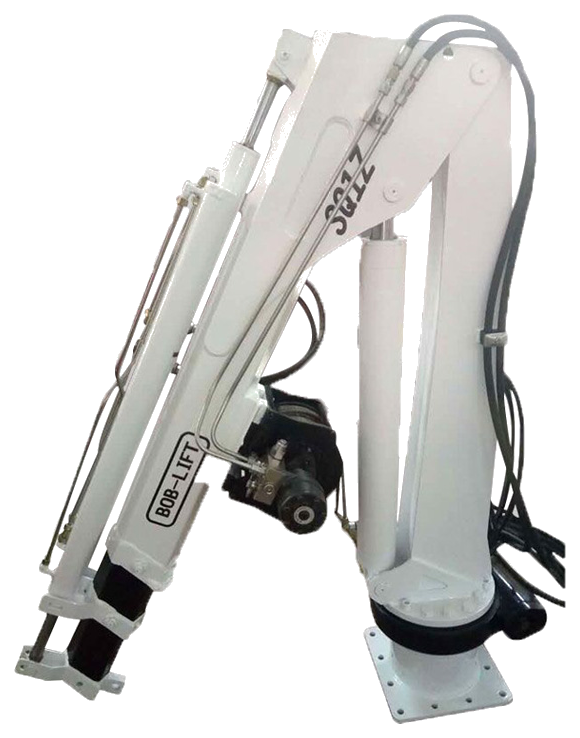
The crane in these photos
Interested in the 1.6 Ton Knuckle Boom Marine Crane?