Customer Case · Utility Construction
Setting Utility Poles with a Truck-Mounted Crane in Honduras
A BOB-LIFT SQ6.3ZA4 truck-mounted knuckle boom crane unloads and stands utility poles for a power line crew in Honduras.
 Written by
Achord Chan
Product Operations Director, BOB-LIFT
Updated

- Country
- Honduras
- Crane
- SQ6.3ZA4 knuckle boom truck crane
- Max lifting capacity
- 6,300 kg
- Application
- Utility pole setting

Project at a glance
A customer in Honduras mounted a BOB-LIFT SQ6.3ZA4 truck-mounted knuckle boom crane behind the cab of a white flatbed truck and used it on a power line job. The customer sent back 10 photos and a short video.
The job sequence they show:
- Unload poles from the truck bed.
- Swing them to the edge of the track and lay them out.
- Stand each pole upright in a freshly dug hole while a crew in hi-vis guides the base.
What follows sticks to those photos and the crane's spec sheet. The customer did not share how many poles were set, so no such figure appears here.

Why a knuckle boom crane fits pole work
Pole setting asks a crane to do two different jobs on the same day. First it unloads long poles from the bed and lays them out; then it lifts each pole, normally slung above its centre of gravity, and holds it vertical while the crew backfills the hole. A knuckle boom does both from the truck: it reaches over the bed without a separate loader, and the hook can be placed precisely above the hole by folding and extending the boom rather than moving the truck.
When the job is done, the boom folds into the space behind the cab, so the truck keeps most of its bed for poles and a low transport height between jobs.

What the SQ6.3ZA4 is rated for
The SQ6.3ZA4 is a 6.3-ton class crane: 6,300 kg maximum lifting capacity and 13.2 t·m maximum lifting moment, with 360° slewing. Its hydraulic system runs at 40 L/min and 28 MPa from about 22 kW of recommended power, with a 100 L oil tank, and the crane weighs 2,180 kg. As with every knuckle boom crane, the rated load drops with radius, so a long, heavy pole lifted at full reach needs checking against the load chart, not the maximum figure.

Outriggers on a gravel verge
In the photos the outrigger legs are lowered to the ground on both sides in the photos, including on loose gravel at the side of the track. Outriggers carry the overturning load into the ground instead of the truck's springs and tyres. On soft ground, add wide pads under the outrigger feet to spread the load further; it is a small item that makes a large difference when the crane holds a pole at reach.
On a power line job, the other limit is clearance. If poles go up next to energized lines, keep the minimum clearances set by your electrical utility and local regulations; the US OSHA rule for cranes near power lines, 29 CFR 1926.1408, is a widely used reference.

Planning a similar utility truck
For pole and utility work, tell us the length and weight of your heaviest pole, the distance from the truck to the hole, and the truck chassis you plan to use. We will check the load chart at that radius and recommend a crane size and mounting position that leave enough payload for the poles.
Products in this case
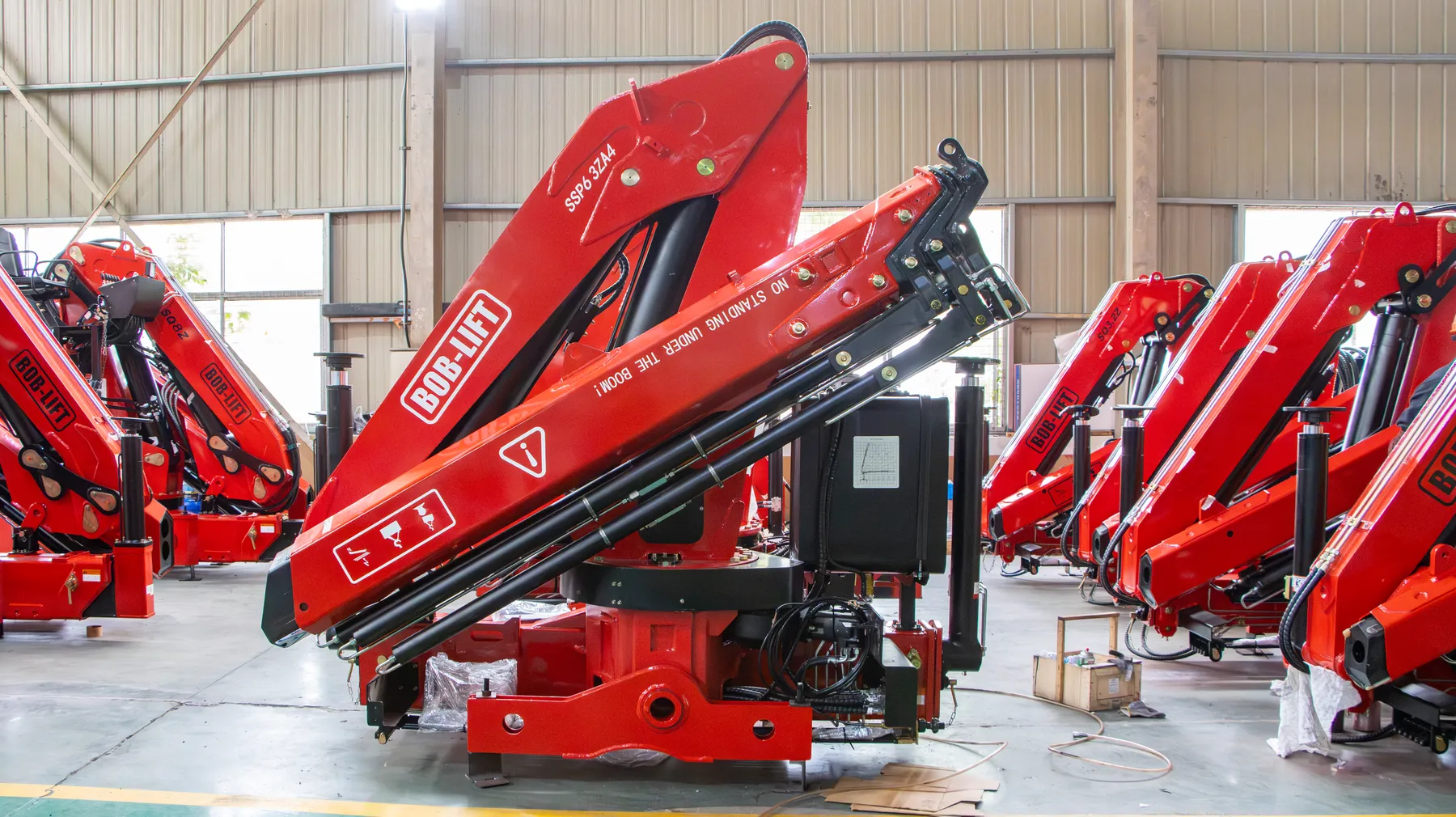
See the crane and the customer photos
- SQ6.3ZA4 6.3 Ton Knuckle Boom Truck Mounted Crane
- All customer photos and video from this project
- Knuckle boom truck-mounted crane range
- Smaller option: 5 Ton SQ5ZA3
- Larger option: 8 Ton SQ8ZA4
- Truck-mounted crane brochure (PDF)
- Ask about a utility truck crane
Further reading
Site photos


Planning a similar project?
Discuss Similar ProjectRelated Cases
View all Customer Case · Marine Operations
Telescopic Marine Cranes for Island Harbour Cargo in the Maldives
 Customer Case · Stone Processing
A 12-Ton Pedestal Crane with a Stone Lifting Clamp in a German Stone Workshop
 Customer Case · Special Chassis
Tractor Cranes with a Stabiliser Leg and Crane Basket in Belarus